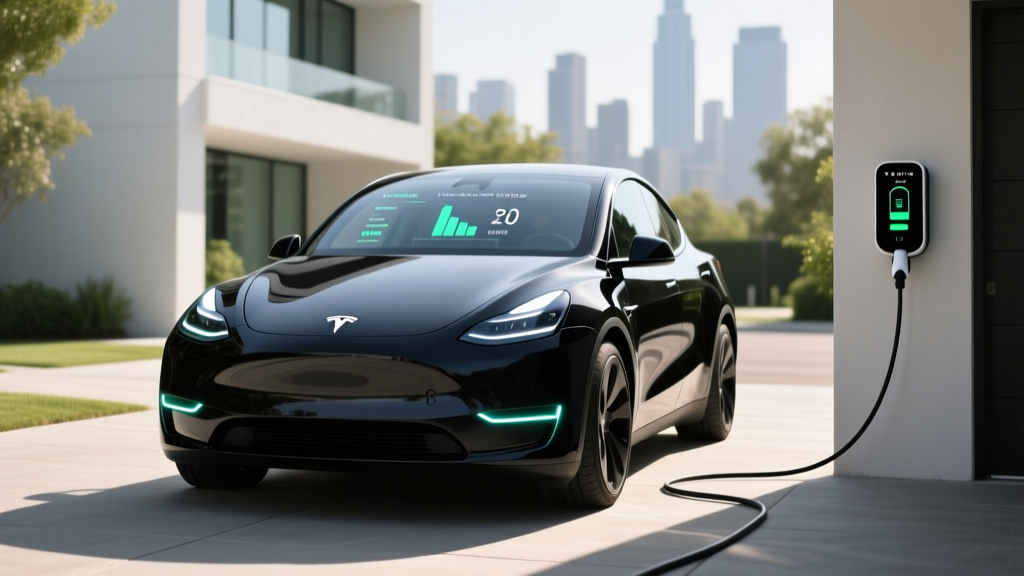
The search query "Trump sells Tesla" surfaces frequently online, usually tied to political commentary, social media rumors, or confusion about whether former President Donald Trump has a commercial partnership with the automaker. The short answer: Trump does not sell Tesla vehicles. Tesla operates a direct-to-consumer sales model with no traditional dealerships and no celebrity sales partnerships. However, the curiosity behind the search is an excellent entry point to evaluate what Tesla is actually selling right now — specifically, the 2026 Tesla Model Y, the brand's best-selling electric SUV and one of the most important EVs on the market.
Below, we break down the 2026 Model Y with the exact specs, real-world range data, charging performance, and tax-credit eligibility that matter to actual buyers — no hype, no politics, just numbers.
2026 Tesla Model Y: Core Specifications at a Glance
| Spec | Long Range AWD | Performance |
|---|---|---|
| EPA Range | 320 miles | 295 miles |
| Battery (usable) | ~75 kWh (NMC) | ~75 kWh (NMC) |
| Drivetrain | Dual-Motor AWD | Dual-Motor AWD |
| Horsepower | 384 hp | 510 hp |
| 0-60 mph | 4.8 sec | 3.5 sec |
| Max DC Fast Charge | 250 kW | 250 kW |
| 10-80% DC Time | ~25 min | ~25 min |
| Level 2 (11.5 kW) | ~44 mi/hr | ~44 mi/hr |
| MPGe (combined) | 122 MPGe | 111 MPGe |
| Base MSRP | $46,630 | $52,130 |
| Battery Warranty | 8 yr / 120,000 mi | 8 yr / 120,000 mi |
Real-World Range: What the EPA Sticker Doesn't Tell You
EPA Estimated: 320 miles (Long Range AWD)
Real-World Expectation: Expect 260–290 miles on highway road trips at 70-80 mph. In freezing temperatures (below 32°F), plan for 200–240 miles due to cabin heating demands and reduced battery chemistry efficiency. City driving with heavy regenerative braking can match or slightly exceed the EPA sticker.
Tesla's efficiency advantage comes from its heat pump (standard on all 2026 Model Y trims), which scavenges waste heat from the battery and drive units rather than relying solely on a resistive heater. This helps in moderate cold, but physics still wins in deep winter. On a fueleconomy.gov comparison, the Model Y Long Rate rates at 28 kWh/100mi combined — competitive with the Hyundai Ioniq 5 and slightly behind the BMW iX.
Charging Speed: DC Fast Charge and Home Level 2
| Charging Level | Power | Miles Added Per Hour | Notes |
|---|---|---|---|
| Level 1 (120V) | ~1.4 kW | ~3-4 mi/hr | Emergency/trickle only |
| Level 2 (240V / 48A) | 11.5 kW | ~44 mi/hr | Full charge overnight (~7 hrs) |
| DC Fast (Tesla Supercharger V3) | 250 kW peak | ~1,000 mi/hr (peak) | 10-80% in ~25 min; tapers above 80% |
| DC Fast (CCS adapter) | Up to 150 kW | ~600 mi/hr (peak) | Via included CCS1 adapter on non-Tesla networks |
The 2026 Model Y still uses a 400V architecture (not 800V like the Hyundai Ioniq 5 or Kia EV6), which limits its peak charge rate to 250 kW. That's adequate, not class-leading. The charge curve holds near 250 kW from roughly 10% to 35% SoC, then tapers progressively. If you regularly charge from 10-80%, plan on 25 minutes at a V3 Supercharger. Above 80%, the rate drops sharply — a common trait of NMC chemistry when the BMS protects against lithium plating.
Tesla now ships all vehicles with a CCS1 adapter, giving access to Electrify America, EVgo, and other non-Tesla networks. The Supercharger network remains the gold standard for reliability, with over 60,000 connectors globally.
Pricing, Trims, and the Federal EV Tax Credit
| Trim | MSRP | Est. Federal Credit (§30D) | Effective Price |
|---|---|---|---|
| Long Range AWD | $46,630 | Up to $7,500* | ~$39,130 |
| Performance | $52,130 | Up to $7,500* | ~$44,630 |
*Federal tax credit eligibility under IRS §30D is subject to buyer income caps ($150K single / $300K joint for new EVs), vehicle MSRP caps ($80K for SUVs), and battery critical-mineral and component sourcing requirements that shift annually. As of 2026, the Model Y Long Range AWD has qualified for the full $7,500, but Tesla's battery sourcing compliance can change mid-year. Always verify on irs.gov before purchasing. The credit can now be transferred to the dealer at point of sale as an upfront discount.
The base Model Y was eliminated for 2026; Tesla now starts the lineup at Long Range AWD. A fully loaded Performance with Full Self-Driving (Supervised) capability ($8,000 add-on), red multi-coat paint ($2,000), and 21" wheels pushes the as-tested price past $63,000 before credits.
Interior, Cargo, and Daily Livability
The 2026 Model Y's interior remains minimalist — a single 15.4" touchscreen handles nearly all vehicle controls, climate, and infotainment. Build quality has improved incrementally since the Fremont early-production days, with tighter panel gaps and revised acoustic glass reducing cabin noise at highway speeds.
- Cargo (behind 2nd row): 30.2 cu ft
- Cargo (2nd row folded): 72.1 cu ft
- Front trunk (frunk): 4.1 cu ft
- Rear legroom: 41.6 inches
- Seating: 5 passengers standard; optional 7-seat config available (third row best suited for children)
The optional third row is tight — 26.5 inches of legroom — and eliminates most cargo space when deployed. For families regularly hauling more than five, a Kia EV9 or Rivian R1S is a better fit.
Driver-Assist Technology: Autopilot and FSD Supervised
SAE Automation Level: Level 2 (partial automation). Tesla Autopilot and Full Self-Driving (Supervised) require continuous driver attention. Hands must remain on the wheel, and eyes must stay on the road. This is not autonomous driving. Level 4 driverless operation is currently limited to geofenced robotaxi services like Waymo.
The 2026 Model Y ships with Tesla's HW4 (Hardware 4) computer and a camera-only vision stack. Autopilot (included) handles adaptive cruise control and lane centering competently on highways. FSD Supervised ($8,000 one-time or $99/month) extends capability to city streets, stop signs, and traffic lights, but real-world performance remains inconsistent in construction zones, unprotected left turns, and adverse weather. NHTSA continues to scrutinize Tesla's driver-monitoring system under its Standing General Order for crash reporting.
What FSD Supervised Does NOT Do: It does not drive the car without supervision. It does not handle all weather conditions. It does not replace an attentive driver. You are legally responsible for the vehicle at all times.
Pros, Cons, and the Verdict
Pros
- Supercharger network reliability is unmatched
- Class-leading efficiency (28 kWh/100mi)
- Strong performance even in base Long Range trim
- Over-the-air updates continuously add features
- Spacious cargo area with flat load floor
- Standard heat pump improves cold-weather range
Cons
- 400V architecture limits DC charge speed vs. 800V rivals
- FSD Supervised is expensive and still requires full attention
- No physical buttons — everything through the touchscreen
- Ride quality firm on 20"/21" wheels
- Insurance premiums run 20-35% higher than ICE equivalents
- Third-row option is impractical for adults
Who the 2026 Model Y Suits Best
The 2026 Model Y Long Range AWD is ideal for tech-forward commuters and small families who have reliable home Level 2 charging and value efficiency, Supercharger access, and strong resale value. It's a strong road-trip vehicle thanks to the Supercharger network's reliability. It is less ideal for buyers who need three usable rows of seating, prefer physical controls, want the fastest possible DC charging (look at 800V platforms like the Ioniq 5 or Porsche Macan EV), or cannot install a home charger.
Frequently Asked Questions
Does Trump sell Tesla vehicles?
No. Tesla sells directly to consumers through its own website and company-owned showrooms. There are no independent dealerships, celebrity partnerships, or third-party sellers affiliated with Donald Trump or any political figure. The "Trump sells Tesla" search trend appears to stem from social media rumors and political commentary, not any commercial arrangement.
What is the real-world range of the 2026 Model Y?
The EPA rates the Long Range AWD at 320 miles. In real-world highway driving at 70-80 mph, expect 260-290 miles. In sub-freezing winter conditions, plan for 200-240 miles. City driving with regenerative braking can match the EPA figure.
How fast does the Model Y charge?
On a Tesla V3 Supercharger (250 kW peak), the Model Y charges from 10-80% in approximately 25 minutes. On a home Level 2 charger (11.5 kW), it adds about 44 miles per hour, achieving a full charge in roughly 7 hours. Charging above 80% slows significantly to protect the NMC battery.
Does the 2026 Model Y qualify for the $7,500 federal tax credit?
As of early 2026, the Model Y Long Range AWD and Performance qualify for the full $7,500 under IRS §30D, provided the buyer meets income caps ($150K single / $300K joint), the vehicle MSRP is under $80K (it is), and Tesla's battery sourcing remains compliant. The credit can be applied as a point-of-sale discount. Always verify current eligibility at irs.gov before purchasing — sourcing rules can shift mid-year.
Is the Model Y worth buying over the Hyundai Ioniq 5 or Ford Mustang Mach-E?
The Model Y wins on efficiency, Supercharger network access, and cargo space. The Ioniq 5 charges faster (800V architecture, 10-80% in ~18 min at 350 kW). The Mach-E offers a more traditional interior with physical controls. If Supercharger reliability matters most, the Model Y is the strongest pick. If peak charge speed or interior ergonomics matter more, test-drive the Ioniq 5.
How long will the Model Y battery last?
Tesla warranties the battery for 8 years or 120,000 miles (whichever comes first) with a minimum 70% capacity retention. Real-world data from high-mileage Teslas shows NMC packs typically retain 85-90% capacity at 100,000 miles with normal charging habits (avoiding frequent 100% charges and deep discharges).