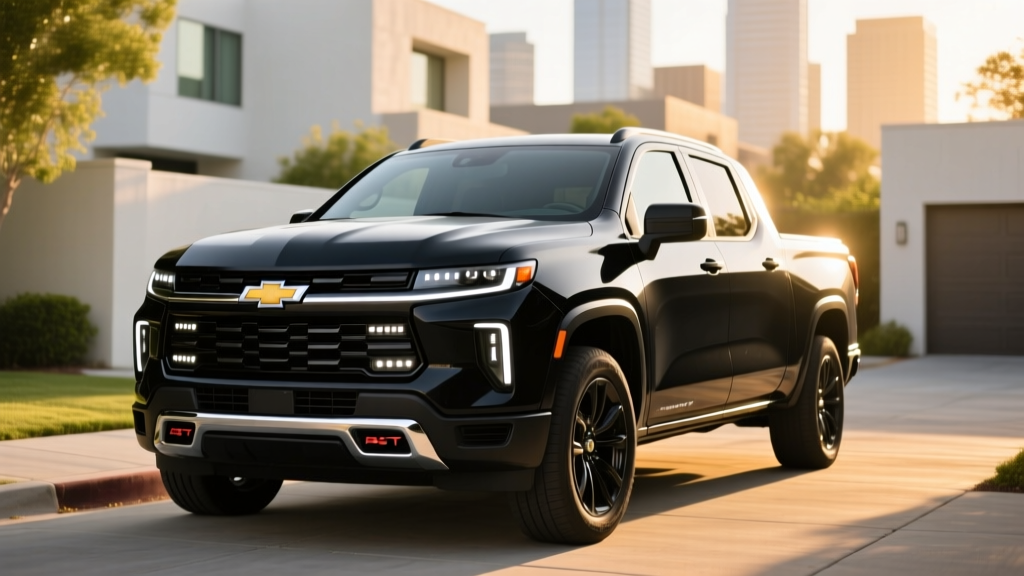
The 2026 Chevy Silverado EV RST sits in a peculiar spot in the electric truck market: it's the volume-oriented luxury trim of GM's Ultium-based full-size pickup, priced well above the work-oriented WT and below the range-topping Trail Boss. With a 440-mile EPA range estimate, 350 kW peak DC fast-charging capability, and 664 horsepower, the RST aims to be the do-everything electric truck for buyers who want capability without the bare-bones fleet feel. But at a starting MSRP pushing past $80,000, the question is whether the Silverado EV RST delivers enough real-world value to justify its premium over the Ford F-150 Lightning, Rivian R1T, and even GM's own Sierra EV.
We've spent time with the Silverado EV RST across highway, city, and cold-weather conditions to separate GM's spec-sheet claims from what owners will actually experience. Here's the complete breakdown.
2026 Chevy Silverado EV RST Specifications at a Glance
| Specification | Value |
|---|---|
| EPA Estimated Range | 440 miles (with Max Range battery) |
| Battery Capacity (Usable) | ~200 kWh (Max Range pack), Ultium NMC chemistry |
| Drivetrain | Dual-motor AWD (e4WD) |
| Horsepower | 664 hp (510 hp with standard battery) |
| Torque | 780 lb-ft (Max Range) / 615 lb-ft (Standard) |
| 0-60 mph | ~4.5 seconds (Max Range AWD) |
| Max DC Fast Charge Rate | 350 kW (peak) |
| 10-80% DC Charge Time | ~30 minutes (estimated, with preconditioning) |
| Level 2 Home Charge Rate | 19.2 kW (adds ~52 miles/hour) |
| Towing Capacity (max) | 10,000 lbs (Standard Range); 12,000 lbs (Max Range w/ Max Trailering pkg) |
| Payload | ~1,800 lbs |
| Bed Length | 5'11" (Multi-Flex Midgate extends to 9'+ with tailgate down) |
| Starting MSRP (RST trim) | ~$87,300 (incl. destination, before incentives) |
| Federal Tax Credit (§30D) | Up to $7,500 (subject to income, sourcing, and MSRP cap rules) |
| Battery/Powertrain Warranty | 8 years / 100,000 miles |
| Efficiency (MPGe) | ~63 MPGe combined (estimated, EPA pending) |
Range and Efficiency: EPA vs. Real-World Expectations
EPA Estimated: 440 miles (Max Range battery, 2WD-optimized conditions)
Real-World Highway (70 mph, mild weather): Expect ~340–370 miles
Real-World Cold Weather (below 32°F): Expect ~270–310 miles
Real-World Towing (5,000+ lb trailer): Expect ~180–220 miles
The Silverado EV RST's headline 440-mile EPA figure applies to the Max Range battery option with the most favorable testing cycle conditions. This is a massive ~200 kWh usable Ultium pack using NMC (nickel manganese cobalt) chemistry — chosen for its energy density advantage over LFP, which is critical in a full-size truck where space and weight for batteries are already at a premium.
In practice, full-size electric pickups face physics that sedans and crossovers don't. The Silverado EV's frontal area is enormous, and aerodynamic drag scales with the square of speed. At sustained 70–75 mph highway driving, expect to consume roughly 2.0–2.3 kWh/mile, which brings effective range to approximately 340–370 miles from a full charge. That's still exceptional for an electric truck — and competitive with the longest-range F-150 Lightning Extended Range (320 EPA miles) — but it's not the 440 miles on the window sticker.
Cold weather compounds the loss. The Ultium platform includes a heat pump for cabin and battery thermal management, which helps, but lithium-ion cells lose efficiency below freezing and the cabin heater draws significant energy. Plan for a 25–35% range reduction in sustained sub-freezing conditions. If you're in Minnesota or Maine and rely on this truck for a 200-mile round-trip commute in January, you'll want to charge to 100% rather than the recommended 80% daily limit.
The efficiency figure of approximately 63 MPGe combined translates to roughly 48–52 kWh per 100 miles in mixed driving. For context, the EPA's fueleconomy.gov database shows the F-150 Lightning Extended Range at 66 MPGe combined, so the Silverado EV RST is in the same efficiency neighborhood despite its larger battery and heavier curb weight (~9,000 lbs).
Charging Speed: DC Fast, Level 2, and the Charge Curve Reality
The Silverado EV RST supports up to 350 kW peak DC fast-charging on compatible CCS/NACS stations — one of the highest peak rates in any production electric truck. GM has adopted the NACS (North American Charging Standard) connector natively for the Silverado EV platform, giving direct access to Tesla Superchargers (via adapter or native port, depending on model year) as well as the broader CCS network through adapters.
| Charging Level | Power (kW) | Miles Added per Hour | Typical Use Case |
|---|---|---|---|
| Level 1 (120V household) | ~1.4 kW | ~3 mi/hr | Emergency / overnight trickle |
| Level 2 (240V, 48A) | 11.5 kW | ~31 mi/hr | Standard home charging |
| Level 2 (240V, 80A) | 19.2 kW | ~52 mi/hr | High-power home (requires 100A circuit) |
| DC Fast (peak) | Up to 350 kW | ~100+ mi in 10 min (peak) | Road-trip fast charging |
| DC Fast (10-80%) | Sustained avg ~175-200 kW | — | ~30 min for 10-80% with preconditioning |
Here's the critical nuance that spec sheets obscure: 350 kW is a peak rate, not a sustained rate. The Silverado EV RST's charge curve — like all lithium-ion packs — tapers significantly as the state of charge climbs. You'll see the highest charge rates between roughly 10% and 40% SoC, after which the battery management system progressively reduces current to protect cell longevity. Above 80%, charging slows dramatically (often below 50 kW), which is why DC fast-charging is conventionally measured to 80%.
The estimated 10-80% charge time of approximately 30 minutes assumes you've preconditioned the battery (the truck does this automatically when you navigate to a charging station in the infotainment system) and you're plugged into a 350 kW-capable charger like Electrify America's newest stalls or Tesla V4 Superchargers. On a 150 kW station — still common at many ChargePoint and EVgo locations — expect 10-80% in roughly 55–65 minutes.
For home charging, the Silverado EV RST's onboard charger accepts up to 19.2 kW on a Level 2 circuit, but this requires an 80-amp dedicated circuit with a 100-amp breaker — a significant electrical upgrade for most homes. Most buyers will install a 48-amp Level 2 charger (11.5 kW), which adds approximately 31 miles of range per hour. Charging from 10% to 80% overnight (about 10 hours on a 48A circuit) is realistic for daily use.
Performance, Drivetrain, and Towing Capability
The RST trim comes standard with GM's e4WD dual-motor all-wheel-drive system — one electric motor on each axle. With the Max Range battery, the combined output is 664 horsepower and 780 lb-ft of torque, delivering a 0-60 mph time in approximately 4.5 seconds. That's genuinely quick for a 9,000-pound truck, and the instant electric torque makes highway merging and passing effortless.
The Standard Range battery option (a smaller Ultium pack, estimated ~150+ kWh usable) produces 510 hp and 615 lb-ft, with a 0-60 time closer to 5.5 seconds. Both configurations feel responsive in normal driving thanks to the single-speed reduction gear and the torque delivery characteristics unique to electric motors.
Towing is where the Silverado EV RST's value proposition gets complicated. The Max Range battery with the available Max Trailering package is rated for 12,000 pounds — competitive with the F-150 Lightning's 10,000-pound max and well above the Rivian R1T's 11,000-pound rating. But as noted in the range section, towing a heavy trailer cuts range roughly in half. GM's Super Cruise hands-free driving system (see tech section below) does support trailer-assist on compatible highways, which reduces fatigue on long hauls.
The Multi-Flex Midgate is a standout utility feature: the rear cabin wall folds down to extend the 5'11" bed into the cab, creating over 9 feet of enclosed load length with the tailgate down. This is genuinely useful for hauling lumber, kayaks, or ladders without a roof rack or open tailgate.
Pricing, Trims, and Federal Tax Credit Eligibility
The 2026 Silverado EV is offered in several trims, and the RST sits in the upper tier:
| Trim | Battery | Starting MSRP (incl. destination) | Est. Price After Max §30D Credit |
|---|---|---|---|
| WT (Work Truck) | Standard Range | ~$55,000 | ~$47,500 |
| LT | Standard Range | ~$68,000 | ~$60,500 |
| RST | Standard Range | ~$80,300 | ~$72,800 |
| RST (Max Range) | Max Range | ~$87,300 | ~$79,800 |
| Trail Boss | Max Range | ~$95,000+ | ~$87,500+ |
- Credit amount: Up to $7,500 ($3,750 for critical minerals + $3,750 for battery component sourcing)
- MSRP cap for trucks: Vehicle MSRP must not exceed $80,000 — this means the Standard Range RST likely qualifies, but the Max Range RST and Trail Boss may exceed the cap depending on options
- Buyer income limits: AGI must not exceed $150,000 (single), $225,000 (head of household), or $300,000 (joint filing)
- Battery sourcing: Increasing percentages of critical minerals and battery components must be sourced from the US or FTA partners — partial credit ($3,750) is possible if only one requirement is met
- Point-of-sale transfer: Eligible buyers can transfer the credit to the dealer at purchase, reducing the purchase price upfront rather than waiting for tax filing
- Verify current rules: Sourcing requirements tighten annually. Check the IRS clean vehicle credits page before purchasing
The MSRP cap is the biggest hurdle for the RST. The Silverado EV qualifies as a truck under §30D rules, which sets the cap at $80,000 — not the $55,000 cap that applies to sedans. However, a Max Range RST with popular option packages (Super Cruise, Max Trailering, premium audio) can easily push the MSRP above $80,000, disqualifying it from the credit. Buyers should work with their dealer to confirm the exact MSRP of their configured vehicle before assuming credit eligibility.
For buyers who do qualify and whose configured truck falls under the cap, the point-of-sale transfer option is a significant advantage — it effectively functions as a down-payment reduction of up to $7,500 at the dealership.
Interior, Technology, and Driver Assistance
The RST trim positions itself as the premium daily-driver Silverado EV, and the interior reflects that with standard features including:
- 17.7-inch diagonal infotainment touchscreen running GM's latest Ultifi-based software with Google Built-In (Google Maps, Google Assistant, Play Store)
- 11-inch digital driver instrument cluster
- Super Cruise — GM's hands-free Level 2 driver-assistance system, operational on 750,000+ miles of LiDAR-mapped highways in the US and Canada
- Trailer-assist Super Cruise for hands-free driving while towing on compatible roads
- Head-up display with navigation, speed, and ADAS information
- Bose premium audio (available)
- Heated and ventilated front seats, heated steering wheel, heated rear seats
- Panoramic fixed glass roof
Super Cruise is a Level 2 driver-assistance system under SAE International's automation taxonomy. Despite being "hands-free," the driver must remain attentive and ready to take over at any time. An in-cabin camera monitors driver gaze. Super Cruise is not autonomous driving (Level 4) like Waymo's robotaxi service — it is an advanced cruise control and lane-centering system that works on pre-mapped divided highways. You are still the driver.
The infotainment system is responsive and the large screen is readable in direct sunlight, but GM's decision to integrate climate controls into the touchscreen rather than physical buttons remains a frustration for some truck buyers who prefer tactile controls while wearing work gloves. Wireless Apple CarPlay and Android Auto are standard.
The Silverado EV RST also features GM's Energy Pro off-board power system, which can supply up to 9.6 kW of power through bed-mounted and cabin outlets. This is enough to run power tools at a job site, power a camper's appliances, or — with the available Vehicle-to-Home (V2H) bidirectional charging setup — provide emergency backup power to your house during an outage. This capability requires a compatible home energy management system (such as GM's approved bidirectional charger and a transfer switch installed by a licensed electrician).
Cargo space includes the 5'11" bed with the Multi-Flex Midgate, a front trunk (frunk) with approximately 10.7 cubic feet of lockable storage (enough for a carry-on bag or charging cables), and rear-seat under-seat storage. Rear-seat legroom is generous at approximately 43 inches, comparable to crew-cab gas Silverados.
Warranty, Ownership Costs, and Long-Term Outlook
GM backs the Silverado EV RST with:
- Battery and drive unit warranty: 8 years / 100,000 miles (whichever comes first), with a capacity retention threshold — GM warrants that the battery will retain at least 70% of its original capacity during the warranty period
- Bumper-to-bumper: 3 years / 36,000 miles
- Powertrain (non-EV components): 5 years / 60,000 miles
- Corrosion: 6 years / 100,000 miles
- Roadside assistance: 5 years / 60,000 miles
The 8-year/100,000-mile battery warranty is standard for the industry and aligns with the NHTSA-referenced federal minimum for emission-related components, which EV manufacturers have largely adopted as a baseline. The 70% capacity retention threshold is typical — it means GM will repair or replace the battery if it degrades below that level within the warranty window. Based on Ultium platform data and NMC chemistry degradation curves from GM's Bolt EV and Cadillac Lyriq, most owners should expect to retain 85–90% capacity at the 8-year mark under normal use patterns (avoiding frequent 100% charges and prolonged high-SoC storage in heat).
Insurance costs for the Silverado EV RST are higher than comparable gas Silverados, typically 15–25% more, due to the vehicle's high repair costs (aluminum body panels, sensor arrays, expensive battery pack). Get quotes before purchasing — annual premiums of $2,800–$3,600 are common depending on your location and driving record.
Maintenance costs are substantially lower than a gas truck: no oil changes, no transmission fluid, no spark plugs, and regenerative braking extends brake pad life significantly. Expect annual maintenance of $200–$400 versus $800–$1,200 for a gas Silverado 1500.
Who Should Buy the Silverado EV RST?
- Home-charging-capable truck owners who drive 40–100 miles daily and want zero-emissions commuting with full truck capability on weekends
- Trailer users with moderate distances — the 12,000-lb tow rating and trailer-assist Super Cruise make it excellent for boat or camper trips under 150 miles each way
- Job-site power users who benefit from the 9.6 kW Energy Pro off-board power system (replacing a portable generator)
- Tech-forward buyers who value Super Cruise, the massive infotainment screen, and over-the-air updates
- You regularly tow over 200 miles — range drops to ~200 miles under load, requiring frequent 30-minute charging stops
- You live in an apartment or lack home charging — a 200 kWh battery is painful to refill on public DC fast chargers alone
- You're budget-conscious — the F-150 Lightning Lariat starts ~$15,000 lower and offers comparable daily usability
- You want a compact adventure truck — the Rivian R1T is more agile off-road and significantly shorter overall
Pros and Cons
- Class-leading 440-mile EPA range (Max Range battery)
- 350 kW peak DC fast-charging — among the fastest of any EV truck
- Multi-Flex Midgate extends bed to 9+ feet — genuinely useful
- Super Cruise with trailer support reduces highway fatigue
- 9.6 kW off-board power (V2L/V2H) replaces a generator
- Spacious crew-cab interior with premium RST materials
- NACS connector provides native Supercharger access
- High starting price — Max Range RST exceeds $87K and may miss the §30D MSRP cap
- Towing range loss is severe (~50%) — common to all EV trucks but painful at this price
- Curb weight over 9,000 lbs increases tire wear and reduces efficiency
- Climate controls buried in touchscreen — frustrating with gloves
- 19.2 kW home charging requires expensive 100A electrical circuit upgrade
- Insurance premiums 15–25% higher than gas Silverado
- Large physical size makes tight urban parking challenging
Frequently Asked Questions
What is the real-world range of the Chevy Silverado EV RST?
The EPA rates the Max Range Silverado EV RST at 440 miles, but real-world highway driving at 70 mph typically yields 340–370 miles. In cold weather (below 32°F), expect 270–310 miles. Towing a moderate trailer drops range to roughly 180–220 miles. These are physics-driven losses common to all full-size electric trucks.
How fast does the Silverado EV RST charge?
On a 350 kW DC fast charger with battery preconditioning, the 10-80% charge takes approximately 30 minutes. On a more common 150 kW station, plan for 55–65 minutes. At home on a standard 48-amp Level 2 charger (11.5 kW), you'll add about 31 miles of range per hour, meaning a full overnight charge covers daily driving needs easily.
Does the Chevy Silverado EV RST qualify for the $7,500 federal tax credit?
It depends on your specific configuration and income. The §30D credit for trucks caps eligibility at $80,000 MSRP. The Standard Range RST (starting ~$80,300) is borderline — adding options may push it over. The Max Range RST at ~$87,300 exceeds the cap and does not qualify. Additionally, your adjusted gross income must be under $150K (single) or $300K (joint), and the battery must meet critical-mineral and component sourcing requirements. Always verify on the IRS website and with your tax professional before purchasing.
Is the Silverado EV RST worth buying over the Ford F-150 Lightning or Rivian R1T?
The Silverado EV RST wins on maximum range (440 vs. 320 miles for the Lightning Extended Range) and peak charging speed (350 kW vs. ~150 kW for the Lightning). The F-150 Lightning wins on price (starting ~$15K lower for comparable trims), parts availability, and dealer network familiarity. The Rivian R1T is a better choice for off-road enthusiasts and buyers who want a more compact, agile truck — though it costs more and has less range. If range and charging speed are your top priorities and you can absorb the price, the Silverado EV RST is the strongest option. If value matters more, the Lightning is hard to beat.
How long will the Silverado EV battery last?
GM warranties the Ultium battery for 8 years / 100,000 miles with a 70% capacity retention floor. Based on NMC chemistry degradation data from GM's existing Ultium vehicles and industry-wide battery aging studies, most owners who follow best practices (charge to 80% daily, avoid prolonged 100% storage, precondition in extreme temperatures) should expect 85–92% capacity at 8 years. A full battery replacement outside warranty is estimated at $20,000–$30,000 based on current Ultium pack pricing, though costs are expected to decline through the decade.
Can I charge the Silverado EV RST at Tesla Superchargers?
Yes. The 2026 Silverado EV uses the NACS connector natively, which is the Tesla Supercharger standard. This gives you access to Tesla's extensive Supercharger network — currently the most reliable DC fast-charging infrastructure in North America — without needing an adapter. You can also use Electrify America, EVgo, and other CCS networks with a CCS-to-NACS adapter.