The Short Answer: Who Makes the Rivian Automobile?
Rivian vehicles are designed, engineered, and manufactured by Rivian Automotive, LLC, an American electric-vehicle company founded in 2009 by RJ Scaringe. Originally incorporated as Mainstream Motors, the company rebranded to Rivian and is headquartered in Irvine, California. All current production vehicles — the R1S SUV, R1T pickup, and the commercial Electric Delivery Van (EDV) built for Amazon — roll off the assembly line at Rivian's 3.3-million-square-foot manufacturing plant in Normal, Illinois.
Unlike legacy automakers that retrofit existing factories, Rivian built its Normal facility on the site of a former Mitsubishi plant, retooling it for dedicated EV production with a vertically integrated approach. Rivian designs its own battery packs, electric drive units, software stack, and even its proprietary driver-assistance system in-house. The company went public on NASDAQ (ticker: RIVN) in November 2021, and Amazon holds a significant minority stake following a 2019 investment and the subsequent EDV partnership.
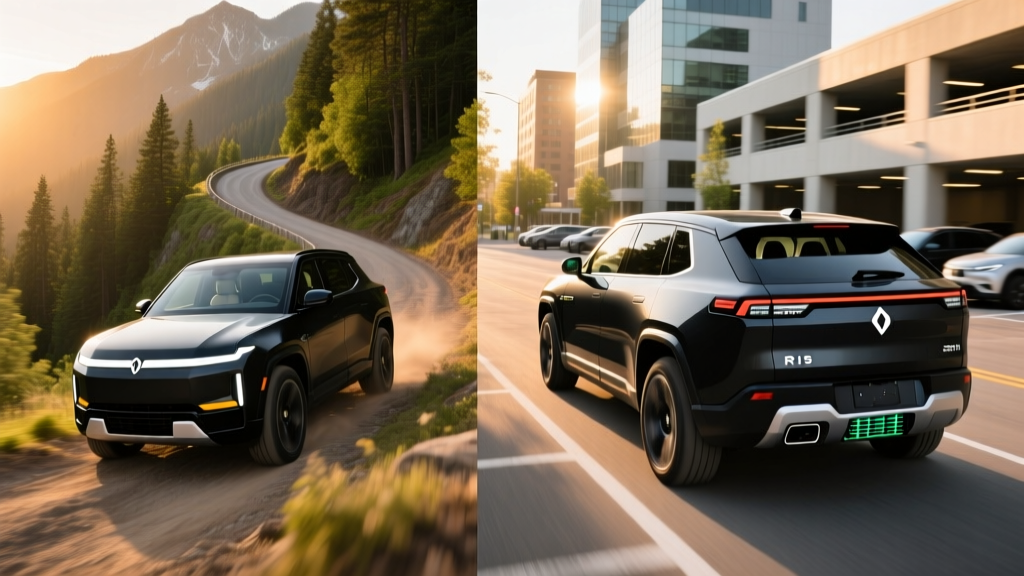
As of the 2025–2026 model years, Rivian offers two consumer vehicles — the three-row R1S SUV and the R1T crew-cab pickup — both riding on the same skateboard platform and available in Dual-Motor, Performance Dual-Motor, Tri-Motor, and the newly introduced Quad-Motor configurations.
Rivian R1S & R1T: Platform, Powertrain, and Performance Specs
Both the R1S and R1T share Rivian's Gen 2 skateboard architecture, which integrates the battery pack, drive units, suspension, and thermal management into a single structural unit. Here's how the 2026 lineup breaks down across trims:
| Specification | R1S (Dual-Motor Max) | R1T (Dual-Motor Max) | Tri-Motor (R1S/R1T) | Quad-Motor (R1T) |
|---|---|---|---|---|
| Drivetrain | AWD (2 motors) | AWD (2 motors) | AWD (3 motors) | AWD (4 motors) |
| Horsepower | 665 hp | 665 hp | 850 hp | 1,025 hp |
| 0–60 mph | 3.5 sec | 3.6 sec | 2.9 sec | 2.5 sec |
| Battery (usable) | ~141 kWh (Max) | ~141 kWh (Max) | ~141 kWh | ~141 kWh |
| Chemistry | NMC (Max/Perf); LFP (Standard) | NMC (Max/Perf); LFP (Standard) | NMC | NMC |
| EPA Range (Max Pack) | 410 mi | 420 mi | 380 mi (est.) | 320 mi (est.) |
| Towing Capacity | 7,700 lb | 11,000 lb | 7,700 lb | 11,000 lb |
Rivian's Standard Pack uses a ~92 kWh LFP (lithium iron phosphate) battery supplied in partnership with Samsung SDI, while the Large and Max Packs use NMC (nickel manganese cobalt) chemistry for higher energy density. The LFP chemistry sacrifices roughly 70–100 miles of range compared to Max but offers superior cycle life, thermal stability, and the ability to charge to 100% daily without accelerated degradation — a meaningful trade-off for commuters.
EPA Range vs. Real-World Expectations
EPA Sticker: Up to 420 miles (R1T Dual-Motor Max Pack), 410 miles (R1S Dual-Motor Max Pack), 270 miles (Standard Pack LFP).
Real-World Expectation: Plan on 330–360 miles at sustained 70–75 mph highway speeds in mild weather. In cold conditions (below 30°F), expect a 20–30% reduction, bringing highway range to roughly 250–290 miles on the Max Pack. The LFP Standard Pack delivers roughly 210–240 real-world highway miles in moderate temps, dropping to 160–190 in deep winter.
Towing Impact: Pulling a 5,000-lb trailer at highway speed can cut range by 40–50%, yielding as little as 180–210 miles on the Max Pack. Use Rivian's built-in tow mode and route planner for accurate estimates.
These figures align with independent testing from fueleconomy.gov and third-party road-trip evaluations. Rivian's thermal management system includes a heat pump (standard on all trims), which helps mitigate cold-weather cabin energy draw, but battery chemistry physics still govern the bulk of winter range loss.
Charging Speed: DC Fast Charging and Home Level 2
| Charging Level | Max Power | Speed / Time | Connector |
|---|---|---|---|
| Level 1 (120V household) | ~1.4 kW | ~3–4 mi/hr | NACS (native) |
| Level 2 (240V home/public) | 11.5 kW (48A) | ~25–30 mi/hr | NACS (native) |
| DC Fast Charge (Max Pack) | Peak ~220 kW | 10–80% in ~30 min | NACS (native) |
| DC Fast Charge (Standard LFP) | Peak ~190 kW | 10–80% in ~28 min | NACS (native) |
Rivian transitioned to the NACS (North American Charging Standard) connector natively starting with 2025 production, meaning R1S and R1T owners can plug directly into Tesla Superchargers without an adapter. This is a significant practical advantage for road-trip charging, as the Supercharger network remains the most reliable DC fast-charging infrastructure in the U.S.
Charging-curve reality: The Max Pack peaks at roughly 220 kW between 10–30% state of charge, then tapers progressively. From 50–80%, expect sustained rates around 120–140 kW. This means the second half of a fast-charge session takes noticeably longer than the first. For practical road-trip planning, plan 25–30 minute stops to reach 80%, then drive on — charging from 80–100% at a DC station is rarely time-efficient.
At home on a Level 2 wall connector wired to a 60-amp circuit (48A continuous), the onboard 11.5 kW charger adds roughly 25–30 miles per hour of charging. A full overnight charge from 20–80% takes about 7–8 hours on the Max Pack. Rivian sells its own Wall Charger rated at 11.5 kW, and the vehicle is also compatible with third-party NACS Level 2 units from ChargePoint, Emporia, and others.
Pricing, Trim Levels, and Federal Tax Credit Eligibility
| Model / Trim | Base MSRP | §30D Credit Eligible? | Effective Price (est.) |
|---|---|---|---|
| R1S Dual-Motor Standard Pack | $75,900 | No (MSRP exceeds $80K SUV cap) | $75,900 |
| R1S Dual-Motor Large Pack | $83,900 | No (MSRP exceeds $80K SUV cap) | $83,900 |
| R1T Dual-Motor Standard Pack | $69,900 | Yes (under $80K truck cap)* | ~$62,400* |
| R1T Dual-Motor Large Pack | $77,900 | Yes (under $80K truck cap)* | ~$70,400* |
| R1T Dual-Motor Max Pack | $85,900 | No (MSRP exceeds $80K truck cap) | $85,900 |
| R1T Tri-Motor | $99,900 | No | $99,900 |
| R1T Quad-Motor | $115,000+ | No | $115,000+ |
*Federal tax credit eligibility depends on IRS §30D rules: the buyer must meet income caps ($150K single / $300K joint MAGI), the vehicle MSRP must fall under the category cap ($80,000 for trucks and SUVs), and the battery must satisfy critical-mineral and battery-component sourcing requirements that tighten annually. Credits can be applied as a point-of-sale rebate through a registered dealer. Always verify current eligibility at IRS.gov §30D guidelines and consult a tax professional.
As of the 2026 tax year, the R1T Dual-Motor Standard and Large Packs are the most likely configurations to qualify, as they sit under the $80,000 truck MSRP cap. The R1S, classified as an SUV, faces a stricter $80,000 cap that most trims exceed. Battery-sourcing requirements continue to tighten under the Inflation Reduction Act, so a configuration eligible in 2025 may not remain eligible in 2026 or beyond.
Efficiency, Cargo Space, and Daily Livability
Efficiency: The R1T Dual-Motor Max Pack achieves approximately 73 MPGe combined (per EPA estimates), translating to roughly 46 kWh/100 miles. The Standard Pack (LFP) rates slightly higher in efficiency at ~76 MPGe due to lower vehicle weight. These figures place Rivian in line with other large electric trucks and SUVs — efficiency drops significantly when towing or carrying heavy payloads.
Cargo and passenger space:
- R1S (3-row SUV): 105.8 cu ft total cargo volume (all rows folded); 46.7 cu ft behind the third row. Third-row legroom is 32.9 inches — adequate for children, tight for adults on long trips. Front legroom: 41.3 in; second-row legroom: 38.9 in.
- R1T (crew-cab pickup): 54-inch bed (4.5 ft) with a unique Gear Tunnel — a 11.7 cu ft transverse pass-through storage compartment behind the rear seats, accessible from both sides. This is a standout feature for gear-heavy owners. Rear-seat legroom: 38.2 in.
- Frunk: Both models include an 11.1 cu ft front trunk with a drain plug, useful for muddy gear or as a cooler.
Standout tech features:
- Rivian Driver+: A Level 2 driver-assistance system (per SAE classification) offering highway assist with lane centering and adaptive cruise. Hands-on-wheel supervision is required — this is not autonomous driving.
- Over-the-air (OTA) updates: Rivian pushes frequent software updates that have added features like improved regenerative braking profiles, camp mode, and UI refinements post-delivery.
- Quad-motor tank turns: Available on the R1T Quad-Motor, enabling the truck to rotate in place — useful for tight trail maneuvers.
- Camp Kitchen (R1T): An optional slide-out kitchen system that integrates into the Gear Tunnel, including an induction cooktop and sink.
- 15.6-inch center display + 12.3-inch driver cluster with native navigation, Spotify/Apple Music integration, and a built-in Wi-Fi hotspot.
Notable drawbacks:
- No Apple CarPlay or Android Auto — Rivian uses its proprietary infotainment system exclusively.
- Service center network remains limited outside major metros; mobile service is available but can mean longer wait times for complex repairs.
- Third-row space in the R1S is best suited for children; adults will find it cramped on longer drives.
- Insurance premiums tend to run 15–25% higher than comparable ICE trucks, reflecting repair costs and parts availability.
Pros and Cons at a Glance
- Class-leading real-world range on Max Pack (330–360 mi highway)
- Native NACS — direct Tesla Supercharger access without adapter
- Exceptional off-road capability (up to 14.9 in ground clearance, quad-motor torque vectoring)
- Innovative Gear Tunnel and frunk maximize storage utility
- Strong OTA update cadence adds features post-purchase
- LFP Standard Pack option offers daily-charge-friendly chemistry
- Most trims exceed the $80K MSRP cap for the federal tax credit
- DC fast-charging peaks at ~220 kW — slower than Hyundai/Kia's 800V architectures
- No Apple CarPlay / Android Auto support
- Service infrastructure still growing — rural owners may face delays
- High insurance costs relative to ICE competitors
- Third-row seating in R1S is tight for adults
Warranty Coverage
Rivian provides the following warranty structure for 2026 models:
- Battery & Drive Unit: 8 years / 175,000 miles (whichever comes first), with a guaranteed minimum 70% capacity retention over the warranty period.
- Vehicle Limited Warranty: 5 years / 60,000 miles bumper-to-bumper.
- Corrosion Perforation: 5 years / unlimited miles.
- Roadside Assistance: 5 years / 60,000 miles.
The 175,000-mile battery warranty is competitive with Tesla and exceeds Ford's 100,000-mile battery coverage on the F-150 Lightning. The 70% capacity retention threshold is industry-standard — Rivian will repair or replace the battery if degradation exceeds 30% within the warranty window.
Who Should Buy a Rivian — and Who Should Look Elsewhere?
- You need a three-row electric SUV with genuine off-road capability and over 300 miles of real-world range.
- You regularly drive in snow, sand, or trail conditions where AWD torque vectoring and adjustable air suspension matter.
- You can charge at home and want NACS Supercharger access for road trips.
- You want an electric pickup that can tow 11,000 lb, handle weekend adventure gear via the Gear Tunnel, and still hit 0–60 in under 4 seconds.
- You're looking for a truck that doubles as a camp platform with the available Camp Kitchen.
- You prioritize build quality and software refinement over maximum bed length (the 4.5-ft bed is shorter than full-size competitors).
- Budget is under $65K — consider the Ford F-150 Lightning Pro or Chevy Silverado EV WT.
- You need Apple CarPlay — every Tesla, Ford, and GM EV supports it.
- You live far from a Rivian service center and can't tolerate potential multi-day repair wait times.
- You need a long-bed truck for commercial work — the R1T's 4.5-ft bed is lifestyle-oriented, not work-truck length.
Frequently Asked Questions
Is Rivian made by Ford or Amazon?
No. Rivian is an independent, publicly traded company (NASDAQ: RIVN). Ford invested $500 million in Rivian in 2019 but the collaboration agreement was later canceled. Amazon invested heavily in Rivian and is its largest commercial customer through the Electric Delivery Van program, but Amazon does not manufacture Rivian vehicles.
Where are Rivian vehicles manufactured?
All Rivian consumer vehicles are built at the company's manufacturing facility in Normal, Illinois. The factory has a production capacity of approximately 150,000 vehicles annually and is undergoing expansion to support the upcoming R2 midsize SUV and R3 crossover, which are expected to begin production at a new facility in Stanton, Georgia.
Does the Rivian R1T qualify for the $7,500 federal EV tax credit?
It depends on the trim. The R1T Dual-Motor Standard Pack ($69,900 MSRP) and Large Pack ($77,900 MSRP) fall under the $80,000 truck cap. However, you must also meet IRS income limits ($150K single / $300K joint), and the battery must satisfy critical-mineral and component sourcing requirements. Always verify at IRS.gov before purchasing.
What is the real-world range of the Rivian R1S and R1T?
The EPA rates the R1T Dual-Motor Max Pack at 420 miles and the R1S at 410 miles. In real-world highway driving at 70–75 mph in moderate temperatures, expect 330–360 miles. In cold weather (below 30°F), plan for 250–290 miles. The Standard Pack (LFP) delivers approximately 210–240 real-world highway miles.
How fast does a Rivian charge at home and on the road?
On a home Level 2 charger (240V, 48A), Rivian adds roughly 25–30 miles per hour — a full overnight session easily covers daily driving. At a DC fast charger, the Max Pack peaks at ~220 kW and charges from 10–80% in approximately 30 minutes. The Standard Pack peaks at ~190 kW with a similar 10–80% time of roughly 28 minutes.
Is Rivian's driver-assist system self-driving?
No. Rivian Driver+ is an SAE Level 2 system, meaning the driver must remain fully engaged, keep hands on the wheel, and monitor the road at all times. It provides lane centering and adaptive cruise on divided highways but does not navigate autonomously. Only Level 4 services like Waymo operate without a driver.
How does Rivian compare to the Tesla Model X, Ford F-150 Lightning, and GMC Hummer EV?
The R1S competes with the Tesla Model X on range and tech but offers superior off-road capability and more practical cargo access. The R1T slots between the Ford F-150 Lightning (more affordable, longer bed, lower performance) and the GMC Hummer EV (heavier, more expensive, similar performance). Rivian's key differentiator is its adventure-oriented design philosophy, NACS native charging, and the Gear Tunnel — features none of these competitors replicate.