Quick Verdict: Two Very Different 7-Seat Experiences
Tesla offers third-row seating in two vehicles: the compact Model Y (a 5+2 occasional-use configuration) and the full-size Model X (a genuine 6- or 7-passenger SUV). If you're researching Tesla third row seats, the critical question isn't whether they exist—it's whether they'll actually work for your family. The Model Y's third row is best suited for children or short trips, while the Model X delivers adult-capable space at nearly double the price. Below, we break down real-world usability, range impact, charging speed, and total cost for both.
Spec Table: Model Y vs Model X at a Glance
| Spec | 2026 Tesla Model Y Long Range AWD | 2026 Tesla Model X Long Range |
|---|---|---|
| EPA Range | 310 miles | 335 miles |
| Battery (usable) | ~75 kWh (NMC) | ~95 kWh (NMC) |
| Drivetrain | Dual-Motor AWD | Dual-Motor AWD |
| Horsepower | 384 hp | 670 hp |
| 0-60 mph | 4.8 seconds | 3.8 seconds |
| Max DC Fast Charge | 250 kW | 250 kW |
| 10-80% DC Time | ~27 minutes | ~32 minutes |
| Level 2 Home Rate | 11.5 kW (~44 mi/hr) | 11.5 kW (~35 mi/hr) |
| MPGe (combined) | 117 MPGe | 102 MPGe |
| Efficiency | 28 kWh/100mi | 33 kWh/100mi |
| Third Row Legroom | 26.5 inches | 32.7 inches |
| Cargo (behind 3rd row) | 12.8 cu ft | 15.8 cu ft |
| Cargo (3rd row folded) | 30.2 cu ft | 37.1 cu ft |
| Base MSRP | $48,990 | $79,990 |
| 7-Seat Option | $3,000 | Standard (6-seat) / $0 (7-seat) |
| Battery Warranty | 8 yr / 120,000 mi | 8 yr / 150,000 mi |
Real-World Range: What the EPA Sticker Doesn't Tell You
Model Y Long Range AWD: EPA 310 miles. Expect ~260-280 miles on highway road trips at 75 mph, and ~220-240 miles in freezing temperatures with cabin heat. Adding passengers and cargo in the third row can shave another 5-8% due to increased weight and reduced aerodynamic efficiency.
Model X Long Range: EPA 335 miles. Real-world highway driving yields ~280-300 miles. Cold-weather range drops to ~240-260 miles. The Model X's larger frontal area and heavier curb weight (~5,100 lbs vs Model Y's ~4,400 lbs) make it more sensitive to speed and temperature.
Both vehicles use Tesla's heat pump system, which mitigates cold-weather losses better than resistive heating. However, neither vehicle achieves its EPA estimate under sustained highway driving above 70 mph—plan charging stops accordingly. On a 300-mile trip, the Model Y will likely need a brief top-up; the Model X can complete it with a small buffer.
Charging Speed: Home and Public Networks
| Charging Level | Model Y | Model X |
|---|---|---|
| Level 1 (120V, 12A) | ~4 mi/hr | ~3 mi/hr |
| Level 2 (240V, 48A) | 11.5 kW / ~44 mi/hr | 11.5 kW / ~35 mi/hr |
| DC Fast (peak) | 250 kW | 250 kW |
| DC Fast (10-80%) | ~27 minutes | ~32 minutes |
| Sustained DC (avg 10-80%) | ~150 kW | ~140 kW |
Tesla's Supercharger network remains the gold standard for reliability and integration. Both vehicles peak at 250 kW but taper significantly above 60% state of charge. The Model X's larger 95 kWh battery means longer absolute charging times despite the same peak rate. For home charging, a 48-amp Level 2 wall connector (hardwired, requiring a 60-amp circuit) will fully replenish the Model Y overnight in ~7 hours and the Model X in ~9 hours. Tesla's home charging guide provides installation specifications.
With the industry-wide shift to NACS (North American Charging Standard), both Teslas access Superchargers natively. Non-Tesla networks like Electrify America require a CCS-to-NACS adapter for DC fast charging, though most new public chargers now include NACS cables.
Third Row Usability: The Critical Differences
Model Y Third Row
The Model Y's optional third row ($3,000) is a 50/50 split bench adding two seats for a total of seven. However, legroom is just 26.5 inches—tight even for children over age 10 on longer drives. Access requires folding and sliding the second row forward, which is manageable but not seamless. Cargo space behind the third row is 12.8 cubic feet, enough for a few backpacks or groceries but not a full family's luggage. This configuration suits families with young children (car seats in row two, kids in row three) or occasional use for carpools.
Model X Third Row
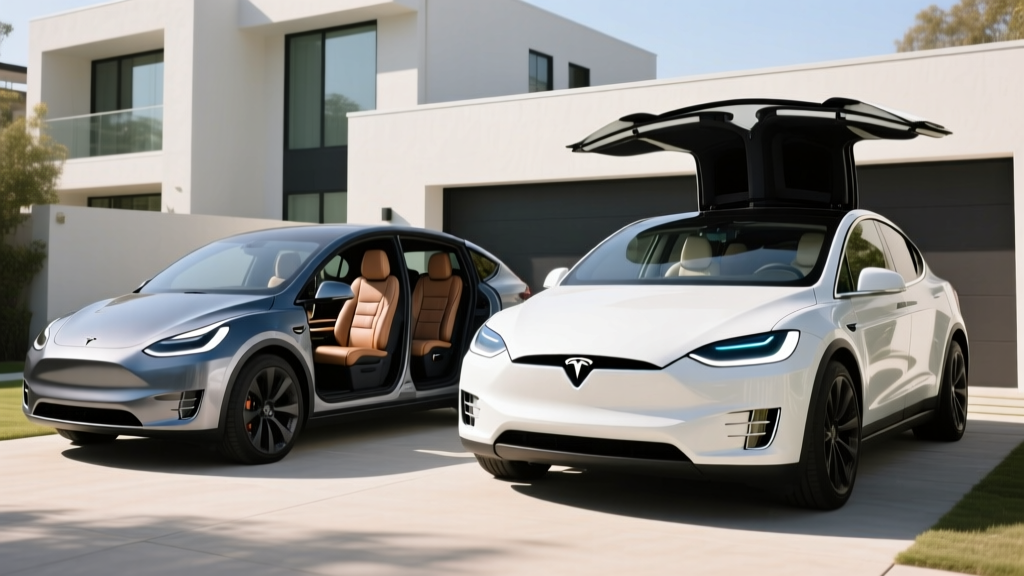
The Model X offers genuine adult-capable third-row seating. In the 7-seat configuration (2-3-2 layout), the third row provides 32.7 inches of legroom—sufficient for adults on trips up to a few hours. The 6-seat configuration (2-2-2) replaces the second-row bench with captain's chairs and a center pass-through, improving third-row access. Cargo behind the third row is 15.8 cubic feet, and the powered falcon-wing doors dramatically improve loading in tight parking spaces. For families regularly hauling five or more passengers, the Model X is the only viable Tesla option.
Pricing, Trims, and Federal Tax Credit Eligibility
| Cost Factor | Model Y Long Range AWD (7-seat) | Model X Long Range (7-seat) |
|---|---|---|
| Base MSRP | $48,990 | $79,990 |
| 7-Seat Option | +$3,000 | Included |
| As-Tested (typical) | $51,990 - $55,000 | $82,000 - $88,000 |
| Federal §30D Credit | Up to $7,500 (if eligible) | $0 (exceeds MSRP cap) |
| Effective Price (max credit) | ~$44,490 - $47,500 | $82,000 - $88,000 |
Federal tax credit rules (IRS §30D, 2026): The Model Y qualifies for up to $7,500 if you meet all requirements: adjusted gross income below $150,000 (single) / $300,000 (joint), MSRP under $80,000 (the Model Y clears this), and battery sourcing/critical mineral compliance. The credit can be applied at point of sale, reducing your out-of-pocket cost immediately. IRS guidance on clean vehicle credits details the battery component and critical mineral thresholds, which tighten annually. The Model X exceeds the $80,000 SUV MSRP cap and is ineligible for the federal credit regardless of buyer income.
State and local incentives vary widely—check your state's energy office or the Alternative Fuels Data Center for applicable rebates.
Performance, Tech, and Driver Assistance
Both vehicles feature Tesla's dual-motor all-wheel drive and regenerative braking with one-pedal driving capability. The Model X's 670 hp and 3.8-second 0-60 time are impressive for a 5,100-pound SUV, though the Model Y's 4.8 seconds feels equally quick in a lighter, more agile package.
Infotainment: Both use Tesla's 15.4-inch center touchscreen with over-the-air updates, streaming services, and integrated navigation with real-time Supercharger routing. The Model X adds a rear-seat entertainment screen for second-row passengers.
Driver Assistance: Tesla's Autopilot (standard) provides adaptive cruise control and lane centering. Full Self-Driving (Supervised), a $8,000 option, adds automated lane changes, traffic light recognition, and city street navigation. Critically, both systems are SAE Level 2—the driver must remain engaged and supervise at all times. These are not autonomous systems.
SAE Automation Level: Tesla Autopilot and FSD (Supervised) are Level 2 driver-assist systems. The driver must keep hands on the wheel (or demonstrate attention via camera monitoring) and remain responsible for all driving decisions. Level 4 autonomy (no driver required in defined conditions) is available only in limited robotaxi services like Waymo.
Pros and Cons
Pros
- Model Y: Most affordable 7-seat EV on the market; eligible for federal tax credit; excellent efficiency (117 MPGe); Supercharger network access; strong resale value
- Model X: Genuine adult-capable third row; falcon-wing doors improve access; air suspension standard; more cargo space; longer battery warranty (150k mi)
- Both: Over-the-air updates; best-in-class charging infrastructure; minimal maintenance costs; strong performance
Cons
- Model Y: Third row only viable for children; minimal cargo with all seats up; no air suspension; 250 kW peak charge rate lags some competitors (Hyundai Ioniq 5 peaks at 350 kW)
- Model X: No federal tax credit; high entry price; falcon-wing doors can be slow and have sensor issues; lower efficiency than Model Y
- Both: No Apple CarPlay/Android Auto; panel gaps and build quality inconsistencies reported; insurance costs above segment average
Who Should Buy Which?
Choose the Model Y (7-seat) if: Your third-row passengers are children under 12; you need a daily driver with low operating costs; you qualify for the federal tax credit; you prioritize efficiency and value; third-row use is occasional (2-3 times per week or less).
Choose the Model X if: You regularly transport five or more adults or teenagers; you need usable cargo space with all seats occupied; you want air suspension and premium features; budget is not the primary constraint; you'll keep the vehicle 8+ years (longer warranty coverage).
Look elsewhere if: You need frequent third-row use on a budget (consider the Kia EV9, starting at $54,900 with a usable third row); you require 300+ miles of real-world highway range with a full load; you want Apple CarPlay or traditional dealership service.
FAQ: Tesla Third Row Seats
Does the Tesla Model 3 have a third row?
No. The Model 3 is a five-passenger sedan with no third-row option. Only the Model Y and Model X offer third-row seating in Tesla's lineup.
Can adults sit comfortably in the Model Y third row?
For short trips (under 30 minutes), yes. For longer drives, the 26.5 inches of legroom and low seat cushion height make it uncomfortable for adults over 5'6". The Model X is far more suitable for adult passengers.
How much range do I lose with a full load of passengers and cargo?
Expect a 5-10% range reduction with a fully loaded vehicle, depending on speed, terrain, and temperature. The Model Y's lighter weight makes it less affected than the Model X, but both will see reduced efficiency.
Is the Model Y 7-seat option worth $3,000?
If you have two or more children and need occasional extra seating, yes—it's the most affordable way to get seven seats in an EV. If your third-row needs are infrequent, a five-seat Model Y with a roof rack for cargo may suffice.
Which Tesla qualifies for the $7,500 federal tax credit?
The Model Y qualifies if you meet income requirements (under $150k single / $300k joint AGI) and the vehicle's battery sourcing meets 2026 critical mineral and component thresholds. The Model X does not qualify due to its MSRP exceeding the $80,000 SUV cap. Always verify current eligibility on the IRS clean vehicle credits page before purchasing.
How does Tesla's third row compare to the Kia EV9?
The Kia EV9 offers more third-row legroom (32.0 inches vs Model Y's 26.5), more cargo space (20.2 cu ft behind the third row), and a lower starting price for its 7-seat trims. However, the EV9 lacks Tesla's Supercharger network and has slower DC charging (210 kW peak vs 250 kW). For families prioritizing space over charging infrastructure, the EV9 is a strong alternative.