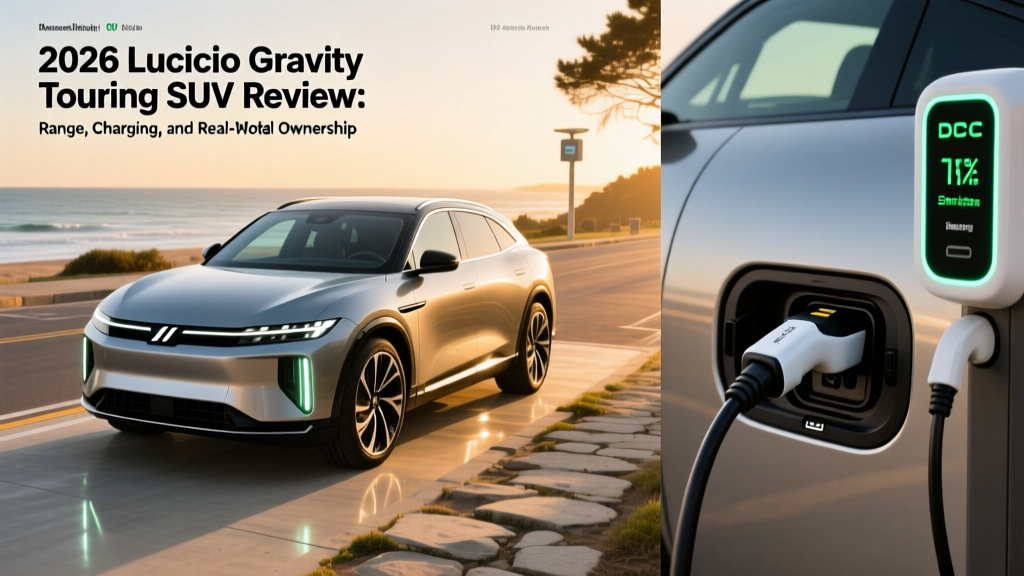
The full-size electric SUV segment just got a serious contender. The 2026 Lucid Gravity Touring SUV arrives with a promise that sounds almost too good: over 440 miles of EPA-estimated range in a three-row family hauler that hits 60 mph in under 3.5 seconds. After spending time with the specs, cross-referencing EPA data, and mapping out the ownership math, we can confirm that Lucid's second production vehicle is not a spec-sheet fantasy — it's a genuine Tesla Model X and Rivian R1S alternative, albeit one that demands careful consideration of price, charging access, and tax credit eligibility.
This review covers the Gravity Touring trim — the mid-tier offering that sits above the Pure base model and below the Grand Touring flagship. It's the volume play for Lucid, and arguably the one most buyers should consider.
Quick Verdict: Who the Lucid Gravity Touring Is For
Bottom line: The Lucid Gravity Touring is the range-and-efficiency king of the three-row electric SUV class. If your priority is maximum miles per charge, class-leading efficiency, and sedan-like driving dynamics in a large SUV, nothing else matches it. If you need hardcore off-road capability, a proven service network, or a sub-$70,000 price tag, look at the Rivian R1S or wait for incentives to shift.
Range and Efficiency: 440+ Miles on Paper, What About Reality?
Lucid has built its reputation on efficiency, and the Gravity Touring continues that tradition. The Touring trim carries an estimated 112 kWh usable battery pack utilizing NMC (nickel manganese cobalt) chemistry — the same cell-supply partnership with LG Energy Solution and Samsung SDI that powers the Air sedan lineup.
| Spec | Value |
|---|---|
| EPA Est. Range | ~440 miles (Touring, est.) |
| Battery (Usable) | ~112 kWh, NMC chemistry |
| Drivetrain | Dual-motor AWD |
| Horsepower | 828 hp (est.) |
| 0-60 mph | ~3.5 seconds |
| Max DC Fast Charge | ~300 kW (peak) |
| 10-80% DC Charge | ~20 minutes (est.) |
| Level 2 Home Charge | 19.2 kW / ~46 mi/hr |
| Efficiency | ~110 MPGe / ~30 kWh/100mi (est.) |
| Base MSRP | ~$94,900 |
| Federal Tax Credit | Up to $7,500 (see eligibility) |
⚡ Real-World Range Callout
The EPA estimate of ~440 miles is impressive, but real-world conditions will reduce this. Expect ~350-380 miles on sustained highway driving at 70-80 mph. In cold weather (below 32°F), plan for a 20-30% reduction — putting you closer to 300-340 miles in winter conditions. Lucid's heat pump and thermal management system help mitigate this, but physics is physics: large SUVs push a lot of air, and cold batteries are less efficient. City driving with regenerative braking will get you closer to, or occasionally above, the EPA sticker.
Lucid's efficiency advantage comes from its miniaturized powertrain technology — smaller, lighter motors with higher power density than competitors. The Gravity is expected to deliver roughly 110 MPGe combined, or about 30 kWh per 100 miles, which would make it significantly more efficient than the Tesla Model X (~100 MPGe) and Rivian R1S (~86 MPGe for the Large Pack). Over a year of 12,000 miles, that efficiency gap translates to real money saved on electricity.
Charging Speed: 300 kW Peak, But What Does the Curve Look Like?
The Gravity Touring supports a 900V+ electrical architecture, enabling DC fast-charging speeds up to an estimated 300 kW at compatible stations. On paper, that means a 10-80% charge in roughly 20 minutes — adding approximately 200+ miles of range in a typical rest stop.
| Charging Level | Power / Rate | Miles Added | Best Use Case |
|---|---|---|---|
| Level 1 (120V) | ~1.4 kW | ~3 mi/hr | Emergency / trickle |
| Level 2 (240V, 48A) | 11.5 kW | ~28 mi/hr | Standard home |
| Level 2 (240V, 80A) | 19.2 kW | ~46 mi/hr | Fast home / workplace |
| DC Fast (350 kW station) | ~300 kW peak | ~200 mi in 15 min | Road trips |
Here's where real-world honesty matters: peak charge rate is not sustained charge rate. The 300 kW figure represents the maximum the Gravity will pull at a low state of charge (around 10-15%) on a compatible 350 kW charger like those from Electrify America or IONITY. As the battery fills, the charge rate tapers — typically dropping significantly above 80% SoC to protect battery longevity. This is normal for all EVs, but buyers fixating on the peak number should understand that a 10-90% charge will take considerably longer than the 10-80% figure suggests.
For home charging, the Gravity's 19.2 kW onboard charger is among the fastest in the industry. If your electrical panel supports an 80-amp circuit (which requires a 100-amp breaker and likely a 200-amp or larger main panel), you can add roughly 46 miles of range per hour. Most Gravity owners will fully recharge overnight from even a near-empty battery. If your home is limited to a 48-amp circuit (more common), expect 11.5 kW and about 28 miles per hour — still enough for a full overnight charge in most cases.
The Gravity ships with a NACS (North American Charging Standard) port, giving it native access to Tesla's Supercharger network — a major practical advantage for road-tripping families. CCS adapters are available for legacy networks, but NACS is rapidly becoming the dominant connector in North America.
Performance and Driving Dynamics
The Touring trim is expected to deliver approximately 828 horsepower from its dual-motor all-wheel-drive powertrain, launching the Gravity from 0-60 mph in roughly 3.5 seconds. That puts it in supercar territory for acceleration, though the Gravity's substantial curb weight (estimated north of 6,000 lbs) means it won't feel as nimble as a lighter sedan through corners.
Lucid's powertrain engineering is genuinely impressive. The company's in-house motors are smaller and lighter than competing units, reducing unsprung mass and allowing more interior space. The low center of gravity from the floor-mounted battery pack helps the Gravity resist body roll, and air suspension (standard on Touring and above) provides adjustable ride height for highway efficiency or rough-road clearance.
Towing capacity is rated at an estimated 6,000+ pounds, sufficient for most boat trailers, small campers, and car haulers. Note that towing will significantly reduce range — expect a 40-50% reduction when pulling a heavy trailer at highway speeds, consistent with all electric SUVs in this class.
Interior, Cargo, and Technology
The Gravity seats up to seven passengers across three rows, with available second-row captain's chairs reducing capacity to six. Legroom and headroom are generous in the first two rows; the third row is usable for adults on shorter trips, which is more than can be said for many three-row competitors.
Cargo space is a highlight:
- Behind third row: ~20 cu ft (estimated)
- Behind second row (third row folded): ~55 cu ft (estimated)
- Maximum (all rear seats folded): ~100+ cu ft (estimated)
- Front trunk (frunk): ~10 cu ft (estimated) — large enough for a carry-on or charging cables
The centerpiece of the interior is Lucid's 34-inch curved glass cockpit display, which spans the dashboard and integrates instrument cluster, infotainment, and navigation. A lower touchscreen handles climate controls and secondary functions. The system runs Lucid's proprietary software — responsive and visually polished, though the app ecosystem is less mature than Tesla's. Wireless Apple CarPlay and Android Auto are expected to be standard.
Lucid's driver-assistance suite, branded DreamDrive Pro, uses a combination of cameras, radar, and lidar sensors. It offers adaptive cruise control, lane-centering, automatic emergency braking, and highway assist features. Importantly, DreamDrive Pro is a SAE Level 2 system — it requires active driver supervision at all times and is not a self-driving system. Lucid has indicated plans for more advanced capabilities in future software updates, but as delivered, it competes with Tesla Autopilot, Ford BlueCruise, and GM Super Cruise in functionality.
Pricing, Trims, and Federal Tax Credit Eligibility
The 2026 Lucid Gravity lineup breaks down across three trims:
| Trim | Est. Base MSRP | Est. Range | Key Features |
|---|---|---|---|
| Pure | ~$79,900 | ~400 mi | RWD or AWD, 480 hp |
| Touring | ~$94,900 | ~440 mi | AWD, 828 hp, air suspension |
| Grand Touring | ~$119,900 | ~450+ mi | AWD, 1,000+ hp, full luxury |
With options (premium paint, upgraded wheels, rear-seat entertainment, advanced driver-assist packages), a well-equipped Gravity Touring can reach $105,000-$110,000 before incentives.
Does the Lucid Gravity Qualify for the Federal EV Tax Credit?
The IRS §30D clean vehicle credit offers up to $7,500 for qualifying new EVs, but eligibility depends on several factors that buyers must verify before purchase:
- MSRP Cap: SUVs must have a base MSRP at or below $80,000 to qualify. The Gravity Pure may qualify; the Touring (~$94,900) and Grand Touring exceed this cap and are not eligible for the new-vehicle credit.
- Buyer Income Cap: Modified adjusted gross income must not exceed $150,000 (single), $225,000 (head of household), or $300,000 (joint filing).
- Battery Sourcing: The credit splits into two halves — $3,750 for battery components manufactured in North America, and $3,750 for critical minerals sourced from the US or free-trade-agreement partners. Lucid's supply chain is evolving, and the exact credit amount varies by production batch.
- Point-of-Sale Transfer: As of 2024, buyers can transfer the credit to the dealer at purchase, reducing the sale price directly rather than waiting for a tax refund.
⚠ Tax Credit Reality Check
The Gravity Touring's ~$94,900 MSRP exceeds the $80,000 SUV cap, meaning it does not qualify for the §30D new-vehicle tax credit. Buyers should not factor $7,500 into their Touring purchase math. The Gravity Pure, if priced under $80,000, may qualify — but confirm current battery-sourcing compliance with your dealer and fueleconomy.gov before signing. Tax rules change; consult a tax professional for your specific situation.
How It Compares: Gravity Touring vs. the Competition
| Metric | Lucid Gravity Touring | Tesla Model X LR | Rivian R1S (Large Pack) |
|---|---|---|---|
| EPA Range | ~440 mi | ~348 mi | ~352 mi |
| 0-60 mph | ~3.5 sec | ~3.8 sec | ~3.5 sec |
| Max DC Charge | ~300 kW | ~250 kW | ~220 kW |
| Starting MSRP | ~$94,900 | ~$81,630 | ~$82,700 |
| Federal Credit | No (over MSRP cap) | Partial (sourcing varies) | Up to $7,500 |
| Off-Road Capability | Limited | Limited | Excellent |
| Service Network | Limited (growing) | Moderate | Growing |
The Gravity Touring wins decisively on range and efficiency — no three-row SUV comes close to 440 miles. It also leads in DC fast-charging speed. The Model X undercuts on price and benefits from Tesla's Supercharger network and service infrastructure. The Rivian R1S is the off-road and adventure pick, and it qualifies for the full tax credit, making its effective price significantly lower.
Warranty and Long-Term Ownership
Lucid backs the Gravity with a warranty package consistent with the luxury EV segment:
- Basic Vehicle Warranty: 4 years / 50,000 miles
- Battery & Powertrain Warranty: 8 years / 100,000 miles (with a minimum 70% capacity retention threshold)
- Roadside Assistance: 4 years / 50,000 miles
The 8-year/100,000-mile battery warranty is standard for the segment. The 70% retention threshold means Lucid will replace or repair the battery if it degrades below 70% of original capacity within the warranty period — consistent with Lucid's coverage on the Air sedan. Based on Lucid Air owner data and NMC chemistry benchmarks, most owners should expect 85-90% capacity retention at 100,000 miles under normal use.
One ownership consideration: Lucid's service center network remains significantly smaller than Tesla's or legacy automakers'. Mobile service handles many software-related and minor hardware issues, but major repairs may require a trip to a metro-area service center. Buyers in rural areas should factor this in.
Pros and Cons
✓ Pros
- Class-leading ~440-mile EPA range
- Exceptional efficiency (~110 MPGe)
- 300 kW DC fast charging capability
- 19.2 kW Level 2 home charging (fastest in class)
- Supercar-level 0-60 acceleration
- Spacious three-row interior with frunk
- NACS port for Tesla Supercharger access
- Premium, minimalist interior design
✗ Cons
- Touring trim exceeds $80K tax credit cap
- Limited service center footprint
- Higher starting price than Model X and R1S
- Brand is young — long-term reliability unproven
- Third row best for children or short trips
- Heavy towing slashes range significantly
- DreamDrive Pro is Level 2 only (not autonomous)
- Delivery timelines have historically slipped
Frequently Asked Questions
What is the real-world range of the Lucid Gravity Touring?
The EPA-estimated range is approximately 440 miles. In real-world highway driving at 70-80 mph, expect 350-380 miles. In cold weather (below freezing), plan for 300-340 miles. City driving with regenerative braking can approach or slightly exceed the EPA figure.
How fast does the Lucid Gravity charge at home and on the road?
On a 350 kW DC fast charger, the Gravity peaks at approximately 300 kW, adding about 200 miles in 15 minutes (10-80% in roughly 20 minutes). At home on a 240V/80A Level 2 charger, it charges at 19.2 kW, adding about 46 miles per hour — enough for a full overnight charge from nearly empty.
How much does the Gravity Touring cost after tax credits?
The Gravity Touring starts at approximately $94,900. Because this exceeds the IRS §30D MSRP cap of $80,000 for SUVs, the Touring does not qualify for the federal new-vehicle tax credit. Your effective price is the sticker price minus any state or local incentives (which vary by jurisdiction — check your state's energy office for details).
Is the Lucid Gravity worth buying over a Tesla Model X or Rivian R1S?
If range and efficiency are your top priorities, the Gravity Touring is the clear winner with ~440 miles versus ~348 for the Model X and ~352 for the R1S. If budget matters, the Model X and R1S start $12,000-$15,000 lower and the R1S qualifies for the $7,500 federal credit. If off-road capability matters, the R1S is the only serious choice. If charging infrastructure and service network reliability are paramount, Tesla still leads.
Does the Lucid Gravity qualify for the federal EV tax credit?
The Gravity Pure (base MSRP ~$79,900) may qualify for up to $7,500 under IRS §30D, subject to buyer income limits and battery-sourcing requirements. The Touring and Grand Touring trims exceed the $80,000 MSRP cap and are not eligible. Always verify current eligibility on fueleconomy.gov and with a tax professional before purchasing.
Can the Lucid Gravity use Tesla Superchargers?
Yes. The Gravity comes equipped with a native NACS (North American Charging Standard) port, providing direct access to Tesla's Supercharger network without an adapter. This is one of the Gravity's strongest practical advantages for road trips.
Sources: fueleconomy.gov (EPA range and efficiency data), IRS §30D Clean Vehicle Credit guidelines, Lucid Motors official specifications. All specifications are estimates based on manufacturer-provided data and EPA testing as of publication; confirm final specs with your dealer.