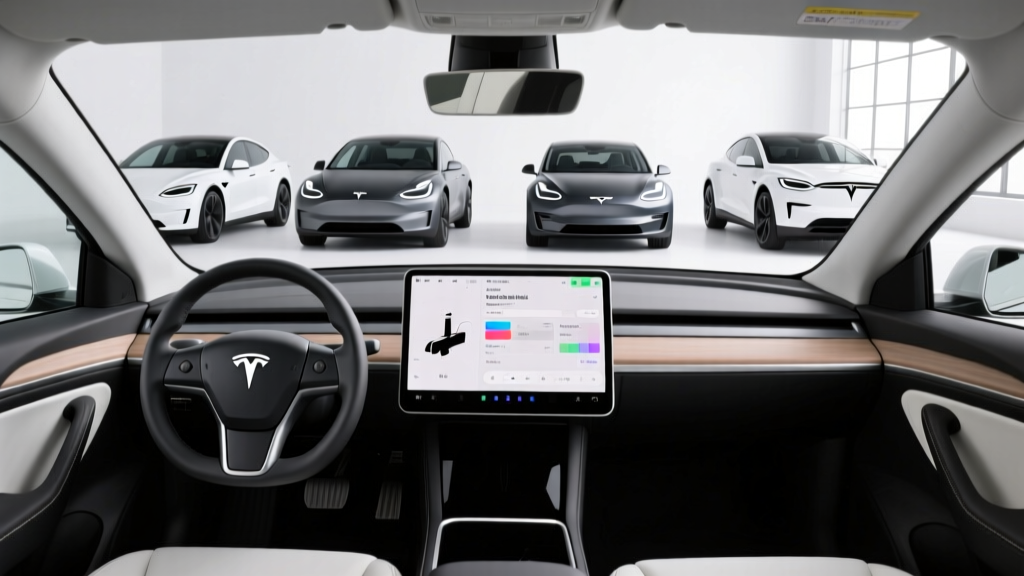
If you've sat in a Tesla for the first time, you already know the screen dominates the cabin. There are no gauge clusters, no physical buttons for climate, no stalks on newer models — everything routes through a single central touchscreen (or two, in the Model S and X). For shoppers searching Tesla screen size, the answer depends entirely on which model you're considering, and that choice cascades into range, charging speed, price, and daily usability.
This guide breaks down every current Tesla model's display dimensions alongside the numbers that actually matter for ownership: EPA range, battery chemistry, DC fast-charge curves, real-world efficiency, and 2025 federal tax credit eligibility under IRS §30D. We'll also flag the quirks that only surface after a few thousand miles — like screen glare in direct sun, gaming performance, and what happens when that single display decides to reboot.
Current Tesla Screen Sizes at a Glance
Tesla has simplified (and complicated) its interior strategy over the last few years. The Model 3 and Model Y now ship with a single 15.4-inch center display, while the refreshed Model S and X get a 17-inch main screen plus a secondary 8-inch rear passenger display. The Cybertruck uses a larger 18.5-inch front screen and a 9.4-inch rear display. Here's the full matrix:
| Model | Front Screen | Rear Screen | Orientation | Resolution (approx.) | Driver Display |
|---|---|---|---|---|---|
| Model 3 (Highland) | 15.4" | 8" (rear seat) | Landscape, fixed | 1920×1200 | None |
| Model Y (Juniper) | 15.4" | 8" (rear seat) | Landscape, fixed | 1920×1200 | None |
| Model S (Refresh) | 17" | 8" (rear seat) | Landscape, fixed | 2200×1300 | None (yoke/round wheel) |
| Model X (Refresh) | 17" | 8" (rear seat) | Landscape, fixed | 2200×1300 | None |
| Cybertruck | 18.5" | 9.4" (rear seat) | Landscape, fixed | 2200×1400 | None |
All current Tesla screens are IPS LCD panels with capacitive touch. Tesla does not publish official nit brightness or color gamut figures, but the Model S/X panels are noticeably brighter and more saturated than the Model 3/Y units — you'll see it immediately in side-by-side test drives. The rear-seat 8-inch screens in all models handle climate controls and entertainment but cannot access navigation or driving settings.
Model 3 Highland: The Entry Point (15.4-Inch Screen)
The refreshed Model 3 (internally called "Highland") replaced the legacy interior in late 2023 and carries into 2025 with minor software updates. The 15.4-inch screen is mounted in a fixed landscape orientation — it does not rotate like some competitors' displays (Hyundai Ioniq 5, for instance). For most drivers, the size is adequate: navigation, media, and climate controls fit comfortably, though the lack of a dedicated driver display means you glance right instead of straight ahead for speed and navigation prompts.
Spec Table: 2025 Tesla Model 3
| Spec | RWD (Base) | Long Range AWD | Performance |
|---|---|---|---|
| EPA Range | 272 mi | 341 mi | 315 mi |
| Battery (usable) | ~57 kWh (LFP) | ~75 kWh (NMC) | ~75 kWh (NMC) |
| Peak DC Fast Charge | 170 kW | 250 kW | 250 kW |
| 10–80% DC Time | ~28 min | ~25 min | ~25 min |
| Level 2 Home Rate | 11.5 kW (~44 mi/hr) | 11.5 kW (~44 mi/hr) | 11.5 kW (~44 mi/hr) |
| 0–60 mph | 5.8 sec | 4.2 sec | 2.9 sec |
| Horsepower | 271 hp | 346 hp | 510 hp |
| MPGe (combined) | 132 MPGe | 134 MPGe | 121 MPGe |
| Base MSRP | $38,990 | $47,740 | $54,990 |
Who the Model 3 Suits
The Model 3 is Tesla's commuter sedan — ideal for solo drivers or couples who prioritize efficiency and charging speed over cargo space. The rear seat fits adults but feels tight on long trips. If you regularly haul four passengers or need hatchback utility, the Model Y is the pragmatic upgrade. For buyers who want the Tesla software ecosystem at the lowest entry price, the RWD trim at $38,990 (before incentives) is the cheapest ticket in.
Model Y Juniper: The Volume Leader (15.4-Inch Screen)
The Model Y received its "Juniper" refresh in early 2025, adopting the Highland-style interior with a 15.4-inch center screen and an 8-inch rear display. The screen hardware is identical to the Model 3's, but the Model Y's taller cabin and hatchback layout make the display feel less cramped — there's more distance between your eyes and the panel, reducing the "screen in your face" sensation some Model 3 drivers report.
Spec Table: 2025 Tesla Model Y
| Spec | Long Range AWD | Performance |
|---|---|---|
| EPA Range | 320 mi | 285 mi |
| Battery (usable) | ~75 kWh (NMC) | ~75 kWh (NMC) |
| Peak DC Fast Charge | 250 kW | 250 kW |
| 10–80% DC Time | ~25 min | ~25 min |
| Level 2 Home Rate | 11.5 kW (~44 mi/hr) | 11.5 kW (~44 mi/hr) |
| 0–60 mph | 4.8 sec | 3.5 sec |
| Horsepower | 384 hp | 510 hp |
| MPGe (combined) | 122 MPGe | 111 MPGe |
| Base MSRP | $46,630 | $52,490 |
| Cargo (rear seats up) | 30.2 cu ft | 30.2 cu ft |
| Cargo (rear seats down) | 72.1 cu ft | 72.1 cu ft |
Who the Model Y Suits
The Model Y is Tesla's family crossover — the best-selling EV in the U.S. for good reason. It handles school runs, grocery hauls, and weekend road trips with room to spare. The 72.1 cu ft of cargo space (seats folded) beats most compact SUVs. If you need three rows, look at the Model X or the Rivian R1S. For two-adult households who want hatchback practicality without the Model Y's price, the Hyundai Ioniq 5 or Kia EV6 offer competitive range and faster 800V charging.
Model S and Model X: Premium Displays (17-Inch Main Screen)
The refreshed Model S and X (2021 onward, with ongoing software updates) use a 17-inch center touchscreen that's visibly larger and brighter than the 15.4-inch units in the 3 and Y. The panel resolution is higher, colors are more saturated, and the viewing angles are better — important for a screen this size where the driver and passenger view it from different angles. Both models also include an 8-inch rear screen for climate and entertainment.
Spec Table: 2025 Tesla Model S & X
| Spec | Model S Long Range | Model S Plaid | Model X Long Range | Model X Plaid |
|---|---|---|---|---|
| EPA Range | 402 mi | 359 mi | 335 mi | 311 mi |
| Battery (usable) | ~95 kWh (NMC) | ~95 kWh (NMC) | ~95 kWh (NMC) | ~95 kWh (NMC) |
| Peak DC Fast Charge | 250 kW | 250 kW | 250 kW | 250 kW |
| 10–80% DC Time | ~30 min | ~30 min | ~32 min | ~32 min |
| Level 2 Home Rate | 11.5 kW (~44 mi/hr) | 11.5 kW (~44 mi/hr) | 11.5 kW (~44 mi/hr) | 11.5 kW (~44 mi/hr) |
| 0–60 mph | 3.1 sec | 1.99 sec | 3.8 sec | 2.5 sec |
| Horsepower | 670 hp | 1,020 hp | 670 hp | 1,020 hp |
| MPGe (combined) | 120 MPGe | 116 MPGe | 109 MPGe | 100 MPGe |
| Base MSRP | $79,990 | $94,990 | $84,990 | $99,990 |
| Seating | 5 passengers | 5 passengers | 5–7 passengers | 5–7 passengers |
Who the Model S/X Suits
These are Tesla's flagship sedan and SUV, aimed at buyers who want maximum range (Model S) or three-row seating with falcon-wing doors (Model X). The 17-inch screen feels appropriately premium for the price point, and the gaming performance (Tesla's infotainment can run Cyberpunk 2077 at playable frame rates) is a genuine differentiator for passengers on road trips. However, at $80k–$100k, these models compete with the Lucid Air, BMW iX, and Mercedes EQS — all of which offer more traditional luxury interiors and, in Lucid's case, even longer range.
Tesla Screen Size vs. Competitors
Tesla's single-screen approach is minimalist, but not everyone loves it. Here's how the display sizes compare to key rivals:
| Vehicle | Center Screen | Driver Display | Total Screen Area |
|---|---|---|---|
| Tesla Model 3/Y | 15.4" | None | 15.4" |
| Tesla Model S/X | 17" | None | 17" |
| Hyundai Ioniq 5 | 12.3" | 12.3" | 24.6" (dual) |
| Kia EV6 | 12.3" | 12.3" | 24.6" (dual) |
| Ford Mustang Mach-E | 15.5" (portrait) | 10.2" | 25.7" (dual) |
| BMW iX | 14.9" | 12.3" | 27.2" (curved) |
| Lucid Air | 34" (curved glass canopy) | Integrated | 34" |
| Mercedes EQS | 17.7" (MBUX Hyperscreen) | 12.3" + 12.3" passenger | 56" (full dash) |
Tesla's approach prioritizes a single, large, high-quality panel over multi-screen layouts. The tradeoff: if that screen fails or reboots (rare, but it happens), you lose climate controls, speed readout, and navigation simultaneously. Competitors with dedicated driver displays retain speed and basic info even if the center screen glitches.
Federal Tax Credit Eligibility (2025 IRS §30D Rules)
Tesla's tax credit situation is model-dependent and subject to IRS battery-sourcing requirements that change annually. Here's the current landscape for 2025:
| Model | MSRP | MSRP Cap Met? | Estimated Credit | Notes |
|---|---|---|---|---|
| Model 3 RWD | $38,990 | Yes (under $55k sedan cap) | $3,750 | Partial credit; battery sourcing limits full $7,500 |
| Model 3 Long Range | $47,740 | Yes | $3,750 | Partial credit |
| Model 3 Performance | $54,990 | Yes (barely) | $3,750 | Partial credit |
| Model Y Long Range | $46,630 | Yes (under $80k SUV cap) | $7,500 | Full credit; U.S. battery assembly |
| Model Y Performance | $52,490 | Yes | $7,500 | Full credit |
| Model S / X | $79,990+ | Yes (SUV/sedan caps vary) | $0–$7,500 | Varies by sourcing; check IRS.gov |
Charging Speed: What the Numbers Actually Mean
Tesla's Supercharger network remains the gold standard for reliability, but peak kW figures don't tell the whole story. Here's what to expect in practice:
| Charging Type | Power | Model 3 LR | Model Y LR | Model S LR |
|---|---|---|---|---|
| Level 1 (120V outlet) | 1.4 kW | ~5 mi/hr | ~5 mi/hr | ~5 mi/hr |
| Level 2 (240V, 48A) | 11.5 kW | ~44 mi/hr | ~44 mi/hr | ~44 mi/hr |
| DC Fast (V3 Supercharger) | 250 kW peak | 10–80% in ~25 min | 10–80% in ~25 min | 10–80% in ~30 min |
| DC Fast (V4 Supercharger) | 350 kW capable | Limited by vehicle | Limited by vehicle | Limited by vehicle |
Charge curve reality: Tesla's 250 kW peak is sustained from roughly 10–40% state of charge, then tapers to 150 kW by 60%, and drops to under 50 kW above 85%. The 10–80% time of 25 minutes assumes you arrive at a low state of charge and the battery is preconditioned (the car does this automatically when you navigate to a Supercharger). Cold batteries charge slower — in winter, add 5–10 minutes to the 10–80% time unless you precondition.
Level 2 home charging at 11.5 kW adds roughly 44 miles per hour of charging. A full overnight charge (8 hours) replenishes 350+ miles — more than enough for daily driving. Most owners charge to 80% daily and only hit 100% before long trips (LFP batteries in the Model 3 RWD can be charged to 100% daily without degradation concerns; NMC batteries in Long Range and Performance models benefit from staying below 90% for daily use).
Pros and Cons: Tesla's Screen-Centric Approach
Pros
- Software updates: Tesla regularly adds features via OTA — the screen gets better over time (new apps, UI refinements, gaming titles).
- Minimalist cabin: No physical buttons means fewer things to break; the screen is the only moving part.
- Screen quality: Bright, responsive, excellent viewing angles — especially the 17-inch Model S/X panels.
- Gaming and entertainment: Full Steam integration on newer hardware; Cyberpunk 2077, Stardew Valley, and browser streaming while parked.
- Navigation integration: Tesla's nav is among the best in any EV — real-time Supercharger availability, route planning with charge stops.
Cons
- No dedicated driver display: Speed, range, and nav prompts require glancing right — a safety concern for some drivers.
- Climate controls on-screen: Adjusting fan speed or temperature requires taking eyes off the road; no physical knobs.
- Single point of failure: If the screen reboots or fails, you lose all controls (rare, but documented).
- Learns curve: First-time Tesla drivers spend weeks building muscle memory for swipe gestures and buried menus.
- Screen glare: In direct sunlight, especially with polarized sunglasses, the Model 3/Y screens can wash out.
Frequently Asked Questions
What is the real-world range of a Tesla?
Real-world range depends on model, weather, and driving style. The Model 3 Long Range (EPA 341 mi) typically delivers 280–300 miles at highway speeds in summer and 230–260 miles in freezing weather. The Model Y Long Range (EPA 320 mi) yields 260–280 miles highway in summer, 210–240 in winter. The Model S Long Range (EPA 402 mi) achieves 340–360 miles highway in moderate conditions.
How fast does a Tesla charge at home and on the road?
At home on a 240V Level 2 charger (48A), all current Teslas charge at 11.5 kW, adding roughly 44 miles per hour — a full overnight charge covers most daily needs. On DC fast chargers (Tesla Superchargers), the Model 3 and Y Long Range peak at 250 kW and hit 10–80% in about 25 minutes. The Model S and X, with larger batteries, take about 30 minutes for the same 10–80% session.
How much does a Tesla cost after tax credits?
After the 2025 federal tax credit (where applicable), the Model 3 RWD drops from $38,990 to roughly $35,240 (with a $3,750 partial credit). The Model Y Long Range falls from $46,630 to $39,130 (full $7,500 credit). The Model S and X may or may not qualify depending on battery sourcing — check IRS.gov for current eligibility. State incentives vary and can stack on top.
Is a Tesla worth buying vs. competitors?
Tesla's advantages are the Supercharger network (still the most reliable), software polish, and efficiency (low kWh/100mi means cheaper charging). Competitors like the Hyundai Ioniq 5 and Kia EV6 offer faster 800V charging (10–80% in 18 minutes vs. Tesla's 25), more traditional interiors with physical buttons and dedicated driver displays, and competitive range. If you prioritize charging infrastructure and software, Tesla wins. If you prefer a more conventional cockpit or need the fastest possible charging, consider Hyundai/Kia.
Does the Tesla Model 3 or Y qualify for the $7,500 federal tax credit?
The Model Y Long Range and Performance qualify for the full $7,500 credit in 2025, as they meet MSRP caps (under $80k for SUVs) and battery sourcing requirements. The Model 3 qualifies for a partial $3,750 credit due to battery component sourcing limitations. Both require your income to fall under the §30D caps ($150k single / $300k joint). Always confirm eligibility at purchase — rules change annually.
Can I use a Tesla screen for gaming while driving?
No. Tesla's gaming features (Steam integration, browser games) are locked out while the vehicle is in drive. They're only accessible when parked. This is a safety and regulatory requirement, not a software limitation Tesla can toggle.
What happens if the Tesla screen fails or reboots?
Screen reboots are rare but documented — typically caused by software glitches or extreme heat. During a reboot (10–30 seconds), you lose climate controls, speed readout, and navigation. The car continues to drive normally (steering, brakes, acceleration are unaffected), but you're flying blind on speed and nav. Tesla's hardware is generally reliable, but this single-point-of-failure design is a legitimate concern for risk-averse buyers.