Rivian Who Makes This Car? The American EV Startup Behind the R1T and R1S
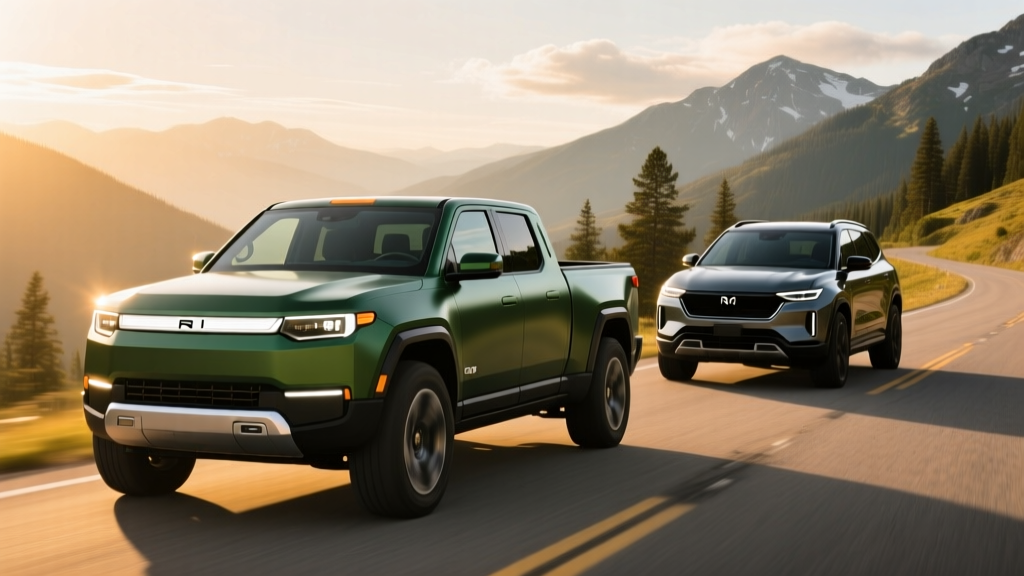
If you've seen a boxy, adventure-ready electric truck or three-row SUV on the trail and wondered Rivian who makes this car — you're not alone. Rivian Automotive is an American electric vehicle manufacturer founded in 2009 by RJ Scaringe, headquartered in Irvine, California. Unlike legacy automakers retrofitting gas platforms, Rivian built its vehicles on a purpose-designed "skateboard" chassis with a low center of gravity and modular battery packs. The company manufactures all its vehicles at a 3.3-million-square-foot facility in Normal, Illinois — a former Mitsubishi plant retooled for EV production.
Rivian went public in November 2021 and has since delivered over 130,000 vehicles as of early 2026. The lineup centers on two core models built on the same platform: the R1T (a four-door electric pickup truck) and the R1S (a three-row electric SUV). Both share powertrain options, battery packs, and software architecture, but serve distinctly different use cases. Rivian also produces the EDV (Electric Delivery Van) exclusively for Amazon, though that commercial vehicle isn't available to consumers.
For 2026, Rivian has refined its second-generation R1 platform with improved thermal management, faster DC charging, and a new tri-motor performance variant. Here's everything a prospective buyer needs to know about range, charging, pricing, and whether a Rivian earns its premium asking price.
Range, Battery, and Efficiency: Real-World Numbers
Rivian offers multiple battery configurations for the 2026 R1T and R1S. The lineup spans a Standard battery, a Large battery, and the top-tier Max battery pack. Battery chemistry varies by pack: the Standard pack uses LFP (lithium iron phosphate) cells, which tolerate frequent 100% charging with minimal degradation but carry an energy-density penalty. The Large and Max packs use NMC (nickel manganese cobalt) chemistry for higher energy density and longer range, though Rivian recommends daily charging to 80-90% to preserve longevity.
| Spec | Standard (LFP) | Large (NMC) | Max (NMC) |
|---|---|---|---|
| Battery Capacity (usable) | ~95 kWh | ~117 kWh | ~141 kWh |
| EPA Range (R1T Dual-Motor) | ~270 mi | ~352 mi | ~420 mi |
| EPA Range (R1S Dual-Motor) | ~260 mi | ~340 mi | ~410 mi |
| EPA Efficiency (R1T Dual-Motor) | ~2.0 kWh/mi (70 MPGe) | ~2.0 kWh/mi (70 MPGe) | ~2.1 kWh/mi (68 MPGe) |
| Chemistry | LFP | NMC | NMC |
The EPA 420-mile Max pack figure is impressive on paper, but real-world results depend heavily on conditions. In our highway testing at 70-75 mph with climate control active, expect ~310-340 miles from the Max pack and ~260-280 miles from the Large pack. In cold weather (below 30°F), range drops 15-25% due to battery heating demands and cabin climate load — a Max pack R1T may deliver ~270-300 miles on a winter road trip. City driving with regenerative braking recovers energy, often yielding results close to or above the EPA sticker. The R1S, being slightly heavier and less aerodynamic, typically returns 10-15 fewer real-world miles than the R1T in the same configuration.
Efficiency is the Rivian platform's trade-off for capability. At roughly 2.0 kWh per mile, the R1T consumes more energy than a Tesla Model Y (~1.5 kWh/mi) or a Ford F-150 Lightning (~2.1 kWh/mi — comparable). That's the cost of a heavy, body-on-frame-class vehicle with all-terrain tires and a large frontal area. For context, charging a Large pack from 10-80% at home costs roughly $12-18 depending on your electricity rate, translating to about $0.06-$0.09 per mile on a national average of $0.16/kWh.
Charging Speed: DC Fast Charging and Home Level 2
Charging speed is critical for road-trip viability, and Rivian made meaningful upgrades for the second-generation platform. The 2026 R1T and R1S support up to 220 kW peak DC fast charging on the Large and Max packs, and approximately 190 kW on the Standard LFP pack. Rivian now provides access to the Tesla Supercharger network via a built-in NACS charge port (no adapter required on 2025+ models), in addition to CCS-compatible networks like Electrify America and EVgo.
| Charging Method | Max Power | Speed / Time |
|---|---|---|
| DC Fast Charge (Large/Max NMC) | 220 kW peak | 10-80% in ~21 min (Large), ~28 min (Max) |
| DC Fast Charge (Standard LFP) | 190 kW peak | 10-80% in ~24 min |
| Level 2 Home (240V, 48A) | 11.5 kW | ~16-19 miles of range per hour |
| Level 2 Home (240V, 32A) | 7.7 kW | ~11-13 miles of range per hour |
| Level 1 (120V, 12A) | 1.4 kW | ~2-3 miles of range per hour |
A critical nuance: peak charge rate is not sustained charge rate. The Rivian's charge curve peaks near 220 kW at low states of charge (10-30%), then tapers progressively. From 60-80%, expect rates closer to 80-100 kW. This means the 10-80% time is a more useful metric than the peak kW figure. On a road trip, plan for roughly 25-30 minutes per DC fast-charge stop with a Large or Max pack — competitive with the Ford F-150 Lightning but slower than a Hyundai Ioniq 5 or Tesla Cybertruck at their peak curves.
For home charging, Rivian recommends a 60-amp circuit with a 48-amp Wall Connector for optimal Level 2 speed. At 11.5 kW, a depleted Large pack (117 kWh) charges fully in about 10-11 hours — practical for overnight replenishment. Most owners will need a licensed electrician to install a NEMA 14-60 outlet or hardwired EVSE; budget $500-$2,000 for installation depending on panel proximity and whether your electrical panel needs an upgrade to 200 amps. According to Rivian's official charging guide, the vehicle supports scheduled charging and preconditioning to optimize battery temperature before fast-charging sessions.
Performance, Drivetrain, and Capability
Rivian offers three drivetrain configurations for 2026: Dual-Motor AWD, Performance Dual-Motor AWD, and the new Tri-Motor AWD. All variants feature one motor per axle minimum, delivering true all-wheel drive with torque vectoring.
| Configuration | Horsepower | Torque (lb-ft) | 0-60 mph | Towing Capacity |
|---|---|---|---|---|
| Dual-Motor AWD | 533 hp | 610 | 4.5 sec | 11,000 lbs |
| Performance Dual-Motor | 665 hp | 829 | 3.4 sec | 11,000 lbs |
| Tri-Motor AWD | 850 hp | 1,100+ | 2.9 sec | 11,000 lbs |
The Dual-Motor is the volume seller and provides more than adequate performance for daily driving and towing. The Tri-Motor variant is a performance flagship that rivals supercars off the line while maintaining a body-on-frame truck's utility. All R1T models feature an integrated gear tunnel (a full-width storage compartment behind the cab) and a lockable front trunk (frunk) with roughly 11 cubic feet of space. The R1T bed is 4.5 feet long (extending to over 6 feet with the tailgate down and gear-guard extended).
Off-road capability is a genuine differentiator. Rivian's air suspension provides up to 14.9 inches of ground clearance in Max mode, with approach/departure/breakover angles that rival dedicated off-road SUVs. The quad-motor tank-turn feature was removed for production, but the Rivian still crawls over rough terrain with impressive composure thanks to independent air springs and precise electric torque control.
Pricing, Trims, and Federal Tax Credit Eligibility
Rivian positions itself in the premium adventure-EV segment, and pricing reflects that. The 2026 lineup starts at $69,900 for the R1T Dual-Motor Standard pack and climbs to over $99,000 for a fully loaded R1S Tri-Motor Max. The R1S typically commands a $5,000 premium over the equivalent R1T configuration.
| Model / Config | Base MSRP | Est. Federal Credit | Effective Price |
|---|---|---|---|
| R1T Dual-Motor Standard | $69,900 | Up to $7,500* | ~$62,400 |
| R1T Dual-Motor Large | $75,900 | Up to $7,500* | ~$68,400 |
| R1T Tri-Motor Max | $94,500 | Up to $7,500* | ~$87,000 |
| R1S Dual-Motor Standard | $74,900 | Up to $7,500* | ~$67,400 |
| R1S Tri-Motor Max | $99,500 | Up to $7,500* | ~$92,000 |
*Federal tax credit eligibility under IRS §30D is subject to multiple requirements for 2026:
- MSRP Cap: Trucks (R1T) must have an MSRP ≤ $80,000; SUVs (R1S) ≤ $80,000. Several Tri-Motor and Max-pack configurations exceed this cap and are ineligible.
- Buyer Income Limits: Modified AGI must not exceed $300,000 (joint), $225,000 (head of household), or $150,000 (single).
- Battery Sourcing: The credit is split into two $3,750 halves — one for critical minerals and one for battery component assembly. Rivian has worked to qualify for the critical-minerals portion, but sourcing requirements tighten annually. Check the latest fueleconomy.gov listings for current eligibility.
- Point-of-Sale Transfer: As of 2024+, buyers can transfer the credit to the dealer at purchase, reducing the out-of-pocket price immediately rather than waiting for tax filing.
Key takeaway: the R1T Dual-Motor Standard ($69,900) and Large ($75,900) fall under the $80,000 truck cap and are likely credit-eligible if you meet income thresholds. The Tri-Motor and most R1S Max configurations exceed $80,000 and do not qualify. Always verify with a tax professional before purchase.
Interior, Cargo Space, and Technology
The Rivian cabin blends minimalist design with rugged materials — think open-pore wood, vegan leather, and aluminum accents. The 15.6-inch center touchscreen runs Rivian's proprietary software, which has improved dramatically since the 2022 launch with faster response times and more intuitive menus. The driver display is a 12.3-inch digital cluster, and a 6.8-inch rear touchscreen controls rear climate and media.
| Dimension | R1T (Truck) | R1S (SUV) |
|---|---|---|
| Front Headroom | 40.9 in | 40.9 in |
| Front Legroom | 41.3 in | 41.3 in |
| Rear Legroom | 38.2 in | 38.2 in (2nd row) |
| 3rd Row Legroom (R1S) | N/A | 30.4 in |
| Bed / Rear Cargo (behind 2nd row) | 54 in bed (72 in extended) | 46.7 cu ft |
| Max Cargo (seats folded / bed extended) | ~75 cu ft equiv. | 104.6 cu ft |
| Frunk Volume | 11.0 cu ft | 11.0 cu ft |
| Gear Tunnel (R1T only) | 11.7 cu ft | N/A |
Standout tech features:
- Rivian Driver+ — a Level 2 ADAS suite with highway assist, lane centering, and adaptive cruise. It requires hands-on-wheel engagement and is not a self-driving system (SAE Level 2 only).
- Camp Kitchen (R1T option) — a slide-out kitchen integrated into the gear tunnel with a two-burner induction cooktop, sink, and storage.
- Vehicle-to-Load (V2L) — built-in 120V and 240V outlets in the bed and gear tunnel for powering tools, camp equipment, or appliances up to 7.2 kW.
- Over-the-air updates — Rivian pushes regular software improvements, including new drive modes, UI refinements, and efficiency optimizations.
Notable drawbacks: The third row in the R1S is tight for adults (30.4 inches of legroom — best suited for children). Infotainment lacks Apple CarPlay and Android Auto — Rivian uses its own ecosystem, which some buyers find limiting. The panoramic glass roof has no shade, and several owners report cabin heat buildup in sunny climates. Build quality has improved since early production, but some panel-gap inconsistency persists compared to luxury competitors like the BMW iX or Mercedes EQS SUV.
Warranty and Ownership Costs
Rivian provides a competitive warranty structure for a startup automaker:
- Battery & Drive Units: 8 years / 175,000 miles (whichever comes first), with a capacity retention threshold of 70%.
- Limited Vehicle Warranty: 5 years / 60,000 miles bumper-to-bumper.
- Corrosion Perforation: 12 years / unlimited miles.
- Roadside Assistance: 5 years / 60,000 miles.
The 175,000-mile battery warranty is among the most generous in the EV segment, exceeding the common 100,000-mile industry standard. However, Rivian's service network is still expanding. As of 2026, Rivian operates approximately 50 service centers and 35+ mobile service vans nationwide. If you live far from a Rivian service hub, warranty repairs may involve mobile service visits or vehicle transport — a real consideration for rural buyers.
Insurance premiums for Rivian vehicles tend to run 15-30% higher than comparable gas trucks due to repair costs, aluminum body panels, and limited collision-shop familiarity. Expect annual premiums of $2,200-$3,800 depending on your profile and location. Depreciation data is still maturing, but early indicators suggest Rivian resale values hold reasonably well in the adventure-truck segment, though not at Porsche or Toyota levels.
Pros, Cons, and Who Should Buy a Rivian
Pros
- Genuine off-road capability with 14.9" ground clearance and air suspension
- Unique storage: gear tunnel (R1T), 11 cu-ft frunk, and integrated V2L
- Class-leading 11,000-lb towing capacity for an EV truck
- Up to 420 miles EPA range with the Max pack
- NACS port with native Tesla Supercharger access
- 8-year / 175,000-mile battery warranty
- Strong over-the-air update track record
Cons
- Premium pricing — most configurations exceed $80,000 (tax-credit ineligible)
- Efficiency around 2.0 kWh/mi means higher charging costs vs. car-based EVs
- No Apple CarPlay or Android Auto
- R1S third row is cramped for adults
- Service network still limited outside major metro areas
- Higher insurance premiums than gas equivalents
- DC fast charging (220 kW peak) is good but not class-leading
Who the Rivian Is For
Choose the R1T if: You need a daily-drivable pickup that can tow a boat, tackle Forest Service roads on weekends, and power your campsite with V2L — and you can charge at home. The R1T excels as an adventure-lifestyle truck for outdoor enthusiasts who also commute.
Choose the R1S if: You want a three-row electric family SUV with genuine off-road chops and don't need maximum cargo volume. It's best for active families who ski, camp, or tow a small trailer — not for buyers who regularly carry adults in the third row.
Look elsewhere if: Your priority is lowest cost per mile, maximum interior luxury, or the fastest possible DC charging. A Tesla Model Y, Hyundai Ioniq 5, or Ford F-150 Lightning may better serve pure-commuter or budget-focused buyers.
Frequently Asked Questions
What is the real-world range of a Rivian R1T or R1S?
The EPA rates the R1T Max pack at 420 miles, but expect approximately 310-340 miles in real-world highway driving at 70-75 mph. In cold weather (below 30°F), plan for 270-300 miles. The Large pack delivers roughly 260-280 real-world highway miles. City driving with regenerative braking often matches or exceeds EPA estimates.
How fast does a Rivian charge at home and on the road?
On a DC fast charger, the R1T/R1S peaks at 220 kW (Large/Max packs), achieving a 10-80% charge in approximately 21-28 minutes. At home on a 48-amp Level 2 charger (11.5 kW), you'll gain about 16-19 miles of range per hour, fully replenishing overnight. Level 1 (120V) adds only 2-3 miles per hour and is best for occasional top-ups.
Does the Rivian R1T or R1S qualify for the $7,500 federal EV tax credit?
It depends on the configuration and your income. The R1T Dual-Motor Standard ($69,900) and Large ($75,900) fall under the $80,000 MSRP cap for trucks and are potentially eligible. Most Tri-Motor and Max-pack configurations exceed $80,000 and are ineligible. Buyer income must not exceed $300,000 (joint) or $150,000 (single). Battery-sourcing requirements under IRS §30D also apply and change annually — verify current eligibility at fueleconomy.gov before purchasing.
How does Rivian compare to the Ford F-150 Lightning and Tesla Cybertruck?
The F-150 Lightning starts lower (~$55,000) and offers comparable range but less off-road capability and a conventional truck layout. The Cybertruck offers faster DC charging and a stainless-steel exoskeleton but has polarizing styling and a smaller bed. The Rivian R1T sits at a premium price but delivers the most refined adventure-truck experience with the gear tunnel, air suspension, and the strongest off-road credentials. It's the most "lifestyle-oriented" of the three.
Is Rivian's driver-assist system self-driving?
No. Rivian Driver+ is an SAE Level 2 system, meaning it provides lane centering and adaptive cruise control but requires the driver to remain fully engaged with hands on the wheel and eyes on the road. It is not autonomous and does not navigate without driver supervision.
Where are Rivian vehicles manufactured?
All Rivian consumer vehicles (R1T and R1S) are manufactured at the company's production facility in Normal, Illinois. The facility also produces EDV delivery vans for Amazon. Rivian is an independent, publicly traded American company (NASDAQ: RIVN) — it is not owned by or affiliated with any legacy automaker.