The Tesla Model Y remains the benchmark compact electric SUV in 2026, balancing range, charging speed, and software-driven automation in a package that undercuts most rivals on price. Whether you're evaluating it as a daily commuter, a family hauler, or a road-trip machine, the numbers tell a compelling story — with a few caveats that buyers need to understand before signing.
This review covers the 2026 Model Y lineup (Long Range AWD, Performance, and the base RWD variant), with exact EPA data, real-world range expectations, charging curves, and a clear-eyed look at Tesla's Full Self-Driving (Supervised) automation — the feature that draws both the most excitement and the most confusion among shoppers.
Quick Verdict: Who the Model Y Is For
The Model Y is best suited for tech-forward buyers who want a spacious, efficient electric SUV with access to the Supercharger network and don't mind a minimalist interior. It excels as a two-row family vehicle, a long-distance road-tripper, and a commuter with home charging. It is not ideal for buyers who prioritize luxury materials, physical button controls, or fully autonomous driving without supervision.
Choose the Model Y if: You want 300+ miles of range, best-in-class DC fast charging, over-the-air updates, and the most mature public charging network in North America.
Look elsewhere if: You need three rows of seating, prefer a traditional interior with physical controls, or want Level 4 autonomous driving today.
Range, Efficiency, and Real-World Expectations
| Trim | EPA Range | Battery (usable) | Chemistry | MPGe (combined) | kWh/100 mi |
|---|---|---|---|---|---|
| Long Range AWD | 320 mi | ~75 kWh | NMC | 122 MPGe | 28 |
| Performance AWD | 295 mi | ~75 kWh | NMC | 111 MPGe | 30 |
| RWD (Base) | 295 mi | ~60 kWh | LFP | 128 MPGe | 26 |
EPA Sticker: 320 miles (Long Range AWD)
Real-World Expectation: Plan for approximately 260–280 miles on highway trips at 70+ mph in moderate weather. In cold weather (below 30°F / -1°C), expect 20–30% range reduction, bringing usable highway range to roughly 200–230 miles. City driving with regenerative braking recovers more energy and can approach or slightly exceed the EPA figure.
Source: EPA Fuel Economy
The Long Range AWD's NMC (nickel manganese cobalt) pack prioritizes energy density, which is why it delivers the highest range figure. The base RWD model uses an LFP (lithium iron phosphate) battery — slightly less range, but LFP chemistry tolerates regular 100% charging without accelerated degradation, making it practical for daily commuters who charge at home every night. NMC owners should typically set their daily charge limit to 80% and reserve 100% for road trips.
Charging Speed: DC Fast, Level 2, and the Supercharger Advantage
| Charging Level | Power / Rate | Time or Miles Added |
|---|---|---|
| DC Fast Charge (V3/V4 Supercharger) | Peak 250 kW | 10–80% in ~22 minutes |
| DC Fast Charge (third-party CCS via adapter) | Up to 250 kW (station dependent) | Varies; ~25 min 10–80% at rated stations |
| Level 2 Home (Tesla Wall Connector, 48A) | 11.5 kW | ~44 miles per hour of charging |
| Level 2 Home (32A mobile connector, 240V) | 7.7 kW | ~30 miles per hour of charging |
| Level 1 (120V household outlet) | ~1.4 kW | ~3–5 miles per hour |
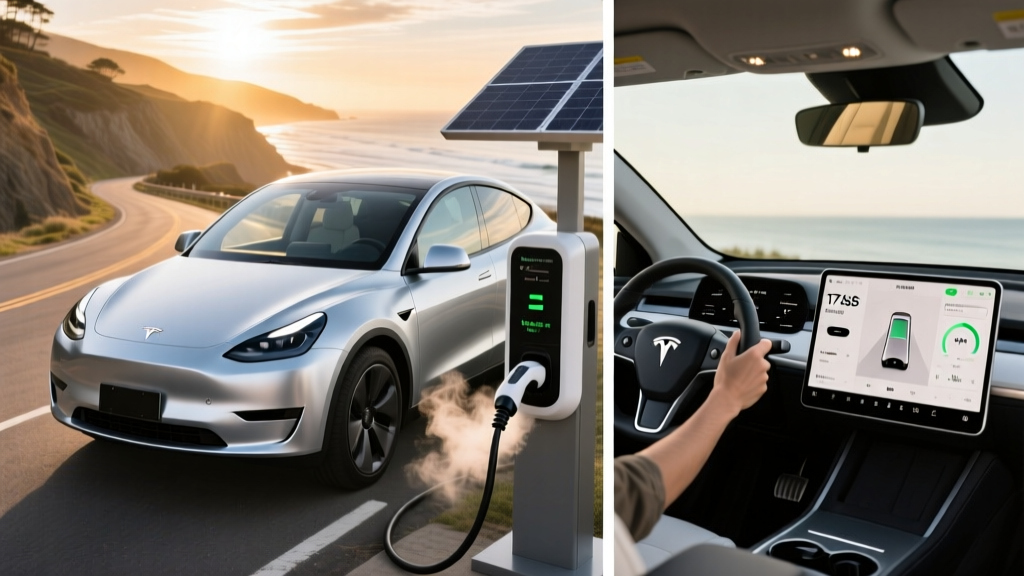
Tesla's charging architecture remains a key ownership advantage. At a V3 or V4 Supercharger, the Model Y Long Range peaks at 250 kW and sustains strong charge rates through roughly 50% State of Charge (SoC), then tapers progressively. The 10–80% time of approximately 22 minutes is competitive with the Hyundai Ioniq 5 and Kia EV6, though those rivals use 800V architectures that sustain peak rates slightly longer.
For home charging, the Tesla Wall Connector at 48 amps on a 60-amp circuit adds roughly 44 miles of range per hour — enough to fully replenish the Long Range battery overnight in about 7–8 hours. Installation costs for a Level 2 home setup typically range from $500 (simple outlet near the panel) to $2,500+ if a panel upgrade or long conduit run is required. Always have a licensed electrician assess your panel capacity before committing to a 60-amp circuit.
The Model Y uses the NACS (North American Charging Standard) connector natively. Tesla has opened the Supercharger network to non-Tesla EVs via a built-in CCS adapter, and Tesla owners can use Electrify America, EVgo, and other CCS networks with the included or optional adapter — though reliability and pricing vary by network.
Performance and Drivetrain
| Trim | Drivetrain | Horsepower | 0–60 mph | Top Speed |
|---|---|---|---|---|
| Long Range AWD | Dual-Motor AWD | ~384 hp | 4.8 sec | 135 mph |
| Performance AWD | Dual-Motor AWD | ~510 hp | 3.5 sec | 155 mph |
| RWD (Base) | Single-Motor RWD | ~295 hp | 6.6 sec | 135 mph |
Even the base RWD Model Y delivers brisk acceleration by any standard. The Long Range AWD's 4.8-second 0–60 time is genuinely quick for a family SUV, and the Performance variant's 3.5-second sprint puts it in sports-car territory. Dual-motor AWD provides confident traction in rain and snow, with torque vectoring that feels planted through corners.
Regenerative braking is strong and effectively enables one-pedal driving in most conditions. The hold mode brings the car to a complete stop without touching the brake pedal, reducing fatigue in stop-and-go traffic.
Interior, Cargo, and Technology
The Model Y's cabin is defined by its radical minimalism. Nearly all controls — climate, mirrors, glovebox, wipers — are accessed through the 15.4-inch central touchscreen. There is no instrument cluster behind the steering wheel; speed and navigation info appear in the upper-left corner of the main display. This design polarizes buyers: some love the clean aesthetic, others miss the redundancy of physical controls.
Cargo and passenger dimensions:
- Front headroom: 41.0 in | Front legroom: 41.8 in
- Rear headroom: 37.7 in | Rear legroom: 35.2 in
- Cargo behind 2nd row: 30.2 cu ft
- Cargo with 2nd row folded: 72.1 cu ft
- Front trunk (frunk): 4.1 cu ft
The rear cargo area is generous for the class, and the flat load floor with the seats folded makes it practical for bulky items. The frunk is modest compared to the Ford Mustang Mach-E's but useful for charging cables and groceries.
Standout tech features:
- Over-the-air software updates that add features and refine performance
- Tesla app with remote climate, Sentry Mode camera access, and vehicle location
- Sentry Mode (dashcam and surveillance when parked)
- Dashcam recording with front, rear, and side cameras
- HEPA air filtration with Bioweapon Defense Mode
- 17-speaker premium audio (Long Range and Performance)
- Heat pump for efficient cabin heating in cold weather
Notable drawbacks:
- No physical buttons for climate or volume — everything is touchscreen
- Rear visibility is compromised by the sloping roofline and small rear window
- Ride quality on 20-inch wheels can be firm over rough pavement
- No Apple CarPlay or Android Auto — Tesla's native infotainment only
- Panel-gap inconsistency still occasionally reported on new deliveries
FSD (Supervised): What Tesla's Automation Actually Does
SAE Automation Level: 2
Tesla's Full Self-Driving (Supervised) is a Level 2 driver-assistance system. The driver must remain fully engaged, hands on or near the wheel, eyes on the road, and ready to take over at any moment. It is not self-driving. Only Level 4 services like Waymo operate without a human driver — and those are limited to geofenced urban areas in select cities.
FSD (Supervised) adds automated lane changes, traffic-light and stop-sign recognition, and city-street navigation on top of the standard Autopilot features (lane centering, adaptive cruise control). In 2026, FSD has improved significantly in handling complex intersections and unprotected left turns, but it still requires active supervision and occasionally makes conservative or unexpected decisions.
Standard Autopilot is included on every Model Y. FSD (Supervised) costs an additional $8,000 as a one-time purchase or $99/month as a subscription. For most buyers, standard Autopilot handles highway driving well; FSD is worth considering only if you frequently navigate complex urban routes and are comfortable acting as a vigilant supervisor.
FSD (Supervised) does NOT:
- Drive without a human in the driver's seat
- Handle all weather conditions (heavy rain, snow, fog can disable features)
- Recognize all construction zones, temporary signage, or road debris
- Replace attentive driving — NHTSA data shows Level 2 systems still require human judgment in edge cases
Source: NHTSA Automated Vehicle Safety
Pricing, Tax Credits, and Ownership Costs
| Trim | Base MSRP | Federal Credit (§30D) | Effective Price (if eligible) |
|---|---|---|---|
| RWD (Base) | $39,990 | Up to $7,500 | ~$32,490 |
| Long Range AWD | $44,990 | Up to $7,500 | ~$37,490 |
| Performance AWD | $49,990 | Up to $7,500 | ~$42,490 |
Federal EV tax credit eligibility under IRS §30D is not automatic. For 2026, the key requirements include:
- MSRP cap: SUVs must be priced at or below $80,000 (all Model Y trims qualify)
- Buyer income cap: Modified adjusted gross income must not exceed $300,000 (joint filers), $225,000 (head of household), or $150,000 (individual)
- Battery sourcing: Critical minerals and battery components must meet escalating domestic-content thresholds that tighten each year — Tesla's US-built batteries generally meet current thresholds, but always verify at the point of sale
- Point-of-sale transfer: Eligible buyers can apply the credit as an immediate price reduction at the dealer rather than waiting for a tax refund
Verify current eligibility at IRS.gov Clean Vehicle Credit or with a qualified tax professional. Rules and sourcing requirements change annually.
Warranty coverage:
- Basic vehicle: 4 years / 50,000 miles
- Battery and drive unit: 8 years / 120,000 miles (Long Range/Performance) or 8 years / 100,000 miles (RWD)
- Battery capacity retention threshold: 70% over the warranty period
Pros, Cons, and Competitor Comparison
Pros
- 320-mile EPA range (Long Range) with best-in-class efficiency
- 250 kW DC fast charging with extensive Supercharger network
- Spacious cargo area (72.1 cu ft max) and comfortable rear seating
- Strong performance even in base trim (0–60 in 6.6s RWD)
- Continuous OTA updates that improve the vehicle post-purchase
- Competitive pricing after federal tax credit
- Heat pump standard for cold-climate efficiency
Cons
- Touchscreen-only controls — no physical buttons or knobs
- No Apple CarPlay or Android Auto integration
- FSD costs $8,000 extra and remains Level 2 (supervised)
- Cold-weather range loss of 20–30% is significant for northern climates
- Insurance premiums tend to run 15–25% higher than comparable gas SUVs
- Rear visibility is limited by the coupe-like roofline
Against key competitors, the Model Y holds advantages in charging infrastructure and software maturity. The Hyundai Ioniq 5 offers 800V charging and a more conventional interior with physical controls but less cargo space. The Ford Mustang Mach-E provides a sportier driving feel and CarPlay support but trails on efficiency and charging speed. The BMW iX is more luxurious but starts well above $60,000.
Frequently Asked Questions
What is the real-world range of the 2026 Tesla Model Y?
The EPA rates the Long Range AWD at 320 miles. In real-world highway driving at 70 mph in moderate temperatures, expect approximately 260–280 miles. In cold weather below 30°F, highway range drops to roughly 200–230 miles. City driving with regenerative braking can meet or slightly exceed the EPA figure.
How fast does the Model Y charge at home and on the road?
On a DC fast charger (Supercharger or equivalent), the Model Y peaks at 250 kW and charges from 10–80% in approximately 22 minutes. At home on a Level 2 Tesla Wall Connector (48A/11.5 kW), it adds about 44 miles of range per hour, fully charging overnight in 7–8 hours.
How much does the Model Y cost after the federal tax credit?
If you meet all IRS §30D requirements (income, MSRP, battery sourcing), the Long Range AWD drops from $44,990 to approximately $37,490. The base RWD can fall to around $32,490. Eligibility is not guaranteed — verify income caps, sourcing requirements, and point-of-sale transfer availability before purchase.
Is the Model Y worth buying over the Ioniq 5 or Mach-E?
The Model Y wins on range, efficiency, Supercharger access, and cargo space. The Ioniq 5 offers a more conventional interior, 800V charging, and CarPlay. The Mach-E is sportier to drive. If charging-network reliability and software updates are priorities, the Model Y has the edge. If you prefer physical controls and CarPlay, test-drive the Ioniq 5.
Does the Tesla Model Y qualify for the $7,500 federal EV tax credit?
All 2026 Model Y trims fall under the $80,000 SUV MSRP cap. However, buyer income limits ($150K individual / $300K joint), battery critical-mineral sourcing thresholds, and point-of-sale transfer rules all affect eligibility. Tesla's US-built battery packs generally meet current sourcing rules, but confirm with your tax professional and at the point of sale. Rules are subject to change — check IRS.gov for the latest.
Is FSD self-driving?
No. Tesla's Full Self-Driving (Supervised) is an SAE Level 2 system. You must remain the active driver at all times — hands near the wheel, eyes on the road, ready to intervene. It handles many highway and city-street scenarios but does not replace human judgment. Only Level 4 robotaxi services (Waymo, Zoox) operate without a driver, and those are limited to specific geofenced areas.