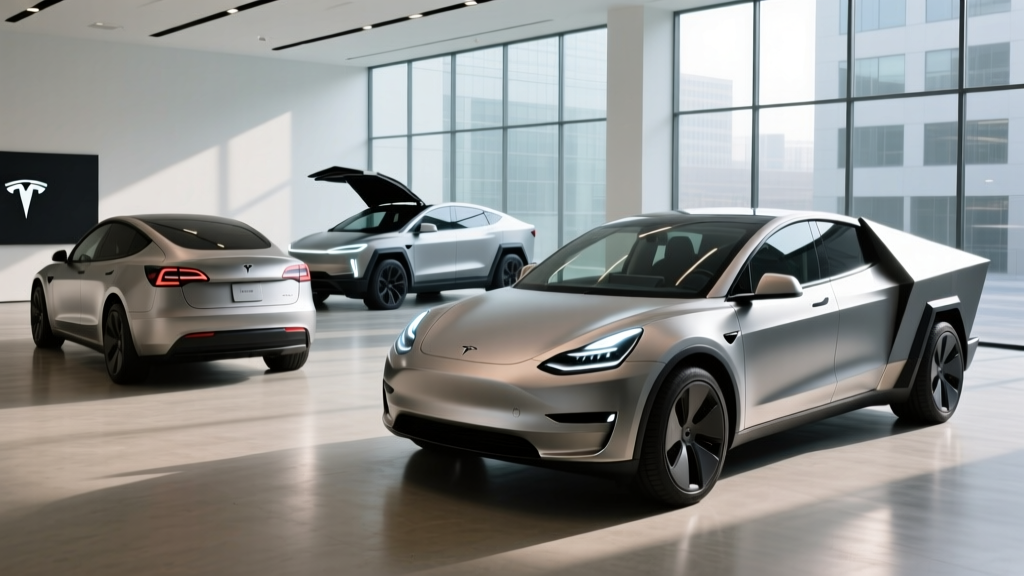
If you're cross-shopping Tesla's lineup or measuring your garage before purchase, you need exact numbers — not marketing copy. This guide compiles the current Tesla dimensions for every model in the 2026 lineup: Model 3, Model Y, Model S, Model X, and Cybertruck. We cover exterior footprint, interior passenger space, cargo volume, and pair those figures with the real-world range, charging, and pricing data that actually drive purchase decisions.
Dimensions matter for EVs in ways that go beyond parking. A larger battery pack adds curb weight that affects tire wear and efficiency. A longer wheelbase improves ride quality but limits turning radius in tight urban environments. And cargo volume determines whether that road-trip gear or weekly grocery haul actually fits. Below, we break down each model with the specs that matter.
Tesla Model Lineup at a Glance: Exterior Dimensions
Tesla's five current models span from a compact sedan to a full-size pickup. Here's how they compare on the outside, using manufacturer-published specifications for the 2025-2026 model years.
| Dimension | Model 3 | Model Y | Model S | Model X | Cybertruck |
|---|---|---|---|---|---|
| Length (in) | 184.8 | 188.0 | 196.0 | 199.1 | 223.6 |
| Width w/o mirrors (in) | 72.8 | 75.6 | 77.3 | 78.7 | 79.0 |
| Width w/ mirrors (in) | 82.2 | 83.8 | 86.2 | 89.4 | 95.0 |
| Height (in) | 56.8 | 63.9 | 56.9 | 66.0 | 70.5 |
| Wheelbase (in) | 113.2 | 113.8 | 116.5 | 116.7 | 143.5 |
| Curb weight (lbs) | 3,862–4,034 | 4,183–4,398 | 4,561–5,390 | 5,072–5,505 | 6,603–6,843 |
| Ground clearance (in) | 5.5 | 6.6 | 5.0 | 6.8 | 16.0 |
Garage-fit tip: If your garage door opening is under 84 inches wide, the Cybertruck (95.0 inches mirror-to-mirror) will not fit without folding mirrors. The Model 3 is the most garage-friendly at 82.2 inches with mirrors deployed. Standard single-car garages (typically 96 inches wide) can accommodate any Tesla, but you'll want at least 24 inches of clearance on each side for door opening and charging-cable access.
Interior Space and Cargo Volume by Model
Exterior size doesn't always predict interior room. Tesla's skateboard platform — with the battery pack under the floor — creates flat floors and generous cabin space relative to each vehicle's footprint. Here's what you get inside.
| Measurement | Model 3 | Model Y | Model S | Model X | Cybertruck |
|---|---|---|---|---|---|
| Front headroom (in) | 40.3 | 41.0 | 39.3 | 40.5 | 41.2 |
| Rear headroom (in) | 37.8 | 38.5 | 38.1 | 38.4 | 38.0 |
| Front legroom (in) | 42.7 | 41.8 | 42.7 | 41.2 | 41.5 |
| Rear legroom (in) | 35.2 | 41.6 | 35.4 | 40.9 | 38.0 |
| Cargo behind 2nd row (cu ft) | 23.0 | 30.2 | 28.0 | 15.8* | 68.4 (bed) |
| Max cargo / frunk (cu ft) | 3.1 (frunk) | 4.1 (frunk) | 28.0 (frunk) | 8.0 (frunk) | 7.4 (frunk) |
| Seating capacity | 5 | 5 (opt. 7) | 5 | 5, 6, or 7 | 6 |
*Model X cargo behind 2nd row is lower due to the rear hatch design and third-row option; fold the third row for ~42 cu ft.
Real-world cargo note: The Model Y's 30.2 cubic feet behind the second row translates to roughly six carry-on suitcases stacked normally. For the Cybertruck, the 6-foot composite bed (68.4 cu ft) handles standard 4x8 sheets of plywood with the tailgate down, but the angular bed walls and tonneau cover reduce usable height compared to a conventional truck bed.
Range, Battery, and Efficiency Across the Tesla Lineup
Tesla offers multiple battery configurations per model. The chemistry choice — LFP (lithium iron phosphate) for standard-range models and NMC (nickel manganese cobalt) for long-range and performance variants — affects not just range but charging habits and long-term degradation characteristics.
| Model / Trim | Battery (kWh usable) | Chemistry | EPA Range (mi) | MPGe (combined) | kWh/100 mi |
|---|---|---|---|---|---|
| Model 3 RWD | ~57.5 | LFP | 272 | 132 | 25 |
| Model 3 Long Range AWD | ~75 | NMC | 341 | 134 | 25 |
| Model 3 Performance | ~75 | NMC | 315 | 121 | 28 |
| Model Y Long Range AWD | ~75 | NMC | 320 | 122 | 28 |
| Model Y Performance | ~75 | NMC | 285 | 111 | 30 |
| Model S Long Range | ~95 | NMC | 402 | 120 | 28 |
| Model S Plaid | ~95 | NMC | 359 | 116 | 29 |
| Model X Long Range | ~95 | NMC | 335 | 105 | 32 |
| Model X Plaid | ~95 | NMC | 311 | 100 | 34 |
| Cybertruck AWD | ~123 | NMC | 340 | 72 | 46 |
| Cybertruck Cyberbeast | ~123 | NMC | 320 | 68 | 49 |
EPA estimates assume a mix of city and highway driving at moderate temperatures. Here's what to expect in practice:
- Highway driving (70-80 mph): Expect 10-15% less than EPA. A Model 3 Long Range rated at 341 miles will deliver roughly 290-305 miles at sustained highway speeds.
- Cold weather (below 32°F): Range drops 20-30% due to cabin heating demand and increased battery resistance. That same Model 3 LR may see 240-270 miles in winter highway driving.
- LFP vs NMC in cold: LFP batteries (Model 3 RWD) experience slightly more cold-weather range loss and charge slower when cold. Preconditioning via the Tesla app or navigation to a Supercharger is essential.
- City/regenerative driving: You can match or exceed EPA range in stop-and-go traffic thanks to regenerative braking recapturing energy.
Source: fueleconomy.gov
Charging Speeds: Supercharger, Level 2, and Home Setup
Tesla's proprietary NACS (North American Charging Standard) connector is now the industry standard, with Ford, GM, Rivian, and others adopting it. All current Teslas charge via NACS natively, giving access to the Tesla Supercharger network — consistently the most reliable DC fast-charging network in the U.S. per J.D. Power and user surveys.
| Model | Max DC Fast Charge | 10-80% Time | Level 2 (240V/48A) | Level 2 Miles/Hr |
|---|---|---|---|---|
| Model 3 (all trims) | 250 kW | ~25 min | 11.5 kW | ~44 mi/hr |
| Model Y (all trims) | 250 kW | ~27 min | 11.5 kW | ~37 mi/hr |
| Model S / X | 250 kW | ~30 min | 11.5 kW | ~34 mi/hr |
| Cybertruck | 250 kW (800V arch) | ~30 min | 11.5 kW | ~25 mi/hr |
Charging curve reality: Peak kW figures are exactly that — peaks. A Model 3 Long Range hitting 250 kW at 10% SoC will taper to ~150 kW by 50% and ~70 kW by 80%. That's why the 10-80% time is the more useful metric. Charging past 80% slows dramatically; a 10-95% session can take 50+ minutes. For road trips, plan stops around the 10-80% window.
Home charging setup: Tesla's Wall Connector ($475) delivers up to 11.5 kW on a 60-amp circuit (48 amps continuous). Installation by a licensed electrician typically costs $500-$2,000 depending on panel proximity and whether a panel upgrade to 200A service is needed. A standard 120V outlet (Level 1) adds only ~3-4 miles per hour — adequate for low-mileage commuters but impractical for Cybertruck or Model X owners.
Performance: 0-60, Horsepower, and Drivetrain
Tesla's electric motors deliver instant torque, and even base models are quick by any standard. Here's the performance breakdown across trims:
| Model / Trim | Drivetrain | Horsepower | 0-60 mph (sec) | Top Speed (mph) |
|---|---|---|---|---|
| Model 3 RWD | RWD (single motor) | 271 | 5.8 | 125 |
| Model 3 Long Range AWD | AWD (dual motor) | 346 | 4.2 | 125 |
| Model 3 Performance | AWD (dual motor) | 510 | 2.9 | 163 |
| Model Y Long Range AWD | AWD (dual motor) | 384 | 4.8 | 125 |
| Model Y Performance | AWD (dual motor) | 456 | 3.5 | 155 |
| Model S Long Range | AWD (dual motor) | 670 | 3.1 | 155 |
| Model S Plaid | AWD (tri-motor) | 1,020 | 1.99 | 200 |
| Model X Long Range | AWD (dual motor) | 670 | 3.8 | 155 |
| Model X Plaid | AWD (tri-motor) | 1,020 | 2.5 | 163 |
| Cybertruck AWD | AWD (dual motor) | 600 | 3.9 | 112 |
| Cybertruck Cyberbeast | AWD (tri-motor) | 845 | 2.6 | 130 |
The Model S Plaid's 1.99-second 0-60 time (with rollout subtracted per Tesla's methodology) makes it one of the quickest production cars ever built. For most buyers, the Long Range AWD variants offer the best balance: strong acceleration, all-weather traction, and maximum range.
Pricing, Trims, and Federal Tax Credit Eligibility
Tesla pricing adjusts frequently — sometimes weekly. Below are approximate MSRPs for the 2026 model year. The federal §30D clean vehicle credit offers up to $7,500, but eligibility depends on MSRP caps, buyer income limits, and battery critical-mineral sourcing requirements that change annually.
| Model / Trim | Base MSRP | §30D Credit Eligible? | Effective Price (est.) |
|---|---|---|---|
| Model 3 RWD | ~$38,990 | Yes (if sourcing rules met) | ~$31,490 |
| Model 3 Long Range AWD | ~$45,240 | Yes (sedan cap: $55,000) | ~$37,740 |
| Model 3 Performance | ~$52,990 | Yes (under $55K cap) | ~$45,490 |
| Model Y Long Range AWD | ~$44,990 | Yes (SUV cap: $80,000) | ~$37,490 |
| Model Y Performance | ~$48,990 | Yes | ~$41,490 |
| Model S Long Range | ~$74,990 | No (exceeds $55K sedan cap) | $74,990 |
| Model X Long Range | ~$79,990 | Yes (under $80K SUV cap) | ~$72,490 |
| Cybertruck AWD | ~$79,990 | Yes (truck cap: $80,000) | ~$72,490 |
Critical tax credit caveats:
- MSRP caps: Sedans must be under $55,000; SUVs, vans, and trucks under $80,000. The Model S is classified as a sedan and exceeds the cap.
- Income caps: Modified AGI must not exceed $300,000 (joint), $225,000 (head of household), or $150,000 (single).
- Battery sourcing: The $7,500 credit splits into $3,750 for critical-mineral sourcing and $3,750 for battery-component manufacturing. Tesla's supply chain shifts frequently — check the fueleconomy.gov credit lookup for current eligibility before purchasing.
- Point-of-sale transfer: Since 2024, you can transfer the credit to the dealer at purchase, reducing your out-of-pocket cost immediately rather than waiting for tax filing.
Warranty, Technology, and Driver Assistance
Tesla's warranty coverage is competitive but not class-leading. Where Tesla differentiates is in software, over-the-air updates, and the Supercharger network.
Warranty coverage:
- Basic vehicle: 4 years / 50,000 miles
- Battery and drive unit (Model 3/Y RWD with LFP): 8 years / 100,000 miles, minimum 70% capacity retention
- Battery and drive unit (Long Range, Performance, Model S/X): 8 years / 120,000 miles (Model S/X: 150,000 miles), minimum 70% retention
- Cybertruck battery: 8 years / 120,000 miles, minimum 70% retention
Standout technology:
- Infotainment: 15.4-inch center touchscreen (Model 3/Y), 17-inch (Model S/X/Cybertruck). No Apple CarPlay or Android Auto — Tesla's native system handles navigation, media, and vehicle controls. Rear-seat entertainment screens on Model S/X and refreshed Model 3/Y.
- Autopilot (standard): SAE Level 2 driver assistance — adaptive cruise control, lane centering, automatic emergency braking. Requires active driver supervision at all times.
- Full Self-Driving (Supervised): Optional $8,000 upgrade (or $99/month subscription). Adds automated lane changes, traffic-light recognition, and navigation-on-autopilot. Still SAE Level 2 — the driver must remain engaged and ready to take over. This is not autonomous driving.
- Over-the-air updates: Tesla regularly pushes software updates that add features, improve efficiency, and refine the UI — sometimes meaningfully changing the car months after purchase.
- Sentry Mode / Dashcam: Built-in camera system records surroundings when parked and while driving, storing footage on USB drive.
Tesla Autopilot and FSD (Supervised) are SAE Level 2 systems. They do NOT make the vehicle self-driving. You must keep your hands on the wheel (or demonstrate attentiveness via the cabin camera) and eyes on the road. The system can miss construction zones, emergency vehicles, and unusual road geometries. Misuse has resulted in NHTSA investigations and serious crashes. Treat it as an advanced cruise control, not a replacement for driving.
Notable drawbacks across the lineup:
- No Apple CarPlay or Android Auto — you must use Tesla's ecosystem
- Minimalist interior means no physical buttons for climate, mirrors, or glovebox (all screen-controlled)
- Panel gap consistency has improved but still varies unit-to-unit
- No traditional instrument cluster — all info is on the center screen (Model 3/Y)
- Cybertruck's stainless steel exterior shows fingerprints and is difficult to repair after dents
- Insurance costs are above average for the segment due to repair costs and parts pricing
Who Should Buy Which Tesla?
Choose the Model 3 if:
- You want the most affordable entry point into the Tesla ecosystem
- Daily commuting is your primary use case
- You value driving dynamics and a lower center of gravity
- Cargo needs are modest (23 cu ft trunk + 3.1 cu ft frunk)
Choose the Model Y if:
- You need SUV cargo space and optional third-row seating
- Family hauling with car seats is a regular task
- You want the best resale value in the Tesla lineup
- You prefer a higher seating position and easier entry/exit
Choose the Model S or X if:
- You want maximum range (Model S: 402 mi EPA) or tri-motor Plaid performance
- Premium interior materials and a quieter cabin matter
- You need Model X's falcon-wing doors for tight parking-space child-seat access
- Budget allows $75K+ and you don't need the §30D credit (Model S)
Choose the Cybertruck if:
- You need a truck bed for work or recreation (6 ft bed, 2,500 lb payload)
- Off-road capability and 16 inches of ground clearance are priorities
- You want to tow (up to 11,000 lbs, though range drops significantly when towing)
- You accept the polarizing design and limited rear-seat comfort
Tesla Dimensions FAQ
What is the real-world range of a Tesla?
EPA estimates are a starting point. In real-world highway driving at 70-80 mph, expect 10-15% less than the sticker. In cold weather (below freezing), plan for 20-30% less due to battery resistance and cabin heating. A Model 3 Long Range rated at 341 miles EPA will realistically deliver 290-305 miles on a summer highway trip and 240-270 miles in winter conditions. City driving with regenerative braking can match or exceed EPA numbers.
How fast does a Tesla charge at home and on the road?
On a Tesla Supercharger (DC fast charging), all current models peak at 250 kW, reaching 10-80% in 25-30 minutes depending on battery size and temperature. At home on a Level 2 Wall Connector (240V, 48 amps / 11.5 kW), the Model 3 gains ~44 miles of range per hour, while the Cybertruck gains ~25 miles per hour due to its larger battery and lower efficiency. A full overnight charge (8-10 hours) replenishes any model completely.
How much does a Tesla cost after the federal tax credit?
The Model 3 RWD starts around $38,990 and drops to ~$31,490 with the full $7,500 §30D credit. The Model Y Long Range AWD at ~$44,990 drops to ~$37,490. However, eligibility depends on your income (under $300K joint / $150K single), the vehicle's battery sourcing compliance, and MSRP caps ($55K for sedans, $80K for SUVs/trucks). Always verify current eligibility at fueleconomy.gov before purchasing, as sourcing rules update periodically.
Is a Tesla worth buying vs competitors?
Tesla's advantages remain the Supercharger network (the most reliable and extensive in North America), over-the-air software updates, and strong resale values. The Model 3 competes with the Hyundai Ioniq 6, BMW i4, and Polestar 2 — the Ioniq 6 charges faster (350 kW peak) but lacks Supercharger access natively. The Model Y faces the Ford Mustang Mach-E, Hyundai Ioniq 5, and Kia EV6. If charging infrastructure reliability is your top priority, Tesla still leads. If you want CarPlay, faster peak charging, or a more traditional interior, competitors are compelling.
What are the biggest pros and cons of owning a Tesla?
Pros: Supercharger network reliability, strong range and efficiency, over-the-air feature updates, low running costs (electricity vs gas), instant torque performance, minimal maintenance (no oil changes, fewer brake replacements due to regen), and strong resale value.
Cons: No Apple CarPlay/Android Auto, all-screen controls can be distracting, panel fit varies, insurance costs are above segment average, repair times can be long due to parts availability, and the minimalist interior isn't for everyone. Cybertruck's stainless steel body is fingerprint-prone and expensive to repair.
Does a Tesla qualify for the federal EV tax credit?
Most models do, with exceptions. The Model 3 (all trims under $55K) and Model Y (all trims under $80K SUV cap) qualify for up to $7,500 if you meet income requirements and the specific vehicle's battery sourcing complies with current-year critical-mineral and component-manufacturing rules. The Model S does not qualify (exceeds $55K sedan cap). The Model X and Cybertruck qualify if under the $80K SUV/truck cap. Check fueleconomy.gov for the latest sourcing-compliance list, and consult a tax professional for your specific situation.