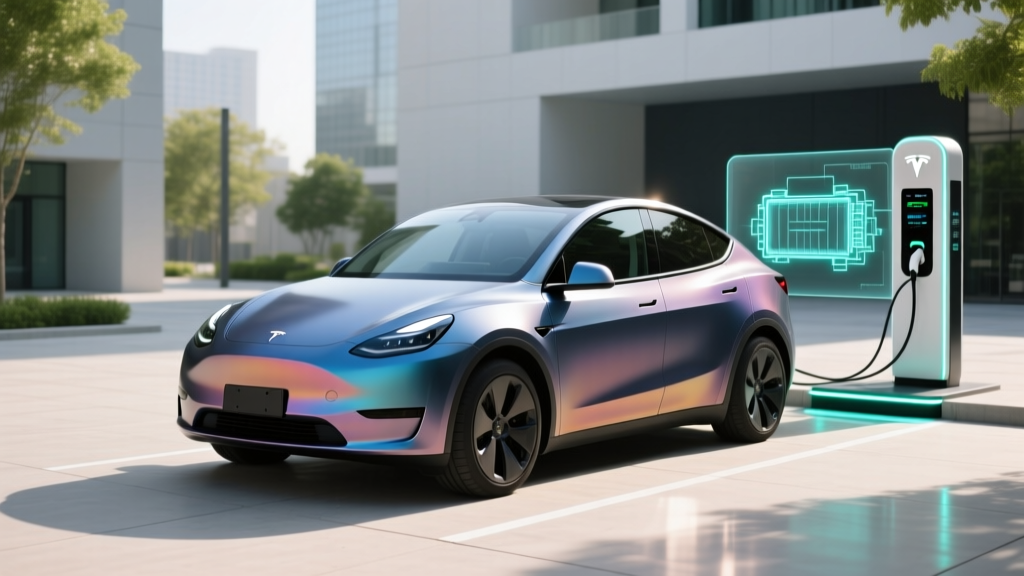
The Tesla Model Y remains the vehicle that defines the modern EV segment. While competitors have narrowed the gap, the 2026 Model Y continues to set the standard for efficiency, charging infrastructure access, and software integration. Whether the Tesla leadership team can maintain this position as legacy automakers scale their EV platforms is the central question for buyers in 2026.
Quick Verdict: The Segment Benchmark Still Holds
The 2026 Model Y Long Range AWD delivers 320 miles of EPA-estimated range, 250 kW peak DC fast charging, and a 0-60 mph time of 4.8 seconds starting at $44,990. It's the default choice for buyers who prioritize Supercharger network reliability and over-the-air updates, though interior material quality and ride comfort lag behind Hyundai's Ioniq 5 and Ford's Mustang Mach-E.
| Specification | 2026 Model Y Long Range AWD |
|---|---|
| EPA Range | 320 miles |
| Battery Capacity | 75 kWh usable (NMC chemistry) |
| Peak DC Fast Charge | 250 kW |
| 10-80% DC Fast Charge | ~20 minutes |
| Level 2 Home Charging | 11.5 kW (44 mi/hr) |
| 0-60 mph | 4.8 seconds |
| Horsepower | 384 hp (dual motor) |
| Drivetrain | AWD (dual motor) |
| Efficiency | 122 MPGe combined / 28 kWh/100mi |
| Cargo Volume | 30.2 cu ft (rear seats up) / 76.2 cu ft (folded) |
| Base MSRP | $44,990 |
| Battery Warranty | 8 years / 120,000 miles |
Real-World Range: What to Actually Expect
EPA Estimate: 320 miles
Real-World Expectation: 270-290 miles highway (70-75 mph), 240-260 miles in cold weather (below 40°F with cabin heating). City driving with regenerative braking can exceed 300 miles.
The Model Y's 75 kWh NMC (nickel manganese cobalt) battery pack prioritizes energy density over the LFP (lithium iron phosphate) chemistry found in the base RWD trim. NMC delivers better range per kilogram but shows slightly faster degradation over 8-10 years—typically 10-12% capacity loss versus 5-8% for LFP.
In mixed driving at 65-70 mph with moderate climate control, expect 280-295 miles before hitting 10% state of charge. Cold weather hits all EVs hard, but Tesla's heat pump and battery preconditioning minimize losses better than most competitors. Still, plan for 20-25% range reduction in sub-freezing conditions.
Charging Speed: Supercharger Advantage
| Charging Level | Power | Speed | Notes |
|---|---|---|---|
| Level 1 (120V) | 1.4 kW | 5 mi/hr | Emergency/trickle only |
| Level 2 (240V home) | 11.5 kW | 44 mi/hr | Full charge in ~7 hours |
| DC Fast (Tesla Supercharger V3) | 250 kW peak | 10-80% in 20 min | Sustains 200+ kW to 50% SoC |
| DC Fast (CCS adapter) | 150-175 kW typical | 10-80% in 28 min | Non-Tesla networks |
The Model Y's charging curve peaks at 250 kW up to 40% state of charge, then tapers to 150 kW by 60%, and drops below 100 kW past 80%. This is why Tesla recommends charging to 80% for daily use and 100% only for long trips.
Home charging requires a 60-amp circuit to achieve the full 11.5 kW (48 amps continuous). Most buyers install a Tesla Wall Connector ($475) or use the Mobile Connector with a NEMA 14-50 outlet ($200 for the adapter, $300-800 for electrician installation depending on panel proximity).
The Supercharger network remains Tesla's strongest competitive advantage. As of 2026, there are over 6,500 V3 Superchargers (250 kW) in the U.S., with plug-and-charge simplicity that Electrify America and EVgo still can't match for reliability. The CCS adapter ($250) opens access to other networks, but you'll encounter more offline chargers and payment friction.
Performance and Driving Dynamics
The dual-motor AWD system delivers 384 horsepower and 376 lb-ft of torque, propelling the Model Y to 60 mph in 4.8 seconds. The Performance trim (not reviewed here) drops that to 3.5 seconds with 456 hp.
Ride quality has improved with the 2025 refresh—softer suspension tuning and acoustic glass reduce harshness, though the Model Y still transmits more road imperfections than the Ioniq 5's compliant setup. Steering is precise but numb, and the one-pedal driving mode (max regen) is well-calibrated for urban traffic.
Towing capacity is 3,500 pounds with the optional tow hitch ($1,000), adequate for small trailers but not boats or campers. The Mach-E and Kia EV6 don't offer towing at all.
Interior, Tech, and Cargo
The minimalist interior centers on a 15.4-inch touchscreen controlling everything from climate to glovebox release. Build quality has improved (fewer panel gaps than 2022-2023 models), but materials still feel utilitarian—hard plastics on the door panels and dash compared to the Mach-E's softer touchpoints.
Cargo space is generous: 30.2 cubic feet behind the second row, 76.2 with seats folded. The rear trunk includes a deep under-floor storage well, and the front trunk (frunk) adds 4.1 cubic feet for charging cables or groceries.
Rear legroom measures 41.6 inches—adequate for adults on longer trips, though the sloping roofline cuts headroom for passengers over 6 feet. The panoramic glass roof creates an airy feel but increases solar heat gain in summer (Tesla includes a removable shade).
Notable tech features:
- Autopilot (Level 2 driver assist) standard—adaptive cruise, lane centering, auto emergency braking
- Full Self-Driving (Supervised) optional at $8,000—adds automatic lane changes, traffic light recognition, navigate on Autopilot. This is not autonomous driving; you must remain engaged.
- Over-the-air updates add features monthly (recent: improved battery preconditioning, new games, dashcam enhancements)
- Sentry Mode (360° camera recording when parked)
- Dog Mode (climate control for pets with external display message)
ADAS Limitation Warning: Tesla Autopilot and FSD (Supervised) are SAE Level 2 systems. The driver must keep hands on the wheel and eyes on the road. These systems do not make the vehicle self-driving and will not handle all scenarios (construction zones, faded lane markings, adverse weather). You are legally responsible for the vehicle at all times.
Pricing and Federal Tax Credit
| Trim | MSRP | Est. Price After §30D Credit |
|---|---|---|
| Long Range AWD | $44,990 | $37,490 (if eligible) |
| Performance AWD | $48,990 | $41,490 (if eligible) |
The Model Y qualifies for the full $7,500 federal tax credit under IRS §30D, but eligibility depends on three factors:
- Buyer income caps: Modified AGI ≤ $150,000 (single), $225,000 (head of household), $300,000 (joint)
- MSRP cap: Vehicle MSRP must be ≤ $80,000 (SUVs/vans)—Model Y qualifies
- Battery sourcing: As of 2026, 80% of critical minerals and 100% of battery components must be sourced from the U.S. or FTA partners. Tesla's U.S.-built battery packs meet this requirement.
The credit can be transferred to the dealer at point of sale (reducing your purchase price directly) or claimed on your tax return. Consult a tax professional to confirm eligibility—IRS rules are complex and subject to change.
Who Should Buy the Model Y?
Best for: Tech-forward commuters who drive 30-60 miles daily, have home charging access, and take 2-4 road trips per year. The Supercharger network makes long-distance travel stress-free, and the 320-mile range covers most round-trip commutes without daily charging.
Consider alternatives if: You prioritize ride comfort and interior luxury (Ioniq 5, Mach-E), need maximum cargo space for large families (Kia EV9), or live in an apartment without home charging (public charging is viable but adds time and cost).
Towing use case: The 3,500-lb capacity works for small utility trailers, but the Ford F-150 Lightning or Rivian R1T are better for serious towing needs.
Pros and Cons
Pros
- Supercharger network reliability (6,500+ V3 stalls)
- Class-leading efficiency (122 MPGe combined)
- Strong over-the-air update cadence
- Spacious cargo area (76.2 cu ft max)
- Full $7,500 tax credit eligibility
Cons
- Interior materials lag behind competitors
- Touchscreen-only controls frustrate some drivers
- FSD ($8,000) is expensive for Level 2 capability
- Ride quality still firm over rough pavement
- Service center wait times can exceed 2 weeks in some markets
Frequently Asked Questions
What is the real-world range of the 2026 Tesla Model Y?
Expect 270-290 miles highway, 240-260 miles in cold weather, and up to 310 miles in city driving with regenerative braking. The EPA rates it at 320 miles, but real-world conditions reduce that by 10-25%.
How fast does the Model Y charge at home and on the road?
Home Level 2 charging adds 44 miles per hour (11.5 kW), fully charging in ~7 hours. DC fast charging peaks at 250 kW, reaching 10-80% in 20 minutes at a Tesla Supercharger.
How much does the Model Y cost after the federal tax credit?
The Long Range AWD starts at $44,990. If you meet IRS §30D income and sourcing requirements, the $7,500 credit reduces the effective price to $37,490. Point-of-sale transfer is available.
Is the Model Y worth buying vs the Hyundai Ioniq 5 or Ford Mach-E?
Choose the Model Y for Supercharger access, efficiency, and software updates. Choose the Ioniq 5 for 800V ultra-fast charging (10-80% in 18 min) and a more comfortable ride. Choose the Mach-E for interior quality and BlueCruise hands-free driving on mapped highways.
Does the Model Y qualify for the $7,500 federal EV tax credit in 2026?
Yes, if your income is below the caps ($150k single / $300k joint) and the vehicle meets battery sourcing requirements (which U.S.-built Model Ys do). Verify at IRS.gov and consult a tax professional.
What are the biggest drawbacks of the Model Y?
Interior material quality, touchscreen-only controls, firm ride quality, and the $8,000 cost of FSD (which remains Level 2 driver assist, not autonomous driving). Service center capacity is also strained in some regions.
Sources: EPA Fuel Economy, Tesla Model Y Specifications, IRS Clean Vehicle Credits