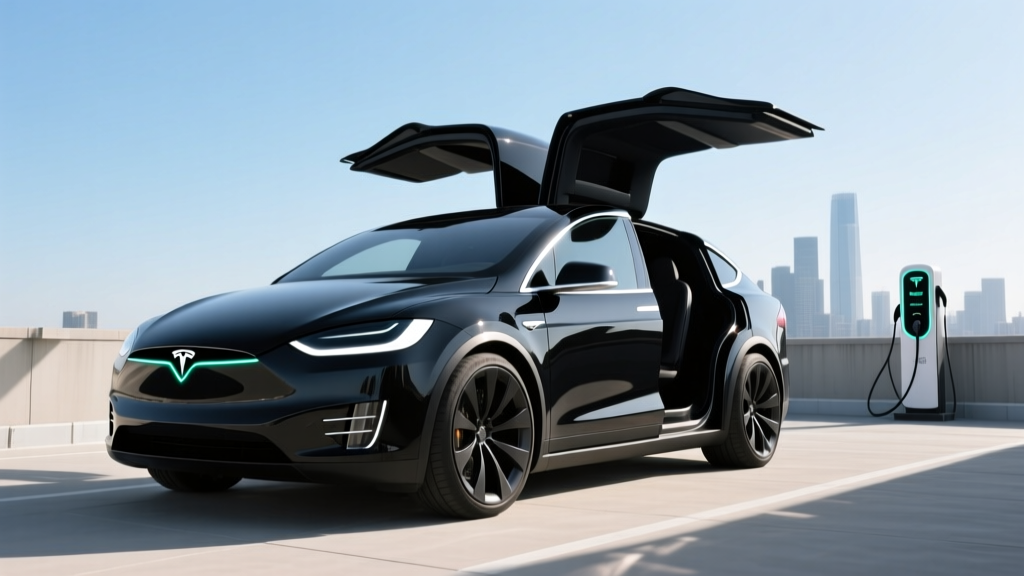
The Tesla Model X has always been the polarizing flagship of Tesla's lineup — a three-row electric SUV wrapped around one unmistakable feature: its rear falcon-wing doors. Often searched as the "Tesla wing door" SUV, the Model X uses a double-hinged gullwing-style rear door system that opens upward rather than outward, promising easier third-row access in tight parking spaces. For 2026, the Model X continues in Dual Motor and Plaid trims with minor software and efficiency updates. But does the signature door design justify its premium price in a market now crowded with three-row EVs like the Rivian R1S, Kia EV9, and Hyundai Ioniq 9?
This review covers the 2026 Tesla Model X from the perspective of someone who has loaded car seats through those wing doors, road-tripped across charging deserts, and tracked real-world energy consumption across seasons. We'll give you exact numbers — EPA range, sustained charging speeds, battery chemistry, and tax credit reality — so you can decide if the Model X earns its place in your garage.
Range, Efficiency, and Real-World Expectations
The 2026 Tesla Model X Long Range (Dual Motor AWD) carries an EPA-estimated range of 335 miles on its 100 kWh (usable ~95 kWh) battery pack. The Plaid variant drops to an EPA-estimated 311 miles due to its tri-motor performance tuning. Both use Tesla's NMC (nickel-manganese-cobalt) battery chemistry, which prioritizes energy density over the cycle-life longevity of LFP packs found in the Model 3 RWD.
| EPA Estimated Range | 335 miles |
| Real-World Highway (70-75 mph) | ~270–290 miles |
| Real-World City / Mixed | ~300–320 miles |
| Cold Weather (below 32°F, highway) | ~230–260 miles |
| EPA Efficiency | 101 MPGe combined / 33 kWh per 100 mi |
The Model X's boxy SUV shape and 5,185-lb curb weight hit efficiency hard at highway speeds. Plan for ~270 miles of usable range on a road trip before needing a charge stop. In freezing temperatures with cabin heat running, expect a further 15–25% reduction despite Tesla's heat pump.
Efficiency is the Model X's weakest spec-sheet number. At 33 kWh/100 miles combined, it trails the more aerodynamic Rivian R1S (31 kWh/100 mi) and significantly trails the Kia EV9 (~34 kWh/100 mi but in a smaller, lighter package). If you're counting cost per mile, the Model X's heavy energy consumption matters — at the national average electricity rate of $0.17/kWh, you're paying roughly $5.61 per 100 miles driven.
Charging Speed: DC Fast, Level 2, and the Supercharger Advantage
The 2026 Model X supports a peak DC fast-charge rate of 250 kW via its native NACS (North American Charging Standard) connector — the same Tesla-designed plug now adopted industry-wide. On a V3 Supercharger or comparable 250 kW CCS station (with adapter), Tesla claims a 10–80% charge in approximately 30 minutes.
| Charging Level | Power (kW) | Rate / Time |
|---|---|---|
| Level 1 (120V household) | ~1.4 kW | ~3–4 miles per hour |
| Level 2 (240V, 48A Wall Connector) | 11.5 kW | ~34 miles per hour |
| Level 2 (240V, 32A mobile connector) | 7.7 kW | ~23 miles per hour |
| DC Fast Charge (V3 Supercharger) | Peak 250 kW | 10–80% in ~30 min |
| DC Fast Charge (50 kW station) | 50 kW | 10–80% in ~90 min |
Real-world charging curve caveat: The Model X does not sustain 250 kW for the entire session. Peak speed is available only between roughly 10–30% State of Charge (SoC) when the battery is preconditioned. Above 50% SoC, the curve tapers to ~120 kW, and above 80% it drops below 50 kW. This is standard NMC chemistry behavior, but it means your actual average charging speed across a 10–80% session is closer to ~110–130 kW. Always use the vehicle's built-in navigation to precondition the battery before arriving at a Supercharger — skipping this step can add 10–15 minutes to your charge time in cold weather.
For home charging, the Tesla Wall Connector at 48 amps delivers 11.5 kW, adding roughly 34 miles of range per hour. A full overnight charge (10 hours) restores the entire battery. Installation typically requires a 60-amp dedicated circuit; consult a licensed electrician for a site-specific quote, as panel upgrades can add $1,500–$3,000 if your home has a 100-amp main panel.
Performance: Dual Motor vs. Plaid
The Model X is genuinely quick for a 5,185-lb three-row SUV. The Dual Motor Long Range produces 670 horsepower and hits 0–60 mph in 3.8 seconds (with rollout subtracted). The Plaid's tri-motor setup generates 1,020 horsepower and a staggering 0–60 of 2.5 seconds. Both come standard with AWD and adaptive air suspension.
| Spec | Long Range (Dual Motor) | Plaid (Tri-Motor) |
|---|---|---|
| Horsepower | 670 hp | 1,020 hp |
| 0–60 mph | 3.8 sec | 2.5 sec |
| Top Speed | 155 mph | 163 mph |
| Drivetrain | AWD (dual motor) | AWD (tri-motor) |
| Towing Capacity | 5,000 lbs | 5,000 lbs |
The 5,000-lb tow rating is competitive with the Rivian R1S but falls short of body-on-frame electric trucks. Towing any trailer above 3,000 lbs will cut range roughly in half — plan accordingly.
Falcon-Wing Doors: Practicality, Gimmick, or Genuinely Useful?
The "Tesla wing door" — officially called Falcon Wing doors — are the Model X's defining feature. These double-hinged rear doors articulate upward and outward, using ultrasonic sensors to detect overhead and lateral obstacles. Tesla claims they require as little as 11 inches of lateral clearance to open.
Where they excel:
- Loading child car seats into the second row without crouching through a conventional door opening
- Third-row access — you can stand nearly upright beside the seat
- Rainy-day loading — the doors create a partial overhead canopy
- Tight parking spaces where a swing-out door would ding the car next to you
Where they frustrate:
- Low-ceiling garages (under ~7 feet) limit opening height, reducing access
- The sensors occasionally misread snow, ice, or overhead branches, causing the door to open more cautiously than needed
- Opening/closing takes ~6–8 seconds — noticeably slower than a manual door
- Repair costs out of warranty are significant; the hinge and sensor assemblies are complex
- They add weight and reduce structural simplicity compared to conventional doors
After years of real-world use, the Falcon Wing doors are a genuine convenience for families with young children but a maintenance liability for long-term ownership beyond the warranty period. If you don't regularly load car seats or use the third row, the doors are a feature you'll stop noticing after the first month.
Interior, Cargo, and Technology
The Model X seats up to seven in a 2-3-2 configuration, or six with optional second-row captain's chairs. Interior materials have improved since the 2021 refresh, with vegan leather standard and real wood or carbon fiber trim available.
| Measurement | Value |
|---|---|
| Cargo (behind 3rd row) | 15.0 cu ft |
| Cargo (3rd row folded) | 42.5 cu ft |
| Cargo (all rear rows folded) | 85.1 cu ft |
| Front trunk (frunk) | 6.6 cu ft |
| 2nd-row legroom | 40.9 in |
| 3rd-row legroom | 32.7 in |
| Front headroom | 41.7 in |
The 32.7 inches of third-row legroom is tight for adults on long trips — the Rivian R1S and Kia EV9 both offer more usable third-row space. The frunk is small for the class; the Rivian R1S offers a significantly larger front trunk.
Tech highlights:
- 17-inch center touchscreen (tilting, 2200×1300 resolution) running Tesla's proprietary infotainment OS
- Second-row 8-inch touchscreen for rear passengers
- 22-speaker audio system with active noise cancellation
- HEPA air filtration with "Bioweapon Defense Mode"
- Tesla Autopilot standard; Full Self-Driving (Supervised) available as a $8,000 add-on or $99/month subscription
Tesla Autopilot and Full Self-Driving (Supervised) are SAE Level 2 systems. They provide steering, acceleration, and braking assistance but require the driver to remain fully attentive with hands on the wheel and eyes on the road at all times. They are not self-driving systems. Only Level 4 robotaxi services like Waymo operate without a human driver. Do not rely on FSD as a substitute for active driving.
Pricing, Tax Credit Eligibility, and Total Cost
The 2026 Model X starts at $79,990 for the Long Range Dual Motor (before destination). The Plaid starts at $94,990. Adding FSD, premium paint, 22-inch wheels, and six-seat configuration can push a Long Range build past $95,000.
| Trim | Base MSRP | Typical As-Tested |
|---|---|---|
| Long Range (Dual Motor AWD) | $79,990 | $85,000–$92,000 |
| Plaid (Tri-Motor AWD) | $94,990 | $100,000–$110,000 |
- MSRP Cap: SUVs must be under $80,000 MSRP. The Long Range base price ($79,990) qualifies, but adding options that push the MSRP above $80,000 disqualifies the vehicle.
- Income Cap: Buyer AGI must not exceed $150,000 (single), $225,000 (head of household), or $300,000 (joint filers).
- Battery Sourcing: Critical minerals and battery component requirements under §30D must be met — Tesla sources from multiple suppliers, but specific eligibility varies by production batch. Verify at fueleconomy.gov before purchase.
- Point-of-Sale Transfer: As of 2024, the credit can be transferred to the dealer at purchase for an immediate price reduction, provided all eligibility criteria are met.
- Maximum Credit: Up to $7,500 if both critical-mineral and battery-component requirements are satisfied; $3,750 if only one is met.
The Plaid trim at $94,990 MSRP exceeds the $80,000 SUV cap and does not qualify for the federal credit. Always confirm current eligibility on IRS.gov or with a tax professional before relying on credit estimates.
Pros, Cons, and Who Should Buy the Model X
- Falcon-wing doors genuinely ease car-seat and third-row loading
- Access to Tesla's Supercharger network (17,000+ stalls in North America)
- Class-leading acceleration, especially in Plaid trim
- Over-the-air updates continuously add features
- Strong EPA range (335 mi) for a three-row SUV
- HEPA cabin air filtration
- Third-row legroom is tight for adults (32.7 in)
- Falcon-wing doors are slow, complex, and expensive out of warranty
- Plaid trim disqualified from federal tax credit
- Highway efficiency lags competitors (33 kWh/100 mi)
- Price premium vs. Kia EV9, Hyundai Ioniq 9
- Panel gaps and build-quality inconsistency persist
Who the Model X suits best: Families with young children who need frequent third-row and car-seat access, value the Supercharger network for road trips, and want sports-car acceleration in a three-row package. It's less ideal for buyers who prioritize maximum interior space per dollar, plan to keep the vehicle well beyond its warranty, or need a usable third row for adults.
Warranty and Long-Term Battery Outlook
Tesla covers the 2026 Model X with:
- Basic Vehicle: 4 years / 50,000 miles
- Battery & Drive Unit: 8 years / 150,000 miles (whichever comes first), with a minimum 70% capacity retention guarantee
The 150,000-mile battery warranty is generous by industry standards (most competitors offer 8 years / 100,000 miles). Tesla's NMC packs historically show ~10–12% degradation over 100,000 miles based on fleet data, though individual results vary with charging habits. To maximize battery longevity, Tesla recommends daily charging to 80–90% and reserving 100% charges for trips. A full battery replacement out of warranty is estimated at $15,000–$22,000 depending on the pack and labor.
Frequently Asked Questions
What is the real-world range of the 2026 Tesla Model X?
The EPA rates the Model X Long Range at 335 miles. In real-world highway driving at 70–75 mph, expect 270–290 miles. In cold weather (below freezing) with highway speeds, plan for 230–260 miles before needing a charge.
How fast does the Model X charge at home and on the road?
At home on a 48-amp Level 2 Tesla Wall Connector (11.5 kW), you gain ~34 miles per hour, enough for a full overnight charge. On a 250 kW DC fast charger, 10–80% takes ~30 minutes with battery preconditioning, though sustained average speed is closer to 110–130 kW due to charge-curve tapering.
Does the 2026 Model X qualify for the $7,500 federal EV tax credit?
The Long Range base MSRP ($79,990) falls under the $80,000 SUV cap and may qualify for up to $7,500, depending on buyer income limits, battery sourcing compliance, and final configured MSRP. The Plaid ($94,990 MSRP) exceeds the cap and is ineligible. Always verify on IRS.gov before purchase.
Are Tesla's falcon-wing doors reliable long-term?
Within the 4-year/50,000-mile warranty, door issues are covered. Out of warranty, the complex hinge motors, sensors, and seals can cost $1,500–$3,000+ per door to repair. Historical owner reports cite occasional sensor errors in rain, snow, and low-clearance garages.
Is the Model X worth buying vs. the Rivian R1S or Kia EV9?
Choose the Model X if you prioritize Supercharger network access, acceleration, and falcon-wing door convenience. Choose the Rivian R1S for superior off-road capability, more third-row space, and a larger frunk. Choose the Kia EV9 for lower pricing (~$55,000–$75,000), better third-row comfort, and more conventional reliability, though with slower DC charging (~236 kW peak, CCS).
What is the biggest drawback of the Tesla Model X?
The combination of high price, tight third row, and the falcon-wing doors' mechanical complexity. If the doors offered no real benefit for your use case, you're paying a premium for a feature that adds weight, cost, and potential repair bills.
Sources: fueleconomy.gov — 2026 Tesla Model X, Tesla Model X Owner's Manual, IRS §30D Clean Vehicle Credit.