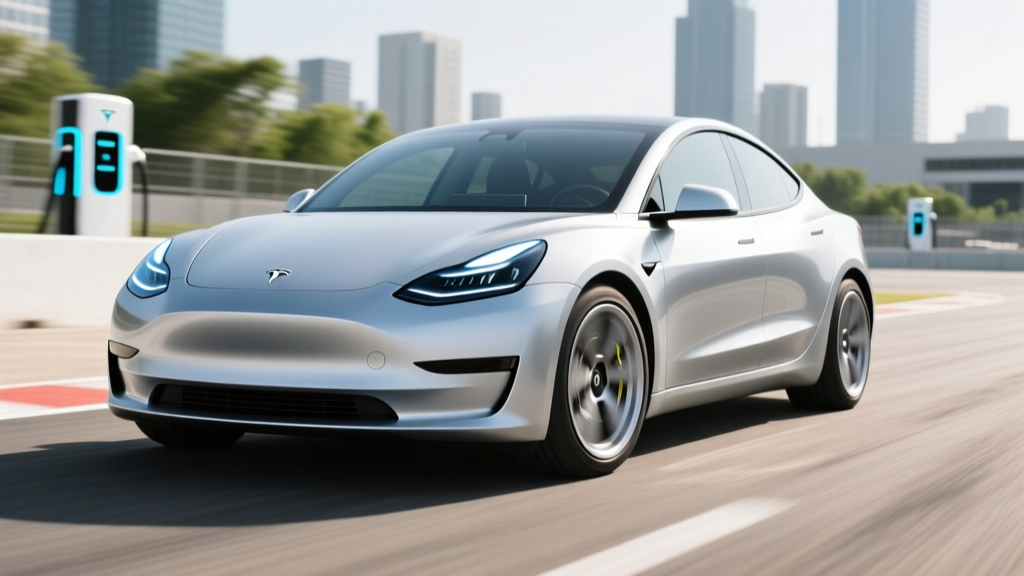
The Tesla Model 3 remains one of the most-searched electric sedans on the market, and for good reason: it delivers competitive range, rapid DC charging, and access to the Supercharger network at a price point that undercuts most luxury EV rivals. But buyers searching for Tesla Model 3 wheel specs and full vehicle details often find scattered information across trim levels. This review consolidates the 2026 Model 3 lineup — RWD, Long Range AWD, and Performance — with exact EPA range figures, charging curves, battery chemistry, and real-world ownership data.
Tesla Model 3 Wheel Specs, Tires & Chassis Hardware
Before diving into range and powertrain details, let's address the hardware that connects the Model 3 to the road. Wheel and tire specifications vary significantly by trim and directly affect efficiency, ride comfort, and real-world range.
| Specification | RWD (Base) | Long Range AWD | Performance |
|---|---|---|---|
| Standard Wheel Size | 18" Photon | 18" Photon | 19" Nova |
| Optional Wheel Size | 19" Nova (+$1,500) | 19" Nova (+$1,500) | 20" Curvature (included w/ Track Pack) |
| Tire Size (Standard) | 235/45R18 | 235/45R18 | 235/40R19 |
| Tire Size (Optional) | 235/40R19 | 235/40R19 | 235/35R20 front / 265/30R20 rear |
| Bolt Pattern | 5×114.3 mm | 5×114.3 mm | 5×114.3 mm |
| Center Bore | 64.1 mm | 64.1 mm | 64.1 mm |
| Wheel Material | Alloy | Alloy | Alloy (forged 20" opt.) |
| Curb Weight (approx.) | 3,862 lbs | 4,034 lbs | 4,065 lbs |
Why wheel size matters for range: The 18" Photon wheels with all-season tires are the efficiency play. Upgrading to 19" Nova wheels on the RWD or Long Range typically costs 15–25 miles of EPA-rated range due to increased rolling resistance, wider contact patch, and added unsprung weight. The Performance model's staggered 20" setup prioritizes grip over efficiency — expect roughly 290–305 real-world highway miles versus the Long Range's potential 320+ miles on 18s.
Range, Battery & Real-World Efficiency
The 2026 Model 3 continues with two distinct battery chemistries depending on trim, which affects charging behavior, longevity, and daily use recommendations.
| Trim | EPA Range | Real-World Highway (70 mph) | Cold Weather (20°F) |
| RWD | 272 mi | ~230–245 mi | ~190–215 mi |
| Long Range AWD | 363 mi | ~310–330 mi | ~250–280 mi |
| Performance | 315 mi | ~270–290 mi | ~220–250 mi |
Cold-weather estimates assume no preconditioning and cabin heating active. Preconditioning the battery while plugged in recovers ~10–15% of cold-weather loss. Source: EPA fueleconomy.gov
| Spec | RWD | Long Range AWD | Performance |
|---|---|---|---|
| Battery Chemistry | LFP (Lithium Iron Phosphate) | NMC (Nickel Manganese Cobalt) | NMC |
| Battery Capacity (usable) | ~57.5 kWh | ~75 kWh | ~75 kWh |
| EPA MPGe (city/hwy/combined) | 140/123/132 | 134/120/127 | 119/108/114 |
| Energy Consumption | 25 kWh/100 mi | 26 kWh/100 mi | 29 kWh/100 mi |
| Recommended Daily Charge Limit | 100% (LFP) | 80% (NMC) | 80% (NMC) |
LFP vs. NMC — what it means for you: The RWD model's LFP battery is heavier and less energy-dense but offers superior cycle life and can (and should) be charged to 100% regularly, which helps with battery calibration. NMC packs in the Long Range and Performance trims offer more range per kilogram but degrade faster if habitually held at 100% — Tesla recommends daily charging to 80% and only charging to full for road trips.
Charging Speed: DC Fast, Level 2 & Home Setup
Charging speed is where the refreshed Model 3 (Highland platform) made meaningful gains over its predecessor. Here's what you can expect at each charging level:
| Charging Level | RWD (LFP) | Long Range / Performance (NMC) |
|---|---|---|
| Max DC Fast Charge Rate | 170 kW peak | 250 kW peak |
| 10–80% DC Fast Charge Time | ~28 minutes | ~25 minutes (Long Range) / ~27 min (Perf.) |
| Sustained DC Rate (10–60%) | ~120–150 kW | ~170–230 kW |
| Level 2 (240V / 48A Wall Connector) | 11.5 kW / ~44 mi/hr | 11.5 kW / ~44 mi/hr |
| Level 2 (240V / 32A mobile connector) | 7.7 kW / ~30 mi/hr | 7.7 kW / ~30 mi/hr |
| Level 1 (120V household) | ~1.4 kW / ~5 mi/hr | ~1.4 kW / ~5 mi/hr |
| Charging Port | NACS (native) | NACS (native) |
Charging curve reality: The 250 kW peak on Long Range and Performance models is only sustained briefly between roughly 10–30% State of Charge (SoC). By 50%, the rate tapers to ~150 kW, and above 80% it drops sharply to under 50 kW. This is normal lithium-ion behavior to protect cell health. Plan your road-trip stops around 10–80% charges for optimal time efficiency — a full 0–100% session will take nearly twice as long as 10–80%.
Home charging cost: A Tesla Wall Connector installed on a 60-amp circuit (48A continuous) delivers the fastest home charging. Expect installation costs of $800–$2,000 depending on panel proximity and whether your home needs a service upgrade. At the national average electricity rate of $0.17/kWh, fully charging a Long Range Model 3 from empty costs roughly $12.75 — compared to $45–$55 to fill a comparable gas sedan.
Performance, Drivetrain & Driving Dynamics
| Spec | RWD | Long Range AWD | Performance |
|---|---|---|---|
| Drivetrain | Rear-Wheel Drive | Dual-Motor AWD | Dual-Motor AWD |
| Horsepower | 271 hp | 346 hp | 510 hp |
| Torque | 317 lb-ft | 389 lb-ft | 546 lb-ft |
| 0–60 mph | 5.8 sec | 4.2 sec | 2.9 sec |
| Top Speed | 125 mph | 125 mph | 163 mph |
| Suspension | Adaptive (Highland refresh) | Adaptive (Highland refresh) | Adaptive w/ Track Mode |
The Highland platform refresh brought a substantially improved suspension tune across all trims. The frequency-selective dampers absorb highway expansion joints and broken pavement far better than the pre-2024 Model 3. The Performance model adds Track Mode with adjustable torque distribution, stability control intervention levels, and regenerative braking intensity. Even the base RWD model's 5.8-second 0–60 time outpaces most gas-powered compact sport sedans.
Interior, Cargo & Technology
Passenger space: The Model 3's cabin fits four adults comfortably (five in a pinch). Front legroom measures 42.7 inches, rear legroom 35.2 inches. Headroom is adequate at 40.3" front / 37.8" rear, though the sloping roofline limits taller rear passengers.
Cargo volume: 23.0 cubic feet combined (trunk + frunk). The trunk offers 19.8 cu ft with a wide hatch opening, and the front trunk (frunk) adds 3.1 cu ft — useful for charging cables and small bags. The 60/40 split rear seats fold nearly flat for longer items.
Infotainment & tech: All controls route through the 15.4" center touchscreen running Tesla's proprietary OS. There is no Apple CarPlay or Android Auto — Tesla's native navigation, Spotify, Netflix (parked), and gaming suite are the only options. The Highland refresh added ambient lighting, ventilated front seats, rear-seat touchscreen (8" for climate and media), power-folding mirrors, and significantly improved cabin insulation.
Driver assistance: Basic Autopilot (traffic-aware cruise + lane centering) is standard. Enhanced Autopilot ($6,000) adds auto lane change, Navigate on Autopilot, and Smart Summon. Full Self-Driving (Supervised) at $8,000 adds traffic light/stop sign recognition and city street navigation. All are SAE Level 2 systems — the driver must remain attentive and hands-on at all times. These are not autonomous driving systems.
Pricing, Trims & Federal Tax Credit Eligibility
| Trim | Base MSRP | Destination | Est. §30D Credit | Effective Price |
|---|---|---|---|---|
| RWD | $38,990 | $1,390 | Up to $7,500* | ~$32,880 |
| Long Range AWD | $45,740 | $1,390 | Up to $7,500* | ~$39,630 |
| Performance | $52,990 | $1,390 | Up to $7,500* | ~$46,880 |
*Federal tax credit eligibility under IRS §30D depends on multiple requirements. Credit may be applied at point of sale as a down-payment reduction. Rules subject to change — verify current eligibility with a tax professional.
- MSRP cap: Sedans must be ≤ $55,000 — RWD and Long Range qualify; Performance at $52,990 + destination clears the cap
- Buyer income cap: AGI ≤ $150,000 (single) / $225,000 (head of household) / $300,000 (joint)
- Battery sourcing: Critical minerals and battery component requirements phase in annually — check fueleconomy.gov for current eligible VINs
- Assembly: Must be assembled in North America (Model 3 is built in Fremont, CA and Austin, TX — qualifies)
- Point-of-sale transfer: You can transfer the credit to Tesla at purchase to reduce your down payment, even if you owe less than $7,500 in federal taxes
Warranty & Long-Term Ownership
| Coverage | Terms |
|---|---|
| Basic Vehicle | 4 years / 50,000 miles |
| Battery & Drive Unit (RWD) | 8 years / 100,000 miles |
| Battery & Drive Unit (LR/Perf) | 8 years / 120,000 miles |
| Battery Capacity Retention | ≥ 70% during warranty period |
Tesla's battery warranty guarantees that the pack will retain at least 70% of its original capacity during the coverage period. Real-world degradation data from fleet monitoring suggests Model 3 NMC batteries retain approximately 88–92% capacity at 100,000 miles under normal use patterns. LFP batteries in the RWD model show even slower degradation curves, partly due to the chemistry's inherent stability and the practice of regular 100% charges that keep the BMS calibrated.
Pros, Cons & Who Should Buy the Model 3
✅ Pros
- Class-leading DC charging speed (250 kW on LR/Perf)
- Supercharger network — most reliable public charging in the US
- Best-in-class energy efficiency (25–29 kWh/100 mi)
- Highland refresh fixed ride quality complaints
- Over-the-air updates continuously add features
- LFP battery on RWD offers excellent longevity
- Strong resale value relative to EV segment
❌ Cons
- No Apple CarPlay or Android Auto
- Minimalist interior lacks physical controls (turn signal stalks removed)
- Rear visibility compromised by sloping roofline
- Insurance premiums 15–30% above segment average
- Turn signals via steering-wheel buttons take adaptation
- No heads-up display
- Service center availability varies by region
🎯 Who the Model 3 Suits Best
- Daily commuters (20–80 mi round trip): RWD at $38,990 covers this easily with home charging. LFP battery loves daily 100% charges.
- Road-trip enthusiasts: Long Range AWD's 363-mile EPA range and 25-minute 10–80% Supercharger stops make cross-country travel practical.
- Tech-forward buyers: If you prefer Tesla's software ecosystem and don't need CarPlay, the Model 3's integration is unmatched.
- NOT ideal for: Families needing rear-facing car seats (tight rear cabin), buyers who want Apple CarPlay, or those in areas without Tesla Service Centers.
Frequently Asked Questions
What is the real-world range of the Tesla Model 3?
The EPA rates the Long Range AWD at 363 miles, but expect 310–330 miles at highway speeds (70 mph) in moderate temperatures. In cold weather (below 30°F), range drops to roughly 250–280 miles without preconditioning. The RWD model's 272 EPA miles translates to about 230–245 highway miles in practice.
How fast does the Model 3 charge at home and on the road?
On a Tesla Wall Connector (48A/11.5 kW), you'll add about 44 miles of range per hour — enough to fully replenish overnight. On DC fast chargers, the Long Range peaks at 250 kW and charges 10–80% in approximately 25 minutes. The RWD peaks at 170 kW, taking about 28 minutes for the same 10–80% session.
Does the Tesla Model 3 qualify for the federal EV tax credit?
All three trims fall under the $55,000 MSRP sedan cap and are assembled in the US. However, eligibility depends on your income (≤ $150K single / $300K joint), battery sourcing compliance for the specific build week, and current IRS rules. The credit can be transferred at point of sale. Always verify with the IRS §30D guidance before purchasing.
Is the Model 3 worth buying vs. competitors like the Hyundai Ioniq 6 or BMW i4?
The Model 3 Long Range offers more range (363 vs. Ioniq 6's 361 mi) and significantly faster charging (250 kW vs. Ioniq 6's ~235 kW peak) at a comparable price. The BMW i4 starts higher (~$52,200) with less range but offers a more traditional luxury interior and CarPlay. The Model 3's Supercharger network access remains a major practical advantage, though competitors now have NACS adapters expanding their options.
What wheel size should I choose for maximum range?
Stick with the standard 18" Photon wheels. The 19" Nova upgrade costs $1,500 and reduces EPA range by roughly 15–25 miles due to wider tires and increased weight. For the Performance model, the 19" wheels are standard — the optional 20" Curvature wheels further reduce range but improve cornering grip and aesthetics.
How long will the Model 3 battery last?
Tesla warranties the battery for 8 years / 100,000 miles (RWD) or 120,000 miles (LR/Performance) with a minimum 70% capacity retention guarantee. Fleet data suggests most NMC packs retain 88–92% at 100K miles. LFP packs in the RWD show even slower degradation. A full battery replacement outside warranty currently runs $12,000–$16,000 depending on the pack.