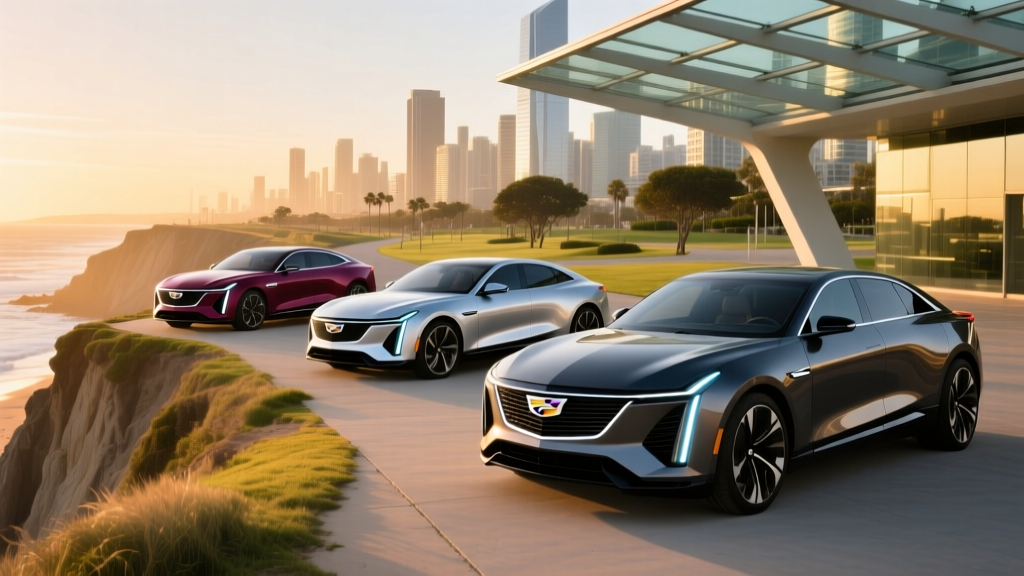
Quick Answer: Cadillac offers three battery-electric SUVs for 2026. The Lyriq (midsize, 2-row, ~314 mi EPA, from ~$58,590) suits most buyers. The Optiq (compact, 2-row, ~300 mi EPA est., from ~$53,000 est.) targets urban professionals. The Vistiq (large, 3-row, ~300 mi EPA est., from ~$75,000 est.) fills the family-hauler role. All ride on GM's Ultium platform with NMC chemistry, 11.5 kW Level 2 onboard charging, and DC fast-charge capability up to 190 kW (Lyriq). Federal §30D tax credit eligibility varies by trim, battery sourcing, and buyer income — verify on IRS.gov before purchase.
The 2026 Electric Cadillac Lineup at a Glance
Cadillac's electrification strategy centers on the Ultium battery architecture shared across GM brands. For 2026, the brand fields three distinct BEVs, each targeting a different buyer profile. The Lyriq entered production in 2023 and receives incremental updates for 2026, including refined battery management software and expanded Advanced Super Cruise availability. The Optiq, announced for late 2024 delivery and now in its second model year, slots below the Lyriq in both size and price. The Vistiq, Cadillac's first electric three-row SUV, targets the large-premium segment dominated historically by the Escalade.
All three use lithium-ion NMC (nickel manganese cobalt) battery packs manufactured at GM's Ultium Cells joint-venture plants. None currently use LFP chemistry, which means buyers should plan to keep state of charge between 20-80% for daily driving to maximize long-term battery health — a departure from LFP packs that tolerate regular 100% charges.
| Spec | Lyriq | Optiq (Est.) | Vistiq (Est.) |
|---|---|---|---|
| Segment | Midsize 2-row SUV | Compact 2-row SUV | Large 3-row SUV |
| Battery (usable) | 102 kWh NMC | ~85 kWh NMC | ~106 kWh NMC |
| EPA Range | 314 mi (RWD) | ~300 mi | ~300 mi |
| Drivetrain | RWD / AWD | AWD | AWD |
| Horsepower | 340 (RWD) / 500 (AWD) | ~300 | ~450 |
| 0-60 mph | 6.0s (RWD) / 4.6s (AWD) | ~5.5s | ~4.5s |
| Max DC Fast Charge | 190 kW | ~150 kW | ~190 kW |
| 10-80% DC Time | ~33 min | ~35 min | ~37 min |
| Level 2 Onboard | 11.5 kW | 11.5 kW | 11.5 kW |
| Base MSRP | $58,590 | ~$53,000 | ~$75,000 |
| Battery Warranty | 8 yr / 100,000 mi | 8 yr / 100,000 mi | 8 yr / 100,000 mi |
Sources: EPA fueleconomy.gov, Cadillac official specifications. Estimated figures for Optiq and Vistiq based on manufacturer announcements; final EPA certification may vary.
Range, Charging, and Real-World Expectations
The Lyriq's 314-mile EPA rating (RWD, 20-inch wheels) is competitive with rivals like the BMW iX and Genesis Electrified GV70. However, EPA stickers represent idealized mixed driving. On a sustained 75 mph highway run in 70°F weather, expect roughly 265-280 miles from a full charge. Drop ambient temperatures to 30°F and that figure falls to approximately 230-250 miles, as the battery management system draws energy for thermal conditioning and cabin heating.
Real-World Range Reality — Lyriq RWD:
EPA Sticker: 314 miles
Highway (75 mph, 70°F): ~265-280 miles
Highway (75 mph, 30°F): ~230-250 miles
City/commute mixed: ~290-310 miles
The AWD Lyriq sacrifices roughly 15-20 miles of EPA range for the dual-motor setup, landing at approximately 307 miles EPA. The larger Vistiq, despite a bigger battery, is heavier and less aerodynamic, so its estimated ~300-mile rating is realistic for a vehicle of its mass.
Charging Speeds and the Curve Reality
The Lyriq peaks at 190 kW on a DC fast charger, but that peak is only sustained between roughly 10-40% state of charge. Above 50%, the charge curve tapers significantly — by 80%, the vehicle is accepting closer to 60-80 kW. This means the 10-80% time of approximately 33 minutes is realistic, but a 10-95% session will take closer to 55-60 minutes. For road-trip planning, plan to charge to 80% and move on; the time cost of pushing past 80% is rarely worth the extra range gained.
At home on a Level 2 charger (240V, 48-amp circuit), the 11.5 kW onboard charger replenishes the Lyriq's 102 kWh pack from empty to full in roughly 9.5 hours. A typical overnight session from 30% to 80% takes about 4.5 hours — more than adequate for daily use.
2026 Electric Cadillac vs. Gas Equivalents: Cost Comparison
The purchase decision for a 2026 electric Cadillac often comes down to total cost of ownership versus a gasoline alternative. Below, we compare the Lyriq AWD ($62,590 MSRP) against the Cadillac XT5 AWD (gas, ~$49,000 MSRP) over a 5-year, 75,000-mile ownership period.
| Cost Category | Lyriq AWD (EV) | XT5 AWD (Gas) |
|---|---|---|
| Base MSRP | $62,590 | $49,000 |
| Est. Federal Tax Credit (§30D) | $0-$7,500* | $0 |
| Effective Purchase Price | $55,090-$62,590 | $49,000 |
| Fuel/Energy (75k mi) | $2,100 (home charging) | $8,400 (22 MPG, $3.50/gal) |
| Maintenance (5 yr) | ~$1,200 | ~$3,800 |
| Insurance (5 yr avg.) | ~$11,500 | ~$9,200 |
| Est. Depreciation | ~$28,000 | ~$22,000 |
| 5-Year Total Cost | ~$97,890-$105,390 | ~$92,400 |
*§30D credit eligibility depends on battery critical-mineral sourcing, buyer AGI limits ($150k single / $300k MFJ), and MSRP caps ($80k for SUVs). Confirm at IRS.gov. Home charging cost assumes $0.14/kWh national average; actual varies by utility. Insurance premiums for EVs run 15-25% higher on average.
The Lyriq's energy cost advantage is substantial — roughly $6,300 in fuel savings over five years when charging primarily at home. Maintenance savings add another $2,600 (no oil changes, fewer brake replacements due to regenerative braking, no transmission fluid). However, higher insurance premiums and steeper projected depreciation partially offset these gains. The break-even point versus the XT5 typically arrives around year 6-7, assuming the buyer qualifies for at least a partial §30D credit and charges predominantly at home.
Federal Tax Credit Eligibility for 2026
The §30D Clean Vehicle Credit remains the most significant purchase incentive, but eligibility is far from automatic. For 2026, the following rules apply:
- MSRP Cap: SUVs must not exceed $80,000 MSRP (all three Cadillac EVs qualify at base, but loaded Vistiq trims may exceed the cap).
- Buyer Income Cap: Adjusted gross income must not exceed $150,000 (single), $225,000 (head of household), or $300,000 (married filing jointly).
- Battery Sourcing: Up to $3,750 requires critical minerals from US or FTA-partner countries; up to $3,750 requires battery components manufactured in North America. The full $7,500 requires both.
- Point-of-Sale Transfer: Buyers can transfer the credit to the dealer at purchase, reducing the sale price directly — no need to wait for tax filing.
- Final Assembly: Vehicle must undergo final assembly in North America (all Cadillac Ultium vehicles are assembled in Spring Hill, TN or Orion Township, MI).
GM has been progressively improving battery-sourcing compliance, but the exact credit amount for each Cadillac model and trim can shift as supply chains evolve. Always verify the current eligibility status on the IRS clean vehicle credit page or through the dealer's point-of-sale transfer paperwork before signing.
Home Charging: What First-Time Buyers Must Know
Charging at home is the cornerstone of convenient EV ownership, and it requires planning before your Cadillac arrives.
Level 2 Installation Realities
Every 2026 electric Cadillac supports 11.5 kW Level 2 charging, which requires a 240-volt circuit on a 60-amp breaker (the charger draws a continuous 48 amps). Here is what installation typically costs:
| Component | Low Estimate | High Estimate |
|---|---|---|
| Level 2 EVSE (hardwired, 48A) | $500 | $800 |
| Electrician labor (240V run) | $600 | $2,000 |
| Panel upgrade (if needed, 200A) | $0 | $3,500 |
| Permits & inspection | $100 | $400 |
| Total | $1,200 | $6,700 |
Most homes with a 200-amp electrical panel and a garage within 50 feet of the panel fall in the $1,200-$2,500 range. Homes requiring a panel upgrade or long conduit runs will be at the higher end. Always hire a licensed electrician and pull permits — unpermitted work can void home insurance and cause issues at sale.
Common EV Misconceptions — Fact-Checked
| Myth | Fact |
|---|---|
| "I need to charge to 100% every night" | NMC batteries last longest when kept between 20-80% SoC for daily use. Only charge to 100% before a road trip. |
| "The battery will need a $20,000 replacement in 5 years" | GM warrants the Ultium pack for 8 years/100,000 miles against degradation below 60% capacity. Real-world data shows most packs lose 8-12% over 100k miles. |
| "Public charging is always unreliable" | Tesla Supercharger reliability averages 99%+ uptime. Electrify America and EVgo have improved significantly; plan routes using A Better Routeplanner and have a backup charger identified. |
| "EVs don't work in cold climates" | Cold reduces range 15-30%, but preconditioning while plugged in mitigates this. Owners in Minnesota and Norway drive EVs year-round successfully. |
| "I can't take a road trip" | The Lyriq's 190 kW DC charging and 314-mi range means stops every ~250 miles, adding ~25 minutes of charging. A 600-mile trip takes roughly 10.5 hours vs. 9.5 hours in a gas car. |
Advanced Super Cruise: What It Is and Isn't
Cadillac's Advanced Super Cruise is available on all three 2026 electric models and represents one of the most capable hands-free driver-assistance systems on the market. It operates on over 750,000 miles of pre-mapped divided highways in the US and Canada, using LiDAR map data, cameras, radar, and a driver-attention monitoring camera on the steering column.
SAE Automation Level: Level 2
Advanced Super Cruise is a driver-assistance system, not self-driving. Despite hands-free operation, the driver must remain alert, monitor the road, and be prepared to take over at any moment. The system will slow and stop the vehicle if the driver fails to respond to attention prompts. This is fundamentally different from Level 4 robotaxi services like Waymo, which operate without any human driver in geofenced areas.
The system excels on long highway stretches, reducing fatigue significantly. However, it disengages at complex interchanges, construction zones, and unmapped roads. It does not handle city streets, stoplights, or roundabouts autonomously. Think of it as an excellent highway co-pilot, not a replacement driver.
Decision Framework: Which 2026 Electric Cadillac Is Right for You?
Choose the Lyriq if:
- You want a proven, well-reviewed midsize luxury EV with verified 314-mile range
- Your budget is $58,000-$72,000 and you want maximum §30D credit eligibility headroom
- You take regular road trips and value the 190 kW DC fast-charging capability
- You don't need a third row
Choose the Optiq if:
- You primarily drive in urban/suburban settings and prefer a smaller footprint
- You want the Cadillac EV experience at the lowest entry price (~$53,000)
- AWD is mandatory for your climate
- You don't regularly carry more than 4 passengers or large cargo
Choose the Vistiq if:
- You need three rows and currently drive an XT6 or Escalade
- You want to electrify a family-hauler role without dropping to a minivan
- Your budget allows $75,000+ (watch the §30D $80k MSRP cap on loaded trims)
- You accept slightly lower efficiency (~300 mi from a larger, heavier pack)
Consider a PHEV or gas vehicle instead if:
- You lack access to home or workplace Level 2 charging
- You regularly tow more than 3,500 lbs (EV range drops dramatically under tow load)
- You frequently drive 400+ mile routes through charging-desert regions
- Your budget cannot absorb the upfront premium, even after incentives
Frequently Asked Questions
Does the 2026 electric Cadillac qualify for the full $7,500 federal tax credit?
It depends on the specific model, trim, your income, and current battery-sourcing compliance. GM's Ultium vehicles are assembled in the US, satisfying the final-assembly requirement. However, the critical-minerals and battery-component requirements shift as supply chains evolve. Some trims may qualify for the full $7,500, others for $3,750, and high-MSRP Vistiq configurations may exceed the $80,000 SUV cap entirely. Check the IRS clean vehicle credit page and confirm with your dealer before purchase.
How long does the Ultium battery last, and what does replacement cost?
GM warranties the Ultium battery for 8 years or 100,000 miles against capacity loss below 60% of original. Industry data from similar NMC packs suggests 8-12% degradation over 100,000 miles under normal use. Full pack replacement, if needed out of warranty, is estimated at $12,000-$18,000 depending on the model, though individual module replacement may be possible at lower cost. Most owners will never need a replacement during typical ownership.
Can I use Tesla Superchargers with a 2026 Cadillac?
Yes. GM adopted the NACS (North American Charging Standard) connector for its EVs beginning with the 2025 model year. The 2026 Lyriq, Optiq, and Vistiq come equipped with native NACS charge ports, granting direct access to Tesla's Supercharger network — over 25,000 stalls in North America — without an adapter. This is a significant advantage for road-trip charging reliability.
What happens if I can only charge on a standard 120V outlet?
Level 1 charging (120V, 12-amp) delivers approximately 1.4 kW, adding roughly 3-4 miles of range per hour. A full charge of the Lyriq's 102 kWh pack would take over 70 hours. Level 1 is viable only as a supplement for low-mileage drivers (under 30 miles/day) or as an emergency top-up. For practical daily ownership, a Level 2 home installation is strongly recommended.
Is the 2026 electric Cadillac good in snow and cold weather?
All three models offer AWD (standard on Optiq and Vistiq, optional on Lyriq), providing confident winter traction. Cold weather reduces range by 15-30% due to battery thermal management demands and cabin heating. The Ultium platform includes a heat pump on select trims, which improves cold-weather efficiency compared to resistive heating. Preconditioning the battery and cabin while plugged in — using scheduled departure charging — recovers much of the lost range. Owners in northern US states report satisfactory winter performance with adjusted range expectations.
How does insurance cost compare to a gas Cadillac?
EV insurance premiums run 15-25% higher than comparable gas vehicles, driven by higher repair costs (specialized body shop training, battery protection protocols) and higher replacement values. For the Lyriq, expect annual premiums of approximately $2,100-$2,600 depending on your state, driving record, and coverage level, versus $1,700-$2,100 for a gas XT5. Shop quotes from multiple insurers — some now offer specific EV discounts.
Specifications and pricing reflect 2026 model year information available at time of publication. Tax credit rules are subject to change. Always verify with Cadillac.com, the EPA, and the IRS before making a purchase decision.