Most Tesla Model 3 owners obsess over tire rotations and wiper fluid, but the cabin air filter is the one maintenance item that directly affects daily comfort — and it is entirely owner-serviceable. This guide covers everything you need to know about Model 3 air filter replacement, from part numbers and intervals to step-by-step instructions, while also providing a full 2026 Model 3 spec and ownership profile so you can see how maintenance fits into the bigger picture.
Why Cabin Air Filters Matter in the Model 3
The Tesla Model 3 uses a two-stage HVAC filtration system: a primary cabin air filter (behind the glovebox area) and, on some model years, a secondary HEPA-style filter in the frunk intake plenum. Unlike the Model Y or Model X, the Model 3 does not come with Tesla's "Bioweapon Defense Mode" HEPA system from the factory, but the standard pleated cabin filter still traps particulate matter, pollen, and road dust before air reaches the vents.
A clogged filter forces the HVAC blower motor to work harder, which can increase energy draw slightly and, more noticeably, cause musty or chemical odors — a well-documented complaint in the Tesla community. Tesla's official maintenance schedule recommends replacing the cabin air filter every 2 years, but owners in high-pollen, dusty, or wildfire-prone regions often swap them annually.
Model 3 Air Filter Replacement: Step by Step
You do not need a service center appointment for this job. Here is the process for the 2024–2026 Highland-refresh Model 3 (the procedure is nearly identical for 2018–2023 legacy models, though trim clip locations differ slightly).
Parts and Tools You Will Need
- OEM cabin filter (Tesla Part #1478245-00-A or equivalent aftermarket, e.g., BOSCH 6059C or K&N VF2008) — typically $20–$35 per filter; some kits include two.
- Trim removal tool or flat plastic pry tool
- T20 Torx driver (for some trim screws on 2024+ Highland models)
- Microfiber cloth and isopropyl alcohol (for wiping the filter housing)
Replacement Procedure
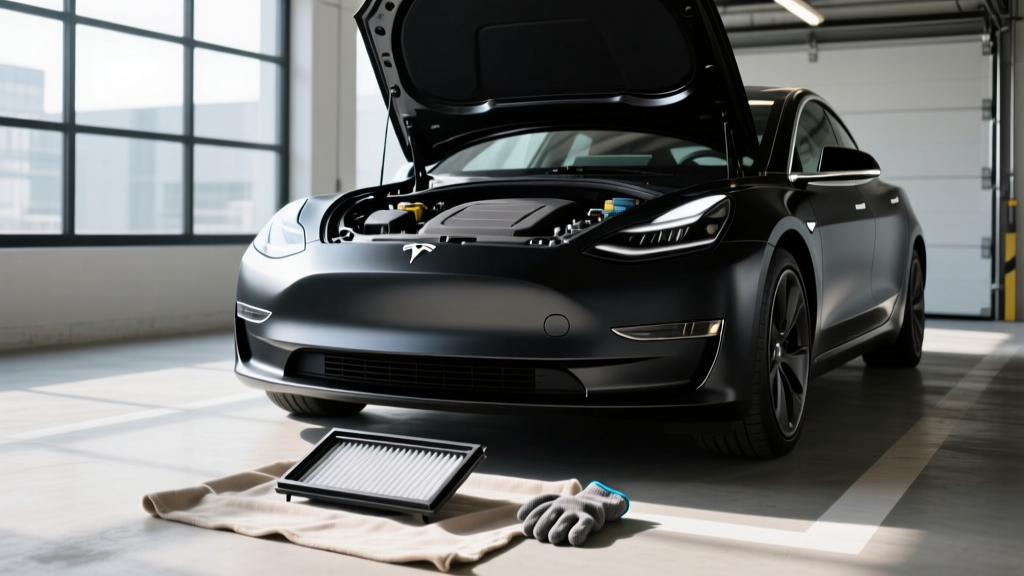
- Open the glovebox and remove any contents. Locate the rectangular access panel on the passenger-side footwell wall, just below and behind the glovebox.
- Remove the trim cover using a plastic pry tool. On Highland models, you may need to remove two T20 Torx screws securing a small bracket.
- Slide out the old filter. Note the airflow direction arrow printed on the filter frame — you will need to match this on the new filter (arrow points toward the blower motor, generally downward/into the dash).
- Wipe the housing with a microfiber cloth dampened with isopropyl alcohol to remove accumulated dust and debris.
- Insert the new filter with the airflow arrow in the correct orientation. It should slide in with light resistance — do not force it.
- Reinstall the trim cover and any screws. Close the glovebox.
- Reset the filter reminder (if equipped): On the touchscreen, go to Controls → Service → Cabin Air Filter and confirm replacement. On older software builds, this may require a third-party app or simply a calendar reminder.
2026 Tesla Model 3: Full Spec Profile
Maintenance is just one ownership variable. Here is the complete specification sheet for the current-generation (Highland) Model 3 lineup so you can evaluate the car holistically.
| Spec | RWD (Base) | Long Range AWD | Performance (Ludicrous) |
|---|---|---|---|
| EPA Range | 272 mi | 341 mi | 315 mi |
| Battery (usable) | ~57.5 kWh (LFP) | ~75 kWh (NMC) | ~75 kWh (NMC) |
| Drivetrain | RWD, single motor | AWD, dual motor | AWD, dual motor |
| Horsepower | 271 hp | 346 hp | ~510 hp |
| 0–60 mph | 5.8 sec | 4.2 sec | 2.9 sec |
| Max DC Fast Charge | 170 kW | 250 kW | 250 kW |
| 10–80% DCFC Time | ~30 min | ~25 min | ~25 min |
| Level 2 Home Charge | 11.5 kW (~44 mi/hr) | 11.5 kW (~44 mi/hr) | 11.5 kW (~44 mi/hr) |
| MPGe (combined) | 132 MPGe | 131 MPGe | 119 MPGe |
| Efficiency (kWh/100 mi) | 25 kWh | 26 kWh | 28 kWh |
| Cargo Volume | 23 cu ft (trunk + frunk) | 23 cu ft | 23 cu ft |
| Rear Legroom | 35.3 in | 35.3 in | 35.3 in |
| Battery Warranty | 8 yr / 100,000 mi | 8 yr / 120,000 mi | 8 yr / 120,000 mi |
| Base MSRP (2026) | $38,990 | $45,990 | $52,990 |
Sources: EPA fueleconomy.gov, Tesla spec sheets. Prices exclude $1,390 destination fee.
Real-World Range: What the EPA Sticker Does Not Tell You
The EPA combined figures assume a mix of city and moderate-speed highway driving at ~70°F. Here is what to expect in actual use:
- Highway (75 mph, 70°F): Expect ~85–90% of EPA — roughly 230 mi (RWD) or 290 mi (Long Range).
- Cold weather (30°F, mixed driving): LFP and NMC batteries both lose efficiency in cold; expect a 20–30% reduction. The RWD may drop to ~190 mi; Long Range to ~240 mi.
- City/regenerative driving (mild weather): You can match or slightly exceed EPA thanks to aggressive regen recapturing energy in stop-and-go traffic.
Preconditioning matters: Using the Tesla app to precondition the battery while plugged in warms the pack and restores range that would otherwise be lost to cold-soak. Always precondition before a DC fast-charge stop — the car needs battery heat to accept peak kW.
Charging Speed and Infrastructure
| Level | Power | Miles Added per Hour | Best Use Case |
|---|---|---|---|
| Level 1 (120V) | ~1.4 kW | ~3–5 mi/hr | Overnight trickle; emergencies |
| Level 2 (240V, 48A) | 11.5 kW | ~44 mi/hr | Daily home charging |
| DC Fast (RWD max) | 170 kW peak | ~700 mi/hr (peak) | Road trips; 10–80% in ~30 min |
| DC Fast (LR/Perf max) | 250 kW peak | ~1,000 mi/hr (peak) | Road trips; 10–80% in ~25 min |
Charging curve reality: Peak kW is only sustained between roughly 10–40% State of Charge (SoC). Above 60%, the rate tapers significantly — from 250 kW down to ~50 kW near 80%. This is why Tesla and Supercharger etiquette recommends charging to 80% and moving on. For daily driving, set your charge limit to 80% (or 100% for LFP RWD models, which benefit from periodic full charges for cell balancing).
Pricing, Tax Credits, and Total Cost
| Trim | MSRP (incl. dest.) | Potential §30D Credit | Effective Price* |
|---|---|---|---|
| RWD | $40,380 | Up to $7,500 | ~$32,880 |
| Long Range AWD | $47,380 | Up to $7,500 | ~$39,880 |
| Performance | $54,380 | Up to $7,500 | ~$46,880 |
*Effective price assumes full credit eligibility. Actual credit depends on IRS §30D rules.
Federal Tax Credit Eligibility (§30D)
- MSRP cap: Sedans must be under $55,000 — the RWD and Long Range qualify; the Performance trim may exceed the cap depending on options. Verify at purchase.
- Buyer income cap: Modified AGI must not exceed $150,000 (single), $225,000 (head of household), or $300,000 (joint). See IRS §30D guidelines.
- Battery sourcing: Critical minerals and battery component requirements phase in annually. Tesla sources LFP cells from CATL (China) for the RWD, which may affect critical-mineral compliance in some model years. The Long Range and Performance use NMC cells with more diverse sourcing. Confirm current-year compliance with your dealer at point of sale.
- Point-of-sale transfer: You can transfer the credit to the dealer at purchase, reducing your out-of-pocket cost immediately rather than waiting for tax filing.
Standout Tech and Notable Drawbacks
Pros
- Class-leading Supercharger network access (17,000+ stalls in North America)
- Over-the-air updates continually add features
- Highland refresh significantly improved ride quality and cabin noise isolation
- Ambient lighting, ventilated seats, and rear touchscreen add premium feel
- Excellent efficiency (25–28 kWh/100 mi) keeps charging costs low
- Standard Autopilot (SAE Level 2) is competent for highway lane-keeping
Cons
- No physical stalks — turn signals and gear selection via touchscreen/buttons takes adjustment
- Rear visibility is limited; reliance on cameras for parking
- Rear seat is tight for tall adults on long trips (35.3" legroom)
- FSD (Supervised) remains SAE Level 2 — driver must stay fully engaged
- Insurance premiums run 20–40% higher than comparable ICE sedans
- LFP battery (RWD) loses more range in extreme cold vs. NMC
Who the Model 3 Suits Best
Ideal for: Solo commuters and couples who prioritize efficiency, tech, and access to the best DC fast-charging network. The Long Range AWD is the sweet spot for road-trippers who regularly drive 200+ miles between stops. The RWD is a strong value pick for city/suburban drivers who charge at home and rarely exceed 150 miles in a day.
Less ideal for: Families needing easy rear-seat child-seat access (the door openings are narrow), buyers in extreme-cold climates without garage parking (LFP range loss is significant), or anyone who wants physical controls for common functions.
Frequently Asked Questions
How often should I replace the Model 3 cabin air filter?
Tesla recommends every 2 years under normal conditions. In dusty, high-pollen, or wildfire-smoke-prone areas, annual replacement is advisable. A musty odor from the vents is the most common indicator that the filter is overdue.
Can I use an aftermarket filter instead of OEM?
Yes. High-quality aftermarket options from BOSCH, K&N, and others fit the Model 3 and typically cost $15–$30 versus $30–$40 for OEM. Ensure the filter matches your model year (pre-2024 vs. Highland 2024+). Activated-carbon variants offer better odor filtration.
What is the real-world range of the 2026 Model 3?
Expect ~230–250 miles on the highway for the RWD and ~290–310 miles for the Long Range in mild weather. Cold weather (below freezing) can reduce these figures by 20–30%. City driving with regenerative braking can match or exceed EPA estimates.
How fast does the Model 3 charge at home and on the road?
At home on a 48A Level 2 charger (240V), the Model 3 adds ~44 miles of range per hour — a full overnight charge from 20% to 80% takes about 5–6 hours. On DC fast chargers, the Long Range and Performance models peak at 250 kW, achieving a 10–80% charge in approximately 25 minutes. The RWD peaks at 170 kW and takes about 30 minutes for the same interval.
Does the 2026 Model 3 qualify for the $7,500 federal tax credit?
It depends on the trim, your income, and current battery-sourcing rules. The RWD and Long Range fall under the $55,000 sedan MSRP cap. Your modified AGI must be within IRS limits ($150K single / $300K joint). Battery critical-mineral and component sourcing requirements change annually — confirm eligibility with your Tesla advisor at the time of purchase and consult IRS.gov or a tax professional.
Is the Model 3 worth buying vs. the Hyundai Ioniq 6 or BMW i4?
The Model 3 wins on charging infrastructure (Supercharger access), software maturity, and efficiency. The Ioniq 6 offers comparable range (361 mi SE) and 800V architecture for faster DC charging, but its public charging network is less reliable. The BMW i4 is more luxurious and has physical controls, but costs significantly more and lacks NACS without an adapter. If Supercharger access and OTA updates matter most, the Model 3 remains the benchmark.
What does Model 3 maintenance cost beyond the air filter?
Minimal. Tesla's scheduled maintenance is limited to cabin air filter replacement (~$25–$40 DIY), tire rotation every 6,250 miles (~$50–$80 at a tire shop), brake fluid check every 2 years, and wiper blade replacement as needed. There are no oil changes, spark plugs, or transmission fluid services. Budget roughly $200–$350 per year for routine maintenance — a fraction of a comparable ICE sedan.