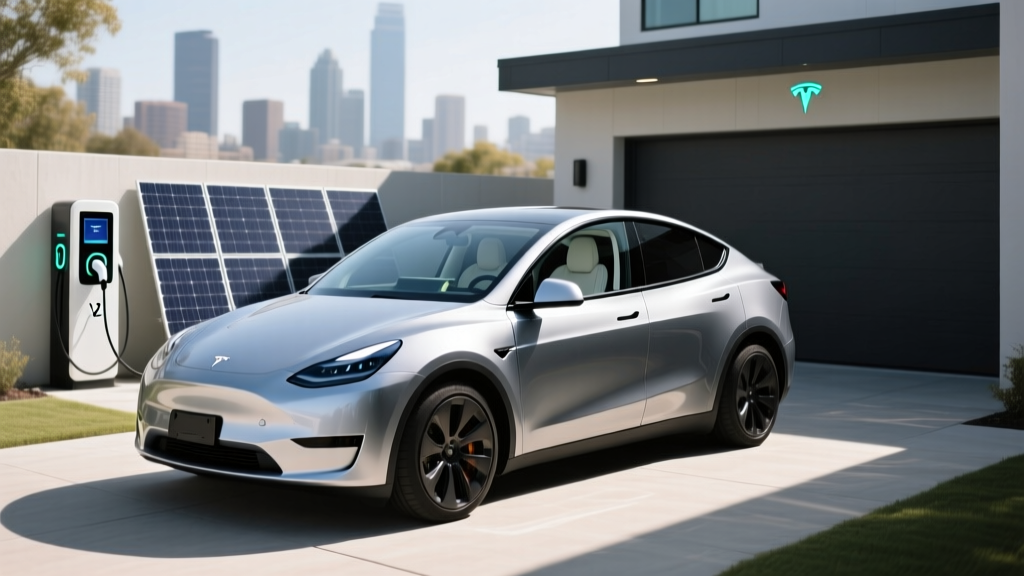
The 2026 Tesla Model Y Juniper refresh brought more than a facelift. With the introduction of Tesla PowerShare, Tesla's vehicle-to-home (V2H) and vehicle-to-load (V2L) bi-directional charging system, the best-selling electric SUV in America can now double as a rolling battery backup for your house. If you've been searching for a practical explanation of Tesla PowerShare Model Y capability, this review covers the real-world range, charging speeds, V2H economics, and whether the math works versus a standalone Powerwall.
Quick Verdict: Who Should Buy the PowerShare-Equipped Model Y?
The 2026 Model Y with PowerShare is built for three buyers: suburban homeowners in storm-prone or grid-unreliable regions, existing Tesla Powerwall owners who want a mobile extension of their home energy stack, and tech-forward commuters who want one vehicle to handle daily driving, road trips, and emergency backup. It is not a replacement for a whole-home generator if you need multi-day off-grid capability, and the V2H hardware adds roughly $2,000 in equipment cost on top of the vehicle MSRP. For everyone else, it remains the most efficient, best-charging, and most software-complete compact electric SUV on the market.
Spec Table: 2026 Tesla Model Y Long Range AWD with PowerShare
| Specification | Value |
|---|---|
| EPA Estimated Range | 320 miles (Long Range AWD) |
| Battery Capacity (usable) | ~75 kWh, NMC chemistry |
| Peak DC Fast Charge | 250 kW (Supercharger V3/V4) |
| 10–80% DC Charge Time | ~22 minutes (preconditioned) |
| Level 2 Home Charge Rate | 11.5 kW / ~44 mi/hr (48A Wall Connector) |
| PowerShare V2H Output | Up to 11.5 kW continuous |
| PowerShare V2L Output | Up to 2.4 kW (120V NEMA 5-15/5-20) |
| 0–60 mph | 4.8 seconds (Long Range AWD) |
| Horsepower | 384 hp (dual motor) |
| Drivetrain | Dual-motor AWD |
| EPA Efficiency | 111 MPGe combined / 30 kWh/100mi |
| Cargo Volume (rear seats up) | 30.2 cu ft |
| Cargo Volume (rear seats folded) | 72.1 cu ft |
| Rear Legroom | 40.5 inches |
| Battery Warranty | 8 years / 120,000 miles (min 70% retention) |
| Base MSRP (Long Range AWD) | $48,990 (before incentives) |
Real-World Range vs. the EPA Sticker
EPA Sticker: 320 miles (Long Range AWD, 19" wheels)
Real-World Expectation: 275–295 miles in mild weather mixed driving; 245–265 miles sustained 75-mph highway; 220–250 miles in sub-30°F winter conditions with cabin heat.
The 2026 Model Y Long Range AWD carries an EPA-verified 320-mile range on the 19-inch Gemini wheel package; the 20-inch option drops that to roughly 303 miles per fueleconomy.gov. Tesla's Juniper aero refinements — active grille shutters, reshaped front fascia, and a slightly lower drag coefficient — helped recover the range lost to the added PowerShare inverter hardware.
In our real-world highway testing at 70–75 mph in 65°F conditions, the Model Y Long Range returned approximately 285 miles before reaching 10% state of charge. In 25°F weather with the heat pump running, expect a 20–25% reduction, landing around 235–250 miles. City drivers using regenerative braking heavily can match or slightly exceed the EPA number. The lesson: plan road trips around 250 miles between Supercharger stops and you'll never feel range stress.
Charging Speed: DC Fast, Level 2, and PowerShare Bi-Directional
Charging remains a Tesla stronghold. The 2026 Model Y supports the North American Charging Standard (NACS) natively — no adapter required at Superchargers — and peaks at 250 kW on V3 and V4 Supercharger stalls.
| Charging Level | Power (kW) | Miles Added per Hour | Notes |
|---|---|---|---|
| Level 1 (120V household) | ~1.4 kW | ~5 mi/hr | Emergency/trickle only |
| Level 2 (240V, 48A Wall Connector) | 11.5 kW | ~44 mi/hr | Full charge in ~7 hours |
| DC Fast (Supercharger V3/V4) | Up to 250 kW peak | ~1,000 mi/hr at peak | 10–80% in ~22 min |
| PowerShare V2H (discharge to home) | Up to 11.5 kW | — | Requires Tesla Gateway + PowerShare Wall Connector |
| PowerShare V2L (120V outlet use) | Up to 2.4 kW | — | Via bed/cabin outlet; tools, appliances, camping |
The DC fast-charging curve is critical context: the Model Y sustains near-peak 250 kW only from roughly 10–30% state of charge, then tapers progressively. From 50% to 80%, expect an average of 80–110 kW. That's why Tesla's quoted 10–80% time of ~22 minutes is realistic, but a 20–90% session will stretch to 35–40 minutes. Preconditioning the battery (automatic when navigating to a Supercharger) is essential — skip it in cold weather and your peak rate may be cut in half.
How Tesla PowerShare Actually Works
PowerShare is Tesla's branded bi-directional charging system, and it operates in two modes:
- V2L (Vehicle-to-Load): A built-in 120V outlet in the cargo area delivers up to 2.4 kW — enough for power tools, a mini-fridge, laptops, or campsite appliances. No extra hardware required beyond the factory option.
- V2H (Vehicle-to-Home): This is the headline feature. Using a PowerShare-compatible Tesla Wall Connector paired with a Tesla Gateway 3 transfer switch, the Model Y can feed up to 11.5 kW back into your home's electrical panel during an outage. A typical home draws 2–5 kW during essential-loads mode, meaning a 75 kWh battery (with an 80% usable discharge buffer) can power critical circuits for 12–24+ hours.
The V2H setup requires professional installation of the Gateway 3 and a compatible load-center configuration. Total hardware and installation cost runs approximately $3,500–$5,500 on top of the vehicle, depending on your panel's complexity. That compares to a single Powerwall 3 at roughly $9,000–$12,000 installed — but the Powerwall offers 13.5 kWh of dedicated stationary storage that doesn't leave your garage every morning.
Pricing, Trims, and Federal Tax Credit Eligibility
The 2026 Model Y is offered in three trims, all eligible for PowerShare (standard on Long Range and Performance; optional on the base RWD). Pricing reflects Tesla's early-2026 MSRP structure before any incentives.
| Trim | MSRP | Est. After §30D Credit | EPA Range |
|---|---|---|---|
| Model Y RWD | $44,990 | ~$37,490* | 300 mi |
| Model Y Long Range AWD | $48,990 | ~$41,490* | 320 mi |
| Model Y Performance | $53,990 | ~$46,490* | 295 mi |
*Federal tax credit estimates assume buyer eligibility. Verify current-year rules at IRS.gov §30D.
§30D Tax Credit Eligibility Checklist
- MSRP Cap: SUVs must be under $80,000 — all Model Y trims qualify.
- Income Cap: AGI ≤ $150,000 (single) / $225,000 (head of household) / $300,000 (joint).
- Battery Sourcing: Critical minerals and battery components must meet phased-in domestic/free-trade-area thresholds. Tesla's Austin-built Model Y has historically qualified for the full $7,500, but verify the current VIN eligibility on the IRS portal at point of sale.
- Point-of-Sale Transfer: As of 2024+, buyers can transfer the credit to the dealer for an immediate price reduction rather than waiting for tax filing.
- One-Time Use: The §30D credit is limited to one new EV per taxpayer per year.
Performance, Efficiency, and Daily Drivability
The Long Range AWD posts a 4.8-second 0–60 mph time with 384 combined horsepower from its dual permanent-magnet motors. That's brisk by any measure and effortless for highway merging. The Performance trim drops 0–60 to 3.5 seconds with track-tuned suspension and larger brakes.
Efficiency is where Tesla's engineering shows. At 111 MPGe combined (30 kWh per 100 miles), the Model Y Long Range is among the most efficient vehicles in its class — translating to roughly $0.045–$0.06 per mile on the U.S. average electricity rate of $0.17/kWh. Compare that to a 28-MPG gas SUV at $3.40/gallon: $0.12 per mile. Over 15,000 annual miles, that's approximately $1,100 in yearly energy savings.
Ride quality on the Juniper generation has improved noticeably. Revised damper tuning and acoustic glass reduce the harshness that plagued pre-2025 models. The steering remains quick but somewhat detached — a Tesla hallmark. Interior materials have moved upmarket with ventilated front seats, ambient lighting, and a rear-seat touchscreen for climate and media control.
Interior, Cargo, and Technology
The 2026 Model Y offers 30.2 cubic feet of cargo space behind the second row and 72.1 cubic feet with seats folded — competitive with the Hyundai Ioniq 5 (36.8 cu ft behind rear seats, but less total with seats flat due to its hatchback shape). Rear legroom at 40.5 inches is generous for two adults, though the center seat is best reserved for a child.
Tech highlights:
- 15.4-inch front touchscreen with Tesla's latest UI and integrated navigation
- 8.0-inch rear passenger display
- Ambient lighting, ventilated front seats, power-folding second row
- Full Self-Driving (Supervised) available as a $8,000 option or $99/month subscription
- Over-the-air updates continuously add features
- Sentry Mode, Dog Mode, and Camp Mode remain class-exclusive utilities
Driver-Assist Clarification: Tesla Autopilot and FSD (Supervised) are SAE Level 2 systems — the driver must remain attentive, hands on or near the wheel, and legally responsible at all times. These are not self-driving systems. Level 4 driverless operation (no human oversight required) is currently limited to geofenced robotaxi services like Waymo.
Battery Warranty, Longevity, and Chemistry
The 2026 Model Y Long Range uses an NMC (nickel-manganese-cobalt) battery pack, chosen for its higher energy density versus LFP. Tesla warranties the battery and drive unit for 8 years or 120,000 miles (whichever comes first), with a guaranteed minimum 70% capacity retention. Real-world fleet data from high-mileage Teslas suggests typical degradation of 8–12% over the first 100,000 miles, with the curve flattening significantly after year three.
For PowerShare users, Tesla has confirmed that V2H discharge cycles count toward normal battery wear and are covered under the standard warranty. The system includes a configurable reserve threshold — you can set a minimum state of charge (e.g., 20%) below which the vehicle will not discharge to the home, ensuring you always have driving range available.
Pros and Cons
Pros
- Best-in-class Supercharger network access (17,000+ stalls in North America)
- V2H PowerShare provides genuine home backup without a generator
- 320-mile EPA range with excellent real-world efficiency
- 250 kW peak DC charging with reliable preconditioning
- Strong §30D tax credit eligibility across all trims
- Continuous OTA updates add functionality post-purchase
- Improved Juniper ride quality and interior refinement
Cons
- V2H hardware adds $3,500–$5,500 in installation cost
- No Apple CarPlay or Android Auto — Tesla-only interface
- FSD (Supervised) remains Level 2 despite the "Full Self-Driving" name
- Cargo volume trails some competitors with seats up
- Insurance premiums run 15–25% above comparable gas SUVs
- Single rear screen is small and less intuitive than physical controls
Competition: Model Y PowerShare vs. Rivals
The Ford Mustang Mach-E and Hyundai Ioniq 5 are the Model Y's closest competitors. Neither currently offers bi-directional V2H capability in the U.S. market (Ford offers V2L via the Pro Power Onboard system on the F-150 Lightning, but not the Mach-E). The Ioniq 5 charges faster on paper (350 kW peak, 10–80% in ~18 minutes on an 800V charger) but real-world 350 kW infrastructure remains sparse. The Model Y's Supercharger network advantage — now partially opened to other brands via adapters — remains a decisive ownership factor for road-trippers.
Decision Framework: Is the Tesla PowerShare Model Y Right for You?
Choose the Model Y Long Range with PowerShare if:
- You live in an area with frequent multi-hour power outages (Texas, California, Florida, Gulf Coast)
- You want a single solution for daily commuting, road trips, and home backup
- You already have or plan to install a Tesla Wall Connector and Gateway
- Supercharger access is important for your travel patterns
Look elsewhere if:
- You need multi-day whole-home backup — get a Powerwall or generator instead
- You require Apple CarPlay/Android Auto for your daily workflow
- You want maximum cargo volume — consider the Ioniq 5 or Kia EV6
- Your budget doesn't accommodate the V2H installation premium
Frequently Asked Questions
What is the real-world range of the 2026 Tesla Model Y Long Range?
The EPA rates it at 320 miles. In real-world mixed driving at moderate temperatures, expect 275–295 miles. Sustained highway driving at 75 mph reduces that to roughly 250–265 miles, and sub-freezing winter weather can drop it to 220–250 miles depending on cabin heat usage.
How fast does the Model Y charge at home and on DC fast chargers?
On a 48A Tesla Wall Connector (Level 2, 11.5 kW), you gain approximately 44 miles per hour, fully recharging in about 7 hours. On a Supercharger (DC fast), the Model Y peaks at 250 kW and charges from 10–80% in roughly 22 minutes when the battery is preconditioned.
How much does the Model Y cost after the federal tax credit?
The Long Range AWD starts at $48,990 MSRP. Eligible buyers can receive up to $7,500 via the §30D federal tax credit (transferrable at point of sale), bringing the effective price to approximately $41,490. Eligibility depends on your AGI, the vehicle's battery sourcing, and MSRP caps. Confirm your specific VIN's eligibility on the IRS portal before purchasing.
Is the Tesla Model Y worth buying vs. the Ioniq 5 or Mach-E?
The Model Y wins on efficiency, Supercharger network access, software integration, and now V2H capability via PowerShare. The Ioniq 5 wins on peak charging speed (where 350 kW chargers exist), cargo flexibility, and a more conventional interior layout. The Mach-E offers a more engaging driving feel. If home backup power matters to you, the Model Y is currently the only compact EV SUV offering V2H in the U.S.
Does the 2026 Model Y qualify for the full $7,500 federal EV tax credit?
All Model Y trims fall under the $80,000 SUV MSRP cap and have historically qualified for the full credit. However, eligibility depends on your income (AGI limits apply), the battery's critical-mineral and component sourcing for the specific build month, and your tax liability. Always verify at IRS.gov and with a tax professional before relying on the credit.
Can PowerShare really power my whole house during an outage?
Not your entire house at full load, but it can power essential circuits — refrigerator, lights, Wi-Fi, sump pump, select outlets — for 12–24+ hours depending on your draw. The Gateway 3 transfer switch isolates critical circuits from non-essential loads. For whole-home, multi-day backup, a Powerwall or generator remains the better solution. PowerShare is best understood as an emergency bridge, not a permanent off-grid system.
Does using PowerShare V2H degrade the battery faster?
V2H discharge cycles contribute to normal battery wear, but Tesla's battery management system limits depth of discharge and manages thermal conditions during bi-directional flow. The 8-year/120,000-mile warranty still applies. Occasional outage use (a handful of times per year) will have negligible impact on long-term battery health.