Where Are Rivians Made? The American Origin Story
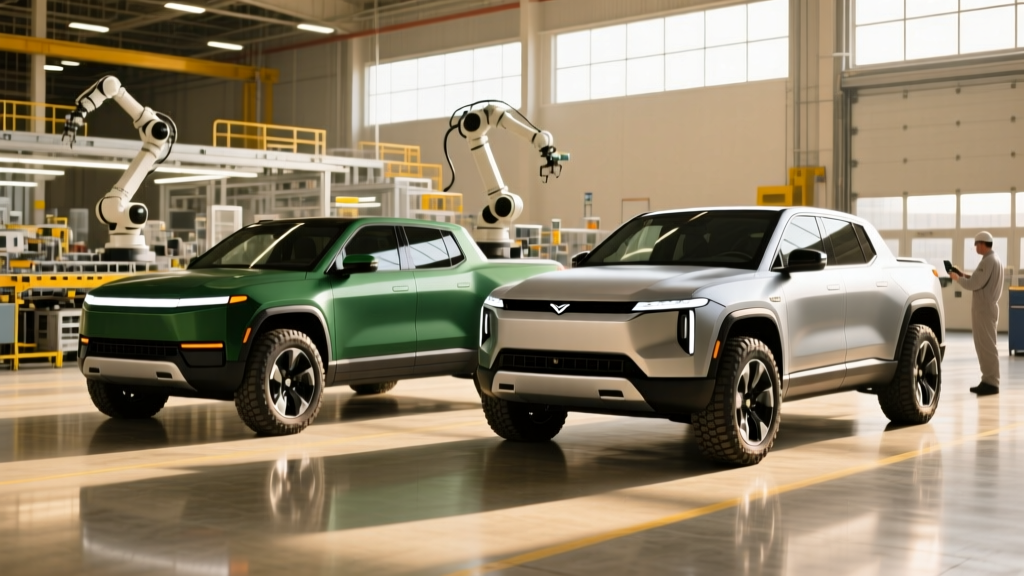
If you've searched for the Rivian origin country, the answer is straightforward: Rivian is an American company headquartered in Irvine, California, and every R1T truck and R1S SUV rolls off the assembly line in Normal, Illinois. The Normal assembly plant — a former Mitsubishi factory Rivian purchased and converted in 2017 — is the sole production facility for all consumer Rivian vehicles as of the 2026 model year.
This matters for more than national pride. U.S. manufacturing is a prerequisite for the federal §30D EV tax credit's North American final-assembly requirement, and Rivian's domestic supply chain gives it a structural advantage over competitors assembling vehicles overseas. Let's break down what this means for the vehicles themselves — specs, range, charging, pricing, and whether a Rivian belongs on your shortlist.
Rivian R1T and R1S: 2026 Spec Snapshot
Rivian sells two core consumer vehicles built on the same skateboard platform: the R1T (a four-door electric pickup) and the R1S (a three-row electric SUV). Both received a significant refresh for the 2025 model year that carries into 2026, including a new Enduro dual-motor powertrain option, updated battery chemistries, and revised software. Here are the headline numbers:
| Spec | R1T Dual-Motor (Standard) | R1T Tri-Motor | R1S Dual-Motor (Standard) | R1S Tri-Motor |
|---|---|---|---|---|
| EPA Range | 352 mi | 420 mi (Max Pack) | 352 mi | 420 mi (Max Pack) |
| Battery (usable) | 106 kWh (LFP) | 149 kWh (NMC) | 106 kWh (LFP) | 149 kWh (NMC) |
| Horsepower | 533 hp | 850 hp | 533 hp | 850 hp |
| 0-60 mph | 4.5 sec | 2.9 sec | 4.5 sec | 3.0 sec |
| Drivetrain | AWD (dual-motor) | AWD (tri-motor) | AWD (dual-motor) | AWD (tri-motor) |
| Max Tow Capacity | 11,000 lb | 11,000 lb | 7,700 lb | 7,700 lb |
| Base MSRP | $69,900 | $99,900 | $74,900 | $104,900 |
Source: Rivian R1T specs and fueleconomy.gov.
Real-World Range: What the EPA Sticker Doesn't Tell You
R1T Dual-Motor Standard Pack: EPA 352 miles. Expect ~290–310 miles in mixed highway driving at 70 mph, and as low as ~240 miles in sub-freezing temperatures with cabin heat running.
R1T Tri-Motor Max Pack: EPA 420 miles. Real-world highway: ~340–370 miles. Cold weather highway: ~280–310 miles.
Efficiency: ~70 MPGe combined (Dual-Motor), roughly 48 kWh/100mi for the Standard Pack. The boxy truck shape and 7,000+ lb curb weight work against highway efficiency — a reality for all body-on-frame EVs.
Rivian's LFP (lithium iron phosphate) Standard Pack batteries sacrifice some energy density versus NMC but gain longevity and tolerate routine 100% charging without degradation concerns. If your commute is under 200 miles round-trip and you charge nightly at home, the LFP pack is the pragmatic choice. Reserve the Max Pack (NMC chemistry) for frequent road-trippers and heavy tow-haul users — towing a 5,000 lb trailer can cut range by 40–50%.
Charging Speed: DC Fast and Home Level 2
Rivian's charging architecture improved substantially with the Gen 2 platform. Here's what you'll see at the plug:
| Charging Level | Power / Rate | Time or Miles Added |
|---|---|---|
| DC Fast Charge (peak) | 220 kW (Max Pack) / 190 kW (Standard) | 10–80% in ~21 min (Standard), ~30 min (Max) |
| DC Fast Sustained | ~150 kW average to 80% | Charge curve tapers sharply above 80% |
| Level 2 (home, 48A / 11.5 kW) | 11.5 kW | ~20 mi/hr added; 0–100% in ~11 hrs (Standard) |
| Level 2 (Rivian Wall Charger, 80A / 19.2 kW) | 19.2 kW | ~33 mi/hr added; 0–100% in ~7 hrs (Standard) |
| Level 1 (120V outlet) | 1.4 kW | ~3 mi/hr — emergency use only |
Rivian uses the NACS (Tesla-style) connector natively on 2026 models, granting direct access to the Tesla Supercharger network — over 25,000 stalls in North America. This eliminates the adapter hassle that earlier CCS-equipped Rivians required. On a road trip, preconditioning the battery via the navigation system is essential: arriving at a DC fast charger with a cold battery can add 10+ minutes to your stop as the thermal management system warms the cells.
For home charging, budget $500–$1,500 for a professional Level 2 installation (240V, 60A circuit) depending on panel proximity. A 200-amp electrical panel is usually sufficient; older homes with 100-amp service may need a $2,000–$4,000 panel upgrade — confirm with a licensed electrician before purchasing equipment.
Pricing, Trims, and Federal Tax Credit Eligibility
| Trim | MSRP | §30D Credit Eligible? | Effective Price (est.) |
|---|---|---|---|
| R1T Dual-Motor Standard | $69,900 | Yes (if income/sourcing met) | ~$62,400 |
| R1T Dual-Motor Large | $75,900 | Yes | ~$68,400 |
| R1T Tri-Motor Max | $99,900 | No (exceeds $80K truck cap) | $99,900 |
| R1S Dual-Motor Standard | $74,900 | Yes | ~$67,400 |
| R1S Tri-Motor Max | $104,900 | No (exceeds $80K SUV cap) | $104,900 |
Under current IRS §30D rules, the federal EV tax credit provides up to $7,500 for qualifying new EVs. However, eligibility is far from automatic:
- MSRP caps: Vans, SUVs, and pickups must be under $80,000. The Tri-Motor Max trims exceed this.
- Buyer income caps: AGI must not exceed $150K (single), $225K (head of household), or $300K (joint).
- Battery sourcing: Critical minerals and battery components must meet phased-in domestic/free-trade-agreement thresholds that tighten annually through 2026.
- Final assembly: Must occur in North America — Rivian's Illinois plant satisfies this requirement.
- Point-of-sale transfer: You can apply the credit at purchase to reduce the sale price directly, rather than waiting for tax filing.
The Dual-Motor Standard and Large trims are the credit-eligible sweet spot. Consult a tax professional to confirm your personal eligibility, as rules change and individual circumstances vary.
Cargo, Passenger Space, and Everyday Livability
The R1T's 4.5-foot bed is shorter than a full-size truck's, but the gear tunnel — a lockable, pass-through compartment behind the rear seats — adds 11.6 cu ft of enclosed storage unique to Rivian. Total cargo behind the rear seats (bed + tunnel): roughly 37 cu ft with the tonneau closed.
The R1S offers three rows with seating for seven. Cargo behind the third row is 21 cu ft; fold the third row for 58 cu ft, and fold both rear rows for a maximum 108 cu ft. Rear-seat legroom is generous at 38.5 inches (second row), though the third row is best suited for children on trips under an hour.
Both vehicles feature a front trunk (frunk) with approximately 11 cu ft of space — useful for charging cables, groceries, or a carry-on. The R1T's camp kitchen accessory (slide-out induction cooktop in the gear tunnel) remains a standout lifestyle feature, though it's a $5,000+ add-on.
Warranty, Reliability, and Ownership Costs
Rivian's warranty coverage for 2026:
- Battery & drivetrain: 8 years / 175,000 miles (whichever comes first), with a capacity retention threshold of 70%.
- Bumper-to-bumper: 5 years / 60,000 miles.
- Roadside assistance: 5 years / 60,000 miles.
The 175,000-mile battery warranty exceeds the industry-standard 100,000 miles and reflects confidence in both LFP and NMC pack longevity. Insurance premiums for Rivians run 15–25% above comparable ICE trucks due to repair costs and aluminum-intensive construction — get quotes before purchasing.
Tech, Driver Assistance, and Software
Rivian runs its own vertically integrated software stack, including a 15.6-inch center touchscreen, a 12.3-inch driver display, and over-the-air updates that have materially improved the vehicle since launch. Key tech features:
- Driver+ (Level 2 ADAS): Adaptive cruise control with lane centering on divided highways. Requires hands-on-wheel engagement. This is not self-driving — it's a competent SAE Level 2 system comparable to Ford BlueCruise or GM Super Cruise in capability, though Rivian does not yet offer hands-off operation.
- Phone-as-key: Reliable Bluetooth LE proximity unlock; no fob required.
- Electric camp features: Vehicle-to-load (V2L) power output (up to 6.6 kW) for running camp appliances, power tools, or tailgate setups.
- Off-road modes: Dedicated software profiles for snow, sand, rock crawl, and a quad-motor tank-turn capability on the Quad-Motor variant.
Rivian Driver+ is SAE Level 2. You must keep your hands on the wheel and eyes on the road at all times. The system does not handle construction zones, unmapped roads, or severe weather autonomously. It is a driver-assistance feature, not a self-driving system.
Rivian vs. Key Competitors: Is It Worth It?
- You want a genuine pickup (11,000 lb tow rating, 4.5-ft bed, gear tunnel) with EV running costs.
- Overlanding and off-road capability are priorities — Rivian's air suspension and quad-motor torque vectoring are class-leading.
- You value U.S.-built manufacturing and qualify for the §30D credit on Dual-Motor trims.
- You need a full 5.5-ft or 6.5-ft bed and a lower starting price (~$55K).
- Dealer proximity for service matters — Ford's dealer network dwarfs Rivian's 50+ service centers.
- You want the lowest cost-per-mile of range and fastest Supercharger access (native NACS advantage is now shared by Rivian, however).
- Stainless-steel exoskeleton styling appeals to you — subjective, but it drives purchase decisions.
- You need three rows and off-road capability without stepping to a full-size SUV like the Escalade IQ.
- Best-in-class off-road capability and air suspension ride quality
- Gear tunnel (R1T) is a genuinely innovative storage solution
- LFP battery option allows daily 100% charging without degradation worry
- Native NACS connector and Supercharger access (2026 models)
- U.S.-built — satisfies §30D final assembly requirement
- V2L output for camping and job-site power
- Tri-Motor trims exceed $80K MSRP cap — no federal tax credit
- Service center network still limited outside major metros
- Insurance premiums 15–25% above comparable ICE trucks
- Highway efficiency suffers (~48 kWh/100mi) — heavy, boxy vehicles use more energy
- Third row in R1S is tight for adults
- Driver+ is competent but not hands-off — no Level 3 capability
Frequently Asked Questions
What country are Rivian vehicles manufactured in?
All Rivian R1T and R1S vehicles are manufactured in the United States at the Rivian Normal assembly plant in Normal, Illinois. Rivian's corporate headquarters are in Irvine, California. The company also operates a battery development facility and is constructing a second assembly plant in Stanton, Georgia (expected operational late 2020s).
What is the real-world range of a Rivian R1T?
The EPA rates the R1T Dual-Motor Standard at 352 miles. In real-world highway driving at 70 mph, expect 290–310 miles. In cold weather (below 32°F), highway range drops to approximately 240–270 miles. The Tri-Motor Max Pack (EPA 420 mi) delivers roughly 340–370 real-world highway miles.
How fast does a Rivian charge at home and on the road?
On a DC fast charger, the Standard Pack peaks at ~190 kW (10–80% in ~21 min) and the Max Pack at ~220 kW (10–80% in ~30 min). At home on a 48A Level 2 circuit (11.5 kW), you'll add about 20 miles per hour of charging. The Rivian Wall Charger at 80A/19.2 kW adds ~33 miles per hour.
Does the Rivian R1T qualify for the $7,500 federal EV tax credit?
The Dual-Motor Standard ($69,900) and Dual-Motor Large ($75,900) trims fall under the $80,000 MSRP cap for trucks and may qualify, subject to buyer income limits ($150K single / $300K joint) and battery-sourcing requirements. The Tri-Motor Max ($99,900) exceeds the MSRP cap and does not qualify. Check current IRS §30D guidance and consult a tax professional.
Is a Rivian worth buying over a Ford F-150 Lightning or Tesla Cybertruck?
Rivian wins on off-road capability, build quality, and adventure-oriented features (gear tunnel, camp kitchen, V2L). The F-150 Lightning wins on bed length, dealer service access, and starting price. The Cybertruck offers polarizing styling and strong range-per-dollar. If overlanding and premium build matter most, Rivian is the strongest pick. If you need a work truck with a full-size bed and nearby service, the Lightning is more practical.
What is Rivian's battery warranty?
Rivian covers the battery and drivetrain for 8 years or 175,000 miles, whichever comes first, guaranteeing at least 70% capacity retention. This exceeds the typical 8-year/100,000-mile industry standard.