Quick Verdict: The Electric 7 Series That Actually Delivers
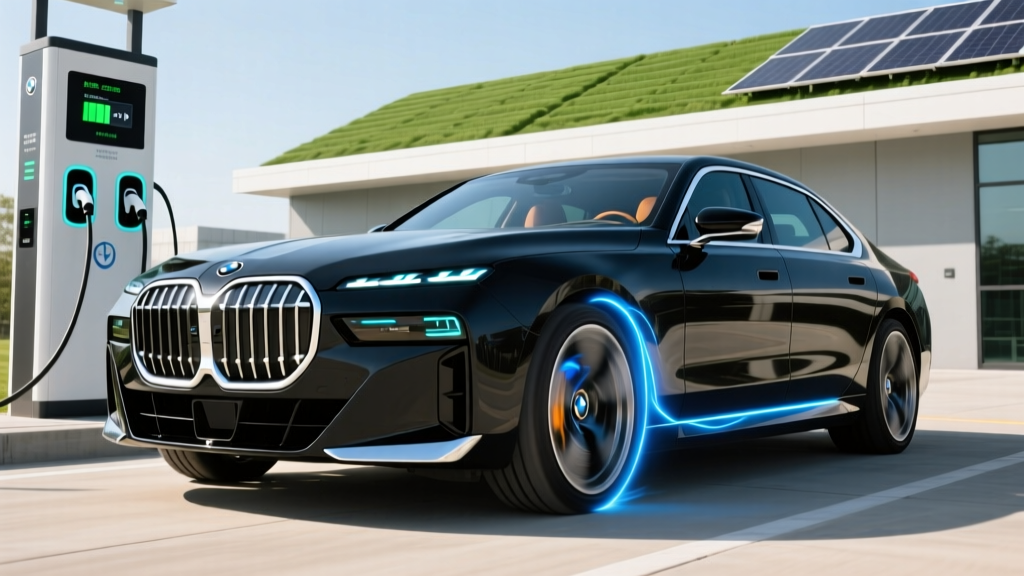
The BMW i7 is a full-size luxury flagship that trades the V8 rumble of its 7 Series sibling for near-silent torque, a 101.7 kWh (usable) NMC battery, and a cabin that borders on a private jet. For 2026, the i7 lineup continues with the xDrive50 and the performance-oriented M70 xDrive, both riding on BMW's CLAR platform with adaptive air suspension and the latest iDrive 8.5 infotainment. If you're searching for BMW i7 0-60 numbers, you've found them: the xDrive50 hits 60 mph in 4.5 seconds, while the M70 slashes that to a supercar-rivaling 3.5 seconds. But this review goes well beyond the stopwatch — we break down real-world range, DC fast-charging curves, home charging practicality, and whether the i7 qualifies for any federal incentives at its six-figure price point.
| Spec | i7 xDrive50 | i7 M70 xDrive |
|---|---|---|
| EPA Range | 318 mi | 295 mi |
| Battery (usable) | 101.7 kWh, NMC | 101.7 kWh, NMC |
| Horsepower | 536 hp | 650 hp |
| Torque | 549 lb-ft | 749 lb-ft (Launch Control) |
| 0-60 mph | 4.5 sec | 3.5 sec |
| Drivetrain | Dual-motor AWD | Dual-motor AWD |
| Max DC Fast Charge | 195 kW | 195 kW |
| 10-80% DC Time | ~34 min | ~34 min |
| Level 2 Charge Rate | 11 kW (AC) | 11 kW (AC) |
| Efficiency | 82 MPGe (combined) | 76 MPGe (combined) |
| Base MSRP | $124,200 | $167,700 |
| Battery Warranty | 8 yr / 100,000 mi | 8 yr / 100,000 mi |
Real-World Range: What the EPA Sticker Doesn't Tell You
The EPA rates the 2026 i7 xDrive50 at 318 miles on a full charge, while the heavier, more powerful M70 drops to 295 miles. Those are competitive numbers for a 5,500-pound luxury sedan — the Mercedes EQS 450+ posts 352 miles but runs a single-motor RWD setup, and the Lucid Air Pure achieves 419 miles at a similar price point. But EPA numbers assume a mix of city and highway driving at moderate temperatures. What happens when you take the i7 on an actual road trip?
Real-World Range Expectations
EPA sticker: 318 mi (xDrive50) / 295 mi (M70)
Highway (70-75 mph, 65°F): ~265-280 mi
Cold weather (30°F, mixed driving): ~225-250 mi (20-25% reduction typical for NMC packs without aggressive preconditioning)
City/regenerative driving: ~310-330 mi (regen recovers significant energy in stop-and-go)
The i7 uses an NMC (nickel manganese cobalt) lithium-ion pack, which offers high energy density but is more temperature-sensitive than LFP chemistry. BMW's thermal management system includes a heat pump, which helps in cold weather by scavenging waste heat from the drivetrain rather than relying solely on resistive cabin heating. Still, expect a 20-25% range reduction in sustained sub-freezing temperatures — physics, not a BMW shortcoming. On a 250-mile highway trip in 40°F weather with the seat heaters on, you'll arrive with roughly 15-20% state of charge remaining. Plan accordingly.
Charging Speed: DC Fast, Home Level 2, and the Curve
Charging is where luxury EV buyers often have the most questions — and where marketing claims need the most context. The i7 supports a peak DC fast-charge rate of 195 kW via its CCS1 connector (BMW has not adopted NACS for the 2026 model year). At that peak rate, BMW claims a 10-80% charge in approximately 34 minutes. But here's what that number doesn't tell you.
| Charge Level | Power | Miles Added per Hour | Notes |
|---|---|---|---|
| Level 1 (120V outlet) | ~1.4 kW | ~3-4 mi/hr | Emergency/trickle only; ~90 hr for full charge |
| Level 2 (240V home) | 11 kW (48A) | ~28-32 mi/hr | Full charge in ~10-11 hr; ideal overnight |
| DC Fast Charge | Peak 195 kW | ~500+ mi/hr (peak) | 10-80% in ~34 min; tapers above 80% |
The charging curve reality: The 195 kW peak is only sustained at low state of charge (roughly 10-30% SoC) and requires a charger capable of delivering at least 200 kW — typically a 350 kW Electrify America or EVgo stall. Above 50% SoC, the rate steps down to roughly 120-140 kW, and above 80% it drops further to protect battery longevity. If you arrive at a charger at 40% SoC, your average rate will be lower and your session longer than the headline 34-minute figure suggests. Preconditioning the battery (via the iDrive navigation system's "Charge Preconditioning" feature) is critical — route to a DC fast charger using the built-in nav, and the car will warm the pack to optimal temperature before you arrive, shaving 5-10 minutes off your session.
For home charging, the i7's onboard charger maxes out at 11 kW (AC, 48 amps). On a properly installed Level 2 home station (such as a ChargePoint Home Flex or BMW's Wallbox), you'll add roughly 30 miles of range per hour. A full overnight charge from 20% to 100% takes about 10-11 hours. Given the i7's 101.7 kWh usable pack, you'll want a dedicated 60-amp circuit with a hardwired Level 2 unit — consult a licensed electrician to verify your panel can support the load.
Performance: BMW i7 0-60 and Driving Dynamics
This is the section that brought you here, so let's get specific. The i7 xDrive50 pairs two electric motors — one on each axle — for a combined 536 horsepower and 549 lb-ft of torque. BMW's official 0-60 mph time is 4.5 seconds, and in independent testing, the xDrive50 has been clocked between 4.3 and 4.6 seconds depending on surface conditions and launch technique. That's quicker than a base Porsche Panamera and roughly on par with a Mercedes-AMG E63 S.
The i7 M70 xDrive is a different animal entirely. With 650 hp and up to 749 lb-ft of torque (via Launch Control), BMW claims a 3.5-second 0-60 mph time. Independent tests have validated sub-3.5-second runs on prepared surfaces. To put that in context: the M70 accelerates faster than the previous-generation M760Li V12, and it does so in near silence. The instant torque delivery — no turbo spool, no transmission downshift — makes the i7 M70 feel even quicker than the numbers suggest in real-world passing maneuvers.
Both models feature BMW's adaptive two-axle air suspension, rear-wheel steering (Integral Active Steering), and xDrive all-wheel drive. The ride quality is genuinely exceptional — the air suspension soaks up expansion joints and potholes with a composure that makes the car feel lighter than its 5,800-pound curb weight. The M70 adds stiffer tuning, larger brakes, and an M Sport differential, but even it prioritizes grand-touring comfort over track-day aggression. This is a luxury express, not a sports sedan.
Pricing, Trims, and Federal Tax Credit Reality
The 2026 BMW i7 starts at $124,200 for the xDrive50 (including destination), while the M70 xDrive commands $167,700. Options like the Executive Package (rear-seat theater screen, massage, heated armrests), Bowers & Wilkins surround sound, and 22-inch wheels can push an xDrive50 to $140,000+ and an M70 well past $180,000.
| Trim | Base MSRP | As-Tested (typical) | §30D Federal Credit |
|---|---|---|---|
| i7 xDrive50 | $124,200 | $135,000-$142,000 | Not eligible (MSRP exceeds $55,000 sedan cap) |
| i7 M70 xDrive | $167,700 | $175,000-$185,000 | Not eligible (MSRP exceeds $55,000 sedan cap) |
Tax credit reality check: Under IRS §30D Clean Vehicle Credit rules, the federal EV tax credit has an MSRP cap of $55,000 for sedans (and $80,000 for SUVs/trucks/vans). The BMW i7, classified as a sedan, far exceeds this threshold and is therefore not eligible for the $7,500 federal tax credit. Additionally, buyer income caps apply (§30D phases out at $150,000 single / $300,000 joint AGI), and battery-critical-mineral sourcing requirements further restrict eligibility even for qualifying models. Always verify current rules on irs.gov or consult a tax professional before purchase.
Some states offer their own EV incentives that may partially offset the cost — check your state's energy office for details. BMW also occasionally offers lease incentives or loyalty credits that can reduce the effective cost, though these vary by dealer and region.
Interior, Tech, and Standout Features
The i7's cabin is where BMW justifies its flagship pricing. The centerpiece is the BMW Curved Display — a 12.3-inch digital instrument cluster fused with a 14.9-inch touchscreen running iDrive 8.5. The system supports wireless Apple CarPlay and Android Auto, over-the-air updates, and BMW's Digital Key Plus (your phone becomes the key via UWB). Voice control via the BMW Intelligent Personal Assistant handles navigation, climate, and media with reasonable accuracy.
The rear seat is where the i7 truly separates itself from competitors. The optional Theater Screen — a 31.3-inch 8K display that descends from the headliner — transforms the rear cabin into a private cinema. Paired with the Executive Lounge seating package (power-reclining rear seats with massage, heated and ventilated cushions, and a dedicated tablet controller), the i7 rear seat rivals a first-class airline pod.
On the driver-assistance front, the i7 comes standard with BMW Driving Assistant Professional, which includes adaptive cruise control with stop-and-go, lane-keeping assist, and automatic lane-change on highways (with driver confirmation via turn signal). This is a Level 2 SAE system — the driver must remain engaged and hands must be detected on the wheel (or eyes on the road via the driver-monitoring camera). The i7 does not offer Level 3 or Level 4 autonomous driving in the U.S. market, though BMW has a Level 3 system (Personal Pilot L3) available in Germany under restricted conditions.
Cargo and passenger space: The i7 offers 17.7 cubic feet of trunk space (no frunk), which is adequate for luggage but less than the EQS's hatchback design. Rear legroom measures 42.8 inches — generous for adults. Front legroom is 41.2 inches. The cabin seats five, though the rear center position is best suited for short trips due to the drivetrain tunnel hump.
Ownership Costs and Efficiency Breakdown
The i7 xDrive50 achieves an EPA-rated 82 MPGe combined (85 city / 79 highway), which translates to roughly 41 kWh per 100 miles. The M70 drops to 76 MPGe combined (~44 kWh/100 mi). At the U.S. average residential electricity rate of ~$0.17/kWh, charging the xDrive50 at home costs approximately $7.00 per 100 miles — compared to roughly $14-$16 per 100 miles for a gas-powered 7 Series averaging 22 MPG at $3.50/gallon. On DC fast charging (averaging $0.40-$0.50/kWh at public stations), the cost rises to roughly $16-$20 per 100 miles, narrowing the advantage.
BMW provides an 8-year / 100,000-mile battery warranty covering capacity loss below 70% of original capacity, along with a 4-year / 50,000-mile bumper-to-bumper warranty and 4 years of complimentary scheduled maintenance. BMW also includes 3 years of complimentary BMW Charging on the Electrify America network (up to a set kWh allowance), which helps offset public charging costs during the ownership honeymoon period.
BMW i7 vs. Key Competitors
The i7 competes in a small but fierce segment. Here's how it stacks up against its primary rivals:
| Spec | BMW i7 xDrive50 | Mercedes EQS 450+ | Lucid Air Pure | Tesla Model S |
|---|---|---|---|---|
| EPA Range | 318 mi | 352 mi | 419 mi | 402 mi |
| 0-60 mph | 4.5 sec | 5.9 sec | 5.2 sec | 3.1 sec (Plaid) |
| Peak DC Charge | 195 kW | 200 kW | 250 kW | 250 kW |
| Base MSRP | $124,200 | $104,400 | $69,900 | $74,990 |
| Cargo (cu ft) | 17.7 | 22.0 | 32.0 | 28.0 |
The i7's advantage is cabin quality and rear-seat luxury — nothing in the segment matches the Theater Screen and Executive Lounge package. Its disadvantage is range and charging speed relative to the Lucid Air, and price relative to the Tesla Model S. The EQS offers more range and a lower entry price but a less engaging drive and a polarizing exterior design.
Pros
- Exceptional cabin materials and rear-seat luxury (Theater Screen is unmatched)
- Smooth, powerful dual-motor AWD with sub-4.5-second 0-60 (xDrive50)
- Quiet, composed ride via adaptive air suspension
- Strong regenerative braking with one-pedal driving capability
- iDrive 8.5 is responsive with wireless CarPlay/Android Auto
- Heat pump included standard for cold-weather efficiency
Cons
- 318-mile range trails Lucid Air, Tesla Model S, and Mercedes EQS
- 195 kW peak DC charge is slower than rivals (Lucid: 250 kW)
- No frunk — 17.7 cu ft trunk is modest for the segment
- $124K+ base price with no federal tax credit eligibility
- Rear-seat Theater Screen and Executive Lounge are expensive add-ons
- Heavy at ~5,800 lbs — affects tire wear and handling agility
Frequently Asked Questions
What is the real-world range of the BMW i7?
The EPA rates the i7 xDrive50 at 318 miles and the M70 at 295 miles. In real-world highway driving at 70-75 mph in moderate temperatures, expect 265-280 miles. In cold weather (below 35°F), plan for 225-250 miles. City driving with regenerative braking can match or slightly exceed the EPA estimate.
How fast does the BMW i7 charge at home and on the road?
On a Level 2 home charger (240V, 48A), the i7 charges at 11 kW, adding roughly 30 miles of range per hour — a full charge takes about 10-11 hours. On a DC fast charger, it peaks at 195 kW, achieving a 10-80% charge in approximately 34 minutes under ideal conditions (low SoC, preconditioned battery, 350 kW-capable station).
Does the BMW i7 qualify for the federal EV tax credit?
No. Under IRS §30D rules, the federal Clean Vehicle Credit has an MSRP cap of $55,000 for sedans. The BMW i7 starts at $124,200, well above this threshold. Buyer income caps and battery-sourcing requirements further restrict eligibility. Check IRS.gov for current rules and consult a tax professional.
Is the BMW i7 worth buying vs. the Lucid Air or Mercedes EQS?
Choose the i7 if rear-seat luxury, cabin quality, and BMW's driving dynamics are your top priorities. Choose the Lucid Air if maximum range (419 mi) and value matter most. Choose the Mercedes EQS if you want the longest range among German rivals at a lower entry price. The i7 wins on interior experience; it loses on range-per-dollar and charging speed.
What is the BMW i7's battery warranty?
BMW covers the i7's high-voltage battery for 8 years or 100,000 miles (whichever comes first), warranting capacity retention above 70% of original. The bumper-to-bumper warranty is 4 years / 50,000 miles, and BMW includes 4 years of complimentary scheduled maintenance.
Does the BMW i7 have a frunk?
No. The i7 does not have a front trunk (frunk). All cargo space is in the rear trunk, which offers 17.7 cubic feet — enough for several suitcases but less than hatchback-style competitors like the EQS or Lucid Air.
What SAE automation level is the BMW i7's driver assist?
The i7's Driving Assistant Professional is a Level 2 SAE system. It provides adaptive cruise, lane-keeping, and automatic lane-change on highways, but the driver must remain fully engaged and supervise the system at all times. It is not self-driving.