When a headline reads "Tesla caught fire," it spreads fast — often faster than the facts. The reality of EV battery fires is far more nuanced than viral clips suggest. This profile examines the engineering behind Tesla's battery safety systems, contextualizes fire risk against gasoline vehicles, and delivers the hard specs buyers actually need: real-world range, charging curves, tax-credit math, and ownership economics for the 2026 Tesla Model Y, the brand's best-selling vehicle and the model most frequently referenced in fire-related news cycles.
The Data Behind "Tesla Caught Fire" Headlines
EV battery fires capture outsized media attention because they are rare and visually dramatic. According to Tesla's own Impact Report and NHTSA incident databases, EVs experience fires at a significantly lower rate per billion miles driven than internal-combustion vehicles. The National Fire Protection Association (NFPA) has consistently found that gasoline vehicles are far more likely to catch fire — yet a gas-car fire rarely makes national news.
When a Tesla does catch fire, the causes typically fall into three categories: severe high-speed collisions that compromise the battery pack structure, manufacturing defects in isolated production batches, or post-crash thermal events during improper towing or storage. Tesla's structural battery pack, introduced with the 4680 cell architecture, is designed to distribute crash forces away from individual cells and reduce propagation risk.
2026 Tesla Model Y: The Specs That Matter
For buyers weighing safety data against everyday utility, the 2026 Model Y remains Tesla's volume leader. Here are the exact specifications you need to evaluate it against the competition.
| Specification | Long Range AWD | Performance |
|---|---|---|
| EPA Range | 320 miles | 295 miles |
| Battery Capacity | 78.1 kWh usable (NMC) | 78.1 kWh usable (NMC) |
| Peak DC Fast Charge | 250 kW | 250 kW |
| 10–80% DCFC Time | ~25 minutes | ~25 minutes |
| Level 2 Home Charge | 11.5 kW / ~44 mi/hr | 11.5 kW / ~44 mi/hr |
| 0–60 mph | 4.8 seconds | 3.5 seconds |
| Horsepower | 384 hp | 456 hp |
| Drivetrain | Dual-Motor AWD | Dual-Motor AWD |
| Efficiency | 122 MPGe / 27 kWh/100mi | 111 MPGe / 30 kWh/100mi |
| Cargo Volume | 76.2 cu ft (rear seats folded) | 76.2 cu ft (rear seats folded) |
| Rear Legroom | 41.6 inches | 41.6 inches |
| Base MSRP | $47,990 | $52,990 |
| Battery Warranty | 8 yr / 120,000 mi | 8 yr / 120,000 mi |
Real-World Range: What the EPA Sticker Doesn't Tell You
EPA Estimate: 320 miles (Long Range AWD)
Real-World Highway (70 mph, 72°F): ~265–285 miles
Real-World Highway (32°F / cold weather): ~215–240 miles
City / Mixed Commuting: ~295–310 miles (regen braking recovers energy)
The Model Y's heat pump helps mitigate cold-weather losses compared to resistive heating, but expect a 20–30% range reduction in sustained sub-freezing temperatures. Source: fueleconomy.gov
Tesla's efficiency remains among the best in the segment. The Model Y's 27 kWh per 100 miles (Long Range) translates to roughly 3.7 miles per kWh — meaning a full 78.1 kWh pack delivers real-world results close to the EPA number in moderate conditions. On road trips at sustained highway speeds, the aerodynamic drag penalty is real: expect to plan charging stops every 240–260 miles in summer and every 200–220 miles in winter.
Charging Speed: DC Fast Charge and Home Setup
| Charging Level | Power (kW) | Miles Added per Hour | Notes |
|---|---|---|---|
| Level 1 (120V outlet) | ~1.4 kW | ~4–5 mi/hr | Emergency/trickle only |
| Level 2 (240V / 48A) | 11.5 kW | ~44 mi/hr | Full overnight charge in ~8 hrs |
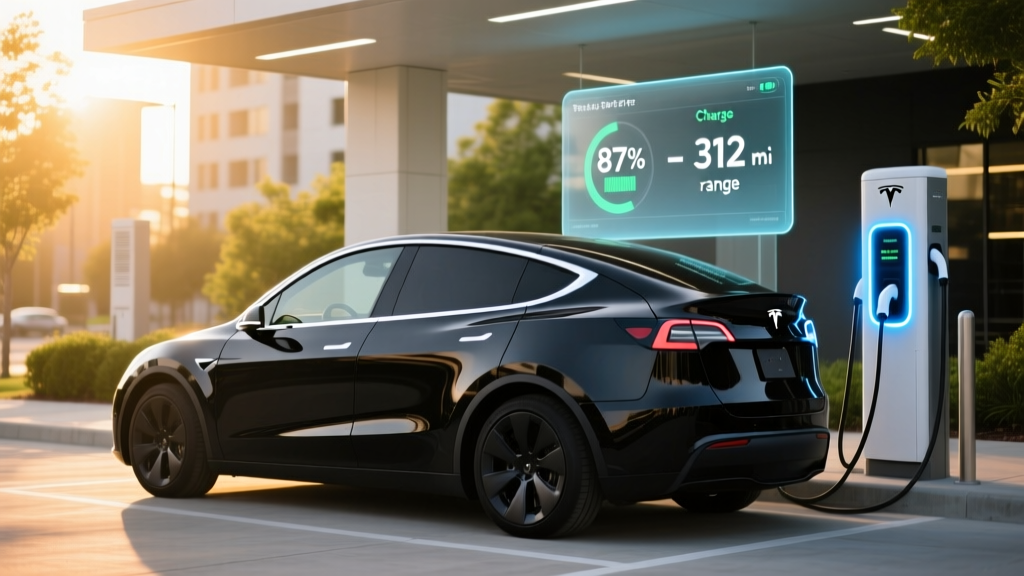
| DC Fast Charge (V3 Supercharger) | Peak 250 kW | ~175 mi in 15 min | Tapers above 50%; 10–80% in ~25 min |
| DC Fast Charge (V4 Supercharger) | Peak 250 kW* | ~175 mi in 15 min | *Vehicle-limited; V4 stalls support higher rates |
A critical detail many reviews omit: the Model Y's charge curve peaks at 250 kW but only sustains that rate from roughly 10% to 30% State of Charge. From 50% to 80%, the rate tapers to approximately 80–100 kW. This means the advertised "15-minute" charge adds about 175 miles only when arriving at a low SoC. If you plug in at 40%, expect longer sessions.
For home charging, Tesla's Wall Connector at 48 amps on a 60-amp circuit delivers 11.5 kW — enough to add 44 miles per hour of charging. A typical overnight session (8 hours) fully replenishes the pack. Installation costs range from $500 to $2,000 depending on your electrical panel's capacity; a 200-amp panel is generally required, and older homes may need a $2,000–$4,000 panel upgrade.
Pricing, Tax Credits, and Total Cost
| Trim | MSRP | Est. Federal Credit (§30D) | Effective Price |
|---|---|---|---|
| Long Range AWD | $47,990 | $3,750–$7,500* | $40,490–$44,240 |
| Performance | $52,990 | $3,750–$7,500* | $45,490–$49,240 |
*The IRS §30D credit is not guaranteed at $7,500. The full credit requires meeting both critical-mineral sourcing ($3,750) AND battery-component manufacturing ($3,750) requirements. Tesla's US-built battery packs partially qualify, but sourcing rules tighten annually. Buyer income caps apply: $150,000 single / $300,000 joint AGI. The Model Y qualifies under the $80,000 SUV MSRP cap. Point-of-sale transfer is available at participating dealers. Always verify current eligibility at fueleconomy.gov before purchase.
Tech, Safety, and Driver Assistance
The Model Y's 15.4-inch center touchscreen handles navigation, climate, media, and vehicle settings — there are no physical buttons. The 2026 refresh includes a redesigned interior with ventilated front seats, ambient lighting, and improved noise insulation. Tesla's infotainment remains best-in-class for responsiveness, though Apple CarPlay and Android Auto are still absent.
Tesla Autopilot and FSD (Supervised) are SAE Level 2 driver-assistance systems. The driver must remain fully engaged — hands on or near the wheel, eyes on the road — at all times. These systems are NOT self-driving. Only SAE Level 4 services (Waymo, Zoox in designated zones) operate without a human driver. Misuse of Level 2 systems has contributed to NHTSA-investigated incidents.
Standard safety features include automatic emergency braking, lane-keeping assist, blind-spot monitoring, and 360-degree cameras. The Model Y earns a 5-Star overall rating from NHTSA and is an IIHS Top Safety Pick+ when equipped with the updated headlight package.
Regarding fire safety specifically: Tesla's battery management system continuously monitors cell voltage, temperature, and current flow. If an anomaly is detected, the system can isolate affected cell modules and alert the driver to pull over. The structural battery pack's steel and aluminum enclosure provides additional crush protection beyond what earlier 2170-cell packs offered.
Who Should Buy the 2026 Model Y — and Who Shouldn't
- Class-leading efficiency (122 MPGe combined)
- Extensive Supercharger network (20,000+ stalls in North America)
- OTA updates continuously add features
- Strong resale value relative to EV segment
- Spacious cargo area (76.2 cu ft) with front trunk
- Heat pump standard — better cold-weather range retention
- No Apple CarPlay / Android Auto
- FSD costs $8,000 extra — remains Level 2 only
- Panel gaps and paint quality inconsistent on some builds
- Touchscreen-only controls frustrate some drivers
- No physical door handles (flush electronic release)
- Insurance premiums 15–30% above segment average
Choose the Model Y if: You want maximum Supercharger network access, best-in-class efficiency, and a spacious family crossover that holds value well. Ideal for road-trippers and daily commuters with home charging.
Look elsewhere if: You demand Apple CarPlay, prefer physical controls, need third-row seating (consider the Kia EV9), or want a more luxurious interior (consider the BMW iX or Genesis Electrified GV70).
How the Model Y Stacks Up Against Competitors
At ~$48,000 before incentives, the Model Y Long Range competes directly with the Hyundai Ioniq 5 ($45,500, 310 mi EPA), Ford Mustang Mach-E ($48,995, 312 mi EPA), and the upcoming Chevrolet Equinox EV ($36,000, 315 mi EPA). The Model Y's advantages are its Supercharger network and efficiency; its disadvantages include interior material quality and the absence of CarPlay. The Ioniq 5 charges faster on 350 kW-capable infrastructure (10–80% in ~18 minutes vs. the Model Y's ~25 minutes), though real-world Supercharger reliability still exceeds Electrify America uptime in most regions.
Frequently Asked Questions
Do Teslas catch fire more often than gas cars?
No. Data from NHTSA, NFPA, and international agencies consistently show EVs catch fire at a fraction of the rate of internal-combustion vehicles. Gasoline vehicles experience roughly 60x more fires per 100,000 vehicles. However, EV battery fires are harder to extinguish (requiring thousands of gallons of water and extended monitoring) and attract disproportionate media coverage, creating a perception gap.
What happens if a Tesla battery catches fire?
Tesla's battery pack includes thermal barriers between cell modules designed to prevent propagation — meaning a single compromised cell ideally won't ignite adjacent cells. If a fire does occur, first responders follow specific EV fire protocols (detailed in Tesla's Emergency Response Guide). The vehicle's systems provide warnings before thermal events in most non-collision scenarios, giving occupants time to exit.
Is the 2026 Model Y eligible for the $7,500 federal tax credit?
It qualifies for up to $7,500 under IRS §30D, but the actual amount depends on battery-component and critical-mineral sourcing compliance, which changes annually. Buyer income must not exceed $150,000 (single) or $300,000 (joint). The Model Y's MSRP is under the $80,000 SUV cap. Check current eligibility on fueleconomy.gov before purchasing, and consult a tax professional for your specific situation.
How long does the Model Y battery last before replacement?
Tesla warrants the battery for 8 years or 120,000 miles (whichever comes first) with a minimum 70% capacity retention. Real-world data from Tesla's fleet indicates most packs retain 85–90% capacity at 150,000 miles. Full battery replacement out of warranty costs approximately $12,000–$16,000 depending on pack configuration and service location.
Can I charge a Tesla at non-Tesla chargers?
Yes. The 2026 Model Y uses the NACS (North American Charging Standard) connector natively. With the industry-wide shift to NACS adoption (Ford, GM, Rivian, Hyundai, and others now use NACS), the Model Y can charge at any NACS-equipped station. For legacy CCS chargers, an adapter is available but rarely needed in 2026 as most networks have transitioned.
Is FSD (Full Self-Driving) worth the $8,000 cost?
For most buyers, no. FSD (Supervised) remains an SAE Level 2 system requiring constant driver attention. It performs well on highways and familiar routes but can make unexpected errors in construction zones, adverse weather, and unmapped areas. The $8,000 cost (or $99/month subscription) does not unlock autonomous capability. Standard Autopilot is sufficient for most commuters.