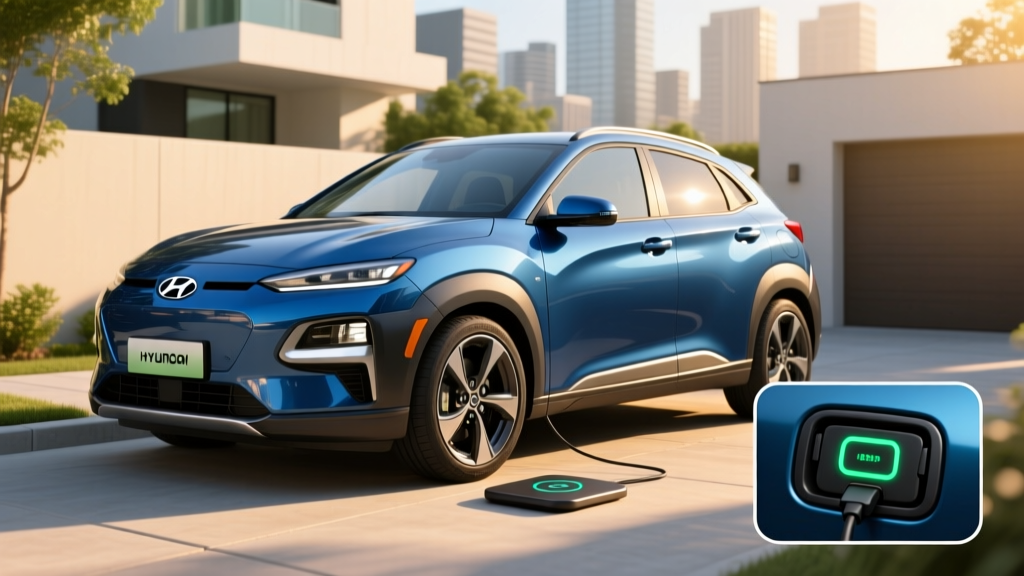
Quick Verdict: The 2026 Hyundai Kona Electric is a practical compact crossover for buyers who want a sub-$35,000 EV with reliable daily range. With an EPA-estimated 261 miles on the SEL and Limited trims, a 64.8 kWh NMC battery, and DC fast charging that peaks at roughly 100 kW (10–80% in about 43 minutes), it fits commuters and small families who have access to Level 2 home charging. It does not qualify for the full $7,500 federal tax credit under current §30D battery-sourcing rules, which affects its value equation versus gas rivals like the Hyundai Kona 1.6T or hybrid alternatives.
Range and Battery: What 261 EPA Miles Actually Means
The 2026 Kona EV carries over the second-generation platform introduced for 2024, powered by a 64.8 kWh (usable) nickel-manganese-cobalt (NMC) battery pack paired with a single front-mounted permanent-magnet synchronous motor producing 201 horsepower and 188 lb-ft of torque. The EPA rates the SEL and Limited trims at 261 miles of combined range, while the lighter SE trim achieves 261 miles as well on its slightly different wheel/tire setup. Efficiency lands at approximately 118 MPGe combined, or roughly 29 kWh per 100 miles, according to fueleconomy.gov.
EPA Sticker: 261 miles
Real-World Highway (70 mph, moderate temps): ~225–240 miles
Cold Weather (below 32°F, highway): ~185–210 miles
Why the gap? The Kona EV lacks a heat pump on lower trims (standard on Limited), meaning cabin heating in winter draws directly from the traction battery. Highway speeds above 65 mph also increase aerodynamic drag significantly on this compact crossover profile. Plan for ~200 miles of usable range in mixed cold-weather driving if you want a comfort buffer.
For context, the Kona EV's range trails segment leaders like the Chevrolet Equinox EV (~315 mi) and Hyundai's own Ioniq 5 (~303 mi), but it undercuts them in price by $5,000–$10,000. The 261-mile figure is enough for most daily commutes and weekend errands, but road-trippers should map charging stops carefully on routes exceeding 200 miles.
Charging Speed and Infrastructure Reality
The Kona EV charges via a standard CCS1 connector for DC fast charging and a J1772 inlet for Level 1 and Level 2 AC charging. Hyundai equips the Kona EV with an 11 kW onboard charger for Level 2, meaning a full charge from empty takes approximately 6.5 hours on a 48-amp home charger.
| Charging Level | Power (kW) | Miles Added per Hour | Time (10–80%) | Best Use |
|---|---|---|---|---|
| Level 1 (120V outlet) | ~1.4 kW | ~4–5 mi/hr | ~55+ hours | Emergency / overnight trickle |
| Level 2 (240V, 48A) | 11 kW (max onboard) | ~35–40 mi/hr | ~6.5 hours (full) | Daily home charging |
| DC Fast Charge | Peak ~100 kW | ~180–220 mi/hr (peak) | ~43 minutes | Road trips |
The ~100 kW peak DC charge rate is the Kona EV's most significant competitive limitation. Rivals like the Ioniq 5 (peak ~240 kW on 800V architecture) and even the Kia Niro EV (~85 kW, but with a slightly smaller battery) offer similar or faster session times. On a 350 kW Electrify America or Tesla Supercharger (with NACS adapter, if available), the Kona EV will not exceed its onboard limit. The charge curve also tapers noticeably above 60% state of charge, meaning the back half of a charging session takes disproportionately longer. On a real road trip, plan for 45–50 minutes per stop if you're charging from 10% to 80%.
Home charging setup cost: Expect to spend $600–$1,200 on a quality Level 2 wallbox (e.g., ChargePoint Home Flex, Emporia Level 2) plus $500–$2,000 for electrician installation, depending on whether your panel needs a 240V/50A circuit run. If your home has a 100-amp main panel with limited spare capacity, a panel upgrade to 200 amps can add $1,500–$3,000. Always get a licensed electrician's assessment before purchasing equipment.
Kona EV vs. Gas Kona vs. Kona Hybrid: Cost Comparison
Hyundai sells the Kona in three powertrains: gas (1.6T, ~28 MPG combined), hybrid (HEV, ~43 MPG combined), and fully electric (118 MPGe). Here's how the numbers stack up for a buyer comparing all three:
| Metric | 2026 Kona EV SEL | 2026 Kona Gas SEL (1.6T) | 2026 Kona Hybrid SEL |
|---|---|---|---|
| Base MSRP | ~$34,000 | ~$28,500 | ~$31,000 |
| EPA Efficiency | 118 MPGe (29 kWh/100mi) | 28 MPG combined | 43 MPG combined |
| Energy Cost per Mile* | $0.04–$0.05 | $0.13–$0.15 | $0.08–$0.10 |
| Annual Fuel/Energy (12,000 mi) | ~$480–$600 | ~$1,560–$1,800 | ~$960–$1,200 |
| Federal Tax Credit (§30D) | $0–$3,750** | $0 | $0 |
| Estimated 5-Year Energy Cost | ~$2,400–$3,000 | ~$7,800–$9,000 | ~$4,800–$6,000 |
| Maintenance (5-Year Est.) | ~$1,200 | ~$2,800 | ~$2,500 |
*Based on $0.15/kWh home electricity and $3.60/gallon regular unleaded. Public DC fast charging at $0.40–$0.50/kWh raises the Kona EV's per-mile cost to $0.12–$0.15, comparable to the gas model.
**The Kona EV's battery sourcing has historically limited its §30D eligibility. Under 2026 IRS rules, the vehicle may qualify for $3,750 (critical minerals requirement met but battery component requirement not met) or $0 depending on supply-chain changes. Always verify current eligibility at irs.gov before purchase. Point-of-sale transfer is available if eligible.
The takeaway: The Kona EV saves $4,800–$6,000 in energy costs over five years versus the gas Kona, plus roughly $1,600 in maintenance savings (no oil changes, fewer brake replacements due to regenerative braking). However, the $5,500 higher MSRP and uncertain tax credit mean break-even takes 4–6 years for most drivers. The hybrid is the middle ground: lower upfront cost, no charging dependency, and still meaningful fuel savings.
Tax Credit Eligibility: What Kona EV Buyers Must Know
2026 §30D Federal EV Tax Credit Requirements:
- MSRP Cap: Vehicle must have an MSRP at or below $55,000 for SUVs/crossovers (Kona EV qualifies)
- Buyer Income Cap: Modified AGI must not exceed $150,000 (single), $225,000 (head of household), or $300,000 (joint filers)
- Battery Component Rule: A percentage of battery components must be manufactured or assembled in North America (phase-in percentage increases annually)
- Critical Minerals Rule: A percentage of critical minerals must be sourced from the U.S. or FTA partners
- FEOC Restriction: Battery components and critical minerals cannot come from Foreign Entities of Concern (primarily China, Russia, North Korea, Iran)
- Point-of-Sale Transfer: If eligible, you can transfer the credit to the dealer at purchase for an immediate price reduction
Hyundai has worked to localize battery sourcing for its U.S.-built EVs (the Ioniq 5 is assembled in Georgia), but the Kona EV is imported from South Korea with battery cells that may not fully satisfy the escalating domestic-content thresholds. As of early 2026, buyers should confirm with their dealer whether the specific VIN qualifies for $3,750 or $7,500 — and prepare for the possibility that it qualifies for $0. This is the single biggest variable in the Kona EV's value proposition.
Common Misconceptions About the Kona EV
| Myth | Fact |
|---|---|
| "The Kona EV charges at any public DC station at full speed." | Its peak rate is ~100 kW. Even at a 350 kW station, it won't charge faster than 100 kW. Expect 43+ minutes for a 10–80% session. |
| "261 miles of range means I can drive 261 miles before stopping." | Highway driving at 70+ mph, cold weather, and HVAC use reduce real range to 200–240 miles. Always plan stops at ~180 miles for a safety margin. |
| "I'll get the full $7,500 tax credit." | Battery-sourcing rules under §30D may reduce or eliminate the credit. Verify per VIN before purchasing. |
| "EVs need no maintenance." | Tires wear faster due to instant torque and higher vehicle weight. Cabin air filters, brake fluid, coolant, and wiper blades still require service. Budget ~$200–$300/year. |
| "The battery will need replacing in a few years." | Hyundai covers the battery with a 10-year/100,000-mile warranty against defects and capacity loss below 70%. NMC batteries typically degrade 1–2% per year under normal use, retaining ~85–90% capacity at 100,000 miles. |
Who Should Buy the Kona EV — and Who Shouldn't
Choose the 2026 Kona EV if:
- You have reliable Level 2 home charging (garage or driveway with 240V access)
- Your daily driving is under 80 miles round-trip, with occasional 150–200 mile weekend trips
- You want an EV under $35,000 MSRP with strong warranty coverage and don't need 300+ mile range
- You live in a mild-to-moderate climate, or can accept winter range reduction to ~200 miles
- You value Hyundai's 10-year/100,000-mile powertrain warranty and complimentary maintenance program
Look elsewhere if:
- You rely exclusively on public charging — the Kona EV's ~100 kW peak rate means longer sessions than competitors
- You regularly drive 250+ miles between stops or live in extreme cold (below 10°F for extended periods)
- You need AWD — the Kona EV is front-wheel drive only; consider the Ioniq 5 AWD or Kia EV6 instead
- Tax credit eligibility is a dealbreaker — the Kona EV's §30D status is uncertain, and a $3,750–$7,500 gap versus eligible rivals (like the U.S.-built Ioniq 5 or Equinox EV) changes the math
- You tow — the Kona EV is not rated for towing
Ownership Costs Over 5 Years: The Full Picture
| Cost Category | Kona EV SEL (Est.) | Kona Gas SEL (Est.) |
|---|---|---|
| Purchase Price (MSRP) | $34,000 | $28,500 |
| Tax Credit Applied | –$0 to –$3,750 | $0 |
| Home Charger Install | $1,500 | $0 |
| Energy/Fuel (5 yr) | $2,700 | $8,400 |
| Maintenance (5 yr) | $1,200 | $2,800 |
| Insurance (5 yr avg.) | $7,500 | $6,000 |
| Depreciation (est.) | $12,000 | $10,500 |
| Total 5-Year Cost | ~$45,150–$48,900 | ~$45,700 |
Insurance tends to run 15–25% higher on EVs due to repair costs and battery replacement risk. Depreciation on the Kona EV has been steeper than gas models in recent years, partly due to Tesla-driven price wars and evolving tax credit rules shifting demand. However, if you qualify for even a partial credit and charge primarily at home, the Kona EV can reach cost parity with the gas Kona within 5 years while delivering a quieter, smoother driving experience.
Frequently Asked Questions
Does the 2026 Hyundai Kona EV qualify for the $7,500 federal tax credit?
Not necessarily. Under current §30D rules, the Kona EV's battery sourcing may limit it to $3,750 or disqualify it entirely. The IRS updates eligible vehicle lists periodically — check fueleconomy.gov's tax credit page and confirm with your dealer for the specific VIN before purchase. State and local incentives may still apply regardless of federal eligibility.
How long does it take to charge the Kona EV at home?
On a Level 2 (240V, 48-amp) home charger, a full charge from near-empty takes about 6.5 hours. Most owners plug in overnight and wake up to a full battery. On a standard 120V outlet (Level 1), expect roughly 4–5 miles of range per hour of charging — adequate only for very low daily mileage or as a backup.
Is the Kona EV good in winter and cold weather?
It's adequate but not class-leading. Without a heat pump (standard only on the Limited trim), cabin heating draws significantly from the battery. Expect 20–30% range reduction in sustained below-freezing temperatures. Preconditioning the battery while plugged in helps preserve range and improves regenerative braking performance in cold weather.
How does the Kona EV compare to the Kia Niro EV?
Both share similar platforms and powertrains (201 hp, ~64–65 kWh battery, ~100 kW peak DC charging). The Niro EV offers slightly more cargo space (23.9 cu ft vs. 25.5 cu ft in the Kona EV, depending on measurement standard) and a marginally lower starting price. The Kona EV counters with a more modern interior design and Hyundai's longer warranty reputation. Neither offers AWD or 200+ kW fast charging.
What is the Kona EV's battery warranty?
Hyundai provides a 10-year/100,000-mile warranty on the high-voltage battery pack, covering defects and capacity loss below 70% of original capacity. The broader powertrain warranty is also 10 years/100,000 miles, and basic vehicle coverage is 5 years/60,000 miles — among the strongest in the industry.
Can I use Tesla Superchargers with the Kona EV?
Hyundai has committed to NACS (Tesla connector) adoption, but the 2026 Kona EV ships with a CCS1 port. You may be able to use Tesla Superchargers via an approved CCS-to-NACS adapter, or future model years may include a native NACS port. Confirm adapter compatibility with Hyundai and Tesla's network policies before relying on this for travel.