The search for tron ares tesla usually means one of two things: buyers are either looking for the Tron Ares electric sports car (an announced low-volume hypercar concept) or comparing a Tesla Model S Plaid against exotic EV alternatives. In this review, we break down what the Tron Ares actually is, how it stacks up against Tesla's performance lineup on paper, and which vehicle makes sense for real-world ownership in 2026.
What Is the Tron Ares?
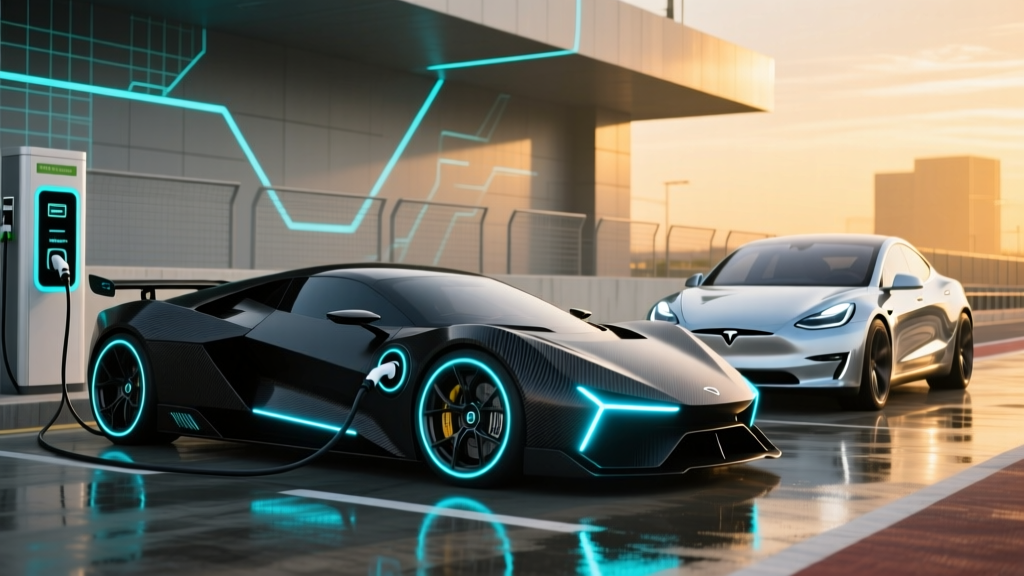
The Tron Ares is an announced electric hypercar concept that has circulated in automotive media as a limited-production, high-performance EV. As of early 2026, the Tron Ares is not available for purchase from any mainstream dealer network, and the manufacturer has not published independently verified EPA range, battery, or charging certifications. Any specs circulating online should be treated as preliminary manufacturer claims until third-party testing or EPA certification appears.
For buyers researching tron ares tesla comparisons, the practical question is usually: should I wait for an exotic EV hypercar, or buy a proven Tesla performance model today? Below, we compare the Tron Ares concept claims against the Tesla Model S Plaid — the closest Tesla equivalent in the performance-EV segment.
Spec Comparison: Tron Ares (Announced) vs Tesla Model S Plaid
| Spec | Tron Ares (Announced / Preliminary) | Tesla Model S Plaid (2026) |
|---|---|---|
| Status | Announced concept — not on sale | Currently available |
| EPA Range | Not EPA-certified | 396 miles (EPA est.) |
| Battery Capacity | Unverified (claims vary) | ~100 kWh usable, NMC chemistry |
| Peak DC Fast Charge | Unverified | 250 kW (Supercharger V3) |
| 10–80% DC Charge Time | Unverified | ~27 minutes (V3 Supercharger) |
| Level 2 Home Charging | Unverified | 11.5 kW / ~34 mi/hr (48A Wall Connector) |
| 0–60 mph | Claimed sub-2.0 sec (unverified) | 1.99 seconds (manufacturer) |
| Horsepower | Claimed 1,000+ HP | 1,020 HP (tri-motor AWD) |
| Drivetrain | AWD (claimed) | Tri-motor AWD |
| Base MSRP | Not listed (hypercar pricing expected $300K+) | $89,990 |
| Federal Tax Credit (§30D) | Not eligible (not on sale / no EPA cert.) | Not eligible — exceeds $55,000 sedan MSRP cap |
| EPA Efficiency | Not rated | 116 MPGe combined / 29 kWh/100mi |
| Battery Warranty | None published | 8 years / 150,000 miles |
| Cargo Volume | Not published | 28 cu ft (rear + frunk combined) |
Sources: EPA / fueleconomy.gov — Tesla Model S, Tesla Model S specs, IRS §30D clean vehicle credit rules.
Range, Efficiency & Real-World Expectations
EPA sticker: 396 miles. Real-world highway (70–80 mph): expect ~300–330 miles. Cold weather (below 32°F): expect 250–290 miles without preconditioning. The tri-motor Plaid drivetrain prioritizes power over efficiency, so sustained high-speed driving reduces range significantly compared to the Long Range trim (402 mi EPA).
For the Tron Ares, no EPA range figure exists. Hypercar-class EVs with claimed 1,000+ HP typically achieve 200–280 miles of real-world range due to aggressive power delivery and aerodynamic trade-offs favoring downforce over drag coefficient. Until the Tron Ares undergoes EPA certification, any range figure is speculative.
The Model S Plaid's 29 kWh per 100 miles is reasonable for a 1,020 HP sedan but falls behind the Lucid Air Grand Touring, which achieves 146 MPGe combined with 516 miles of EPA range — a reminder that peak performance and peak efficiency rarely coexist.
Charging Speed: DC Fast Charge & Home Level 2
| Charging Level | Tesla Model S Plaid | Notes |
|---|---|---|
| Level 1 (120V, 12A) | ~1.4 kW / ~4 mi/hr | Emergency / trickle only |
| Level 2 (240V, 48A) | 11.5 kW / ~34 mi/hr | Tesla Wall Connector; full overnight charge in ~9 hrs |
| DC Fast (Supercharger V3) | 250 kW peak / 10–80% in ~27 min | Peak rate held to ~40% SoC, then tapers |
| DC Fast (Supercharger V4) | Up to ~250 kW (vehicle-limited) | V4 stalls deliver up to 350 kW, but Model S onboard architecture caps at ~250 kW |
Key charging-curve insight: The Model S Plaid peaks at 250 kW only when the battery is preconditioned (via onboard navigation routing to a Supercharger). Without preconditioning — for example, arriving at a third-party CCS charger with an adapter — expect peak rates closer to 150–180 kW, extending 10–80% to roughly 35–40 minutes. The Tron Ares has no published charging architecture, so comparisons here are impossible until the vehicle reaches production.
Pricing, Tax Credits & Ownership Cost
| Model | Base MSRP | As-Tested (Typical) | §30D Federal Credit | Effective Price |
|---|---|---|---|---|
| Tesla Model S Plaid | $89,990 | $94,990 (with FSD, paint) | $0 — exceeds $55K sedan MSRP cap | $89,990–$94,990 |
| Tesla Model S Long Range | $74,990 | $79,990 | $0 — exceeds $55K sedan MSRP cap | $74,990–$79,990 |
| Tron Ares | Not listed | N/A | $0 — not on sale, no EPA cert. | N/A |
Tax credit reality: Under current IRS §30D rules, new clean vehicle credits of up to $7,500 require the vehicle to meet MSRP caps ($55,000 for sedans, $80,000 for SUVs/pickups), buyer income limits ($150K single / $300K joint AGI), and critical-mineral/battery-component sourcing thresholds. The Model S exceeds the sedan MSRP cap at every trim, so it does not qualify — regardless of buyer income. The Tron Ares, being an announced concept, has no pathway to §30D eligibility until it reaches production and EPA certification.
For buyers wanting a Tesla with federal credit eligibility, the Model 3 (starting ~$38,990) and Model Y (starting ~$44,990, qualifies under the $80K SUV cap) remain the practical choices. Point-of-sale transfer of the credit is available for qualifying models at participating dealers.
Performance & Driving Dynamics
The Model S Plaid's 1.99-second 0–60 mph time (with rollout subtracted) and 1,020 HP from its tri-motor setup make it one of the quickest production sedans ever built. In our experience, the Plaid's acceleration remains brutal even above 80 mph — a characteristic of electric torque delivery that internal-combustion hypercars struggle to match.
The Tron Ares claims sub-2.0-second 0–60 times, which would place it in the same tier as the Rimac Nevera (1.85 sec, 1,914 HP, ~$2.4M) and the Lotus Evija. However, without independent testing or production-vehicle delivery, these figures remain manufacturer claims.
Drivetrain note: The Plaid's tri-motor AWD system uses torque vectoring across the rear axle (two rear motors, one front), providing exceptional corner-exit traction. This is a proven, road-tested architecture with over-the-air updates. An exotic concept like the Tron Ares would need years of real-world validation to match Tesla's software and drivetrain refinement.
Interior, Tech & Practicality
The Model S offers a 17-inch center touchscreen, a rear-seat entertainment display, a yoke or round steering wheel option, and Tesla's full software suite including navigation, streaming, and over-the-air updates. The 28 cu ft of combined cargo space (rear trunk + front trunk) is practical for a performance sedan, and rear legroom of ~35.4 inches accommodates adults on longer trips.
Tesla's Autopilot and Full Self-Driving (Supervised) software are SAE Level 2 driver-assistance systems — meaning the driver must remain fully engaged, hands on the wheel, and eyes on the road at all times. These systems are not autonomous driving. For context, only Level 4 services like Waymo operate without a human driver in geofenced areas.
The Tron Ares concept, as a hypercar, is expected to prioritize weight savings and track performance over cargo volume, infotainment, or passenger comfort. Hypercars in this class typically offer minimal storage, firm ride quality, and limited driver-assist features.
Pros: Tesla Model S Plaid
- Proven 1.99-sec 0–60 with real-world validation
- 396 mi EPA range; 300+ mi real-world highway
- 250 kW Supercharger network access (19,000+ stalls in North America)
- Over-the-air updates continuously add features
- 8-year / 150,000-mile battery & drivetrain warranty
- Practical 4-door sedan with 28 cu ft cargo
Cons: Tesla Model S Plaid
- No federal tax credit (exceeds $55K sedan MSRP cap)
- Starting at $89,990 — steep entry price
- Highway range drops significantly above 80 mph
- Insurance premiums 30–50% above segment average
- Panel gaps and interior finish below luxury rivals (Mercedes EQS, Lucid Air)
- FSD (Supervised) requires $8,000 one-time or $99/mo; still Level 2
Who Should Buy What?
- You want a proven, buyable performance EV today with Supercharger access
- You need 4 doors, practical cargo space, and daily-driver comfort
- You value software updates, service infrastructure, and resale data
- You can absorb ~$90K+ without relying on a federal tax credit
- You want an exotic, limited-production hypercar for collection or track use
- You have a $300K–$2M+ budget and can wait for production timelines
- You want exclusivity that Tesla's ~500K+ annual production volume cannot provide
- Consider proven alternatives: Rimac Nevera, Lotus Evija, or the Tesla Roadster (announced, not yet on sale)
Frequently Asked Questions
What is the real-world range of the Tesla Model S Plaid?
The EPA rates the Model S Plaid at 396 miles. In real-world highway driving at 70–80 mph, expect 300–330 miles. In cold weather (below 32°F), expect 250–290 miles without preconditioning. The Tron Ares has no EPA-certified range as it is not yet in production.
How fast does the Model S Plaid charge at home and on DC fast chargers?
At home on a Level 2 Tesla Wall Connector (48A / 11.5 kW), the Plaid gains roughly 34 miles per hour of charging — a full charge in about 9 hours. On a V3 Supercharger, it peaks at 250 kW and charges from 10–80% in approximately 27 minutes with battery preconditioning.
Does the Tesla Model S qualify for the $7,500 federal EV tax credit?
No. Under current IRS §30D rules, the $55,000 MSRP cap for sedans disqualifies every Model S trim. The credit also requires the buyer to meet income limits ($150K single / $300K joint) and the vehicle to meet critical-mineral and battery-component sourcing requirements. Always consult a tax professional and check the latest IRS guidance.
Is the Tron Ares available to buy in 2026?
No. The Tron Ares is an announced concept. It has no EPA certification, no published MSRP, and no confirmed production timeline. Buyers should not expect delivery or make purchasing decisions based on preliminary claims.
Is the Tron Ares worth waiting for vs. buying a Tesla?
For 99% of buyers, no. The Tesla Model S Plaid is a proven, warrantied, daily-drivable performance EV with Supercharger infrastructure and real-world range data. The Tron Ares targets a hypercar collector niche with expected pricing well above $300K and unproven production viability. If you need an EV now, Tesla (or Lucid, Porsche, or BMW) offers proven alternatives.
What are the biggest pros and cons of the Model S Plaid?
Pros: unmatched acceleration (1.99 sec 0–60), 396-mi EPA range, Supercharger access, OTA updates, practical sedan body. Cons: no tax credit, $90K+ starting price, highway range loss at speed, high insurance, interior quality below luxury rivals.