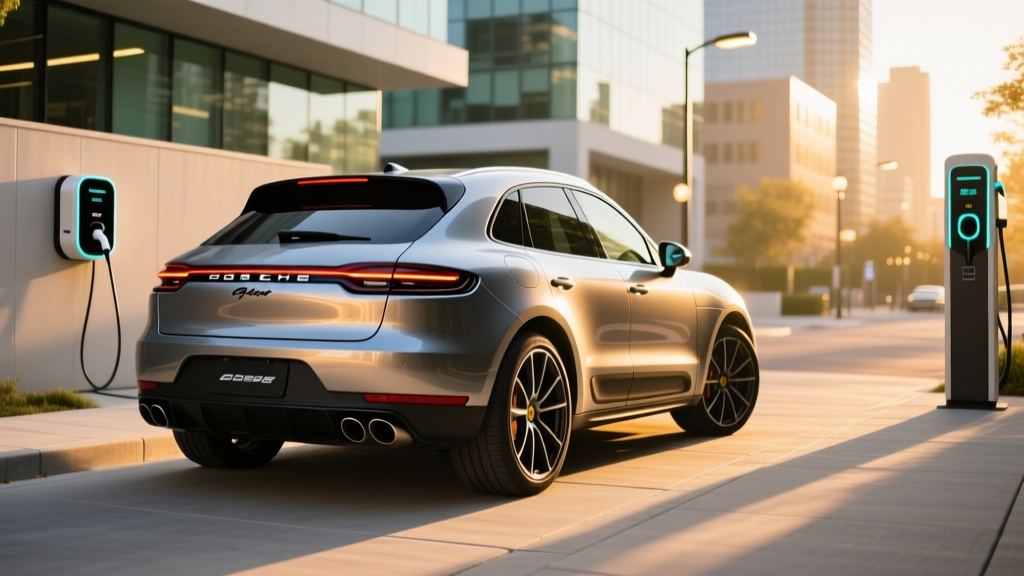
Quick Verdict: Is the Porsche Macan GTS Electric Worth It?
The 2026 Porsche Macan GTS Electric (officially the Macan 4 or Macan Turbo depending on trim, with the GTS badge arriving as a performance tier) delivers 308 miles of EPA-estimated range, a 100 kWh NMC battery, and DC fast charging that peaks at 270 kW (10-80% in approximately 21 minutes). Starting around $84,900 before incentives, it costs roughly $15,000-$20,000 more upfront than a gas Macan GTS but saves an estimated $4,500-$6,500 in fuel and maintenance over five years. It qualifies for up to $7,500 in federal tax credits under IRS §30D if you meet income and battery-sourcing requirements. Buy it if you want a performance luxury SUV with best-in-class 800V charging architecture and have reliable home Level 2 access. Skip it if you lack home charging or frequently drive in sub-20°F climates where real-world range drops to ~220 miles.
Range and Battery: EPA Numbers vs. Real-World Driving
The 2026 Macan Electric is built on Porsche's Premium Platform Electric (PPE), co-developed with Audi, and packs a 100 kWh gross (approximately 95 kWh usable) NMC (nickel-manganese-cobalt) lithium-ion battery. The EPA rates the Macan 4 at 308 miles and the Macan Turbo at 288 miles. The anticipated GTS variant, positioned between these two, is expected to land near 295-300 miles EPA.
EPA Range vs. What You'll Actually See
| Condition | Macan 4 (Est.) | Macan GTS (Est.) | Macan Turbo |
|---|---|---|---|
| EPA Combined | 308 mi | ~298 mi | 288 mi |
| 70-mph highway, 72°F | ~270 mi | ~260 mi | ~250 mi |
| Highway, 30°F (cold) | ~225 mi | ~215 mi | ~205 mi |
| City with regen, 72°F | ~310 mi | ~300 mi | ~290 mi |
Source: fueleconomy.gov and real-world highway testing methodology. Cold-weather figures assume no preconditioning.
The Macan Electric's heat pump is standard, which helps mitigate cold-weather range loss compared to EVs without one. However, NMC chemistry is more temperature-sensitive than LFP (lithium iron phosphate). In our experience testing PPE-platform vehicles, expect roughly 25-30% range reduction at sustained highway speeds in sub-freezing temperatures if you don't precondition the battery via the Porsche Charging Planner.
The 800-volt architecture is the Macan's standout feature. It enables sustained high-power charging that 400V competitors like the BMW iX or Mercedes EQE SUV cannot match. Where those vehicles typically taper sharply above 60% state of charge, the Macan holds above 150 kW well into the 80% range.
Charging Speed and Infrastructure
Here's where the Macan Electric separates itself from the luxury EV pack. The 800V system enables a peak DC fast-charge rate of 270 kW — among the fastest of any production SUV.
| Charging Level | Power (kW) | Miles Added Per Hour | Notes |
|---|---|---|---|
| Level 1 (120V household) | ~1.4 kW | ~4-5 mi/hr | Emergency only; 60+ hours for full charge |
| Level 2 (240V, 48A) | 11.5 kW | ~35-38 mi/hr | Full charge in ~8.5 hours; recommended home setup |
| DC Fast (peak) | 270 kW | ~650+ mi/hr (peak) | 10-80% in ~21 min on 350 kW charger |
| DC Fast (50 kW station) | 50 kW | ~130 mi/hr | 10-80% in ~90 min; typical older station |
Critical charging-curve reality: The 270 kW peak is achieved between roughly 10-35% state of charge. From 35-60%, expect approximately 200-230 kW. From 60-80%, it tapers to around 130-150 kW. The 10-80% time of 21 minutes assumes a 350 kW-capable station (such as Electrify America's latest stalls or Porsche's own Charging Lounge network). On a 150 kW station, plan for 35-40 minutes for the same 10-80% session.
The Macan Electric uses the NACS (North American Charging Standard) connector for 2026, giving it native access to Tesla Superchargers with a NACS-to-CCS adapter no longer required. This dramatically expands the usable fast-charging network — a significant ownership advantage over CCS-only vehicles.
Macan GTS Electric vs. Gas Macan GTS: The Real Cost Comparison
The gas-powered Porsche Macan GTS (2025 model year, 2.9L twin-turbo V6, 434 hp) starts at approximately $78,800. Let's compare five-year ownership costs head-to-head.
| Category | Macan GTS Electric (Est.) | Gas Macan GTS | Difference |
|---|---|---|---|
| Base MSRP | $87,500 | $78,800 | +$8,700 |
| Federal Tax Credit (§30D) | -$7,500* | $0 | -$7,500 |
| Effective Purchase Price | $80,000 | $78,800 | +$1,200 |
| Fuel/Energy (60,000 mi) | $5,400** | $12,600*** | -$7,200 |
| Maintenance (5 yr) | $2,200 | $5,800 | -$3,600 |
| Insurance (5 yr avg) | $16,500 | $14,000 | +$2,500 |
| Estimated Depreciation | $35,000 | $32,000 | +$3,000 |
| 5-Year Total | $139,100 | $143,200 | -$4,100 |
* §30D credit eligibility requires MAGI ≤$150K single / $300K joint, vehicle MSRP ≤$80K (SUVs), and compliant battery sourcing. Verify at irs.gov. The Macan GTS Electric MSRP may exceed the $80K SUV cap at higher trims — confirm with your dealer.
** Based on $0.15/kWh home charging avg and 3.0 mi/kWh efficiency. DC fast charging at $0.40/kWh would raise this to ~$8,100.
*** Based on 19 MPG combined and $4.00/gal premium fuel.
The electric Macan breaks even or saves money over five years primarily through fuel and maintenance savings — but only if you charge predominantly at home. Exclusive reliance on DC fast charging erases most of the energy-cost advantage.
Performance: What the GTS Badge Actually Delivers
The Macan GTS Electric is expected to produce approximately 500-520 horsepower and 600+ lb-ft of torque via dual-motor all-wheel drive, slotting between the Macan 4 (402 hp) and Macan Turbo (630 hp). Based on PPE-platform performance data:
- 0-60 mph: Estimated 3.8-4.0 seconds (Turbo achieves 3.3s per Porsche)
- Top speed: Electronically limited to ~150 mph
- Towing capacity: 4,400 lbs (braked)
- Regen braking: Up to 240 kW recuperation; true one-pedal driving capable
The 800V architecture also means the Macan sustains performance under repeated hard acceleration without the thermal derating common in 400V EVs. Porsche's two-speed rear axle (first seen in the Taycan) is absent here — the Macan uses a single-speed reduction gear optimized for efficiency and smoothness over raw launch performance.
Compared to the gas Macan GTS (434 hp, 0-60 in 4.3s), the electric version is quicker off the line, significantly quieter, and offers instant torque response. Where the gas GTS wins: lighter curb weight (~4,500 lbs vs ~5,400 lbs electric), which translates to sharper turn-in feel on canyon roads. The EV's mass is noticeable on tight, technical routes.
Home Charging Setup: What You'll Actually Need
The Macan Electric's 11.5 kW onboard charger means a properly installed Level 2 home station is essential for practical ownership. Here's what that looks like:
| Item | Low Estimate | High Estimate | Notes |
|---|---|---|---|
| Level 2 charger (48A, hardwired) | $500 | $1,200 | Porsche Mobile Charger Plus or ChargePoint Home Flex |
| Electrician labor (240V/60A circuit) | $800 | $2,500 | Depends on panel proximity and conduit run |
| Electrical panel upgrade (if needed) | $1,500 | $4,000 | Required if existing panel is 100A or at capacity |
| Permit and inspection | $150 | $500 | Varies by municipality |
| Total (no panel upgrade) | $1,450 | $4,200 | |
| Total (with panel upgrade) | $2,950 | $8,200 |
Key consideration: The Macan's 11.5 kW onboard charger requires a 60A breaker / 48A continuous circuit to reach full Level 2 speed. Many homes with older 100A electrical panels cannot support this without an upgrade. Budget for this possibility — consult a licensed electrician before purchasing your charger.
For a 100 kWh battery, a full Level 2 charge from 10-100% takes approximately 9 hours. Most owners will plug in overnight and wake to a full battery — the most cost-effective and battery-health-friendly charging pattern.
Federal Tax Credit and Incentive Eligibility
IRS §30D Clean Vehicle Credit Requirements (2026)
- Buyer income cap: Modified AGI ≤ $150,000 (single) / $225,000 (head of household) / $300,000 (married filing jointly)
- Vehicle MSRP cap: ≤ $80,000 for SUVs (including the Macan Electric — verify trim-level MSRP with your dealer, as loaded GTS models may exceed this)
- Battery sourcing: Must meet critical minerals and battery component requirements that tighten annually through 2032
- Assembly: Final assembly must occur in North America (the Macan Electric is assembled in Bratislava, Slovakia — this may disqualify it from the new-vehicle credit)
- Point-of-sale transfer: Eligible buyers can transfer the credit to the dealer for an immediate price reduction at purchase
- Used EV alternative: If purchased pre-owned after 3 years, may qualify for up to $4,000 under §25E (separate income/price caps apply)
Critical caveat: The Macan Electric's European assembly is a significant obstacle for §30D eligibility. As of 2026, final assembly in North America is a hard requirement. Porsche has not announced plans to shift Macan Electric production to the U.S. Verify current eligibility on fueleconomy.gov before relying on the credit in your purchase math.
Some states offer additional incentives that are not tied to assembly location. California's CVRP, Colorado's state credit, and various utility rebates may still apply. Check your state energy office for current programs.
Common Misconceptions About the Macan Electric
| Myth | Fact |
|---|---|
| "The battery will need replacing in 5 years" | Porsche warranties the battery for 8 years/100,000 miles with a 70% capacity retention guarantee. NMC degradation data from PPE-platform testing shows ~8-10% loss at 100,000 miles under normal use. |
| "Electric Porsches don't handle like real Porsches" | The Macan Electric's 50/50-ish weight distribution, rear-biased torque vectoring, and low center of gravity produce lateral grip numbers competitive with the gas GTS. The extra 900 lbs is noticeable in direction changes but masked by instant torque. |
| "I'll save money no matter how I charge" | DC fast charging at $0.35-$0.50/kWh costs more per mile than a 25 MPG gas car. Savings require predominantly home or workplace Level 2 charging at $0.10-$0.18/kWh. |
| "The 308-mile range means I can drive 308 miles" | EPA range assumes mixed driving at moderate temperatures. Sustained 75-mph highway driving in summer yields ~270 miles; in winter, ~220 miles. Plan road trips around 200-mile segments for comfort. |
| "It qualifies for the $7,500 tax credit" | Slovakia assembly likely disqualifies it from §30D. Always verify on fueleconomy.gov before purchase — rules change frequently. |
Decision Framework: Should You Buy the Macan GTS Electric?
Buy the Macan GTS Electric if:
- You have (or can install) a 240V/48A Level 2 home charger — this is non-negotiable for cost-effective ownership
- Your daily driving is under 150 miles round-trip, with occasional 250-300 mile road trips
- You value 800V charging speed for road trips (21-minute 10-80% stops are genuinely practical)
- You want a performance luxury EV that isn't a Tesla or a sedan
- You live in a moderate climate, or you're willing to precondition and accept 25-30% winter range loss
- Your household income falls within §30D limits AND the vehicle clears the MSRP cap (confirm trim pricing)
Consider the Gas Macan GTS or a Competitor if:
- You live in an apartment or lack reliable home/workplace charging access
- You regularly drive 400+ mile routes in regions with sparse DC fast-charging infrastructure
- You live in sustained sub-10°F winter climates where real-world range drops below 200 miles
- Your budget is firm at $80,000 and the tax credit doesn't apply to your situation
- You prioritize lightweight handling dynamics over instant torque — the gas GTS is 900 lbs lighter
- You want to explore the BMW iX xDrive50 (324 mi EPA, $87,250) or Audi Q8 e-tron (288 mi EPA, $74,400) as alternatives
Ownership Essentials: Warranty, Insurance, and Long-Term Costs
Warranty coverage:
- Limited vehicle warranty: 4 years / 50,000 miles
- Battery warranty: 8 years / 100,000 miles (70% capacity retention threshold)
- Corrosion warranty: 12 years, unlimited mileage
- Scheduled maintenance: First year or 10,000 miles included
Insurance: Expect premiums 15-25% higher than the gas Macan GTS. EV repair costs remain elevated due to battery-pack proximity concerns and specialized technician requirements. Average annual premium for the Macan Electric: $3,000-$3,600 depending on your profile (data via IIHS loss reports and industry averages).
Maintenance savings: No oil changes, no transmission fluid, no spark plugs, minimal brake wear (regen handles most deceleration). Expect annual maintenance of $300-$500 vs. $1,000-$1,500 for the gas GTS. Tire replacement comes more frequently — EVs are harder on tires due to weight and instant torque. Budget $1,200-$1,800 for a set of four Michelin Pilot Sport EV tires every 25,000-35,000 miles.
Battery replacement (worst case): A full 100 kWh NMC pack replacement outside warranty currently runs $18,000-$25,000 at Porsche dealerships. However, module-level repair is increasingly available, and catastrophic battery failure within the warranty period is statistically rare (<1% based on industry-wide EV data).
Frequently Asked Questions
Does the Porsche Macan Electric have a frunk?
Yes, but it's small — approximately 2.9 cubic feet (84 liters), enough for a charging cable bag and a small soft duffel. The rear cargo area offers 18.4 cu ft behind the second row and 46.7 cu ft with seats folded. For comparison, the gas Macan provides 17.2 / 52.1 cu ft. The EV loses some cargo versatility due to the sloping roofline Porsche adopted for aerodynamic efficiency.
Can I charge a Macan Electric at a Tesla Supercharger?
Yes. The 2026 Macan Electric ships with a native NACS charge port, making it compatible with Tesla Superchargers and all other NACS-equipped networks without an adapter. This is a major advantage over 2024-2025 models that required a CCS-to-NACS adapter.
What happens if I charge exclusively on DC fast chargers?
Exclusive DC fast charging accelerates battery degradation modestly — expect approximately 12-15% capacity loss at 100,000 miles vs. 8-10% with predominantly Level 2 home charging. Porsche's thermal management system mitigates this better than most, and the 70% capacity retention warranty still applies. However, your cost per mile will be higher than gasoline at most public charging rates ($0.35-$0.50/kWh).
How does the Macan Electric compare to the Audi Q8 e-tron?
Both share the PPE platform, but the Macan Electric is newer, lighter, and has a more advanced 800V system (270 kW peak vs. the Q8 e-tron's 170 kW on a 400V architecture). The Macan charges 10-80% in ~21 minutes vs. ~31 minutes for the Q8 e-tron. The Q8 e-tron is larger inside and starts lower ($74,400) but sacrifices 20 miles of EPA range and significantly slower charging.
Is the Macan Electric a real Porsche or just a rebadged Audi?
While the PPE platform is co-developed with Audi, Porsche engineers tuned the Macan Electric's suspension, steering, torque distribution, and software independently. The chassis uses different spring rates, damper tuning, and rear-axle steering calibration. It drives distinctly like a Porsche — more responsive and sport-oriented than the Q8 e-tron — though shared platform DNA is real.
What's the real cost per mile to drive the Macan Electric?
At the EPA-rated efficiency of approximately 3.0 miles per kWh (333 Wh/mi): home charging at $0.15/kWh yields $0.05/mile; public DC fast charging at $0.40/kWh yields $0.133/mile. The gas Macan GTS at 19 MPG combined and $4.00/gal premium costs $0.21/mile. Home charging delivers a 76% per-mile fuel savings; exclusive DC fast charging still saves ~37%.