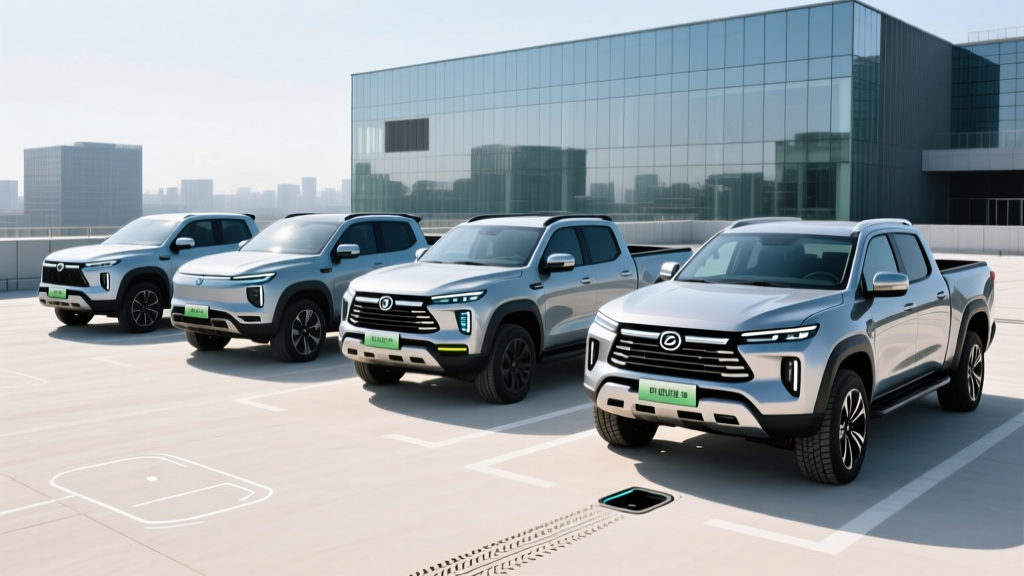
The Tesla Cybertruck has dominated the angular-electric-pickup conversation since its 2023 launch, but a fleet of Chinese competitors has emerged with a different value proposition: rugged styling, aggressive pricing, and rapid global expansion. While most of these trucks remain unavailable in the U.S. market due to steep tariffs and homologation barriers, they represent a serious challenge to American and Japanese incumbents in Australia, Southeast Asia, the Middle East, and parts of Europe.
This profile examines the most prominent "China Cybertruck" contenders as of early 2026 — the GWM Poer EV, BYD Shark 6, and JAC T9 EV — and compares them against the Tesla Cybertruck on the metrics that matter: range, charging speed, price, and real-world capability.
What Is the "China Cybertruck" Phenomenon?
The term "China Cybertruck" has become shorthand among EV enthusiasts for a wave of Chinese-built electric and plug-in-hybrid pickup trucks that mimic the Cybertruck's angular, stainless-steel-adjacent aesthetic at a fraction of the price. Unlike Tesla's $80,000+ stainless-steel monolith, these trucks typically start between $30,000 and $55,000 USD equivalent in their home and export markets.
Three models lead this charge in 2026:
- GWM Poer EV (also called Cannon EV): Great Wall Motors' fully electric ute, available in Australia, Thailand, and South Africa.
- BYD Shark 6: A plug-in hybrid (PHEV) pickup with ~62 miles of electric-only range, sold in Australia, Mexico, Brazil, and the Middle East.
- JAC T9 EV: A fully electric midsize pickup from JAC Motors, exported to Australia, New Zealand, and Latin America.
None of these are sold in the United States. The 25% "Chicken Tax" on imported light trucks, combined with 100%+ tariffs on Chinese-origin EVs imposed under Section 301, effectively prices them out of the American market. But for global buyers — and for anyone tracking where EV competition is heading — these trucks are worth a close look.
Spec-by-Spec: China Cybertruck Contenders vs. Tesla Cybertruck
| Specification | GWM Poer EV | BYD Shark 6 (PHEV) | JAC T9 EV | Tesla Cybertruck AWD |
|---|---|---|---|---|
| Powertrain | Dual-motor AWD | PHEV (1.5T + rear e-motor) | Rear-motor RWD | Dual-motor AWD |
| Battery (usable kWh) | 78.5 kWh (NMC) | 26.7 kWh (BYD Blade/LFP) | 88.0 kWh (LFP) | ~123 kWh (NMC, est.) |
| EPA / WLTP Range | ~310 mi WLTP (~260 mi EPA est.) | 62 mi EV-only / 580 mi total | ~330 mi WLTP (~275 mi EPA est.) | 340 mi (EPA) |
| Horsepower | 349 hp | 430 hp combined | 201 hp | 600 hp |
| 0–60 mph | ~7.0 sec | 5.7 sec | ~9.5 sec | 4.1 sec |
| Max DC Charge Rate | ~100 kW | ~55 kW (DC) | ~95 kW | ~250 kW (peak) |
| 10–80% DC Time | ~45 min | ~28 min (10–80%) | ~50 min | ~15 min |
| Level 2 Home Rate | 7.2 kW (~22 mi/hr) | 6.6 kW (~20 mi/hr EV) | 7.0 kW (~22 mi/hr) | 11.5 kW (~37 mi/hr) |
| Towing Capacity | ~3,300 lbs | ~5,500 lbs | ~2,200 lbs | 11,000 lbs |
| Bed Length | 5.2 ft (1,580 mm) | 5.0 ft (1,520 mm) | 5.2 ft (1,580 mm) | 6.0 ft (1,830 mm) |
| Base Price (USD equiv.) | ~$38,000 | ~$42,000 | ~$33,000 | $81,895 (AWD) |
| U.S. Availability | No | No | No | Yes |
Note: WLTP ranges are typically 10–15% higher than EPA estimates. EPA-equivalent figures for Chinese-market trucks are estimated based on WLTP-to-EPA conversion ratios from fueleconomy.gov testing methodology. Prices reflect export-market MSRPs converted to USD and do not include local taxes or incentives.
Real-World Range: What to Expect Beyond the Sticker
EPA-estimated ranges: Tesla Cybertruck AWD: 340 mi | GWM Poer EV: ~260 mi (EPA est.) | JAC T9 EV: ~275 mi (EPA est.) | BYD Shark 6: 62 mi EV-only
Real-world expectations: Subtract 15–25% for sustained highway driving at 70+ mph. In cold weather (below 32°F / 0°C), expect an additional 20–30% range loss across all models due to battery chemistry and cabin heating demands. The BYD Shark 6's LFP battery handles cold somewhat better than NMC packs but still suffers reduced regenerative braking efficiency.
The GWM Poer EV's 78.5 kWh NMC pack delivers approximately 260 EPA-equivalent miles under mixed driving. On a highway-heavy road trip at 70 mph with mild temperatures, expect closer to 210–220 miles before needing a charge. In sub-freezing conditions, that figure can drop to 170–180 miles — a meaningful limitation for regional touring.
The JAC T9 EV, with its larger 88 kWh LFP (lithium iron phosphate) battery, edges ahead on paper. LFP chemistry offers superior cycle life and thermal stability but lower energy density, which is why the T9's range advantage is modest despite a 12% larger pack. Real-world highway range lands around 225–240 miles in moderate weather.
The BYD Shark 6 is a different animal entirely. As a PHEV, its 62 miles of electric-only range covers most daily commutes, and the 1.5-liter turbocharged engine extends total range to approximately 580 miles. This eliminates range anxiety for road trips but introduces the complexity of maintaining both an internal combustion engine and an electric drivetrain.
Charging Speed: The Hidden Weakness of Chinese EV Trucks
Charging speed is where the Tesla Cybertruck's engineering advantage becomes most apparent. While the Chinese contenders offer adequate home charging, their DC fast-charging capabilities lag significantly behind Tesla's Supercharger-optimized architecture.
| Model | Max DC kW | 10–80% Time | Level 2 Rate | Miles/HR (L2) |
|---|---|---|---|---|
| Tesla Cybertruck AWD | ~250 kW (peak) | ~15 min | 11.5 kW | ~37 mi/hr |
| GWM Poer EV | ~100 kW | ~45 min | 7.2 kW | ~22 mi/hr |
| JAC T9 EV | ~95 kW | ~50 min | 7.0 kW | ~22 mi/hr |
| BYD Shark 6 (PHEV) | ~55 kW | ~28 min | 6.6 kW | ~20 mi/hr |
The Cybertruck's ~250 kW peak charge rate (sustaining roughly 170–200 kW through the 20–60% SoC window before tapering) enables 10–80% charging in approximately 15 minutes on a V3 or V4 Supercharger. This is a road-trip game-changer.
By contrast, the GWM Poer EV and JAC T9 EV peak around 95–100 kW and sustain closer to 60–75 kW through the bulk of the charge curve. The result is 45–50 minutes for a 10–80% session — workable for destination charging or lunch stops, but noticeably slower on long highway runs.
The BYD Shark 6's smaller 26.7 kWh battery charges faster in absolute terms (~28 minutes to 80%), but its 55 kW DC peak means it cannot take full advantage of 150+ kW chargers. For most Shark 6 owners, home Level 2 charging will be the primary refueling method, with the gasoline engine handling longer trips.
Connector note: These Chinese-market trucks use GB/T connectors domestically and CCS2 in export markets (Australia, Europe). None support NACS (Tesla's North American standard), which is now becoming the dominant connector in the U.S. and Canada.
Pricing and Tax Credits: The Tariff Wall
U.S. Pricing & Federal Tax Credit Eligibility (2026):
| Model | U.S. MSRP | §30D Credit Eligible? | Effective Price |
|---|---|---|---|
| Tesla Cybertruck AWD | $81,895 | Partial — $7,500 if income/MSRP/sourcing rules met | ~$74,395 (with full credit) |
| GWM Poer EV | Not sold in U.S. | N/A | N/A |
| JAC T9 EV | Not sold in U.S. | N/A | N/A |
| BYD Shark 6 | Not sold in U.S. | N/A | N/A |
The Tesla Cybertruck AWD starts at $81,895 (2026 model year). Under IRS §30D clean vehicle credit rules, it may qualify for the full $7,500 federal tax credit — but only if the buyer meets all of the following requirements:
- MSRP cap: Pickup trucks must have an MSRP at or below $80,000. The Cybertruck AWD at $81,895 exceeds this cap, making it ineligible. The (discontinued) base RWD variant at ~$62,000 would have qualified.
- Income cap: Modified adjusted gross income must not exceed $150,000 (single), $225,000 (head of household), or $300,000 (joint).
- Battery sourcing: Critical minerals and battery components must meet escalating domestic-content thresholds that tighten annually through 2032.
- Point-of-sale transfer: Eligible buyers can apply the credit at purchase rather than waiting for tax filing.
For the Chinese contenders, U.S. availability is a non-starter. Even if GWM or BYD wanted to sell in America, the 25% light-truck tariff (the "Chicken Tax" from 1964) plus 100%+ Section 301 tariffs on Chinese-origin EVs would push prices well above competitive levels. These trucks are designed for markets without such trade barriers.
In their export markets, pricing is remarkably aggressive. The JAC T9 EV starts around AUD $49,990 (~$33,000 USD) in Australia, making it one of the cheapest electric pickups available anywhere. The GWM Poer EV lists at approximately AUD $57,000 (~$38,000 USD), and the BYD Shark 6 at AUD $63,000 (~$42,000 USD).
Tech, Interior, and Daily Usability
Where the Chinese trucks compete most fiercely is in features-per-dollar. The GWM Poer EV comes standard with a 12.3-inch infotainment display, wireless Apple CarPlay and Android Auto, a 360-degree camera system, adaptive cruise control, and lane-keeping assist. The interior uses soft-touch materials on the dashboard and door panels — a notable upgrade from the utilitarian plastics found in similarly priced ICE trucks like the Toyota Hilux or Ford Ranger.
The BYD Shark 6 leverages BYD's vertically integrated tech stack, including the company's proprietary DiLink infotainment system, a 15.6-inch rotating center display, and BYD's advanced DiPilot ADAS suite (Level 2 driver assistance with highway cruise and lane-centering). The Shark 6 also offers V2L (vehicle-to-load) capability, allowing owners to power tools, camping gear, or home appliances from the truck's battery — a feature that has proven enormously popular in the Australian outback and among tradespeople.
The JAC T9 EV is more spartan. It offers a 10.4-inch touchscreen, basic ADAS features, and a functional but plasticky interior. The trade-off for its lower price is evident in fit-and-finish and material quality, though the drivetrain itself is competent.
None of these trucks approach the Cybertruck's 18.5-inch center display, yoke steering, or steer-by-wire system. The Tesla also offers the most advanced (and controversial) driver-assistance suite, with FSD (Supervised) available as an add-on — though it remains an SAE Level 2 system requiring full driver attention, not autonomous driving.
Driver-assist clarification: All ADAS systems discussed here — Tesla FSD (Supervised), BYD DiPilot, GWM's adaptive cruise — are SAE Level 2 driver-assistance features. The driver must remain fully engaged, monitor the road, and keep hands available at all times. None of these systems provide autonomous (Level 4) driving capability.
Warranty and Long-Term Ownership
| Model | Battery Warranty | Powertrain Warranty | Capacity Retention Guarantee |
|---|---|---|---|
| Tesla Cybertruck | 8 yr / 120,000 mi | 8 yr / 120,000 mi | ≥70% retention |
| GWM Poer EV | 8 yr / 160,000 km (~100,000 mi) | 5 yr / 100,000 km | ≥70% retention (market-dependent) |
| BYD Shark 6 | 8 yr / 160,000 km | 6 yr / 150,000 km | BYD Blade — no formal % guarantee in all markets |
| JAC T9 EV | 8 yr / 160,000 km | 5 yr / 100,000 km | ≥70% retention |
All three Chinese contenders match or approach Tesla's 8-year battery warranty in their primary export markets, though service networks remain thin outside major cities. In Australia, GWM and BYD have rapidly expanded dealer networks since 2023, but rural owners may face 200+ km drives for warranty service. JAC's network is smaller still.
On battery longevity, the BYD Shark 6's Blade (LFP) battery is theoretically the longest-lasting. LFP cells typically sustain 3,000+ charge cycles before reaching 80% state of health, compared to roughly 1,500–2,000 cycles for NMC. For a truck used as a daily commuter with home charging, this means the Shark 6's battery could outlast the vehicle itself.
Pros and Cons: The Verdict
Pros of Chinese EV Trucks
- Dramatically lower pricing — 50–60% less than Cybertruck
- Strong standard features for the money (ADAS, infotainment, V2L)
- BYD Shark 6's PHEV eliminates range anxiety for long trips
- LFP batteries (Shark 6, T9) offer superior cycle life
- Growing dealer networks in Australia, SE Asia, Latin America
Cons of Chinese EV Trucks
- Not available in the U.S. (tariff barriers)
- DC fast-charging speeds 2–3× slower than Cybertruck
- Lower towing capacity (2,200–5,500 lbs vs. 11,000 lbs)
- Sparse service networks outside major metro areas
- No NACS connector support; limited fast-charger compatibility
- Real-world range 210–240 mi — adequate but not class-leading
Who Should Consider These Trucks?
Best for: Global buyers (Australia, SE Asia, Middle East, Latin America) who want an electric or electrified pickup for daily commuting and light-duty work at a sub-$45,000 price point. The BYD Shark 6 is particularly well-suited for buyers who want electric daily driving with gas-engine backup for longer trips or towing.
Not for: U.S. buyers (unavailable), heavy-towing applications, frequent long-distance road trippers who need fast DC charging, or buyers who prioritize autonomous-grade driver assistance.
U.S. buyer takeaway: If you're in America and want an electric pickup, the Tesla Cybertruck, Ford F-150 Lightning, and Rivian R1T remain your primary options. The Chinese contenders show where the global market is heading — toward affordable, feature-rich electric trucks — but trade policy keeps them firmly overseas for now.
Frequently Asked Questions
Can I buy a "China Cybertruck" in the United States?
No. The GWM Poer EV, BYD Shark 6, and JAC T9 EV are not sold in the U.S. market. Even if imported, they would face the 25% "Chicken Tax" on light trucks plus 100%+ Section 301 tariffs on Chinese-origin electric vehicles, making them uncompetitive. They also lack U.S. homologation (FMVSS compliance).
What is the real-world range of these Chinese electric pickups?
Expect approximately 210–240 miles of real-world highway range from the GWM Poer EV and JAC T9 EV in moderate temperatures. In cold weather (below freezing), subtract another 20–30%. The BYD Shark 6 offers 62 miles of electric-only range, with the gasoline engine extending total range to ~580 miles.
How fast do these trucks charge compared to the Tesla Cybertruck?
Significantly slower. The Cybertruck peaks at ~250 kW and charges 10–80% in approximately 15 minutes. The Chinese EV trucks peak at 55–100 kW and require 28–50 minutes for the same session. For road-trip charging, this difference is substantial.
Does the Tesla Cybertruck qualify for the $7,500 federal EV tax credit?
The 2026 Cybertruck AWD at $81,895 exceeds the IRS §30D MSRP cap of $80,000 for pickup trucks, making it ineligible for the credit. Buyers should consult a tax professional and check current IRS guidance, as rules and eligible vehicle lists are updated periodically.
Is the BYD Shark 6 a fully electric truck?
No. The BYD Shark 6 is a plug-in hybrid (PHEV) with a 1.5-liter turbocharged gasoline engine and a rear-mounted electric motor. It offers 62 miles of electric-only range from its 26.7 kWh LFP battery, with the gas engine providing extended range for longer trips.
Which Chinese electric pickup has the best towing capacity?
The BYD Shark 6 leads with approximately 5,500 lbs of towing capacity, thanks to its combined 430 hp and the torque characteristics of its PHEV powertrain. However, all three Chinese trucks fall well short of the Tesla Cybertruck's 11,000-lb rating.
Are LFP batteries better than NMC for electric trucks?
It depends on your priorities. LFP (lithium iron phosphate) batteries — used in the BYD Shark 6 and JAC T9 EV — offer longer cycle life (3,000+ cycles), better thermal stability, and lower cost. NMC (nickel manganese cobalt) batteries — used in the GWM Poer EV and Tesla Cybertruck — provide higher energy density (more range per kg) and better cold-weather performance. For a work truck charged nightly at home, LFP is often the better long-term choice.