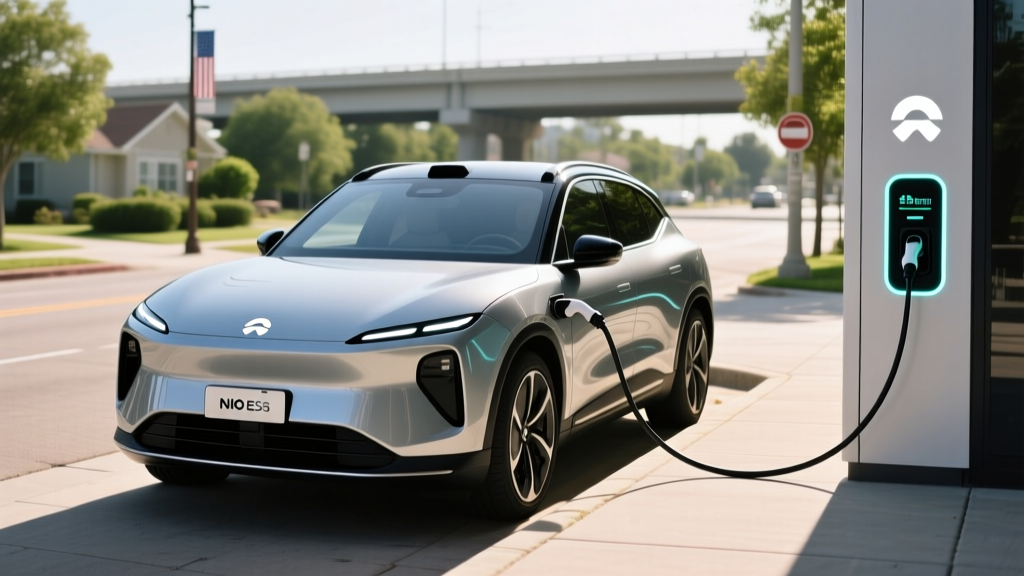
If you follow the global EV market, you've likely seen the NIO ES6 pop up in headlines — a premium midsize electric SUV with a trick up its sleeve that no mainstream competitor offers: swappable batteries. Now in its second generation (launched globally as the EL6 in Europe), the ES6 is one of NIO's best-selling models and a direct shot at the Tesla Model Y, BMW iX3, and Mercedes EQB. But for U.S. buyers, the story is complicated. NIO has not entered the American market as of 2026, and the ES6 is not available for purchase stateside. This review covers the ES6's verified specs from European and Chinese markets, translates them to U.S.-relevant terms, and gives you a clear-eyed look at what this SUV offers — and what it doesn't.
Quick Verdict: A Premium SUV With a Unique Battery Strategy
The NIO ES6 is a genuinely competitive premium electric SUV when judged on build quality, tech, and its battery-swap ecosystem. Its dual-motor AWD powertrain, available 100 kWh battery, and refined interior put it in the same conversation as European luxury EVs. However, U.S. buyers cannot currently purchase one. NIO has focused its expansion on China and Europe, with no announced U.S. launch timeline. If NIO does arrive stateside, the ES6 would be a strong contender — but for now, this is a vehicle to watch, not buy, in America.
| Spec | Standard Range (75 kWh) | Long Range (100 kWh) |
|---|---|---|
| Battery Capacity | 75 kWh usable | 100 kWh usable |
| Chemistry | LFP (Lithium Iron Phosphate) | NMC (Nickel Manganese Cobalt) |
| WLTP Range | ~308 miles (495 km) | ~388 miles (625 km) |
| Estimated EPA-Equivalent Range | ~265–280 miles | ~330–350 miles |
| Drivetrain | Dual-motor AWD | Dual-motor AWD |
| Horsepower | 483 hp (360 kW) | 483 hp (360 kW) |
| 0–60 mph | ~4.4 seconds | ~4.4 seconds |
| Max DC Fast Charge | ~125 kW (75 kWh pack) | ~130 kW (100 kWh pack) |
| 10–80% DC Charge Time | ~30 minutes | ~35 minutes |
| Level 2 AC Charge Rate | 11 kW (~35 mi/hr) | 11 kW (~35 mi/hr) |
| Length / Width / Height | 190.0 in / 76.4 in / 67.8 in | |
| Wheelbase | 114.2 in | |
| Cargo Volume (rear seats up) | ~20.4 cu ft | |
| Cargo Volume (rear seats folded) | ~51.0 cu ft | |
| Battery Swap Time | ~3–5 minutes (NIO Power Swap Station Gen 3/4) | |
| Base Price (Europe, EL6) | ~€55,900 (~$61,000 USD) | ~€63,900 (~$69,500 USD) |
Range and Efficiency: WLTP vs. Real-World Expectations
Range Reality Check: The NIO ES6 is rated under the WLTP cycle, which is more optimistic than the U.S. EPA test. For the 100 kWh Long Range variant, WLTP rates it at ~388 miles — but a realistic EPA-equivalent figure would land closer to 330–350 miles. The 75 kWh Standard Range version drops to an estimated 265–280 miles EPA-equivalent.
Real-world caveats: Expect 10–15% range loss at sustained highway speeds (75+ mph) and 20–30% loss in freezing temperatures (below 32°F). The LFP 75 kWh pack is more resilient to cold than NMC at the chemistry level, but both will see reduced range in winter. On a 70°F day with mixed city/highway driving, the 100 kWh model should comfortably deliver 310–330 miles before needing a charge.
Efficiency for the 100 kWh variant runs approximately 2.5–2.7 miles per kWh, or roughly 37–40 kWh per 100 miles — translating to an estimated 84–90 MPGe combined. That puts the ES6 in the same efficiency ballpark as the BMW iX xDrive50 and slightly behind the more aerodynamic Tesla Model Y Long Range (which achieves ~122 MPGe combined per fueleconomy.gov). The ES6's boxier SUV profile and heavier curb weight (~4,850 lbs) explain the gap.
Charging Speeds: DC Fast, Level 2, and Battery Swap
The ES6's charging story is a tale of two experiences: conventional plug-in charging, which is adequate but not class-leading, and NIO's proprietary battery-swap system, which is genuinely innovative.
| Charging Method | Power / Rate | Speed (Approx.) | Notes |
|---|---|---|---|
| Level 1 (120V household) | ~1.4 kW | ~4–5 mi/hr | Emergency only; impractical for daily use |
| Level 2 (240V home/public) | 11 kW | ~35 mi/hr | Full charge in ~7–9 hours depending on pack |
| DC Fast Charge (75 kWh) | Peak ~125 kW | 10–80% in ~30 min | Charge curve tapers significantly above 80% |
| DC Fast Charge (100 kWh) | Peak ~130 kW | 10–80% in ~35 min | Larger pack = longer session despite higher peak |
| Battery Swap (Gen 3/4 station) | N/A | Full swap in ~3–5 min | Requires NIO Power Swap Station; not available in U.S. |
Charging curve reality: The ES6's peak DC rate of 125–130 kW is modest compared to rivals like the Hyundai Ioniq 5 (which peaks at 240 kW on 800V architecture) or the Porsche Macan Electric (up to 270 kW). In practice, the ES6 sustains close to its peak rate between 10–50% SoC, then tapers progressively. A 10–80% session takes about 30–35 minutes at a 150+ kW charger. Below that threshold, expect longer times.
Battery swap — the differentiator: NIO operates over 2,500 Power Swap Stations globally (primarily in China, with a growing European network). At a Gen 3 or Gen 4 station, the vehicle drives into an automated bay, and robotics remove the depleted pack and install a fully charged one in 3–5 minutes. This eliminates charging wait times entirely — but it's infrastructure that simply does not exist in the United States. NIO's subscription model (BaaS, or Battery as a Service) also lets buyers purchase the vehicle without the battery, reducing the upfront price by ~€10,000–12,000 in exchange for a monthly battery rental fee of roughly €99–169 depending on pack size.
Performance and Driving Dynamics
Every ES6 variant comes with dual-motor all-wheel drive: a 150 kW (201 hp) induction motor up front and a 210 kW (282 hp) permanent-magnet synchronous motor in the rear, for a combined system output of 483 hp (360 kW) and approximately 516 lb-ft of torque. The 0–60 mph sprint takes about 4.4 seconds — quick for a family SUV, though not in Tesla Model Y Performance territory (3.5 seconds).
Driving dynamics are composed rather than sporty. The ES6 uses a multi-link front and rear suspension with available CDC (Continuous Damping Control) and air suspension on higher trims. Ride quality is a strength — it absorbs road imperfections with the kind of compliance that European luxury buyers expect. Steering is light and precise but offers minimal feedback, which suits its grand-touring character. Regenerative braking offers multiple levels, including a one-pedal driving mode that can bring the vehicle to a complete stop, though it lacks the aggressive initial bite of some competitors.
Interior, Technology, and Driver Assistance
The ES6's cabin is where NIO makes its strongest case against established luxury brands. Materials are premium — Nappa leather, microfiber suede headliner, real wood and aluminum trim. The second generation adopted a cleaner, more horizontal dashboard layout with a large 12.8-inch AMOLED center touchscreen (vertically oriented) running NIO's Banyan infotainment system.
NOMI: NIO's signature feature is NOMI, a small robotic AI assistant that sits atop the dashboard. It has an animated face, responds to voice commands, and can control climate, navigation, and media. It's charming on first encounter, though some owners report it becomes more novelty than utility over time.
Driver Assistance (NIO Pilot / NAD): The ES6 comes equipped with NIO's ADAS suite, which includes adaptive cruise control, lane-keeping assist, automated lane changes, and traffic-jam assist. The system uses a suite of cameras, millimeter-wave radars, and (on equipped trims) a LiDAR sensor mounted above the windshield. This is a Level 2 driver-assistance system per SAE classification — the driver must remain fully engaged and responsible at all times. NIO's NAD (NIO Autonomous Driving) subscription service unlocks additional highway and urban assist features in supported regions. It is not self-driving, and it does not approach Level 4 autonomy.
Cargo and passenger space: With rear seats up, the ES6 offers ~20.4 cu ft of cargo space — competitive with the BMW iX3 (~19.7 cu ft) but less than the Tesla Model Y (30.2 cu ft behind the second row). Fold the rear seats and you get ~51.0 cu ft. Rear legroom is generous at approximately 38.5 inches, thanks to the long 114.2-inch wheelbase. A small front trunk (frunk) is not available — the space is occupied by battery-swap hardware.
Pricing, Tax Credits, and U.S. Availability
This is where the ES6 story hits a wall for American buyers: NIO does not sell vehicles in the United States as of 2026. The company has focused its international expansion on Norway, Germany, the Netherlands, Sweden, and Denmark in Europe, alongside its dominant Chinese market. There is no announced timeline for U.S. entry, and geopolitical and regulatory factors (including data-security scrutiny and tariff structures) make near-term entry uncertain.
| Variant | European MSRP (EL6) | Approx. USD | U.S. Federal Tax Credit (§30D) |
|---|---|---|---|
| Standard Range (75 kWh) | €55,900 | ~$61,000 | Not eligible — not sold in U.S. |
| Long Range (100 kWh) | €63,900 | ~$69,500 | Not eligible — not sold in U.S. |
| BaaS (Battery Subscription) | Vehicle minus ~€10,000–12,000 | ~$48,000–58,000 | Not eligible — not sold in U.S. |
If NIO were to enter the U.S. market, the ES6 would face significant hurdles for the IRS §30D federal tax credit. The credit requires final assembly in North America, MSRP caps ($80,000 for SUVs), buyer income limits ($300,000 joint / $150,000 individual AGI), and strict battery-component and critical-mineral sourcing requirements. A China-assembled NIO with Chinese-sourced battery cells would almost certainly not qualify for the full $7,500 credit under current rules — and possibly not at all. This is a key reason NIO has not prioritized the U.S. market.
Warranty and Battery Longevity
In European markets, the NIO EL6 (ES6) carries a 6-year / 93,000-mile (150,000 km) vehicle warranty and an 8-year / 100,000-mile (160,000 km) battery warranty guaranteeing a minimum of 70% state-of-health (SoH) retention. The battery-swap model adds an interesting wrinkle: because you can swap packs, you're never stuck with a degraded battery. NIO maintains and cycles its battery fleet, retiring packs that fall below health thresholds. This effectively means the "battery longevity" concern is largely eliminated for BaaS subscribers — you're always driving a pack within NIO's health standards.
For outright battery purchasers, the LFP chemistry in the 75 kWh pack offers superior cycle life (typically 3,000+ full cycles before significant degradation) compared to the NMC pack in the 100 kWh variant (typically 1,500–2,000 cycles). In practical terms, both should comfortably outlast the vehicle's useful life under normal use.
Pros and Cons
Pros
- Battery swap in 3–5 minutes eliminates charging wait times where infrastructure exists
- Premium interior rivals BMW, Mercedes, and Audi on materials and fit-and-finish
- Standard dual-motor AWD with 483 hp across all trims — no base RWD model
- LFP option (75 kWh) offers excellent cycle life and cold-weather resilience
- BaaS subscription lowers purchase price and eliminates battery-degradation risk
- Generous rear legroom (~38.5 in) for a midsize SUV
- Available air suspension with CDC for excellent ride quality
Cons
- Not available in the U.S. — no purchase path, no service network, no swap stations
- Modest DC fast-charge speeds (125–130 kW peak) vs. 200+ kW rivals
- Smaller cargo area (20.4 cu ft) than the Tesla Model Y or Hyundai Ioniq 5
- No frunk — battery-swap hardware occupies the front compartment
- NOMI robot is polarizing — useful novelty or gimmick depending on taste
- Efficiency trails competitors at ~84–90 MPGe vs. Model Y's 122 MPGe
- U.S. tax credit eligibility highly unlikely even if NIO enters the market
Who the NIO ES6 Is For — and Who Should Look Elsewhere
Choose the NIO ES6 (if you're in a supported market) if:
- You live near NIO Power Swap Stations and want to eliminate charging downtime
- You value premium interior materials and a refined, quiet ride over sporty handling
- You want the flexibility of upgrading or downgrading battery size via swap
- You prefer the BaaS subscription model to reduce upfront cost and battery-degradation risk
Look elsewhere if:
- You're a U.S. buyer — the ES6 simply isn't available, and there's no timeline for entry
- Fast DC charging is a priority — rivals like the Ioniq 5, Kia EV6, and Porsche Macan Electric charge significantly faster
- Cargo space is critical — the Model Y and Ioniq 5 offer substantially more room
- You need maximum efficiency and range per kWh — the ES6 is heavier and less aero-efficient than its competitors
Competitive Alternatives Available in the U.S.
Since the ES6 isn't a purchase option for American buyers, here's how its closest U.S.-available rivals stack up:
| Vehicle | EPA Range | Max DC Charge | 0–60 mph | Base MSRP | §30D Credit Eligible? |
|---|---|---|---|---|---|
| Tesla Model Y Long Range | 320 mi | 250 kW | 5.0 sec | ~$48,990 | Yes (check current sourcing rules) |
| BMW iX xDrive50 | 324 mi | 200 kW | 4.4 sec | ~$87,250 | No (MSRP exceeds cap, assembled in Germany) |
| Genesis GV70 Electrified | 236 mi | ~200 kW | 4.5 sec | ~$66,950 | No (assembled in Korea) |
| Hyundai Ioniq 5 (AWD) | 290 mi | 240 kW | 5.1 sec | ~$47,500 | Yes (GA-assembled) |
Frequently Asked Questions
What is the real-world range of the NIO ES6?
The 100 kWh Long Range ES6 is rated at ~388 miles WLTP, which translates to an estimated 330–350 miles under the stricter EPA cycle. In real-world mixed driving at moderate temperatures, expect 310–330 miles. Highway-only driving at 75+ mph drops this to roughly 270–290 miles. Cold weather (below 32°F) can reduce range by 20–30%, bringing the 100 kWh model down to approximately 230–260 miles in harsh winter conditions.
How fast does the NIO ES6 charge?
On a DC fast charger, the 75 kWh pack peaks at ~125 kW (10–80% in ~30 minutes) and the 100 kWh pack at ~130 kW (10–80% in ~35 minutes). At home on a Level 2 charger (240V), the ES6 charges at up to 11 kW, adding about 35 miles of range per hour. A full Level 2 charge takes 7–9 hours depending on battery size. These speeds are adequate but noticeably slower than 800V competitors like the Hyundai Ioniq 5 (240 kW peak, 10–80% in ~18 minutes).
Does the NIO ES6 qualify for the U.S. federal EV tax credit?
No. As of 2026, the NIO ES6 is not sold in the United States, making it ineligible for the IRS §30D federal tax credit. Even if NIO entered the U.S. market, the ES6 would face significant eligibility barriers: it is assembled in China, uses Chinese-sourced battery cells and critical minerals, and would need to meet North American final-assembly, MSRP ($80,000 SUV cap), buyer-income, and battery-sourcing requirements. Qualification for any portion of the $7,500 credit is unlikely under current rules.
Is the NIO ES6 worth buying vs. key competitors?
In markets where it's available (China, parts of Europe), the ES6 is competitive on interior quality, standard AWD performance, and the unique battery-swap ecosystem. Against the Tesla Model Y, it trades range efficiency and charging speed for a more luxurious cabin and the swap advantage. Against the BMW iX, it's significantly less expensive but also slightly smaller. For U.S. buyers, the question is moot — the ES6 isn't an option, and rivals like the Model Y, Ioniq 5, and BMW iX are all available with established service networks and, in some cases, federal tax-credit eligibility.
What are the biggest pros and cons of the NIO ES6?
Top pros: battery-swap capability (3–5 minute "refuel"), premium interior materials, standard dual-motor AWD with 483 hp, LFP battery option for longevity, and the BaaS subscription model that lowers upfront cost. Top cons: unavailable in the U.S., modest DC fast-charge speeds (125–130 kW), smaller cargo area than key rivals, no frunk, lower efficiency (~84–90 MPGe) than competitors, and uncertain U.S. tax-credit eligibility even if it launches stateside.
Can I import a NIO ES6 to the United States?
Importing a NIO ES6 into the U.S. for personal use is extremely difficult. The vehicle would need to meet all NHTSA safety standards (FMVSS), EPA emissions certification, and DOT import requirements. Since the ES6 was not designed for the U.S. market, it lacks FMVSS compliance, and the importation process for non-conforming vehicles is costly, time-consuming, and typically requires modifications that NIO does not support. Practically speaking, this is not a viable path for consumers.
How does NIO's battery swap work?
NIO's Power Swap Stations are automated drive-in facilities. You pull into a designated bay, and robotic arms beneath the vehicle unbolt the depleted battery pack and replace it with a fully charged one. The process takes approximately 3–5 minutes at Gen 3 and Gen 4 stations. NIO manages the battery fleet centrally, charging, inspecting, and maintaining packs in rotation. For subscribers to the BaaS (Battery as a Service) plan, this means you never own a specific battery — you always have access to a healthy, charged pack from NIO's pool.