Quick Answer: Are Mercedes-Benz EV Cars Worth It in 2026?
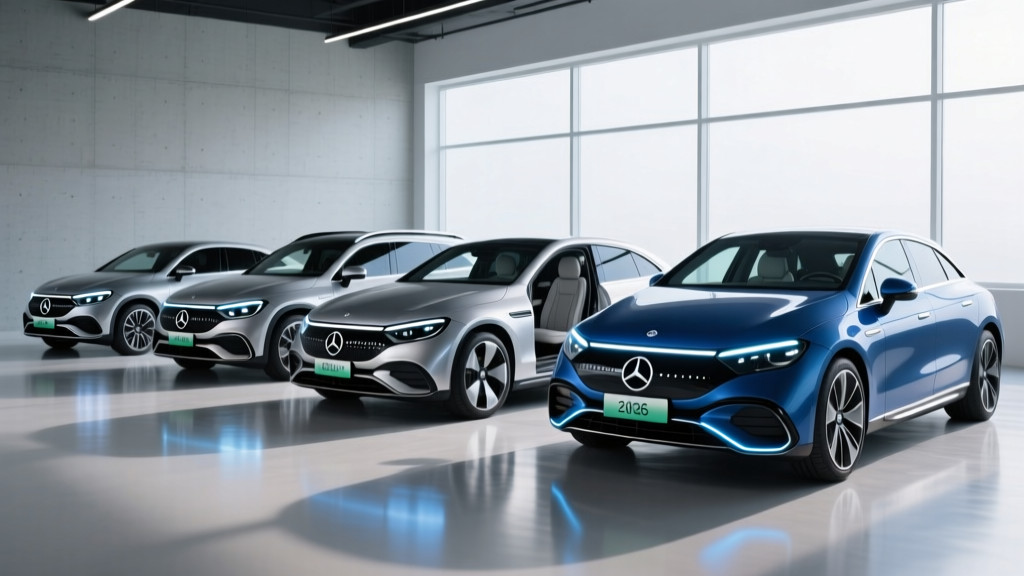
Mercedes-Benz currently offers four battery-electric models in the US under the EQ sub-brand: the EQB (compact SUV, ~220 mi EPA), EQE Sedan (~305 mi EPA), EQE SUV (~279 mi EPA), and EQS Sedan (~345 mi EPA). Starting prices range from roughly $54,000 to $105,000 before incentives. These are luxury EVs that prioritize ride comfort, cabin refinement, and advanced ADAS over maximum efficiency or segment-leading range. They charge at up to 170–200 kW DC, use NMC battery chemistry, and come with an 8-year/100,000-mile battery warranty. However, none currently qualify for the full $7,500 federal §30D tax credit due to battery-sourcing rules, and real-world highway range typically runs 15–25% below EPA stickers.
The 2026 Mercedes-Benz EV Lineup at a Glance
Mercedes has consolidated its electric strategy around the EQ family. Here's how the current US-market models stack up on paper:
| Model | EPA Range | Battery (usable) | Chemistry | Peak DC Charge | 10–80% Time | 0–60 mph | Base MSRP |
|---|---|---|---|---|---|---|---|
| EQB 300 4MATIC | ~220 mi | 66.5 kWh | NMC | 100 kW | ~32 min | 6.2 sec | $54,350 |
| EQE 350+ Sedan | ~305 mi | 90.6 kWh | NMC | 170 kW | ~32 min | 5.6 sec | $75,050 |
| EQE 350 4MATIC SUV | ~279 mi | 90.6 kWh | NMC | 170 kW | ~32 min | 6.4 sec | $77,900 |
| EQS 450+ Sedan | ~345 mi | 108.4 kWh | NMC | 200 kW | ~31 min | 5.9 sec | $104,400 |
Sources: fueleconomy.gov, Mercedes-Benz USA press specifications. All figures for 2025–2026 model year; verify at time of purchase.
Real-World Range Reality Check
EPA estimates assume a mix of city and highway driving at moderate temperatures. In our experience and consistent with independent testing:
- Highway-heavy trips (70–80 mph): Expect 75–85% of EPA range. An EQS 450+ rated at 345 miles will deliver roughly 260–295 miles at sustained highway speeds.
- Cold weather (below 32°F): NMC batteries lose 20–35% range in freezing temps without preconditioning. The EQE Sedan may drop to ~200–230 miles on a winter highway drive.
- City/regen-heavy driving: You can meet or slightly exceed EPA numbers thanks to aggressive regenerative braking recapturing energy in stop-and-go traffic.
All EQ models feature a heat pump (standard on EQS, available on EQE/EQB), which mitigates cold-weather cabin-heating energy draw substantially.
Charging Speeds and Infrastructure
Mercedes-Benz EVs use the CCS1 connector natively, though newer models are being built with NACS compatibility or adapters for Tesla Supercharger access. Here's what charging looks like across levels:
| Level | Power | Speed (approx.) | Best For |
|---|---|---|---|
| Level 1 (120V household) | ~1.4 kW | 3–5 mi/hr | Overnight top-ups, PHEVs |
| Level 2 (240V home/public) | 7.2–11.5 kW | 20–35 mi/hr | Daily home charging |
| DC Fast Charge | 100–200 kW | 150–250 mi in 30 min | Road trips |
Charging curve reality: The EQS's 200 kW peak only sustains from roughly 10–40% state of charge (SoC). Above 60%, the curve tapers significantly — from 80–100% can take as long as the 10–80% session. This is normal for NMC chemistry and protects long-term battery health, but plan road-trip stops around the 10–80% window for maximum efficiency.
Home charging setup: The EQE and EQS accept up to 9.6 kW on Level 2 (48A). A full charge from empty takes about 10–11 hours. The EQB accepts 7.2 kW, taking roughly 9.5 hours. Budget $500–$2,500 for a home Level 2 installation depending on panel capacity and run length — a 200A panel upgrade can push costs to $3,000+.
Cost of Ownership: Mercedes-Benz EV vs. Gas Equivalent
Luxury EVs carry higher sticker prices, but the operating-cost equation shifts over time. Let's compare the EQE 350+ Sedan (~$75,050) against a comparable E 350 gas sedan (~$58,000) over 5 years and 75,000 miles:
| Category | EQE 350+ (EV) | E 350 (Gas) | Notes |
|---|---|---|---|
| Purchase Price | $75,050 | $58,000 | Before any incentives |
| Federal Tax Credit (§30D) | $0–$3,750* | $0 | *Partial credit possible; see IRS sourcing rules |
| Fuel/Energy (5 yr) | $4,200 | $9,750 | EV: $0.14/kWh avg; Gas: $3.50/gal, 26 MPG combined |
| Maintenance (5 yr) | $1,800 | $4,500 | No oil changes, fewer brake replacements (regen) |
| Insurance (5 yr) | $12,500 | $10,000 | EV premiums typically 15–25% higher |
| Depreciation (est.) | $32,000 | $24,000 | EVs depreciate faster currently |
| 5-Year Total | ~$91,050 | ~$82,250 | EV costs more overall in this comparison |
The Honest Math
The EQE saves roughly $8,250 in fuel and maintenance over 5 years, but the higher purchase price, insurance premiums, and steeper depreciation erase those savings in a head-to-head with the gas E-Class. You buy a Mercedes EQ car for the driving experience, technology, and emissions reduction — not purely for cost savings. The economics improve if:
- You have access to cheap home electricity (under $0.12/kWh)
- Your state offers additional rebates or HOV-lane access
- You drive more than 15,000 miles/year (fuel savings scale with mileage)
Federal Tax Credit Eligibility for Mercedes-Benz EVs
This is the most misunderstood aspect of buying a luxury EV. Under current IRS §30D rules, the $7,500 federal credit requires meeting all of these criteria:
- MSRP cap: Sedans must be under $55,000; SUVs/trucks under $80,000. The EQB may qualify as an SUV; the EQE and EQS sedans exceed the cap.
- Buyer income cap: AGI must not exceed $150K (single), $225K (head of household), or $300K (joint).
- Battery sourcing: Critical minerals and battery components must meet phased-in percentages from US or FTA-partner countries. Most Mercedes-Benz batteries currently fail this test.
- Assembly: Final assembly must occur in North America. Several EQ models are built in Germany or China.
Bottom line: As of 2026, most Mercedes-Benz EV cars do not qualify for the full $7,500 credit. Some buyers may capture a partial $3,750 credit if one of the two sourcing requirements is met. Always verify on the IRS Clean Vehicle portal before purchasing, and consult a tax professional — rules change frequently.
Common Misconceptions About Mercedes-Benz EVs
| Myth | Fact |
|---|---|
| "Mercedes EVs are self-driving" | Mercedes Drive Pilot is a Level 3 system approved only in Nevada and California, under 40 mph on designated highways, in clear weather. It is not available on all models and requires specific conditions. Most driving still requires full driver attention (Level 2). |
| "The battery will need replacing in 5 years" | NMC batteries in the EQ lineup are warranted for 8 years / 100,000 miles at 70% capacity retention. Real-world degradation data from similar packs shows ~10–15% loss over 8 years with normal use. |
| "I can't road-trip in an EQ" | With 170–200 kW DC charging and a growing Electrify America / Mercedes High Power Charging network, a 500-mile trip requires 2 stops of ~25–30 minutes each. It's slower than a gas fill-up but entirely practical. |
| "Level 2 charging at home is too expensive to install" | A basic 240V/48A hardwired charger installation averages $800–$1,500 if your panel has capacity. The 5-year fuel savings alone ($5,500+) pay for this many times over. |
| "All EQ models qualify for the $7,500 tax credit" | Most do not, due to MSRP caps, foreign assembly, and battery-sourcing requirements. Always check before buying. |
A Note on Mercedes Drive Pilot (Level 3)
Mercedes-Benz is one of the first automakers with a certified SAE Level 3 system — meaning the car assumes legal liability during activation, and the driver can disengage attention (but not sleep). However, it operates only under strict geofenced and environmental conditions. This is fundamentally different from Waymo's Level 4 robotaxis, which operate without any driver. Outside Drive Pilot zones, all Mercedes EQ cars function at Level 2 — hands on or near the wheel, eyes on the road, full driver responsibility.
Who Should Buy a Mercedes-Benz EV — and Who Shouldn't
Buy an EQ if:
- You prioritize ride quality, cabin silence, and luxury materials over maximum range-per-dollar
- You have reliable home Level 2 charging access
- Your daily commute is under 80 miles (all EQ models handle this easily, even in winter)
- You want a luxury sedan/SUV with advanced ADAS and are willing to pay a premium
- You value brand prestige and dealer service infrastructure
Look elsewhere if:
- You need 350+ miles of real-world highway range — consider a Lucid Air or Tesla Model S
- You rely exclusively on public charging and live in a charging-desert area
- Total cost of ownership is your primary decision driver — a Tesla Model 3 or Hyundai Ioniq 6 delivers far more efficiency per dollar
- You want the full $7,500 federal tax credit — most EQ models won't qualify
- You regularly tow heavy loads — the EQ lineup is not optimized for towing (EQS SUV max: ~3,500 lbs)
First-Time EV Buyer Checklist for Mercedes-Benz
If you're transitioning from a gas Mercedes to an EQ model, here's what to prepare for:
- Get a home electrical assessment. A licensed electrician should evaluate your panel capacity (200A recommended) and run a dedicated 60A circuit for a 48A Level 2 charger. Budget $800–$2,500.
- Download the Mercedes me app. You'll use it to precondition the battery before fast charging, schedule off-peak charging, and monitor state of health (SoH).
- Learn preconditioning. Navigate to a DC fast charger in the MBUX system and the car will warm the battery for optimal charge speed. Skipping this can cut charge rates by 30–50% in cold weather.
- Plan your first road trip with PlugShare or A Better Routeplanner. Identify chargers at 150+ kW along your route. Mercedes is also building its own High Power Charging network, with stations co-located at select Mercedes dealerships.
- Adjust your insurance. Get quotes before signing — EV insurance for luxury models can run 20–30% above gas equivalents.
- Understand regen braking modes. The EQ models offer adjustable regen via steering-wheel paddles, including a strong one-pedal-driving mode. Practice in a parking lot before highway driving.
Frequently Asked Questions
What is the longest-range Mercedes-Benz EV car available?
The EQS 450+ Sedan leads the lineup at an EPA-estimated ~345 miles. Real-world highway range is typically 260–295 miles depending on speed, temperature, and terrain. It carries a 108.4 kWh usable NMC battery.
Do Mercedes-Benz EVs use NACS or CCS connectors?
Current EQ models ship with CCS1 ports. Mercedes has committed to adopting NACS for future models and offers adapters for Tesla Supercharger access on newer vehicles. Verify adapter availability for your specific model year with your dealer.
How much does it cost to charge a Mercedes EQ at home?
At the US average residential rate of ~$0.16/kWh, fully charging the EQS (108.4 kWh) costs roughly $17.35 — good for about 275 real-world miles. That's approximately $0.063 per mile, versus $0.135/mile for a 26 MPG gas car at $3.50/gallon.
Is the Mercedes EQB a good entry-point EV?
The EQB is the most affordable EQ at ~$54,350 and offers compact-SUV practicality with three rows (optional). However, its 220-mile EPA range and 100 kW peak charging rate are modest by 2026 standards. It works well as a second car or for buyers with short commutes and home charging. Road-trippers will find the charging speed limiting.
What happens if the EQ battery degrades significantly?
Mercedes-Benz warrants the high-voltage battery for 8 years or 100,000 miles against dropping below 70% capacity. Out-of-warranty replacement costs are estimated at $15,000–$25,000 depending on the model, though widespread failures are rare based on current data from similar NMC packs across the industry.
Can I lease a Mercedes EQ and still get a tax benefit?
Under the commercial-vehicle leasing loophole (§45W), leasing companies can capture a $7,500 credit and pass savings through as a reduced lease payment — even on models that don't qualify for the consumer §30D credit. Several Mercedes dealers structure leases this way. Ask specifically about "lease cash" or "EV lease bonuses" when negotiating.
Data sources: EPA fueleconomy.gov, IRS §30D Clean Vehicle Credits, Mercedes-Benz USA press specifications. All pricing and eligibility subject to change; verify with dealer and tax professional before purchase.