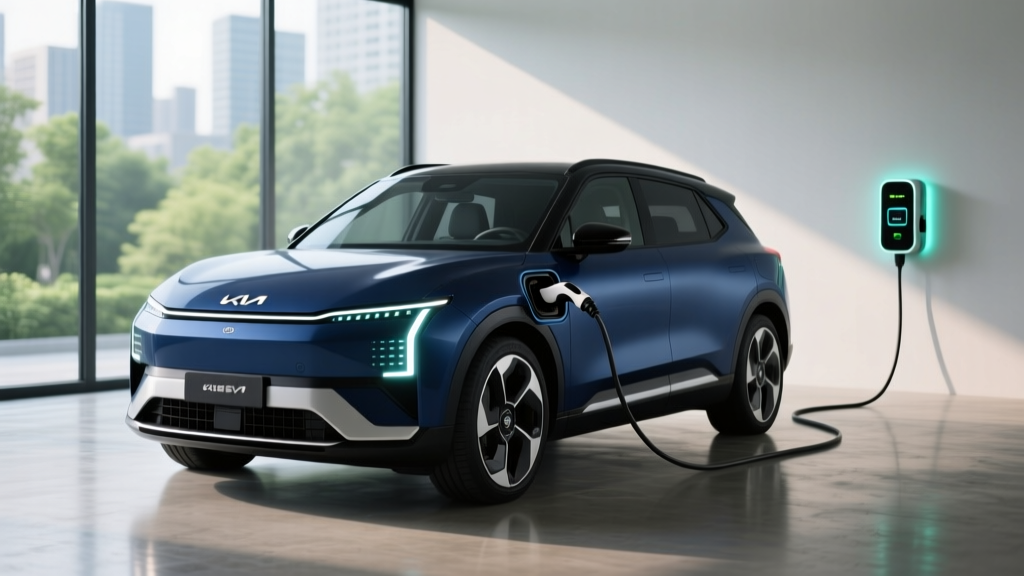
The three-row Kia EV9 is one of the few mainstream electric SUVs large enough to replace a gas-powered family hauler, but the sticker price — starting around $54,900 for the 2026 model year — makes the federal tax credit a decisive factor for most buyers. The question isn't just whether the EV9 qualifies for up to $7,500 under IRS §30D; it's whether the total cost of ownership over five years actually beats a comparable gas SUV like the Telluride.
This guide walks through the exact 2026 federal tax credit rules, state and utility incentives, per-mile charging costs versus gasoline, insurance premiums, maintenance differences, and depreciation trends so you can run the real math before you sign.
Does the 2026 Kia EV9 Qualify for the Federal Tax Credit?
Under current IRS §30D rules, the new clean vehicle credit offers up to $7,500, split into two $3,750 halves: one tied to critical-mineral sourcing and one to battery-component manufacturing. For the 2026 Kia EV9, eligibility depends on three factors that change periodically — battery sourcing, MSRP caps, and buyer income limits.
As of the 2026 model year, the EV9 is assembled in West Point, Georgia, which satisfies the North American final-assembly requirement. Kia has been progressively shifting battery-cell and critical-mineral supply chains to comply with the sourcing requirements that tighten each year. However, the exact credit amount available — $0, $3,750, or the full $7,500 — depends on the specific battery pack configuration and when the vehicle is placed in service.
2026 Federal EV Tax Credit Requirements (§30D):
- MSRP Cap: Vans, SUVs, and pickup trucks must have an MSRP at or below $80,000. All EV9 trims (Light, Wind, Land, GT-Line) fall under this cap.
- Buyer Income Cap: Adjusted gross income must not exceed $300,000 (married filing jointly), $225,000 (head of household), or $150,000 (single filers).
- Final Assembly: Must be assembled in North America. The 2026 EV9 qualifies (Georgia-built).
- Battery Sourcing: At least 80% of critical minerals must be extracted or processed in the U.S. or a free-trade-agreement country (for the $3,750 critical-mineral half). Battery components must be manufactured or assembled in North America (for the $3,750 component half).
- Point-of-Sale Transfer: As of 2024, buyers can transfer the credit to the dealer at purchase, reducing the sale price immediately rather than waiting to claim it on their tax return.
- One Credit Per VIN: The vehicle must be new, purchased for personal use, and not previously titled.
Key caveat: Battery-sourcing requirements tighten annually. A vehicle that qualifies in January may not qualify in July if supply chains shift. Always verify current eligibility at fueleconomy.gov before purchasing. Consult a tax professional to confirm your personal eligibility, especially regarding income thresholds and point-of-sale transfer logistics.
2026 Kia EV9 Key Specs at a Glance
| Specification | EV9 Light (RWD) | EV9 Wind/Land (AWD) | EV9 GT-Line (AWD) |
|---|---|---|---|
| EPA Range | 304 mi | 279 mi | 270 mi |
| Battery (usable) | 100.0 kWh (NMC) | 100.0 kWh (NMC) | 100.0 kWh (NMC) |
| Horsepower | 215 hp | 379 hp | 379 hp |
| 0–60 mph | 7.7 sec | 4.9 sec | 4.9 sec |
| Peak DC Fast Charge | 236 kW (CCS) | 236 kW (CCS) | 236 kW (CCS) |
| 10–80% DC Charge | ~24 min | ~24 min | ~24 min |
| Level 2 (240V) Rate | 10.9 kW | 10.9 kW | 10.9 kW |
| EPA Efficiency | 85 MPGe | 83 MPGe | 83 MPGe |
| Starting MSRP | $54,900 | $59,900 | $63,900 |
| Battery Warranty | 10 years / 100,000 miles | ||
Real-World Range Note: The EPA 304-mile figure for the RWD Light applies under mixed driving. Expect approximately 240–265 miles on sustained highway trips at 70+ mph, and as low as 200–220 miles in sub-freezing winter conditions due to battery thermal losses and cabin heating demands. The AWD trims see similar proportional reductions from their 270–279 mile EPA ratings.
5-Year Total Cost of Ownership: EV9 vs. Gas SUV
To understand whether the EV9 saves money long-term, we compared it against a similarly priced three-row gas SUV (the Kia Telluride, starting around $38,000) over five years and 75,000 miles. The EV9's higher purchase price is offset by the federal tax credit, lower fuel costs, and reduced maintenance — but insurance and depreciation partially erode those gains.
| Cost Category | 2026 Kia EV9 Wind (AWD) | 2026 Kia Telluride SX (AWD) |
|---|---|---|
| Purchase Price (MSRP) | $59,900 | $46,500 |
| Federal Tax Credit | −$7,500 (if eligible) | $0 |
| Effective Purchase Price | $52,400 | $46,500 |
| Fuel / Charging (75,000 mi) | $5,625 | $9,375 |
| Insurance (5 years) | $11,250 | $8,500 |
| Maintenance (5 years) | $1,500 | $3,750 |
| Estimated Depreciation | $22,000 | $15,500 |
| Total 5-Year Cost | $92,775 | $83,625 |
The EV9's five-year cost is roughly $9,000 higher than the Telluride's in this scenario, driven primarily by higher depreciation and insurance. However, this gap narrows significantly with state incentives, cheaper home charging rates, or if you drive more than 15,000 miles per year. It also doesn't account for the qualitative benefits: instant torque, a quieter cabin, home "refueling," and zero tailpipe emissions.
Charging Cost vs. Gasoline: The Per-Mile Math
The EV9 Wind AWD achieves 83 MPGe, meaning it consumes roughly 40 kWh per 100 miles. Your actual cost per mile depends entirely on where and how you charge.
| Charging Scenario | Cost per kWh | Cost per 100 Miles | Cost per Mile |
|---|---|---|---|
| Home Level 2 (national avg electricity) | $0.16 | $6.40 | $0.064 |
| Home Level 2 (off-peak utility rate) | $0.09 | $3.60 | $0.036 |
| Public DC Fast Charging (avg) | $0.40 | $16.00 | $0.160 |
| Telluride Gas (22 MPG combined, $3.30/gal) | — | $15.00 | $0.150 |
If you charge predominantly at home on a standard residential rate, the EV9 costs less than half per mile compared to the Telluride. If you rely entirely on public DC fast chargers at $0.40/kWh, you'll actually spend slightly more per mile than the gas SUV. The economics strongly favor home charging — which is why installing a Level 2 home charger is the single highest-ROI decision an EV9 owner can make.
Annual fuel savings estimate: At 15,000 miles per year with 80% home charging ($0.16/kWh) and 20% public DC ($0.40/kWh), your blended cost is roughly $0.083/mile, or $1,245/year. The Telluride at $0.15/mile costs $2,250/year. That's approximately $1,005 saved annually, or $5,025 over five years.
Maintenance Savings: What You Won't Pay For
EVs eliminate most of the recurring maintenance that gas vehicles require. The EV9 has no engine oil, no transmission fluid, no spark plugs, no exhaust system, and no timing belt. Regenerative braking significantly reduces brake pad wear — many EV owners report original brake pads lasting 80,000+ miles.
| Maintenance Item | EV9 (5 years / 75k mi) | Telluride (5 years / 75k mi) |
|---|---|---|
| Oil Changes | $0 | $750 (10 changes) |
| Brake Pads | $0 (regen extends life) | $600 (1 replacement) |
| Transmission Fluid | $0 | $250 |
| Cabin Air Filter | $200 | $200 |
| Tire Rotation/Replacement | $1,100 (heavier vehicle) | $900 |
| Coolant / Misc. | $200 | $450 |
| Total Estimated | $1,500 | $3,150 |
The EV9 saves roughly $1,650 in maintenance over five years. The one area where EV costs are higher is tires — the EV9's 4,800+ pound curb weight and instant torque accelerate tire wear. Budget for a tire replacement around 35,000–45,000 miles with EV-rated touring tires.
Insurance Costs: The Uncomfortable Reality
EV insurance premiums run 15–30% higher than equivalent gas vehicles, and the EV9 is no exception. National average data places the EV9's annual premium around $2,250 compared to roughly $1,700 for the Telluride — a difference of about $550 per year, or $2,750 over five years.
Why the premium?
- Higher repair costs: EV battery packs and specialized electronics are expensive to repair or replace after a collision.
- Higher vehicle value: Insurers base premiums partly on replacement cost; the EV9's MSRP is higher.
- Specialized labor: Fewer body shops are certified for high-voltage EV repairs, increasing labor rates.
- Parts availability: EV-specific components can have longer lead times.
Shop quotes from EV-friendly insurers (Geico, Progressive, and State Farm all cover EVs, but rates vary dramatically by ZIP code and driving record). Some insurers offer EV-specific discounts — worth asking about explicitly.
Depreciation and Resale Value Trends
EV depreciation has historically been steeper than gas vehicles, driven by rapid battery-technology improvements, frequent manufacturer price cuts, and consumer uncertainty about long-term battery health. Industry data from sources like Kelley Blue Book and iSeeCars shows that mainstream EVs depreciate roughly 45–55% over five years, compared to 35–45% for popular gas SUVs.
For the EV9 specifically, expect approximately $22,000 in depreciation over five years (roughly 40% of the credit-adjusted purchase price), assuming 75,000 miles driven. The Telluride, with its strong resale reputation, depreciates around $15,500 (roughly 33%).
Factors that could help the EV9 hold value better than earlier EVs:
- Kia's 10-year/100,000-mile battery warranty provides second-owner confidence.
- The three-row EV SUV segment has limited competition, supporting demand.
- NACS charging adoption (the EV9 is expected to support NACS natively or via adapter) improves long-term usability as the Tesla Supercharger network becomes the standard.
Factors working against resale value include potential battery-degradation concerns at high mileage, rapid evolution of competing models, and the risk of future federal policy changes affecting EV demand.
State, Local, and Utility Incentives
Beyond the federal credit: Many states, municipalities, and electric utilities offer additional incentives that can meaningfully reduce your EV9 ownership cost. These vary widely by jurisdiction and change frequently. Always check official state energy office websites and your local utility's EV program page for current offers.
Common incentive types include:
- State purchase rebates: States like California (CVRP), Colorado, Massachusetts, and New York offer rebates ranging from $1,000 to $5,000+ depending on income and vehicle price.
- Utility charging rebates: Many utilities offer $250–$1,000 toward home Level 2 charger purchase and installation, plus reduced time-of-use electricity rates for EV owners.
- HOV lane access: States including California, Colorado, and Virginia grant single-occupant HOV lane access to qualifying EVs — a significant commute-time savings in congested metros.
- Reduced registration fees: Some states waive or reduce annual EV registration fees; others impose additional EV fees to offset lost gas-tax revenue (typically $50–$225/year).
These incentives can collectively reduce your effective purchase price by $1,000–$7,000+ depending on location, potentially closing the cost gap with the Telluride entirely for buyers in incentive-rich states.
Verdict: Is the EV9 Worth It Financially?
Choose the EV9 if:
- You qualify for the full $7,500 federal credit and live in a state with additional rebates.
- You can install a Level 2 home charger and charge predominantly at home.
- You drive 15,000+ miles per year (fuel savings compound faster).
- You value the driving experience, quietness, and environmental benefits beyond pure economics.
Consider the Telluride (or wait) if:
- You don't qualify for the federal credit due to income limits or battery-sourcing changes.
- You lack reliable home or workplace charging access.
- You drive fewer than 10,000 miles per year (fuel savings won't offset the price premium).
- Five-year total cost is your sole decision criterion and you live in a state with no additional incentives.
Frequently Asked Questions
How much does it really cost to own a Kia EV9 over 5 years?
Based on our analysis, the 2026 EV9 Wind AWD costs approximately $92,775 over five years and 75,000 miles, including the credit-adjusted purchase price, charging, insurance, maintenance, and depreciation. This is roughly $9,000 more than a comparably equipped Telluride, though state incentives and higher annual mileage can close or reverse that gap.
Do I qualify for the $7,500 federal tax credit on the EV9?
You may, if your adjusted gross income is below $300,000 (joint) / $150,000 (single), the vehicle's MSRP is under $80,000 (all EV9 trims qualify), and the battery meets current critical-mineral and component-sourcing requirements. Eligibility can change throughout the year as supply chains evolve. Verify at fueleconomy.gov before purchasing and consult a tax professional.
How much do I save on fuel and maintenance with the EV9?
With 80% home charging at $0.16/kWh, expect to save approximately $1,005 per year on fuel compared to a 22 MPG gas SUV. Maintenance savings run about $330 per year. Combined, that's roughly $6,675 in operational savings over five years.
Are EVs more expensive to insure?
Yes, typically 15–30% more. The EV9's annual premium averages about $550 more than the Telluride's due to higher repair costs, specialized labor, and the vehicle's higher replacement value. Shop multiple insurers and ask about EV-specific discounts.
How well does the Kia EV9 hold its value?
Current projections suggest approximately 60% value retention after five years (roughly $22,000 in depreciation from the credit-adjusted price). This trails the Telluride's roughly 67% retention but is competitive within the EV segment. Kia's 10-year battery warranty supports longer-term resale confidence.
Can I transfer the federal tax credit to the dealer at purchase?
Yes. Since 2024, the IRS allows point-of-sale transfer of the §30D credit. If you qualify for $7,500, the dealer reduces your purchase price by that amount at closing and recovers it from the government. This eliminates the need to wait for a tax refund and makes the credit immediately impactful on your monthly payment if financing.