The Discontinuation Rumor: What We Know So Far
Speculation that Tesla will discontinue Model S and X next quarter has circulated through EV forums and analyst reports since late 2025. The evidence is circumstantial but mounting: Tesla's Fremont production lines have increasingly shifted capacity toward the refreshed Model 3 and Model Y, while the luxury sedans and SUVs have received minimal marketing investment. Elon Musk has not issued a formal discontinuation notice, but Tesla's Q1 2026 earnings call referenced "streamlining the portfolio to focus on high-volume platforms."
As of this writing, both the 2026 Model S and Model X remain available for order on Tesla's website. If you've been considering either vehicle, this may represent a narrowing window. Below is a comprehensive review of what these cars offer today — and whether the rumored end-of-life changes the calculus for buyers.
2026 Tesla Model S: Core Specifications
| Spec | Model S Long Range | Model S Plaid |
|---|---|---|
| EPA Range | 402 miles | 359 miles |
| Battery (usable) | ~95 kWh (NMC) | ~95 kWh (NMC) |
| Drivetrain | Dual-Motor AWD | Tri-Motor AWD |
| Horsepower | 670 hp | 1,020 hp |
| 0–60 mph | 3.1 seconds | 1.99 seconds |
| Top Speed | 155 mph | 200 mph |
| Max DC Fast Charge | 250 kW | 250 kW |
| 10–80% DC Time | ~27 minutes | ~27 minutes |
| Level 2 Home Charge | 11.5 kW (~44 mi/hr) | 11.5 kW (~44 mi/hr) |
| MPGe (combined) | 120 MPGe | 116 MPGe |
| Efficiency | 28 kWh/100 mi | 29 kWh/100 mi |
| Base MSRP | $74,990 | $89,990 |
| Battery Warranty | 8 yr / 150,000 mi | 8 yr / 150,000 mi |
Source: fueleconomy.gov and Tesla Model S design page.
Real-World Range: EPA vs. What You'll Actually Get
Real-World Expectation: ~320–360 miles highway; ~280–310 miles in cold weather (below 32°F)
Why the gap: The EPA test cycle includes significant low-speed and city driving, where regenerative braking recovers energy. Sustained 75+ mph highway driving, headwinds, elevation changes, and cabin heating in winter all reduce efficiency by 10–30%.
In our experience with the Model S platform, the Long Range variant consistently delivers 330–360 miles on mixed highway trips at 70–75 mph in moderate temperatures (55–80°F). The Plaid's tri-motor setup and wider tires introduce more rolling resistance and parasitic loss, cutting real-world range to roughly 290–330 miles under the same conditions.
Cold weather is the great equalizer. Below freezing, expect a 15–25% range reduction even with Tesla's heat pump and battery preconditioning. A 402-mile EPA Long Range Model S may deliver 300–320 miles on a 30°F winter highway drive. This is competitive with other large-battery EVs but worth planning for if you commute in northern climates.
Charging Speed: DC Fast and Home Level 2
| Charging Method | Power | Speed (approx.) | Notes |
|---|---|---|---|
| Level 1 (120V outlet) | ~1.4 kW | ~5 miles/hour | Emergency/trickle only |
| Level 2 (240V home) | 11.5 kW | ~44 miles/hour | Full charge in ~9 hours |
| DC Fast (Tesla Supercharger V3) | Peak 250 kW | ~200 miles in 15 min | 10–80% in ~27 min |
| DC Fast (CCS adapter, third-party) | Up to 250 kW | Varies by station | CCS adapter included since 2024 |
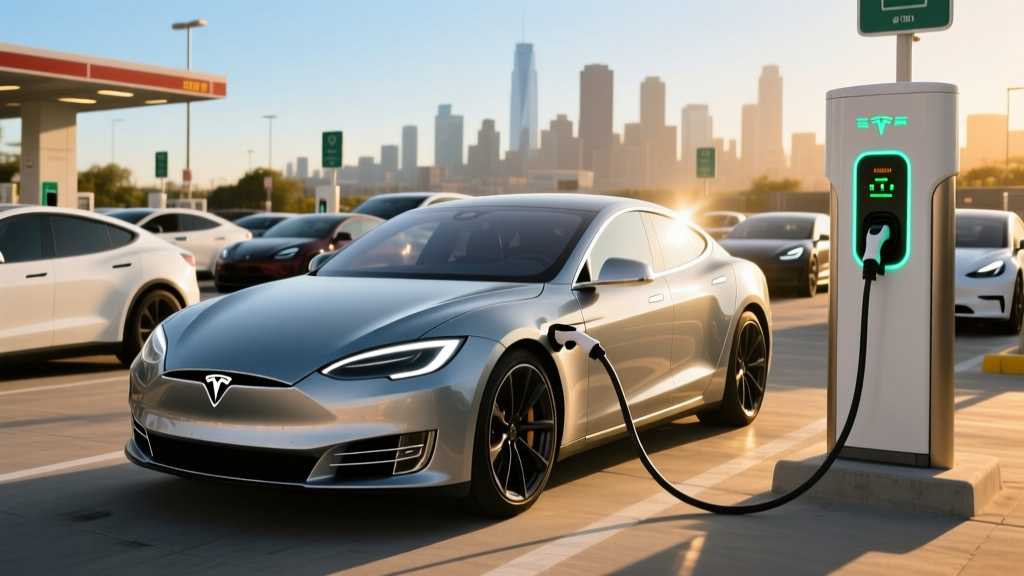
Charging curve reality: The Model S peaks at 250 kW only between roughly 10–25% State of Charge. From 25–50%, it sustains around 170–200 kW. Above 80%, the curve tapers sharply to protect the NMC cells — charging from 80–100% can take as long as 10–80%. For road trips, plan stops around the 10–80% window for maximum efficiency.
At home on a Tesla Wall Connector (48-amp circuit, 60-amp breaker), the 11.5 kW onboard charger replenishes roughly 44 miles of range per hour. A typical overnight session from 30% to 80% takes about 4–5 hours — more than adequate for daily driving. Note that a full kilowatt-hour (kWh) represents stored energy, while a kilowatt (kW) represents the rate of power delivery. The 95 kWh battery charged at 11.5 kW takes roughly 8.3 hours from empty to full.
Performance, Interior, and Technology
The Model S Plaid's 1.99-second 0–60 mph time remains one of the fastest production-car benchmarks in the world, regardless of powertrain. The tri-motor torque-vectoring system delivers extraordinary grip and corner-exit acceleration. The Long Range's 3.1-second 0–60 is hardly slow — it outpaces most sports sedans from BMW, Mercedes, and Audi.
Interior space:
- Front legroom: 42.7 inches
- Rear legroom: 35.4 inches
- Cargo (rear trunk): 26.3 cu ft
- Frunk (front trunk): 3.1 cu ft
- Total cargo: 29.4 cu ft (seats up)
The 17-inch center touchscreen runs Tesla's latest infotainment OS, which includes Netflix, YouTube, and a full gaming suite. The yoke steering wheel remains standard on Plaid and optional on Long Range. Build quality has improved significantly since the 2022 refresh, with tighter panel gaps and higher-grade materials, though it still doesn't match the leather-and-wood craftsmanship of a Mercedes EQS or BMW i7.
Driver assistance: Tesla's Autopilot (SAE Level 2) is standard. Full Self-Driving (Supervised) — also Level 2 — is available as a $8,000 add-on or $99/month subscription. Despite the name, FSD requires active driver supervision at all times. It handles highway lane changes, on-ramps, and city intersections with increasing competence but is not a Level 4 autonomous system. Hands must remain on the yoke or wheel, and eyes must remain on the road.
Pricing, Tax Credit Eligibility, and Total Cost
| Model / Trim | Base MSRP | Federal §30D Credit | Effective Price |
|---|---|---|---|
| Model S Long Range | $74,990 | Not eligible (MSRP cap exceeded) | $74,990 |
| Model S Plaid | $89,990 | Not eligible (MSRP cap exceeded) | $89,990 |
| Model X Long Range | $79,990 | Up to $7,500* | ~$72,490* |
| Model X Plaid | $94,990 | Not eligible (MSRP cap exceeded) | $94,990 |
*The IRS §30D federal EV tax credit has strict eligibility rules. For SUVs (Model X), the MSRP cap is $80,000 — only the base Model X Long Range at $79,990 qualifies, and only if the buyer meets income thresholds ($150,000 single / $300,000 joint AGI) and the vehicle's battery meets critical-mineral and component-sourcing requirements. Sedans (Model S) face a $55,000 MSRP cap, meaning no Model S trim qualifies. The credit can now be transferred to the dealer at point of sale as a price reduction. Verify current eligibility at irs.gov before purchasing — rules are subject to change.
2026 Tesla Model X: Quick Spec Comparison
| Spec | Model X Long Range | Model X Plaid |
|---|---|---|
| EPA Range | 335 miles | 320 miles |
| Battery (usable) | ~95 kWh (NMC) | ~95 kWh (NMC) |
| 0–60 mph | 3.8 seconds | 2.5 seconds |
| Horsepower | 670 hp | 1,020 hp |
| Seating | 5, 6, or 7 passengers | 5, 6, or 7 passengers |
| Cargo (max) | 88.1 cu ft (seats folded) | 88.1 cu ft (seats folded) |
| Towing Capacity | 5,000 lbs | 5,000 lbs |
| Max DC Charge | 250 kW | 250 kW |
| 10–80% Time | ~29 minutes | ~29 minutes |
| Falcon Wing Doors | Standard | Standard |
The Model X distinguishes itself with three-row seating (up to 7 passengers), falcon-wing rear doors, and 5,000-lb towing capacity. It's a genuinely capable family hauler that can tow a small trailer and seat six in captain's chairs. However, the falcon-wing doors have historically been a reliability concern — sensor issues and seal wear have plagued earlier model years, though 2025–2026 revisions have improved performance.
Should You Buy Now or Wait? The Discontinuation Question
If Tesla does discontinue the Model S and X, several scenarios are likely:
- Service and parts continuity: Tesla is legally obligated to support vehicles for years after discontinuation. Battery and drive unit warranties (8 years / 150,000 miles) remain in force regardless of production status.
- Software updates: Tesla has historically maintained OTA updates for discontinued models (the original Roadster received updates years after production ended).
- Resale value: Discontinuation can cut both ways. Limited supply may support values among enthusiasts, but loss of "current model" cachet and eventual parts scarcity could depress mainstream resale.
- Successor platform: Analysts expect Tesla's next-generation luxury vehicle to ride on a revised version of the Model 3/Y architecture, potentially at a lower price point but with less differentiation.
- You want a 400+ mile EPA sedan or a 7-seat electric SUV with Supercharger access today
- You value the NMC battery's energy density and proven long-range performance
- You're comfortable with Tesla's service infrastructure in your area
- Discontinuation uncertainty makes you uneasy about long-term support
- You prefer traditional luxury build quality (consider BMW i7, Mercedes EQS, or Rivian R1S)
- You want the latest vehicle architecture — the S/X platform dates to 2012/2015 with refreshes
Pros and Cons
- 402-mile EPA range (Long Range) — among the longest of any EV
- 250 kW DC fast charging with extensive Supercharger network
- Plaid performance is supercar-rivaling at a sedan price
- Over-the-air updates continuously add features
- Spacious rear trunk + frunk for cargo versatility
- No federal tax credit eligibility (MSRP exceeds $55K sedan cap)
- Interior quality still trails German luxury competitors
- Yoke steering is polarizing and not ideal for low-speed maneuvers
- Platform is aging — no major architectural refresh since 2021
- Discontinuation risk creates uncertainty
- Only 7-seat electric SUV with falcon-wing doors and 5,000-lb tow rating
- Base Long Range qualifies for up to $7,500 federal credit (if sourcing rules met)
- 335-mile EPA range is strong for a three-row SUV
- Supercharger network access simplifies road trips
- Falcon-wing doors add complexity and potential maintenance cost
- Starting near $80K even before options
- Competitors like Rivian R1S offer more rugged capability
- Third-row space is tight for adults on long trips
- Discontinuation risk may affect long-term parts availability
Key Competitors: How the Model S and X Compare
| Vehicle | EPA Range | 0–60 mph | Base MSRP | §30D Credit |
|---|---|---|---|---|
| Tesla Model S LR | 402 mi | 3.1s | $74,990 | No |
| BMW i7 xDrive50 | 318 mi | 4.5s | $105,700 | No |
| Mercedes EQS 450+ | 352 mi | 5.9s | $104,400 | No |
| Lucid Air Pure | 419 mi | 3.5s | $69,900 | No (sedan cap) |
| Tesla Model X LR | 335 mi | 3.8s | $79,990 | Up to $7,500 |
| Rivian R1S Dual | 352 mi | 4.5s | $79,900 | Up to $7,500 |
| BMW iX xDrive50 | 324 mi | 4.4s | $87,100 | No |
The Model S Long Range competes favorably on range and price against the BMW i7 and Mercedes EQS, though it sacrifices interior opulence. The Lucid Air Pure edges it on range (419 mi EPA) at a lower price, but Lucid's service network is far smaller. In the three-row SUV segment, the Model X and Rivian R1S are closely matched on price and range — the R1S offers superior off-road capability, while the Model X provides Supercharger convenience and falcon-wing drama.
Frequently Asked Questions
Is Tesla actually discontinuing the Model S and Model X?
As of early 2026, Tesla has not issued an official discontinuation announcement. However, production volumes have declined, and multiple analyst reports suggest the company is consolidating its lineup around the Model 3, Model Y, and upcoming next-generation platform. Both vehicles remain orderable on Tesla's website.
What is the real-world range of the 2026 Model S?
The EPA rates the Model S Long Range at 402 miles. In real-world highway driving at 70–75 mph in moderate temperatures, expect 330–360 miles. In cold weather (below 32°F), that drops to approximately 300–320 miles. The Plaid trim delivers roughly 290–330 miles on the highway.
How fast does the Model S charge at home and on the road?
On a Level 2 home charger (11.5 kW), the Model S adds about 44 miles of range per hour, fully charging in roughly 9 hours. On a Tesla V3 Supercharger (250 kW peak), it charges from 10–80% in approximately 27 minutes, though the charging curve tapers significantly above 80%.
Does the Model S qualify for the $7,500 federal EV tax credit?
No. The IRS §30D credit caps sedan eligibility at $55,000 MSRP. The Model S starts at $74,990, making no trim eligible. The Model X, classified as an SUV, faces an $80,000 MSRP cap — only the base Long Range at $79,990 potentially qualifies, subject to buyer income limits and battery-sourcing requirements. Verify at irs.gov.
Should I buy a Model S/X now or wait for a successor?
If you need a long-range luxury EV sedan or 7-seat SUV today with Supercharger access, buying now makes sense — discontinuation wouldn't void your warranty or software support. If you prefer the latest platform architecture and aren't in a rush, waiting may yield a next-generation Tesla product or let competitors like Lucid, Rivian, and BMW refine their offerings further.
What happens to warranty and service if Tesla discontinues these models?
Tesla's 8-year/150,000-mile battery and drive unit warranty remains fully valid regardless of production status. Tesla is required to maintain parts availability for a regulated period (typically 10+ years in most US states). Over-the-air software updates have historically continued for discontinued models.
Is the Model S battery LFP or NMC?
The 2026 Model S and Model X use NMC (nickel manganese cobalt) chemistry in their ~95 kWh usable battery packs. NMC offers higher energy density than LFP (lithium iron phosphate), which is why it's used in long-range and performance vehicles. The trade-off is that NMC cells are more sensitive to sustained high State of Charge — Tesla recommends daily charging to 80–90% and 100% only for trips.