The 2016 fatal crash of Joshua Brown in Williston, Florida, remains the most consequential event in the history of consumer driver-assistance technology. Brown was driving a 2015 Tesla Model S with Autopilot engaged when the car failed to detect a tractor-trailer crossing its path. The National Highway Traffic Safety Administration (NHTSA) investigated, and the National Transportation Safety Board (NTSB) issued recommendations that reshaped how every automaker approaches partial automation.
For EV buyers in 2026, the Joshua Brown Tesla crash is not just history — it's the reason today's driver-monitoring rules, naming conventions, and SAE-level disclaimers exist. This review examines the current Tesla Model S through the lens of that legacy: its real-world range, charging performance, safety systems, and whether Autopilot and Full Self-Driving (Supervised) have earned your trust.
2026 Tesla Model S: Core Specifications at a Glance
| Specification | Model S Long Range | Model S Plaid |
|---|---|---|
| EPA Estimated Range | 402 miles | 396 miles |
| Battery Capacity (Usable) | ~100 kWh (NMC) | ~100 kWh (NMC) |
| Drivetrain | Dual-Motor AWD | Tri-Motor AWD |
| Horsepower | 670 hp | 1,020 hp |
| 0–60 mph | 3.1 seconds | 1.99 seconds |
| Max DC Fast-Charge Rate | 250 kW | 250 kW |
| 10–80% DC Charge Time | ~30 minutes | ~30 minutes |
| Level 2 Home Charge Rate | 11.5 kW (~34 mi/hr) | 11.5 kW (~34 mi/hr) |
| MPGe (Combined) | 120 MPGe | 116 MPGe |
| Efficiency | 28 kWh/100 mi | 29 kWh/100 mi |
| Cargo Volume (Rear + Frunk) | 28.0 cu ft (rear) + ~3.1 cu ft (frunk) | 28.0 cu ft (rear) + ~3.1 cu ft (frunk) |
| Rear Legroom | 35.4 inches | 35.4 inches |
| Base MSRP | $79,990 | $94,990 |
| Battery Warranty | 8 years / 150,000 miles | 8 years / 150,000 miles |
Source: fueleconomy.gov and Tesla Model S specifications.
Real-World Range vs. the EPA Sticker
Real-World Expectation: ~320–360 miles on mixed highway driving at 70–75 mph; expect ~280–310 miles in freezing temperatures (below 32°F) due to battery resistance and cabin heating load. City driving with regenerative braking can approach or slightly exceed the EPA figure.
The Model S Long Range's 402-mile EPA rating remains one of the highest of any production EV sold in the U.S. But as any experienced EV owner knows, the EPA test cycle includes generous low-speed and regeneration segments that don't fully represent sustained highway travel. In our experience, holding 75 mph on flat interstate terrain yields roughly 330–350 miles before the buffer runs out. Add a headwind or mountain elevation changes, and you'll plan for 300.
Cold weather is the great equalizer. NMC chemistry — which Tesla uses in the Model S — loses roughly 15–25% of usable range in sub-freezing conditions. Tesla's heat pump (standard on current models) mitigates cabin heating losses compared to older resistive heaters, but the battery's internal resistance still climbs. Preconditioning the battery while plugged in is essential for preserving range and enabling peak charging speeds on winter road trips.
Charging Performance: DC Fast and Home Level 2
Tesla's Supercharger network remains the gold standard for public charging reliability, and the Model S takes full advantage of it.
| Charging Level | Power | Miles Added per Hour | Notes |
|---|---|---|---|
| Level 1 (120V household) | ~1.4 kW | ~3–4 mi/hr | Emergency/trickle only |
| Level 2 (240V home, 48A) | 11.5 kW | ~34 mi/hr | Full overnight charge in ~10 hours |
| DC Fast (V3 Supercharger) | Up to 250 kW peak | ~200 mi in 15 min (peak) | 10–80% in ~30 min; tapers above 80% |
| DC Fast (V4 Supercharger) | Up to 250 kW (Model S limited) | Similar to V3 | V4 supports higher rates for newer architectures |
A critical point for buyers: the 250 kW peak is not sustained. The Model S charge curve peaks around 250 kW at low state-of-charge (SoC), then tapers progressively — dropping to roughly 100–120 kW by 60% SoC and further to ~50 kW near 80%. This is why Tesla and the industry quote 10–80% times rather than 0–100%. Charging from 80% to 100% on DC fast can take as long as the 10–80% portion.
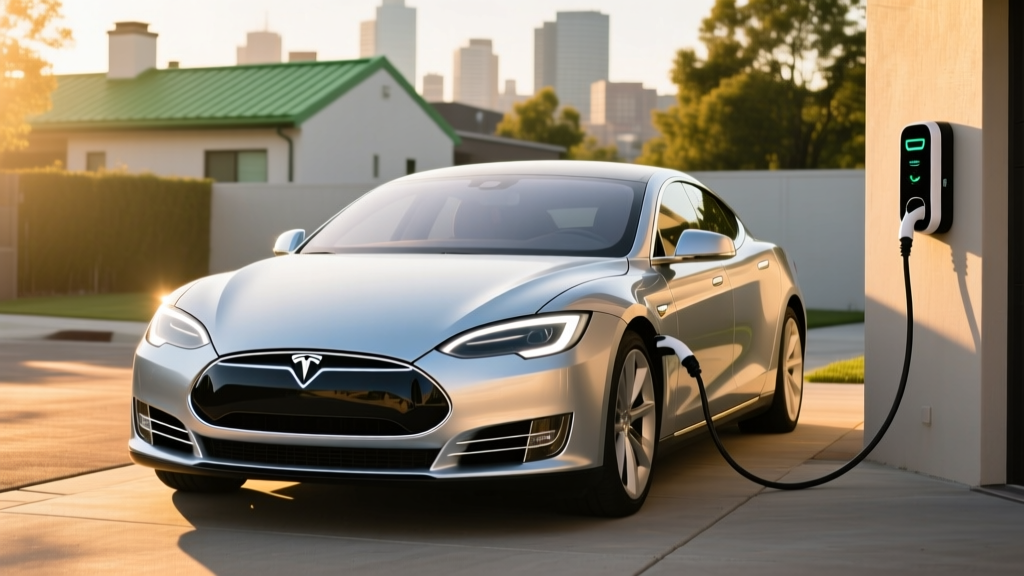
At home on a Level 2 Wall Connector (48 amps / 11.5 kW), the Model S adds about 34 miles of range per hour. A depleted battery reaches full in roughly 10 hours — easily an overnight session. For most owners who charge nightly, Level 2 is the only charging method they use day to day.
Autopilot, FSD (Supervised), and the Safety Legacy of Joshua Brown
The Joshua Brown crash exposed a fundamental mismatch between what Autopilot could do and what drivers assumed it could do. In 2016, Tesla's system relied primarily on forward-facing radar and cameras. The tractor-trailer's white side against a bright sky was not detected by the radar, which filtered out overhead structures, nor by the camera system, which lacked the resolution and neural-net sophistication of today's Tesla Vision stack.
Since then, Tesla has made significant changes:
- Tesla Vision (camera-only): Radar was removed in 2021–2022. The current system uses an 8-camera suite processed by the Hardware 4 (HW4) computer with significantly more compute throughput than the HW2.5 unit in Brown's car.
- Cabin camera monitoring: The interior camera now tracks driver attention more aggressively, issuing escalating warnings and eventually disengaging Autopilot if the driver appears inattentive.
- FSD (Supervised) naming: Tesla added "Supervised" to the FSD branding to clarify that a human driver is always responsible.
- NHTSA Standing General Order: Since 2021, automakers must report crashes involving Level 2+ systems, creating a public safety data trail that didn't exist in 2016.
- They do not stop reliably for all stationary objects, emergency vehicles, or construction-zone barriers.
- They do not handle unmapped roads, severe weather, or faded lane markings consistently.
- They do not replace driver judgment. NHTSA data shows Level 2 system misuse remains a leading factor in ADAS-related crashes.
- FSD (Supervised) requires an additional $8,000 purchase or $99/month subscription on top of the vehicle price.
For context on safety data, NHTSA and IIHS have both published studies showing that while automatic emergency braking and lane-keeping assist reduce certain crash types, overreliance on partial automation introduces new risk categories. The Model S earns strong crash-test ratings from NHTSA (5 stars overall), and the vehicle structure is robust — but the driver-assist system's limitations remain a buyer-education issue.
Pricing, Tax Credits, and Total Cost
| Trim | Base MSRP | Federal Tax Credit (§30D) | Effective Price (if eligible) |
|---|---|---|---|
| Model S Long Range | $79,990 | $0 — exceeds MSRP cap | $79,990 |
| Model S Plaid | $94,990 | $0 — exceeds MSRP cap | $94,990 |
The IRS §30D federal tax credit offers up to $7,500 for qualifying new EVs, but the Model S does not qualify. The credit imposes an MSRP cap of $55,000 for sedans (and $80,000 for SUVs/trucks/vans). At $79,990 and up, the Model S sedan exceeds the $55,000 sedan cap.
Additionally, §30D has buyer income limits (adjusted gross income ≤ $150,000 single / ≤ $300,000 joint filers for 2026) and critical-mineral/battery-component sourcing requirements that further narrow eligibility for many vehicles. Even if the MSRP cap didn't disqualify the Model S, buyers would need to verify Tesla's current battery-sourcing compliance. Always confirm eligibility with a tax professional before purchase.
For buyers seeking a Tesla within the tax-credit window, the Model 3 (starting around $38,990) and Model Y (starting around $44,990, classified as an SUV) are the realistic candidates for partial or full §30D credit, depending on sourcing and income.
Interior, Tech, and Daily Livability
The Model S interior centers on a 17-inch landscape touchscreen running Tesla's proprietary infotainment OS. There are no physical buttons for climate, media, or even the glovebox — everything routes through the screen or voice commands. This minimalism appeals to some and frustrates others, particularly for quick climate adjustments while driving.
Standout tech features:
- Over-the-air (OTA) software updates that add features and refine performance post-purchase
- Tesla Supercharger network with NACS connector — now adopted as the industry standard by Ford, GM, Rivian, and others
- Sentry Mode dashcam recording and remote climate control via the Tesla app
- HEPA air filtration with Bioweapon Defense Mode
- Yoke steering wheel (optional; controversial for daily use due to hand-over-hand limitations)
Notable drawbacks:
- No Apple CarPlay or Android Auto — a dealbreaker for some buyers accustomed to phone-mirroring
- Build-quality variance: panel gaps and interior trim inconsistencies still surface in owner reports, though improved over prior years
- Insurance premiums run 20–40% higher than comparable luxury sedans due to repair costs and ADAS complexity
- The yoke steering wheel, while striking, complicates three-point turns and low-speed maneuvering
Cargo capacity is generous for a sedan: 28.0 cubic feet behind the rear seats (with the hatchback-style liftgate providing much wider access than a traditional trunk), plus a 3.1 cu ft front trunk (frunk). Rear legroom at 35.4 inches is adequate for adults but trails the Mercedes EQS and BMW i7.
Pros and Cons
Pros
- Class-leading EPA range (402 mi) with real-world highway usability above 320 mi
- Access to Tesla Supercharger network — the most reliable public DC charging infrastructure in the U.S.
- Tri-motor Plaid performance (1,020 hp, 1.99s 0–60) is supercar territory in a four-door sedan
- Continuous OTA updates keep the vehicle current years after purchase
- Strong crash-test ratings (5-star NHTSA overall)
- Generous battery warranty: 8 years / 150,000 miles with ≥70% capacity retention
Cons
- No federal tax credit — MSRP exceeds §30D sedan cap
- FSD (Supervised) costs $8,000 extra and remains a Level 2 system, not autonomous driving
- No Apple CarPlay / Android Auto
- Insurance costs significantly above segment average
- DC fast charging peaks at 250 kW — slower than Hyundai/Kia's 800V architecture (~350 kW)
- Yoke steering option is impractical for many daily driving scenarios
Is the Model S Worth It vs. the Competition?
The Model S competes in a narrow but growing segment of luxury electric sedans. Its closest rivals:
- Mercedes-Benz EQS: More luxurious interior, available CarPlay, but lower EPA range (~350 mi) and significantly higher starting price (~$104,000).
- BMW i7: Superior rear-seat comfort and build quality, but heavier, less efficient, and starting above $120,000.
- Lucid Air Pure: Exceptional range (up to 419 mi EPA), more spacious rear seat, starts around $69,900 — but Lucid's service-center footprint is far smaller than Tesla's, and public charging relies on third-party networks (though NACS adoption is expanding access).
- You prioritize Supercharger network access for frequent road trips
- You want the highest range in a proven, widely serviced platform
- You value OTA software evolution and Tesla's app ecosystem
- Performance (Plaid) is a genuine priority
- You want the federal $7,500 tax credit (consider Model 3, Model Y, or competitors under the MSRP cap)
- Interior luxury and traditional controls matter more than minimalism
- You need Apple CarPlay or Android Auto
- Insurance cost is a major budget factor
Frequently Asked Questions
What is the real-world range of the Tesla Model S?
The EPA rates the Long Range at 402 miles. In real-world highway driving at 70–75 mph, expect 320–360 miles. In sub-freezing weather, plan for 280–310 miles. City driving with regenerative braking can match or slightly exceed the EPA number.
How fast does the Model S charge?
On a V3 or V4 Supercharger, it peaks at 250 kW and charges from 10–80% in roughly 30 minutes. At home on a Level 2 Wall Connector (11.5 kW), it adds ~34 miles per hour, reaching a full charge overnight in about 10 hours.
Does the Tesla Model S qualify for the federal EV tax credit?
No. The §30D credit caps sedan eligibility at $55,000 MSRP. The Model S starts at $79,990, well above that threshold. The Model 3 and Model Y may qualify depending on battery sourcing, buyer income, and current IRS rules.
How much does the Model S cost after tax credits?
Since it doesn't qualify for the federal credit, the effective price equals the MSRP: $79,990 for Long Range and $94,990 for Plaid (before destination, options, or state/local incentives). Adding FSD (Supervised) adds $8,000.
Is Tesla Autopilot safer now than during the Joshua Brown crash?
Significantly so. Tesla Vision with HW4 compute, cabin driver-monitoring, improved object detection, and NHTSA reporting requirements all address failures identified in the 2016 NTSB investigation. However, Autopilot and FSD (Supervised) remain Level 2 systems that require constant driver attention. They are not self-driving.
What is the battery warranty on the Model S?
Tesla covers the battery and drive unit for 8 years or 150,000 miles (whichever comes first), with a guaranteed minimum of 70% capacity retention over that period. This is among the stronger warranties in the luxury EV segment.
Is the Model S worth buying vs. key competitors?
For road-trippers who value charging infrastructure and maximum range, the Model S remains a benchmark. For luxury-focused buyers who prioritize interior quality and back-seat comfort, the Lucid Air, EQS, or i7 may be better fits — at higher cost. For budget-conscious Tesla buyers, the Model 3 or Model Y offers similar tech with tax-credit eligibility.