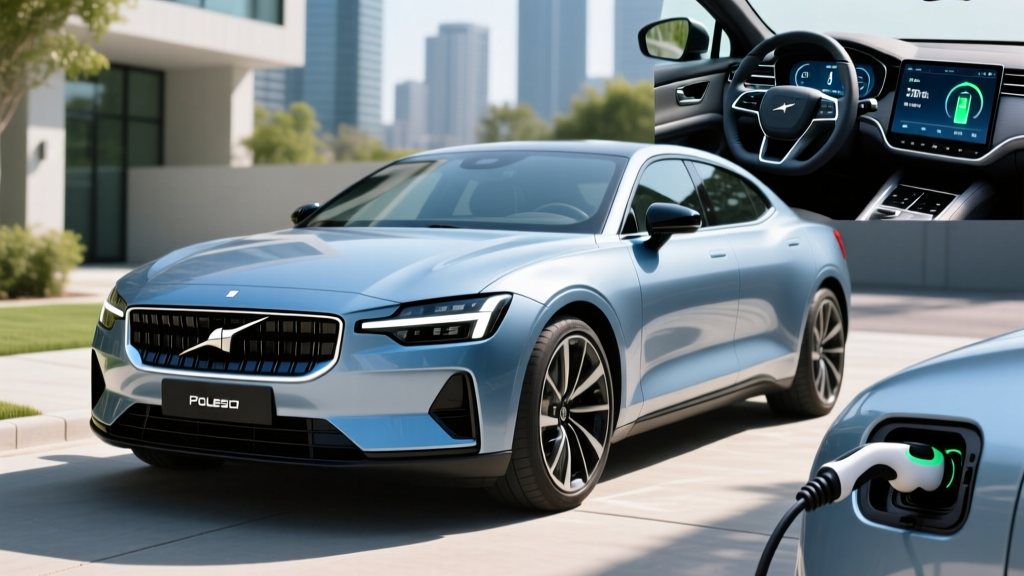
The Polestar 2 electric sedan occupies a distinct niche in the premium EV market: Scandinavian minimalism, a driver-focused chassis, and increasingly competitive range and charging metrics. For the 2025-2026 model years, Polestar overhauled the powertrain lineup—shifting the Standard Range Single Motor to rear-wheel drive, boosting the Long Range battery to 82 kWh usable capacity, and adding NACS native charging access. This review breaks down the exact numbers buyers need before signing a lease or purchase agreement.
Quick Verdict: Who the Polestar 2 Is For
The Polestar 2 suits design-conscious commuters and driving enthusiasts who prioritize handling precision and build quality over maximum cargo volume or segment-leading range. It competes directly with the Tesla Model 3, BMW i4, Hyundai Ioniq 6, and Volvo S60 Recharge (its corporate cousin). If you value a physical button layout, Google Automotive OS, and a chassis tuned for real roads—not just straight-line drag strips—the Polestar 2 earns a serious test drive. If your priority is lowest cost per mile of range or the largest Supercharger network advantage, look at the Model 3 or Ioniq 6 first.
Range, Efficiency, and Real-World Expectations
Long Range Single Motor: EPA 320 miles | Real-world highway (70 mph): ~270-285 mi | Cold weather (below 32°F): ~230-255 mi
Long Range Dual Motor: EPA 298 miles | Real-world highway: ~250-265 mi | Cold weather: ~215-235 mi
Standard Range Single Motor: EPA 270 miles | Real-world highway: ~230-240 mi | Cold weather: ~195-210 mi
The 82 kWh lithium-ion battery pack (NMC chemistry) in Long Range variants uses a 400-volt architecture. Efficiency on the combined EPA cycle lands at roughly 28-30 kWh/100 mi for the single-motor configuration—competitive with the BMW i4 eDrive40 but trailing the Hyundai Ioniq 6's exceptional aero efficiency. The dual-motor AWD variant consumes more energy due to added weight and drivetrain losses, dropping MPGe from approximately 107 MPGe combined (single motor) to around 96 MPGe combined (dual motor), according to fueleconomy.gov.
Expect roughly 15-20% range reduction in sustained cold-weather driving. The Polestar 2 includes a heat pump on most trims (standard on Long Range, optional or standard depending on package on Standard Range), which mitigates cabin-heating energy draw but does not eliminate cold-weather chemistry losses in the pack itself. Preconditioning the battery while plugged in—via the Polestar app—is essential for preserving range and enabling peak DC charge rates in winter.
Battery, Charging Speed, and Connector Details
| Spec | Standard Range | Long Range Single Motor | Long Range Dual Motor |
|---|---|---|---|
| Usable Battery Capacity | 69 kWh (LFP) | 82 kWh (NMC) | 82 kWh (NMC) |
| Battery Chemistry | LFP (Lithium Iron Phosphate) | NMC (Nickel Manganese Cobalt) | NMC |
| Max DC Fast Charge Rate | 135 kW | 205 kW | 205 kW |
| 10-80% DC Fast Charge Time | ~30 min | ~26 min | ~26 min |
| Level 2 AC Charge Rate | 11 kW | 11 kW | 11 kW |
| Level 2 Miles Added/Hour | ~35 mi/hr | ~37 mi/hr | ~35 mi/hr |
| Charge Port / Connector | NACS (native) / CCS adapter | NACS (native) / CCS adapter | NACS (native) / CCS adapter |
The shift to 205 kW peak DC charging on Long Range models is a meaningful upgrade from the pre-refresh 150 kW cap. On a 350 kW Electrify America or Tesla Supercharger (via NACS), the Long Range Polestar 2 sustains roughly 175-190 kW from 15-50% State of Charge, then tapers progressively. The 10-80% time of approximately 26 minutes is competitive with the BMW i4 but about 5-8 minutes slower than the Hyundai Ioniq 6's 800V architecture, which can achieve 10-80% in roughly 18 minutes.
The Standard Range model uses an LFP (lithium iron phosphate) battery—meaning it tolerates daily 100% charging better than NMC chemistry, offsetting its lower energy density with longevity and lower degradation risk. However, its 135 kW DC charge ceiling means road-trip charging stops take noticeably longer.
Home Level 2 charging at 11 kW (48 amps on a 60-amp circuit) replenishes the 82 kWh pack from 10-100% in roughly 8 hours—overnight charging is practical for most commutes. A NEMA 14-50 outlet or hardwired Wallbox/ChargePoint unit will suffice; panel upgrades may be necessary in older homes with 100-amp service.
Performance, Drivetrain, and Driving Dynamics
| Variant | Drivetrain | Horsepower | Torque (lb-ft) | 0-60 mph |
|---|---|---|---|---|
| Standard Range Single Motor | RWD | 299 hp | 361 | 5.9 sec |
| Long Range Single Motor | RWD | 299 hp | 361 | 5.9 sec |
| Long Range Dual Motor (AWD) | AWD | 421 hp | 546 | 4.3 sec |
| Dual Motor + Performance Pack | AWD | 476 hp | 546 | 3.9 sec |
The 2025 refresh corrected one of the original Polestar 2's biggest quirks: the single-motor variant is now rear-wheel drive instead of front-wheel drive, dramatically improving traction and driving balance. The dual-motor AWD variant with the optional Performance Pack (Öhlins dampers, Brembo brakes, 20-inch forged wheels, software torque bump) delivers genuine sports-sedan acceleration.
Regenerative braking offers one-pedal driving in most scenarios, with adjustable regen levels via the center touchscreen. The chassis—shared with Volvo's CMA platform—delivers composed ride quality, though the 20-inch Performance Pack wheels firm up the ride noticeably on rough pavement. Steering is precise but light; this is a grand-touring EV, not a track weapon.
Interior, Cargo, and Technology
The Polestar 2's interior follows Scandinavian design principles: vegan textile or available Nappa leather upholstery, a portrait-oriented 11.2-inch touchscreen running Google Automotive OS (with native Google Maps, Google Assistant, and Play Store apps), and a 12.3-inch digital driver display. Physical buttons for climate and steering-wheel controls are a welcome ergonomic choice compared to Tesla's touchscreen-only approach.
Cargo volume: 14.4 cubic feet in the rear liftback (competitive with a compact sedan trunk, but less than the Model 3's ~23 cu ft or the Ioniq 6's ~12.3 cu ft trunk—though the liftback opening aids loading). The front trunk (frunk) adds 1.4 cubic feet for charging cables or a small bag.
Passenger space: Rear legroom is 34.0 inches—adequate for adults under 6 feet but tighter than the Tesla Model 3 (35.3 in) or Hyundai Ioniq 6 (35.7 in). Headroom is generous thanks to the liftback roofline. The center rear seat is best suited for children due to the pronounced floor tunnel (a CMA platform compromise from its hybrid-compatible architecture).
Driver assistance: Polestar's Pilot Pack includes adaptive cruise control with stop-and-go, lane centering (Pilot Assist), blind-spot monitoring, and a 360-degree camera. This is an SAE Level 2 system—meaning the driver must remain fully engaged with hands on the wheel and eyes on the road. It does not offer hands-free highway driving like GM's Super Cruise or Ford's BlueCruise.
Pricing, Trims, and Federal Tax Credit Eligibility
| Trim | Base MSRP | Est. As-Tested* | §30D Credit Eligibility |
|---|---|---|---|
| Standard Range Single Motor | $49,900 | $52,000-$54,500 | Up to $7,500 (if sourcing + income met) |
| Long Range Single Motor | $53,400 | $56,000-$60,500 | Up to $7,500 (if sourcing + income met) |
| Long Range Dual Motor | $57,900 | $61,000-$66,000 | Up to $7,500 (if sourcing + income met) |
*As-tested includes destination, common options (Pilot Pack, Plus Pack, 20" wheels).
The Polestar 2 qualifies as a sedan under the IRS §30D MSRP cap of $55,000 for sedans (SUVs/pickups have a higher $80,000 cap). This means the Long Range Dual Motor, once options push it above $55,000, may exceed the MSRP cap and become ineligible for the federal credit. The Standard Range and base Long Range Single Motor trims typically fall within the cap.
- MSRP cap: Sedan ≤ $55,000 (includes destination, excludes dealer add-ons)
- Buyer income cap: MAGI ≤ $150,000 (single) / $300,000 (joint) / $225,000 (head of household)
- Battery sourcing: Must meet critical-minerals and battery-component requirements (phased percentages increase annually; verify current-year thresholds on IRS.gov)
- Point-of-sale transfer: Eligible buyers can transfer the credit to the dealer at purchase for an immediate price reduction (effective Jan 2024+)
- Assembly: Final assembly must occur in North America (Polestar 2 is assembled in China — verify current eligibility on IRS.gov before purchase)
Critical caveat: The Polestar 2 is manufactured in Luqiao, China. Under current §30D rules requiring North American final assembly, the Polestar 2 has historically not qualified for the federal purchase credit. Polestar has indicated plans to shift some production, but buyers must verify current eligibility via the DOE/Fuel Economy tax credit lookup tool before relying on a $7,500 price reduction. Consult a tax professional for your specific situation.
Ownership Costs, Warranty, and Long-Term Value
Warranty: Polestar provides a 4-year/50,000-mile limited vehicle warranty and an 8-year/100,000-mile battery and drive unit warranty, with a capacity retention threshold of 70% (if the pack drops below 70% State of Health within that window, Polestar will repair or replace). This matches industry norms from BMW and Volvo but trails Hyundai/Kia's 10-year/100,000-mile battery coverage.
Maintenance: EV maintenance costs are low—no oil changes, no spark plugs. Expect cabin air filter replacements ($50-100 every 2 years), brake fluid checks, and tire rotations. The regenerative braking system significantly extends brake pad life. Polestar offers a service-included program in some markets covering scheduled maintenance for 2-3 years.
Insurance: Premium EVs carry higher insurance costs. Polestar 2 insurance averages 10-20% higher than a comparable Volvo S60, according to industry aggregators—shop quotes before purchase.
Depreciation: Premium EVs from lower-volume brands like Polestar have historically depreciated faster than Tesla or Toyota. Lease deals (often $499-599/month with $3,500-4,500 due at signing) can insulate buyers from residual-value risk.
Pros, Cons, and the Competition
- Excellent chassis balance and steering feel (RWD single-motor is a big upgrade)
- Physical buttons + Google Automotive OS = intuitive daily use
- 205 kW DC fast charging on Long Range (competitive for 400V architecture)
- Standard heat pump on Long Range trims
- Distinctive Scandinavian design; stands out vs. ubiquitous Teslas
- LFP battery option (Standard Range) supports daily 100% charging without degradation concern
- China assembly likely disqualifies from §30D federal tax credit (verify before purchase)
- Rear seat and cargo space trail Tesla Model 3 and Hyundai Ioniq 6
- No hands-free Level 2+ driver assist (Pilot Assist requires hands on wheel)
- 400V architecture means slower peak charging than 800V rivals (Ioniq 6, Porsche Taycan)
- Premium pricing without premium brand cachet of BMW or Mercedes
- Center rear seat compromised by floor tunnel
Key competitors:
- Tesla Model 3 Highland: More range (EPA ~341 mi LR), faster charging, Supercharger access, lower price, but spartan interior and no physical buttons.
- Hyundai Ioniq 6: 800V charging (10-80% in ~18 min), EPA 361 mi (SE LR), lower MSRP, but polarizing design and less premium interior materials.
- BMW i4 eDrive40: Superior driving dynamics and brand prestige, EPA ~307 mi, but higher price and no federal credit eligibility (German assembly).
Frequently Asked Questions
What is the real-world range of the Polestar 2?
The EPA rates the Long Range Single Motor at 320 miles, but expect 270-285 miles at sustained highway speeds (70 mph) and 230-255 miles in cold weather (below freezing). City driving with regenerative braking can approach or slightly exceed the EPA number.
How fast does the Polestar 2 charge?
Long Range models peak at 205 kW on DC fast chargers, achieving 10-80% in approximately 26 minutes. Home Level 2 charging at 11 kW adds roughly 35-37 miles per hour, fully replenishing the 82 kWh pack in about 8 hours.
Does the Polestar 2 qualify for the $7,500 federal EV tax credit?
Most likely not under current rules. The Polestar 2 is assembled in China, and §30D requires North American final assembly. Always verify current eligibility on the DOE's fueleconomy.gov tax credit page and consult a tax professional before purchase.
Is the Polestar 2 worth buying over the Tesla Model 3?
Choose the Polestar 2 if you prioritize interior build quality, physical controls, distinctive design, and ride comfort. Choose the Model 3 if you prioritize maximum range, lowest price, Supercharger network convenience, and over-the-air feature updates. Both are competent EVs—the decision comes down to brand loyalty, aesthetics, and charging-network preference.
What's the difference between the Standard Range and Long Range battery?
The Standard Range uses a 69 kWh LFP (lithium iron phosphate) battery—heavier but more durable for daily 100% charging, with EPA 270 miles range and 135 kW DC charging. The Long Range uses an 82 kWh NMC (nickel manganese cobalt) pack with higher energy density, EPA 320 miles, and 205 kW DC charging. NMC batteries are best kept between 20-80% for daily use to minimize long-term degradation.
Is Polestar's Pilot Assist self-driving?
No. Pilot Assist is an SAE Level 2 driver-assistance system combining adaptive cruise control and lane centering. The driver must keep hands on the steering wheel and eyes on the road at all times. It does not navigate autonomously or handle complex urban scenarios without driver input.