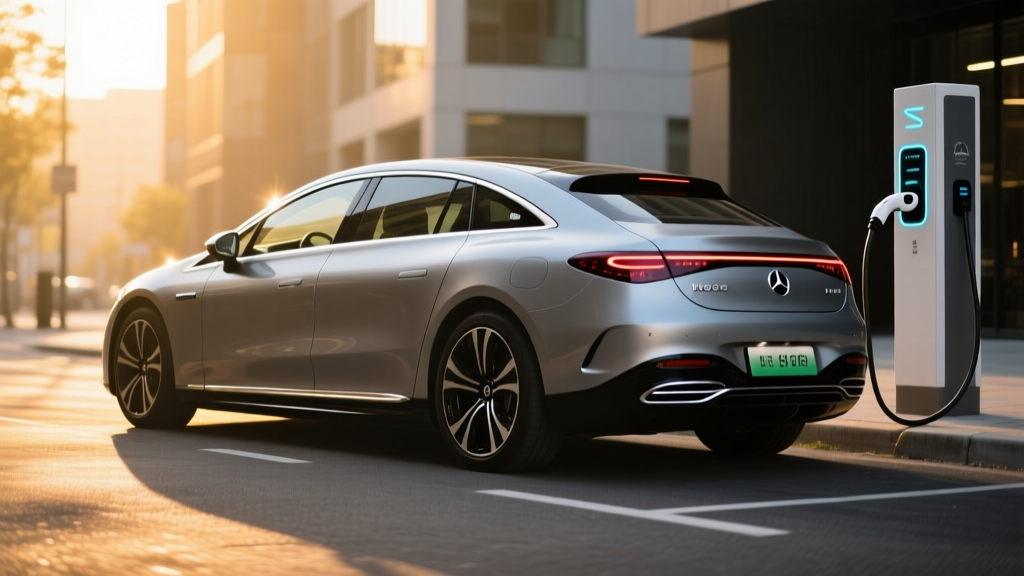
The 2023 Mercedes-Benz EQS 580 4MATIC occupies a rare position in the electric-vehicle market: a six-figure luxury sedan that prioritizes aerodynamic efficiency and ride comfort over outright track performance. With a 107.8 kWh usable battery pack and a slippery 0.20 drag coefficient, it remains one of the most energy-efficient large luxury EVs ever sold in the United States. But as we evaluate this model from a 2026 ownership perspective — with three years of real-world data on battery degradation, charging network reliability, and long-term maintenance — the EQS 580 tells a more nuanced story than its spec sheet suggests.
This review examines the 2023 EQS 580 with exact figures for range, charging speed, efficiency, pricing, and tax-credit eligibility, so you can decide whether a certified-pre-owned example or remaining dealer stock is worth the investment today.
Core Specifications at a Glance
| Specification | 2023 EQS 580 4MATIC |
|---|---|
| EPA Estimated Range | 340 miles (with 20" wheels) / 350 miles (19" wheels) |
| Battery Capacity (Usable) | 107.8 kWh (NMC chemistry) |
| Drivetrain | Dual-motor AWD (4MATIC) |
| Horsepower | 516 hp (536 hp with Sport+ mode) |
| Torque | 631 lb-ft |
| 0–60 mph | 4.1 seconds |
| Max DC Fast-Charge Rate | 200 kW peak |
| 10–80% DC Fast Charge | ~31 minutes (optimal conditions) |
| Level 2 Charge Rate | 9.6 kW (onboard charger) |
| EPA Efficiency | 91 MPGe combined (36 kWh/100 mi) |
| Cargo Volume (rear seats up) | 22.0 cu ft (hatchback liftback) |
| Cargo Volume (rear seats folded) | 63.0 cu ft |
| Rear Legroom | 41.8 inches |
| Base MSRP (at launch) | $125,900 (before destination) |
| Battery/Powertrain Warranty | 10 years / 155,000 miles |
Real-World Range: What the EPA Sticker Doesn't Tell You
Real-World Highway (70–80 mph, mild weather): ~270–295 miles
Real-World Highway (cold weather, below 32°F): ~220–250 miles
City/Commuter Driving (moderate speeds, regen-heavy): ~310–340 miles
The EQS 580's EPA range rating of 340 miles (with the standard 20-inch AMG wheels) is among the highest of any luxury EV from its model year, and the sedan's exceptional aerodynamics play a major role. The 0.20 Cd drag coefficient is one of the lowest of any production car, and it pays measurable dividends at highway speeds where air resistance dominates energy consumption.
However, EPA testing cycles include a significant low-speed and city component that flatters large, heavy EVs. In sustained highway driving at 75 mph in 65–75°F conditions, expect roughly 270–295 miles before the battery buffer forces you toward a charger. The EQS 580 weighs approximately 5,800 pounds, and that mass shows up in stop-and-go efficiency penalties in hot weather when cabin cooling demands spike.
Cold weather is where the EQS reveals its biggest range vulnerability. Without a dedicated heat pump (Mercedes uses a resistive PTC heater supplemented by waste-heat recovery from the powertrain), range drops to approximately 220–250 miles in sub-freezing highway driving. This is a 25–35% reduction from the EPA sticker — typical for EVs without heat pumps, but still a planning consideration for winter road trips in northern states.
One ownership advantage worth noting: the EQS 580's large 107.8 kWh battery means that even at 70% real-world retention in worst-case winter conditions, you still have roughly 240 miles of usable range. That buffer reduces charging-stop frequency compared to smaller-battery competitors, even when conditions aren't ideal.
Charging Performance: DC Fast Charging and Home Level 2
| Charging Method | Power (kW) | Miles Added Per Hour | Notes |
|---|---|---|---|
| Level 1 (120V standard outlet) | ~1.2 kW | ~3–4 mi/hr | Emergency/trickle only |
| Level 2 (240V, 40A circuit) | 9.6 kW | ~28–30 mi/hr | Full charge in ~11.5 hours |
| DC Fast Charge (peak) | 200 kW | ~180 mi in 15 min (10–50%) | CCS1 connector |
| DC Fast Charge (10–80%) | Avg ~130 kW sustained | ~31 minutes total | Curve tapers above 60% SoC |
The EQS 580's 200 kW peak DC fast-charge capability was competitive at launch but falls short of the 250–350 kW peaks offered by the Hyundai Ioniq 5, Kia EV6, Porsche Taycan, and Lucid Air. In practice, peak rate matters less than the charge curve — how long the vehicle sustains high charging power as the battery fills.
The EQS 580's charge curve is relatively flat from 10% to about 55% State of Charge (SoC), holding between 160–200 kW at a compatible 350 kW Electrify America or Ionity station. Beyond 60%, the curve tapers progressively: you'll see roughly 100–120 kW in the 60–70% range, dropping to 50–70 kW by 80%. This means the 10–80% charge takes approximately 31 minutes under optimal thermal conditions — about 5–8 minutes longer than an Ioniq 5 or Taycan on the same charger.
The EQS uses the CCS1 connector standard. With the industry-wide shift to NACS (Tesla's connector) now well underway in 2026, CCS1 chargers remain widely available at Electrify America, EVgo, and ChargePoint stations, but new deployments increasingly favor NACS. Mercedes-Benz has offered NACS adapter solutions for existing CCS1 vehicles, so public charging access remains viable — just plan for an adapter purchase (~$200–$250) if you rely on Tesla Superchargers.
For home charging, the 9.6 kW onboard charger is adequate. A full 0–100% charge takes roughly 11.5 hours, meaning an overnight session on a Level 2 home charger (typically a 48A wallbox on a 60A circuit) easily replenishes a full day's driving. Most EQS owners report plugging in nightly and starting each morning at 80–90% SoC, which is also the recommended daily charge limit for NMC battery longevity.
Driving Dynamics and Performance
The EQS 580's dual-motor 4MATIC powertrain produces 516 horsepower and 631 lb-ft of torque, with a brief 536 hp available in Sport+ mode via the "Power Boost" overboost function. The 0–60 mph sprint takes 4.1 seconds — quick by any measure, but deliberately restrained compared to the 3.4-second EQS 580 or the 2.5-second Lucid Air Dream Edition. Mercedes tuned the EQS 580 for effortless, surge-on-demand passing power rather than launch-control theatrics.
The ride quality is where this sedan justifies its price. Standard AIRMATIC air suspension with adaptive damping absorbs road imperfections with a plushness that rivals the S-Class. Rear-axle steering (up to 10 degrees on properly equipped models) shrinks the car's effective turning radius to that of a compact hatchback — a genuine benefit in urban parking and tight residential streets.
Regenerative braking offers three levels via steering-wheel paddles (D+, D, D−) plus an intelligent D-Auto mode that uses radar and navigation data to modulate regen based on traffic and upcoming intersections. One-pedal driving is possible but not as aggressive as Tesla or Nissan implementations — Mercedes intentionally left some creep behavior for drivers transitioning from ICE vehicles.
Interior, Technology, and the Hyperscreen Question
The 2023 EQS 580's interior centers on the available MBUX Hyperscreen — a 56-inch curved glass panel spanning the entire dashboard, encompassing a 17.7-inch central OLED touchscreen, a 12.3-inch driver cluster, and a 12.3-inch passenger display. It's visually arresting and functionally capable, running Mercedes' latest MBUX software with wireless Apple CarPlay and Android Auto, over-the-air updates, and a fingerprint reader for driver profile switching.
However, the Hyperscreen drew criticism for its learning curve and occasional lag when navigating nested menus. Many owners report preferring the standard 12.8-inch portrait touchscreen (included on base EQS 450+ models) for its simpler layout. The Hyperscreen was a $5,000+ option on the EQS 580 in 2023 and remains a polarizing feature on the used market — some buyers specifically seek it, others avoid it.
Driver assistance comes via Mercedes' Driver Assistance Package, which includes Active Distance Assist DISTRONIC (adaptive cruise), Active Steering Assist, Active Lane Change Assist, and Active Emergency Stop Assist. This is an SAE Level 2 system — it requires continuous driver supervision and does not permit hands-off driving. Mercedes' DRIVE PILOT Level 3 system (which does allow conditional hands-off operation at speeds up to 40 mph on limited-access highways) was not available on US-spec 2023 EQS models and remains limited to select markets and conditions as of 2026.
Practical space is a strong suit. The hatchback-style liftback trunk (not a traditional sedan trunk lid) opens to reveal 22.0 cu ft of cargo room — substantially more than a Tesla Model S (28 cu ft behind the second row, but the EQS trunk opening is wider and lower). Fold the rear seats and you get 63.0 cu ft, enough for furniture-scale hauling. Rear-seat passengers enjoy 41.8 inches of legroom and available heated/ventilated/massaging outboard seats with individual climate and entertainment screens.
Pricing, Trims, and Federal Tax Credit Eligibility
The 2023 EQS 580 4MATIC launched with a base MSRP of $125,900, plus a $1,150 destination charge. Well-equipped examples with the Hyperscreen, Executive Rear Seat Package, AMG Line exterior, and Driver Assistance Package routinely exceeded $145,000–$155,000 as-tested.
As of 2026, certified pre-owned (CPO) and low-mileage used 2023 EQS 580 sedans trade in the $65,000–$85,000 range depending on mileage, condition, and equipment — a steep depreciation curve that makes the EQS 580 one of the best value propositions in the used luxury EV market for buyers who can accept the running costs.
| Cost Factor | Amount |
|---|---|
| Original Base MSRP (2023) | $125,900 |
| Typical As-Tested Price (2023) | $140,000–$155,000 |
| Used/CPO Market Price (2026) | $65,000–$85,000 |
| Federal Used EV Tax Credit (§25E) | Up to $4,000 (30% of sale price, max $4,000) |
| Federal New EV Tax Credit (§30D) | Not eligible (MSRP exceeds $55,000 sedan cap) |
Federal tax credit note: The 2023 EQS 580 did NOT qualify for the $7,500 new-vehicle §30D federal tax credit when sold new. The IRS caps eligible sedans at $55,000 MSRP, and the EQS 580's $125,900 starting price far exceeded that threshold. This has not changed. However, purchasing a used 2023 EQS 580 from a licensed dealer in 2026 may qualify you for the §25E Used Clean Vehicle Credit — up to $4,000 (30% of the sale price, capped at $4,000), subject to buyer income limits ($75,000 single / $150,000 married filing jointly) and the requirement that the vehicle's original MSRP was under $80,000 (which the EQS 580's was not — this is a point of confusion, as the §25E credit references the original MSRP cap of $80,000 for used EV eligibility, and the EQS 580 exceeds it). Consult a tax professional to confirm eligibility for your specific situation.
Ownership Costs: Warranty, Efficiency, and Long-Term Outlook
Mercedes-Benz provides a 10-year / 155,000-mile high-voltage battery warranty for the EQS, covering defects and capacity loss below 70% of original capacity. This is among the most generous battery warranties in the luxury EV segment and exceeds the federal minimum of 8 years / 100,000 miles. The basic vehicle warranty is 4 years / 50,000 miles, with complimentary scheduled maintenance for the same period.
Efficiency in mixed driving averages approximately 36 kWh per 100 miles (91 MPGe combined per fueleconomy.gov). At the national average residential electricity rate of ~$0.17/kWh, that translates to roughly $6.12 per 100 miles of driving — compared to approximately $14–$16 per 100 miles for a similarly sized gas-powered S-Class at $3.50/gallon and 22 MPG combined. Over 15,000 annual miles, the EQS 580 saves roughly $1,200–$1,500 per year in energy costs.
Insurance premiums for the EQS 580 are elevated — expect $3,500–$5,000 annually depending on your driving record, location, and coverage level. Luxury EVs carry higher repair costs (aluminum body panels, sensor-dense bumpers, battery proximity concerns), and insurers price accordingly. Obtain quotes before purchasing.
Tire wear is another ownership reality. The EQS 580's weight and instant torque wear through tires faster than comparable ICE sedans. Owners report replacing the 20-inch Michelin Pilot Sport EV tires every 20,000–28,000 miles, at roughly $400–$500 per tire. Budget $1,600–$2,000 every 2–3 years for a full set.
Pros and Cons
Pros
- Class-leading EPA range (340–350 mi) among 2023 luxury sedans
- Exceptional ride comfort with AIRMATIC air suspension
- Hatchback-style liftback with 22 cu ft cargo (63 cu ft folded)
- 10-year / 155,000-mile battery warranty
- Whisper-quiet cabin with outstanding NVH isolation
- Rear-axle steering dramatically improves low-speed maneuverability
- Strong CPO/depreciation value for second-hand buyers
Cons
- No heat pump — significant cold-weather range loss (25–35%)
- 200 kW peak DC charging trails rivals (Taycan: 270 kW, Lucid: 300+ kW)
- Hyperscreen interface can be distracting and laggy
- Heavy (5,800 lbs) — eats tires and affects braking distances
- No federal §30D new-vehicle tax credit (MSRP cap exceeded)
- High insurance premiums ($3,500–$5,000/year)
- CCS1 connector requires adapter for growing NACS/Supercharger network
Who Should Buy the 2023 EQS 580?
The 2023 EQS 580 is best suited for luxury-sedan buyers who prioritize ride comfort, cabin isolation, and long highway range over sporty handling or cutting-edge charging speed. It's an excellent executive commuter and road-trip vehicle for warm-climate owners who have reliable home Level 2 charging and don't frequently drive in sub-freezing conditions.
It's less ideal for buyers who need the fastest possible road-trip charging (look at the Lucid Air or Porsche Taycan), those in cold northern states who need a heat pump for range preservation (the BMW i7 or Tesla Model S are stronger here), or budget-conscious buyers who need tax-credit eligibility to justify the purchase.
For second-hand buyers in 2026, the EQS 580's steep depreciation makes it a compelling value: a $140,000+ luxury flagship available for $70,000–$80,000 with remaining factory battery warranty. If your use case aligns with its strengths, the EQS 580 delivers an ownership experience that few EVs at any price can match for serenity and long-distance comfort.
Frequently Asked Questions
What is the real-world range of the 2023 EQS 580?
In mild-weather highway driving at 70–80 mph, expect 270–295 miles. City and commuter driving with regenerative braking can return 310–340 miles. In sub-freezing winter highway conditions, plan for 220–250 miles due to the lack of a heat pump and increased cabin heating demands.
How fast does the 2023 EQS 580 charge?
On a DC fast charger, the EQS 580 peaks at 200 kW and charges from 10–80% in approximately 31 minutes under optimal conditions. The charge curve tapers noticeably above 60% SoC. On a home Level 2 charger (9.6 kW), a full charge takes about 11.5 hours, adding roughly 28–30 miles of range per hour.
Does the 2023 EQS 580 qualify for the federal EV tax credit?
No — the EQS 580 did not qualify for the §30D new-vehicle credit ($7,500) because its MSRP of $125,900 exceeded the $55,000 sedan cap. For used purchases, the §25E credit (up to $4,000) has its own original-MSRP cap of $80,000, which the EQS 580 also exceeds. Consult a tax professional to verify eligibility for your situation, as IRS rules are subject to change.
Is the EQS 580 worth buying versus the Lucid Air or Tesla Model S?
If your priority is ride comfort, cabin quietness, and traditional Mercedes luxury, the EQS 580 is the strongest choice. The Lucid Air offers superior range (up to 516 mi EPA), faster charging, and more interior volume, but a firmer ride and less polished interior materials. The Tesla Model S offers the fastest charging (via Supercharger network), the longest range (402 mi EPA for Long Range), and over-the-air updates, but its interior quality and ride refinement fall short of the EQS at this price point.
What are the biggest drawbacks of the EQS 580?
The three most significant limitations are: (1) no heat pump, causing 25–35% range loss in cold weather; (2) 200 kW peak DC charging that is slower than key competitors; and (3) ineligibility for federal EV tax credits at both the new and used levels due to MSRP caps. Secondary concerns include high insurance costs, accelerated tire wear from the vehicle's weight, and the Hyperscreen's occasionally sluggish interface.
How long will the EQS 580 battery last?
Mercedes warranties the 107.8 kWh NMC battery for 10 years or 155,000 miles against capacity loss below 70%. Real-world data from high-mileage EQS owners (as of 2026, with some exceeding 80,000 miles) suggests annual degradation of approximately 1.5–2.5% under normal charging habits (daily 80% limit, occasional 100% for trips). At that rate, the battery should retain 80–85% capacity at the 10-year mark.