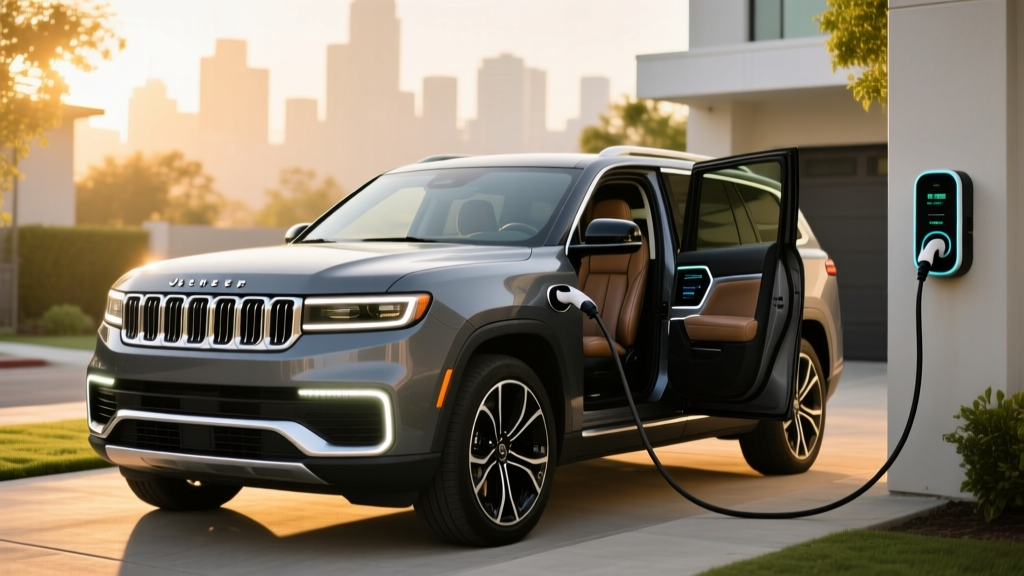
The 2026 Jeep Wagoneer S is Stellantis' first serious attempt at a premium electric SUV built on the dedicated STLA Large platform. It positions itself against the Tesla Model Y, BMW iX, and Genesis Electrified GV70 with a blend of dual-motor performance, aggressive pricing, and Jeep brand equity. But for buyers researching Jeep Wagoneer S incentives, the real question is whether this EV qualifies for the full $7,500 federal tax credit — and whether the total package justifies its sticker price once you factor in real-world range and charging behavior.
We've broken down every number that matters: EPA range versus what you'll actually see on the highway in January, DC fast-charge curves, trim-level pricing, and the specific §30D requirements you'll need to meet at the dealership.
2026 Wagoneer S: Core Specifications at a Glance
| Specification | Launch Edition / Limited |
|---|---|
| EPA Estimated Range | 300 miles (Launch Edition, 20" wheels) |
| Battery Capacity | 100.5 kWh usable (NMC lithium-ion) |
| Drivetrain | Dual-motor AWD |
| Horsepower | 600 hp |
| Torque | 617 lb-ft |
| 0–60 mph | 3.4 seconds |
| Max DC Fast Charge | ~165 kW peak |
| 10–80% DC Charge Time | ~23 minutes (optimal conditions) |
| Level 2 Home Charging | 11.5 kW onboard charger (~30 mi/hr) |
| EPA Efficiency | 88 MPGe combined / 38 kWh/100 mi |
| Cargo Volume (behind 2nd row) | 30.4 cu ft |
| Cargo Volume (rear seats folded) | 61.0 cu ft |
| Base MSRP (Launch Edition) | $65,200 (before destination) |
| Battery Warranty | 8 years / 100,000 miles |
Sources: Stellantis press materials, fueleconomy.gov. Verify final 2026 EPA figures before purchase.
Real-World Range: What the EPA Sticker Doesn't Tell You
EPA Estimate: 300 miles (Launch Edition)
Real-World Highway (70 mph, moderate climate): ~255–275 miles
Real-World Cold Weather (below 30°F): ~210–240 miles
City / Stop-and-Go with Regen: ~285–310 miles
The 300-mile EPA figure for the Launch Edition (equipped with 20-inch wheels) assumes a mix of city and highway driving at moderate temperatures. In practice, the Wagoneer S's 5,300+ lb curb weight and boxy SUV profile work against highway efficiency. Expect to see roughly 255–275 miles on a flat interstate run at 70 mph in spring or fall conditions.
Cold weather is the bigger concern for northern-climate buyers. NMC batteries lose roughly 20–30% of usable capacity in sustained sub-freezing temperatures due to increased internal resistance and cabin heating demands. The Wagoneer S includes a heat pump (standard), which mitigates some of this loss compared to resistive heating, but plan for approximately 210–240 miles of range on a full charge during January in the upper Midwest or Northeast.
City driving with frequent regenerative braking opportunities pushes efficiency closer to or slightly above the EPA estimate. If your commute is primarily urban, the 300-mile sticker is a reasonable daily expectation.
Charging Performance: DC Fast Charge and Home Setup
| Charging Level | Power / Rate | Speed | Notes |
|---|---|---|---|
| Level 1 (120V household) | ~1.4 kW | ~4 mi/hr | Emergency/trickle only |
| Level 2 (240V home) | 11.5 kW | ~30 mi/hr | Full charge in ~9 hours |
| DC Fast Charge (peak) | ~165 kW | 10–80% in ~23 min | Peak rate, not sustained |
| DC Fast Charge (sustained avg.) | ~120 kW avg. | 10–80% realistic ~28 min | Charge curve tapers above 60% |
The Wagoneer S uses a CCS1 connector for DC fast charging (NACS adapter availability for Tesla Superchargers may be offered — check with your dealer for the latest adapter compatibility). At a 350 kW-capable station like Electrify America or EVgo, the SUV will peak around 165 kW under optimal battery temperature conditions.
Here's where the charge curve matters: the peak rate applies roughly from 10% to 50% state of charge. Above 60%, the battery management system tapers charging speed to protect the NMC cells, dropping to approximately 80–100 kW through 80%. This means your real-world 10–80% session will take closer to 25–28 minutes, not the marketing-friendly 23-minute figure. Plan road-trip stops accordingly — a 20-minute break gets you roughly 150–170 miles of range.
For home charging, the 11.5 kW onboard charger is competitive. A Level 2 wall connector on a 60-amp circuit will replenish the 100.5 kWh battery from empty to full in roughly 9 hours — meaning an overnight charge is more than sufficient for daily use. Home installation costs for a Level 2 charger typically run $800–$2,000 depending on your electrical panel capacity and conduit run length (licensed electrician required).
Pricing, Trims, and Jeep Wagoneer S Incentives Breakdown
| Trim | Base MSRP | Est. Destination | Federal §30D Credit | Effective Price |
|---|---|---|---|---|
| Launch Edition | $65,200 | $2,095 | Up to $7,500* | ~$59,795 |
| Limited (if available) | ~$58,000 (est.) | $2,095 | Up to $7,500* | ~$52,595 |
*Federal tax credit eligibility is NOT guaranteed. See requirements below.
The Wagoneer S Launch Edition's MSRP of $65,200 sits under the IRS §30D SUV MSRP cap of $80,000, making it theoretically eligible for the full $7,500 federal tax credit. However, eligibility depends on three factors that you must verify before signing paperwork:
- Buyer Income Caps: Modified adjusted gross income (MAGI) must not exceed $300,000 (joint filers), $225,000 (head of household), or $150,000 (individual). This is based on the tax year of delivery or the prior year — whichever is lower.
- MSRP Cap: The vehicle's MSRP (including factory-installed options, before destination) must not exceed $80,000 for SUVs. The Wagoneer S clears this threshold comfortably.
- Battery Sourcing Requirements: As of 2026, both critical minerals and battery component sourcing requirements apply under §30D. The credit is split: $3,750 for meeting critical minerals thresholds and $3,750 for battery component sourcing. Stellantis has not published full battery supply-chain details for the Wagoneer S at the time of writing. Verify with your dealer and consult IRS.gov before assuming the full $7,500.
If you qualify for the full credit, it can now be transferred at the point of sale, reducing your purchase price directly at the dealership rather than waiting for a tax refund. This is a significant cash-flow advantage.
State and local incentives may stack on top. California's CVRP, Colorado's state credit, and various utility rebates can add $1,000–$7,500 depending on your jurisdiction. Check your state energy office and local utility for current programs — these change frequently.
Performance and Driving Dynamics
The dual-motor AWD powertrain produces 600 horsepower and 617 lb-ft of torque, launching the Wagoneer S to 60 mph in 3.4 seconds. That puts it in the same acceleration bracket as the Tesla Model Y Performance and well ahead of the BMW iX xDrive50 (4.4 seconds).
The STLA Large platform uses a multi-link rear suspension and adaptive dampers (standard on Launch Edition), giving the Wagoneer S surprisingly composed handling for its weight. Steering is direct if slightly numb, and the regen braking offers multiple levels adjustable via paddle shifters — strong enough for near one-pedal driving in city traffic.
Ground clearance sits at approximately 7.1 inches, and Jeep includes Selec-Terrain drive modes (Auto, Sport, Snow, Sand, Eco). This isn't a Wrangler — there's no low-range transfer case or locking differentials — but the AWD system and ride height handle light trail use, snow-covered roads, and gravel driveways without issue. Towing capacity is rated at 3,500 lbs with the factory tow package, adequate for a small boat or utility trailer but not a large camper.
Interior, Technology, and Daily Livability
The Wagoneer S cabin seats five across two rows. Front legroom measures 40.9 inches; rear legroom is 38.5 inches — competitive with the Model Y and noticeably more generous than the Genesis Electrified GV70's rear quarters.
The infotainment system runs Uconnect 5 on a 12.3-inch center touchscreen with wireless Apple CarPlay and Android Auto. A 10.25-inch digital instrument cluster and available head-up display round out the driver-facing tech. The passenger gets their own 10.25-inch display (a Stellantis hallmark), useful for navigation preview or media without distracting the driver.
Driver assistance comes via Jeep's Active Driving Assist, a Level 2 system offering adaptive cruise control with stop-and-go, lane centering, and traffic sign recognition. It requires hands on the wheel at all times — this is not a hands-free system like GM's Super Cruise or Ford's BlueCruise. For highway commuting it's competent, but don't expect to disengage.
Notable drawbacks include the absence of a front trunk (frunk) — the space is occupied by power electronics — and cargo volume that trails the Model Y (30.4 vs. 34.3 cu ft behind the second row). The panoramic glass roof is fixed with no shade, which can cause cabin heat buildup in summer despite UV tinting.
Pros
- 600 hp / 3.4-sec 0–60 in a premium SUV
- 300-mile EPA range is competitive
- Under $80K MSRP — federal credit eligible
- Strong standard equipment on Launch Edition
- Heat pump standard (cold-weather efficiency)
- Point-of-sale credit transfer available
Cons
- Peak DC charge rate (~165 kW) trails rivals
- No frunk
- Cargo space trails Model Y
- Hands-free driving assist not available
- Fixed glass roof lacks retractable shade
- Battery sourcing details unclear for full credit
Wagoneer S vs. Key Competitors: Is It Worth Buying?
| Spec | Jeep Wagoneer S | Tesla Model Y LR | BMW iX xDrive50 |
|---|---|---|---|
| EPA Range | 300 mi | 320 mi | 324 mi |
| Battery | 100.5 kWh NMC | ~78 kWh NMC | 105.2 kWh NMC |
| 0–60 mph | 3.4 sec | 4.8 sec (LR AWD) | 4.4 sec |
| Max DC Charge | ~165 kW | ~250 kW | ~195 kW |
| Base MSRP | $65,200 | ~$48,990 | ~$87,250 |
| Cargo (rear seats up) | 30.4 cu ft | 34.3 cu ft | 35.5 cu ft |
| Federal Credit Eligible | Yes (verify sourcing) | Partial/No | No (over MSRP cap) |
The Wagoneer S occupies a specific niche: buyers who want premium-SUV performance and build quality but find the Model Y too austere and the BMW iX too expensive. The $65K entry point (potentially ~$58K after the federal credit) undercuts the iX by over $25,000 while delivering faster acceleration.
However, the Model Y Long Range remains the efficiency and practicality benchmark. It charges faster (250 kW peak), offers more cargo space, and costs significantly less even without incentives. If maximizing value and charging speed are your top priorities, the Model Y is the rational choice.
Choose the Wagoneer S if you want a more traditionally luxurious interior, Jeep brand identity, stronger straight-line performance, and a vehicle that doesn't look like every other EV in the school pickup line. It's also the stronger pick for buyers in regions with robust state incentives that stack with the federal credit.
Who Should Buy the 2026 Wagoneer S?
- Daily commuters with home Level 2 charging who want a premium, fast SUV that stands apart from the Tesla crowd
- Families of 4–5 needing comfortable rear seating and adequate (not class-leading) cargo space
- Cold-climate buyers who benefit from the standard heat pump and AWD traction
- Incentive-eligible buyers whose income falls under §30D caps and who can verify battery sourcing compliance
- You regularly road-trip 400+ miles and need the fastest possible DC charging
- Maximum cargo volume is essential (consider Model Y or Rivian R1S)
- You want hands-free highway driving (GM Super Cruise or Ford BlueCruise vehicles)
- Your income exceeds §30D limits, removing the price advantage
Frequently Asked Questions
Does the 2026 Jeep Wagoneer S qualify for the $7,500 federal EV tax credit?
The Wagoneer S's MSRP is under the $80,000 SUV cap, making it theoretically eligible. However, you must meet IRS income limits ($300K joint / $150K individual) and the vehicle must satisfy 2026 battery critical-mineral and component sourcing requirements. Stellantis has not fully disclosed supply-chain details — confirm with your dealer and check IRS.gov before committing.
What is the real-world range of the Wagoneer S?
Expect 255–275 miles on the highway in moderate weather, 210–240 miles in sustained cold (below 30°F), and up to 310 miles in city driving with regenerative braking. The 300-mile EPA estimate is a combined-cycle figure that assumes mixed conditions.
How fast does the Wagoneer S charge at home and on the road?
At home on a 240V Level 2 charger (11.5 kW), you'll add roughly 30 miles per hour of charging, with a full 0–100% charge taking about 9 hours. On a DC fast charger, it peaks at approximately 165 kW, delivering a 10–80% charge in roughly 23–28 minutes depending on battery temperature and station capability.
How much does the Wagoneer S cost after incentives?
The Launch Edition starts at $65,200 plus $2,095 destination. With the full $7,500 federal credit (point-of-sale transfer), the effective price drops to approximately $59,795. State incentives may reduce this further — California, Colorado, and several Northeast states offer additional rebates of $1,000–$7,500.
Is the Wagoneer S better than the Tesla Model Y?
It depends on priorities. The Wagoneer S is faster (3.4 vs. 4.8 seconds 0–60), has a more premium interior, and offers a distinctive design. The Model Y charges faster (250 vs. ~165 kW), offers more cargo space, has longer EPA range (320 vs. 300 miles), and costs significantly less. For pure value, the Model Y wins. For luxury and performance feel, the Wagoneer S has the edge.
What is the battery warranty on the Wagoneer S?
Jeep covers the battery and electric powertrain for 8 years or 100,000 miles, whichever comes first. This matches the industry standard for EV battery warranties and aligns with federal requirements for emissions-related component coverage.