The 2026 Nissan Leaf: A Budget EV With a Charging Cost Advantage
Despite an increasingly crowded affordable-EV segment, the 2026 Nissan Leaf remains one of the lowest-barrier entries into battery-electric ownership. Starting under $30,000 before incentives, it targets urban commuters and second-car households who can charge at home. But with its CHAdeMO connector and modest DC fast-charging speeds, the Leaf demands a clear-eyed look at where it excels — and where it falls short compared to rivals like the Chevrolet Bolt EV, Hyundai Kona Electric, and Volvo EX30.
This review covers everything a prospective buyer needs: real-world range, charging speed and cost breakdowns, tax credit eligibility, and total ownership economics. If you've been searching for how much it costs to charge a Nissan Leaf — and whether those costs make it worth buying — the data below will give you concrete answers.
2026 Nissan Leaf Specifications at a Glance
| Spec | Leaf S (40 kWh) | Leaf SV Plus (60 kWh) |
|---|---|---|
| EPA Range | 149 miles | 212 miles |
| Battery Capacity (Usable) | ~39 kWh | ~59 kWh |
| Battery Chemistry | NMC (lithium-ion) | NMC (lithium-ion) |
| Motor Output | 110 kW (147 hp) | 160 kW (214 hp) |
| Drivetrain | FWD | FWD |
| 0–60 mph | ~7.9 sec | ~6.5 sec |
| EPA Efficiency (Combined) | 111 MPGe (30 kWh/100 mi) | 104 MPGe (32 kWh/100 mi) |
| Max DC Fast Charge | 50 kW (CHAdeMO) | 100 kW (CHAdeMO) |
| Level 2 Charge Rate | 6.6 kW | 6.6 kW |
| Cargo Volume (rear seats up) | 23.6 cu ft | 23.6 cu ft |
| Cargo Volume (rear seats folded) | 68.8 cu ft | 68.8 cu ft |
| Rear Legroom | 33.5 in | 33.5 in |
| Base MSRP | $28,140 | $36,190 |
| Battery Warranty | 8 yr / 100,000 mi | 8 yr / 100,000 mi |
Real-World Range: What the EPA Number Doesn't Tell You
Leaf S (40 kWh): EPA 149 miles. Expect 120–135 miles highway at 70 mph; 100–115 miles in freezing temperatures with cabin heat.
Leaf SV Plus (60 kWh): EPA 212 miles. Expect 170–190 miles highway at 70 mph; 140–160 miles in sub-30°F conditions.
The Leaf's EPA numbers are measured under controlled laboratory conditions per fueleconomy.gov. In practice, the Leaf's lack of a heat pump (it uses resistive PTC heating) means cold-weather range loss is more severe than in competitors equipped with heat-pump HVAC systems. On a 30°F morning with the heater set to 72°F, expect a 25–30% range reduction.
Highway driving also hurts the Leaf disproportionately. Its aerodynamic profile and single-speed reduction gear mean efficiency drops noticeably above 65 mph. City commuters who drive 20–40 miles daily and regenerate frequently will see numbers close to or even exceeding the EPA combined rating. Road-trippers averaging 75 mph on interstates will not.
How Fast Does the Nissan Leaf Charge?
Charging speed is the Leaf's most debated limitation. Nissan uses the CHAdeMO DC fast-charging standard — not CCS1 or NACS — which narrows your public charging network options. Here's what the numbers look like in practice:
| Charging Method | Power / Rate | Leaf S (40 kWh) | Leaf SV Plus (60 kWh) |
|---|---|---|---|
| Level 1 (120V household) | ~1.2 kW | ~3–4 mi/hr | ~3–4 mi/hr |
| Level 2 (240V home) | 6.6 kW | ~22 mi/hr (full in ~6 hr) | ~22 mi/hr (full in ~9.5 hr) |
| DC Fast (CHAdeMO) | 50 kW (S) / 100 kW (SV Plus) | 10–80% in ~45 min | 10–80% in ~40 min |
The SV Plus's 100 kW peak rate sounds competitive, but the Leaf's charge curve tapers aggressively above 60% state of charge. In real-world testing, sustained power from 10–60% may average 75–85 kW, then drop to 40 kW or below as you approach 80%. This means a 10–80% session takes longer than the peak number suggests — and longer than CCS/NACS rivals like the Hyundai Kona Electric (which peaks at 100+ kW on CCS and sustains it more effectively).
The CHAdeMO connector is the bigger structural concern. Electrify America stations still carry CHAdeMO cables at many locations, but new installations increasingly favor CCS1 and NACS. If you rely on public fast charging, verify CHAdeMO availability on your regular routes using apps like PlugShare or ChargePoint before committing to the Leaf.
How Much Does It Cost to Charge a Nissan Leaf?
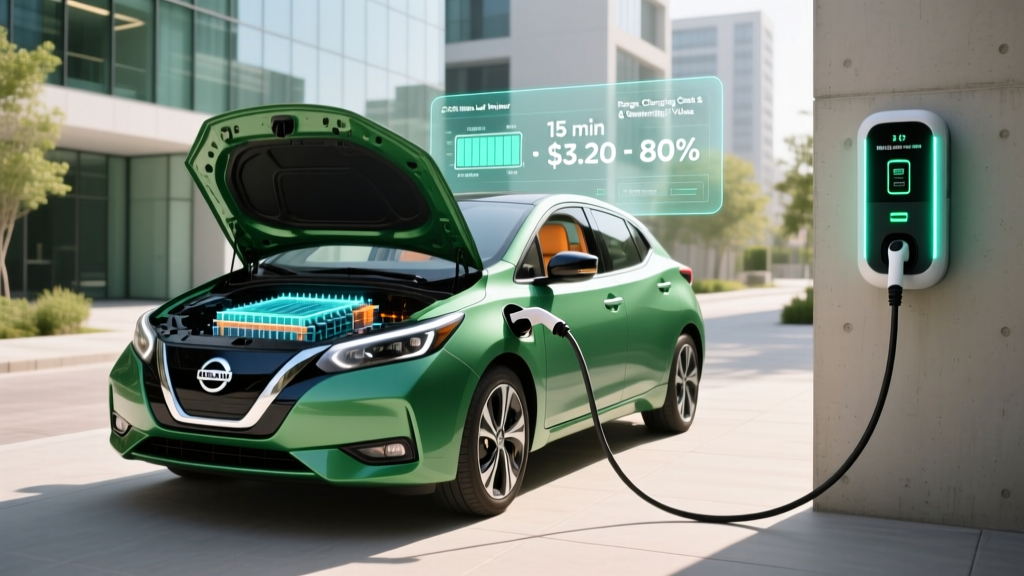
This is where the Leaf makes its strongest case — especially for home chargers. Let's break down the per-mile and per-fill cost with real numbers.
Home Charging (Level 2, 240V)
The average U.S. residential electricity rate is approximately $0.17 per kWh (EIA data, early 2026). Charging the Leaf SV Plus from 10% to 100% requires roughly 53 kWh of energy delivered to the battery (accounting for ~10% charging losses from the onboard charger):
- Cost for a full home charge (SV Plus): ~59 kWh drawn × $0.17 = $10.03
- Cost per mile (SV Plus, 212 mi EPA): ~$10.03 ÷ 212 = $0.047/mile
- Cost for a full home charge (S): ~43 kWh drawn × $0.17 = $7.31
- Cost per mile (S, 149 mi EPA): ~$7.31 ÷ 149 = $0.049/mile
For comparison, a 30 MPG gasoline car at $3.40/gallon costs roughly $0.113/mile in fuel. The Leaf cuts per-mile energy costs by more than half when charging at home.
Public DC Fast Charging
Public DC fast-charging networks typically charge $0.30–$0.48 per kWh, with some networks adding idle fees or session fees. At $0.40/kWh:
- SV Plus (10–80%, ~42 kWh delivered): ~47 kWh drawn × $0.40 = $18.80
- Cost per mile on DC fast charging: ~$0.11/mile — approaching gasoline parity
The economics shift dramatically if you rely exclusively on public fast charging. The Leaf is cheapest to own when home charging covers 90%+ of your energy needs.
Level 1 (Standard 120V Outlet)
If you can only access a standard household outlet, charging is slow but cheap. A full charge of the SV Plus takes over 48 hours from near-empty — impractical for daily use on the larger battery but workable for the 40 kWh Leaf S if your daily commute is under 30 miles.
Pricing, Trims & Federal Tax Credit Eligibility
| Trim | Base MSRP | Est. As-Tested* | §30D Credit Eligible? |
|---|---|---|---|
| Leaf S | $28,140 | $29,500–$31,000 | See eligibility notes below |
| Leaf SV | $31,590 | $33,000–$35,000 | See eligibility notes below |
| Leaf SV Plus | $36,190 | $38,000–$42,000 | See eligibility notes below |
*As-tested prices include destination and common option packages.
Federal §30D Tax Credit: Does the Leaf Qualify?
Under current IRS rules for the §30D Clean Vehicle Credit, the Leaf faces several eligibility hurdles that buyers must verify before purchase:
- MSRP Cap: The Leaf falls well under the $55,000 cap for cars — passes.
- Buyer Income Cap: Modified AGI must not exceed $150,000 (single) or $300,000 (joint). Verify your tax situation with a professional.
- Battery Sourcing / Critical Minerals: The Leaf's battery cells are manufactured in the U.S. (Smyrna, TN), but critical-mineral sourcing requirements have tightened annually. As of 2026, 100% of critical minerals must come from the U.S. or FTA-partner countries. Nissan has not publicly confirmed full compliance for all trims — check the fueleconomy.gov tax credit lookup for the specific VIN before purchase.
- Point-of-Sale Transfer: If eligible, the credit can be transferred to the dealer at purchase, reducing your out-of-pocket cost immediately rather than waiting for a tax refund.
- Final Assembly: Must occur in North America. The Leaf is assembled in Smyrna, TN — passes.
Bottom line: The Leaf's MSRP and assembly location qualify, but battery-sourcing compliance is the variable. If the full $7,500 credit applies, a base Leaf S drops to an effective ~$20,640 — making it one of the cheapest new EVs available. Always confirm eligibility with the IRS tool or a tax professional before signing.
Performance, Tech & Daily Livability
The SV Plus's 214 hp and 250 lb-ft of torque deliver a 6.5-second 0–60 mph time — adequate for highway merging and passing. The base S trim's 147 hp feels leisurely by modern EV standards but is fine for urban driving. Both trims are front-wheel drive only; no AWD option exists.
One-pedal driving via Nissan's e-Pedal mode is a highlight. It provides strong regenerative braking that can bring the car to a complete stop without touching the brake pedal — ideal for stop-and-go commuters. Unlike some competitors, e-Pedal actually holds the car at a stop, which reduces brake wear significantly.
Interior & Technology
The 2026 Leaf carries over an 8-inch touchscreen infotainment system with wireless Apple CarPlay and wired Android Auto. It's functional but dated compared to the 12-inch-plus screens in rivals. ProPILOT Assist — Nissan's Level 2 driver-assistance suite — includes adaptive cruise control with stop-and-go, lane centering, and automatic emergency braking. It works well on marked highways but requires hands on the wheel at all times (this is not a self-driving system; it operates at SAE Level 2).
Cargo space is competitive: 23.6 cubic feet behind the rear seats and 68.8 cubic feet with them folded. Rear legroom of 33.5 inches is tight for tall adults on longer trips but acceptable for children and average-height passengers.
Notable Drawbacks
- CHAdeMO connector: Shrinking public fast-charging compatibility as CCS1 and NACS dominate new infrastructure.
- No heat pump: Resistive heating causes outsized cold-weather range loss.
- Liquid-cooled battery: The Leaf does use active thermal management (liquid cooling), which is a significant improvement over earlier passive-air-cooled generations and helps reduce degradation.
- Dated interior: Hard plastics, small screen, and no over-the-air software updates.
- No frunk: The motor and power electronics occupy the front compartment.
Pros & Cons: The Honest Verdict
Pros
- Low starting MSRP — under $29K before incentives
- Excellent home-charging economics (~$0.05/mile)
- Strong e-Pedal one-pedal driving experience
- Proven reliability track record over multiple generations
- U.S.-assembled (Smyrna, TN)
- Generous 8-year/100,000-mile battery warranty
- Spacious cargo area for the hatchback class
Cons
- CHAdeMO connector limits public DC fast-charging access
- No heat pump — significant winter range loss
- Modest DC fast-charge speeds with aggressive taper
- Base 40 kWh battery's 149-mile range limits road-trip utility
- Dated infotainment and interior materials
- FWD only — no AWD option for snow-belt buyers
- Tax credit eligibility uncertain due to battery-sourcing rules
Who Should Buy the 2026 Nissan Leaf?
Choose the Leaf if:
- You can charge at home (Level 2) and your daily commute is under 80 miles round-trip.
- You want the lowest-cost entry into a new EV and prioritize low per-mile energy costs over fast-charging capability.
- You live in a mild climate where cold-weather range loss is less severe.
- You need a practical hatchback with decent cargo space for errands and groceries.
Look elsewhere if:
- You regularly road-trip 200+ miles and need fast, widely compatible DC charging (consider the Chevrolet Bolt EUV or Hyundai Kona Electric with CCS).
- You live in a cold climate and need maximum winter range retention (heat-pump-equipped rivals like the Hyundai Ioniq 5 or Kia EV6 are better choices).
- You need AWD for snow or mountain driving.
- You want cutting-edge infotainment, OTA updates, or advanced driver-assist features.
2026 Nissan Leaf vs. Key Competitors
The Leaf competes in the affordable compact EV segment. Here's how it stacks up against two primary rivals:
| Spec | 2026 Nissan Leaf SV Plus | 2025 Chevrolet Bolt EV 2LT | 2026 Hyundai Kona Electric SEL |
|---|---|---|---|
| EPA Range | 212 mi | 259 mi | 261 mi |
| Battery | ~59 kWh NMC | 65 kWh NMC | 64.8 kWh NMC |
| DC Fast Charge | 100 kW (CHAdeMO) | 115 kW (CCS1) | 100+ kW (CCS1/NACS) |
| 0–60 mph | ~6.5 sec | ~6.5 sec | ~7.2 sec |
| Base MSRP | $36,190 | $28,785 | $33,975 |
| Connector | CHAdeMO | CCS1 | CCS1/NACS |
| Heat Pump | No | No | Yes |
The Bolt EV undercuts the Leaf on price and beats it on range while using the more widely supported CCS1 connector. The Kona Electric offers a heat pump and growing NACS compatibility. The Leaf's advantages are its U.S. assembly, proven e-Pedal system, and potential tax-credit-adjusted pricing if sourcing requirements are met.
Frequently Asked Questions
How much does it cost to charge a Nissan Leaf at home?
At the U.S. average electricity rate of ~$0.17/kWh, a full charge of the Leaf SV Plus (60 kWh) costs approximately $10. That's about $0.05 per mile — roughly 60% cheaper per mile than a 30 MPG gas car at $3.40/gallon.
Can I charge the Nissan Leaf at Tesla Superchargers?
Not directly. The Leaf uses the CHAdeMO connector, and Tesla Superchargers use the NACS connector. No commercially available CHAdeMO-to-NACS adapter currently exists that supports DC fast charging. Some Tesla destination chargers (Level 2, J1772-compatible) can charge the Leaf with a standard J1772 adapter, but at slow speeds.
How long does the Nissan Leaf battery last?
Nissan warranties the Leaf's battery for 8 years or 100,000 miles against defects and capacity loss below 9 bars (out of 12) on the capacity gauge. With the current generation's liquid-cooled thermal management, real-world degradation is typically 10–15% over 100,000 miles — significantly better than early air-cooled Leaf models that saw 20–30% loss.
Does the 2026 Nissan Leaf qualify for the $7,500 federal tax credit?
The Leaf meets the MSRP cap (under $55,000) and final-assembly (North America) requirements. However, the critical-minerals and battery-component sourcing rules under §30D have tightened for 2026. Buyers should verify the specific vehicle's eligibility on fueleconomy.gov or consult a tax professional before purchase.
Is the Nissan Leaf good for road trips?
The SV Plus's 212-mile EPA range is workable for road trips with planning, but the CHAdeMO connector and aggressive charge-curve taper mean longer stops than CCS/NACS competitors. Expect 40–50-minute charging stops every 150–170 highway miles. It's viable but not ideal — this is primarily a commuter and second-car EV.
What's the real-world range of the Leaf in winter?
Without a heat pump, the Leaf's resistive heater draws heavily from the traction battery. In temperatures below 30°F, expect a 25–30% range reduction. The SV Plus drops from 212 EPA miles to roughly 140–160 real-world miles. Preconditioning the cabin while still plugged in can recover some of this loss.