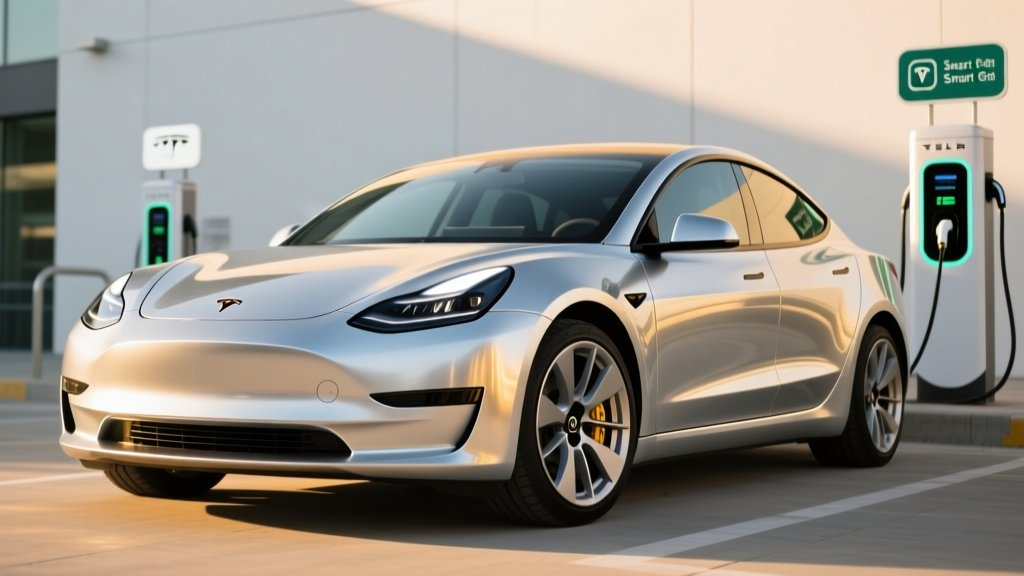
Quick Silver remains one of Tesla's most requested paint options across the Model 3 lineup, and for good reason: it hides road grime better than white, costs nothing extra on most trims, and suits the refreshed "Highland" body style introduced for the 2024 model year and carried into 2026. But paint is only skin-deep. What really matters is whether the 2026 Tesla Model 3 in Quick Silver delivers on range, charging speed, tech, and value in an increasingly crowded midsize EV sedan segment. This review breaks down every spec that matters to a real buyer — from EPA range and DC fast-charging curves to federal tax credit eligibility under current IRS §30D rules.
2026 Tesla Model 3 Quick Silver: Full Spec Sheet
| Specification | Long Range RWD | Long Range AWD | Performance |
|---|---|---|---|
| EPA Range | 341 mi | 334 mi | 315 mi |
| Battery (usable) | ~75 kWh, NMC | ~75 kWh, NMC | ~75 kWh, NMC |
| Drivetrain | Rear-Wheel Drive | Dual-Motor AWD | Dual-Motor AWD |
| Horsepower | 271 hp | 346 hp | ~510 hp |
| 0-60 mph | 5.8 sec | 4.2 sec | 2.9 sec |
| Top Speed | 125 mph | 125 mph | 163 mph |
| Max DC Fast Charge | 250 kW | 250 kW | 250 kW |
| 10-80% DC Time | ~25 min | ~25 min | ~25 min |
| Level 2 (11.5 kW AC) | ~44 mi/hr | ~44 mi/hr | ~44 mi/hr |
| MPGe (combined) | 132 MPGe | 125 MPGe | 115 MPGe |
| Efficiency | 25 kWh/100mi | 27 kWh/100mi | 29 kWh/100mi |
| Base MSRP | $44,130 | $49,130 | $55,630 |
| Battery Warranty | 8 yr / 120,000 mi | 8 yr / 120,000 mi | 8 yr / 120,000 mi |
Source: fueleconomy.gov and Tesla spec sheets. Prices reflect 2026 MSRP before destination.
Real-World Range: Beyond the EPA Sticker
EPA Estimate: 341 miles (Long Range RWD)
Real-World Expectation: 280-310 mi highway at 70-75 mph; 250-275 mi in sub-freezing temperatures; 320-340 mi city/mixed driving in mild weather.
The 341-mile EPA figure on the Long Range RWD is genuinely achievable in moderate conditions with a mix of city and suburban driving. Tesla's heat pump, introduced in the prior generation and refined for the Highland refresh, significantly reduces cabin-heating energy draw in cold weather compared to resistive heaters. Still, physics is physics: at sustained 75 mph highway speeds, expect roughly 85-90% of the EPA sticker. In winter conditions (below 30°F), plan for 75-80% of rated range due to both cabin heating demand and reduced battery chemistry efficiency.
On a 280-mile road trip at highway speeds in 65°F weather, the Long Range AWD model typically arrives with 8-12% State of Charge remaining — comfortable but not excessive. The RWD variant stretches that buffer slightly thanks to its lower mass and single-motor efficiency.
The Performance trim's 315-mile EPA rating reflects its stickier tires, sportier tuning, and higher rolling resistance. Real-world highway range for the Performance lands around 255-280 miles, which remains adequate for most daily use but requires more planning on long road trips.
Charging Speed: DC Fast Charging and Home Setup
| Charging Level | Power (kW) | Miles Added per Hour | Notes |
|---|---|---|---|
| Level 1 (120V, 12A) | ~1.4 kW | ~5 mi/hr | Emergency/trickle only |
| Level 2 (240V, 48A) | 11.5 kW | ~44 mi/hr | Full overnight charge in ~7-8 hrs |
| Level 2 (240V, 32A Mobile) | 7.7 kW | ~30 mi/hr | Tesla Mobile Connector on dryer outlet |
| DC Fast (Supercharger V3) | Up to 250 kW peak | ~170 mi in 15 min | Peak only at low SoC, tapers above 60% |
| DC Fast (CCS adapter, non-Tesla) | Up to 250 kW | Varies by network | Requires Tesla CCS adapter ($250 MSRP) |
Tesla's 250 kW peak DC fast-charging rate on V3 Superchargers is well-established, but the real-world charging curve matters more than the headline number. The Model 3 Highland peaks near 250 kW only between roughly 5-15% State of Charge. From 15-50%, it sustains around 150-180 kW. Above 60%, it tapers to ~100 kW, and above 80% it drops sharply to ~50 kW and below. A typical 10-80% session takes approximately 25 minutes at a V3 Supercharger — competitive with Hyundai's E-GMP platform but not class-leading against the Lucid Air or upcoming 800V architectures.
For home charging, the onboard 11.5 kW AC charger is excellent. A full charge from 10% takes roughly 7-8 hours on a 48-amp Level 2 circuit (60-amp breaker required). This means a daily commuter who drives 40-60 miles round trip will replenish their battery in under two hours each night — effectively invisible to your routine.
Important: kW (kilowatts) measures charging power — the rate at which energy flows. kWh (kilowatt-hours) measures battery energy capacity — the total "tank size." The Model 3's ~75 kWh battery charged at 11.5 kW takes about 6.5 hours from empty; at 250 kW peak, the math is faster but taper makes the real session ~25 minutes for a 10-80% fill.
Performance and Driving Dynamics
The Highland refresh brought meaningful improvements to the Model 3's ride quality. Tesla retuned the suspension, added acoustic glass, and improved sound deadening — making the 2026 Model 3 noticeably quieter and more composed over rough pavement than the pre-2024 version. The steering remains quick and precise, if somewhat numb in feel.
The Long Range RWD at 5.8 seconds to 60 mph is brisk for daily driving — passing maneuvers are effortless, and the instant torque makes it feel quicker than the number suggests. The AWD variant's 4.2-second sprint puts it in sports-sedan territory, while the Performance trim's 2.9 seconds is supercar-rapid and remains one of the quickest production sedans at any price.
Regenerative braking in the Model 3 is strong but not fully one-pedal by default. Tesla removed the adjustable regen setting several years ago; the default "hold" mode provides aggressive deceleration that most drivers adapt to within a week. In stop-and-go traffic, it significantly reduces brake wear.
Interior, Tech, and Cargo Space
The Highland interior is a significant step up in materials and execution. Ventilated front seats are now standard across all trims, ambient lighting runs the full cabin width, and the rear passengers get an 8-inch touchscreen for climate and entertainment control — a welcome addition for family duty.
Cargo and Passenger Dimensions:
- Front legroom: 42.2 inches
- Rear legroom: 35.3 inches
- Trunk (rear): 23.1 cu ft (21.1 cu ft AWD/Performance due to rear motor)
- Frunk (front trunk): 3.1 cu ft
- Total cargo: 26.2 cu ft (RWD) / 24.2 cu ft (AWD)
The rear seat accommodates two adults comfortably or three in a pinch. The sloping roofline cuts into headroom for taller passengers (over 6'2") in the back — a common complaint. The 23.1 cu ft trunk is generous for the segment and includes a deep under-floor well, but the trunk opening is relatively narrow, making bulky items like large boxes harder to load than in a hatchback or crossover.
The 15.4-inch central touchscreen runs Tesla's proprietary infotainment OS. It's responsive and feature-rich — navigation, streaming, gaming, and vehicle controls all live here. However, there are no physical buttons for climate or volume; everything routes through the screen or steering-wheel scroll wheels. This minimalist approach draws strong opinions: enthusiasts love the clean aesthetic, while some buyers find it distracting while driving.
Driver Assistance: Basic Autopilot (Traffic-Aware Cruise Control and Autosteer) is standard. Enhanced Autopilot ($6,000) adds Auto Lane Change, Autopark, Summon, and Navigate on Autopilot. Full Self-Driving (Supervised) at $8,000 adds city-street traffic light and stop-sign recognition with active guidance.
SAE Automation Level: All Tesla driver-assist features — including FSD (Supervised) — are SAE Level 2. The driver must remain fully attentive, keep hands on or near the wheel, and be prepared to take over at any moment. This is not autonomous or self-driving. Only Level 4 services like Waymo operate without a human driver in defined areas.
Pricing, Trims, and Federal Tax Credit Eligibility
| Trim | Base MSRP | Destination | Out-the-Door (est.) | §30D Credit Eligibility |
|---|---|---|---|---|
| Long Range RWD | $44,130 | $1,390 | ~$45,520 | Up to $7,500 (subject to rules) |
| Long Range AWD | $49,130 | $1,390 | ~$50,520 | Up to $7,500 (subject to rules) |
| Performance | $55,630 | $1,390 | ~$57,020 | Up to $7,500 (subject to rules) |
The Quick Silver paint color is included at no extra charge on all 2026 Model 3 trims, keeping costs predictable. Adding Enhanced Autopilot or FSD (Supervised) pushes the as-tested price significantly higher — a Long Range AWD with FSD lands near $58,500 before tax credits.
Federal Tax Credit (§30D) — Current 2026 Rules:
- MSRP Cap: Sedans must be under $55,000 MSRP. The Long Range RWD ($44,130) and Long Range AWD ($49,130) qualify. The Performance trim at $55,630 exceeds the cap and does NOT qualify.
- Buyer Income Cap: Modified AGI must not exceed $150,000 (single), $225,000 (head of household), or $300,000 (joint filing).
- Battery Sourcing: The credit splits into two halves — $3,750 for critical-minerals sourcing and $3,750 for battery-component manufacturing. Eligibility depends on current-year supply-chain rules per IRS guidance. Tesla has historically met both halves for US-built Model 3 vehicles, but this can change quarterly.
- Point-of-Sale Transfer: As of 2024, the credit can be transferred to the dealer at purchase, reducing your out-of-pocket cost by up to $7,500 at the time of sale rather than waiting for a tax refund.
- One-Time Use: The §30D credit is limited to one new EV credit per taxpayer every three years.
Bottom line: The Long Range RWD at $44,130, with a full $7,500 point-of-sale credit, effectively drops to ~$36,630 before state incentives — making it one of the best value propositions in the EV sedan market. Always verify current eligibility on IRS.gov before purchasing, as sourcing requirements update periodically.
Pros, Cons, and Key Competitors
Pros
- 341-mile EPA range (Long Range RWD) is class-leading for the segment
- Tesla Supercharger network reliability — the most mature DC fast-charging ecosystem in the US
- 11.5 kW onboard AC charger enables fast home replenishment
- Excellent efficiency (25 kWh/100mi on RWD) keeps electricity costs low
- Highland refresh delivers meaningful ride, noise, and interior improvements
- Strong resale value relative to EV segment averages
- Over-the-air updates continuously add features
Cons
- No physical buttons — all controls through touchscreen
- Rear headroom tight for passengers over 6'2"
- Trunk opening is narrow; not a hatchback
- FSD (Supervised) costs $8,000 extra and remains Level 2 — not autonomous
- 250 kW peak DC charging is competitive but not class-best (Hyundai Ioniq 6 peaks at ~350 kW on 800V)
- Performance trim exceeds $55,000 MSRP cap for federal tax credit
- Rear visibility is limited; relies heavily on cameras
Versus key competitors: The Hyundai Ioniq 6 offers comparable range (361 mi on Long Range RWD), faster 800V charging architecture (~18 min 10-80%), and a lower starting price — but its charging network (via Electrify America and others) is less reliable than Tesla's Superchargers. The BMW i4 eDrive40 offers a more premium interior and traditional controls but at a significantly higher price ($57,900 base) and shorter range (307 mi). The Polestar 2 has strong build quality and a hatchback form factor, but its 276-mile range and higher price make it harder to recommend for range-focused buyers.
The Model 3's strongest competitive advantage remains the Supercharger network. For buyers who road-trip regularly, the reliability and density of Tesla's charging infrastructure is difficult to overstate. For buyers who primarily commute and charge at home, the Ioniq 6 or even the Chevy Bolt EUV (at a lower price point) may offer better value.
Who Should Buy the Quick Silver Tesla Model 3?
Choose the Model 3 Long Range RWD if: You want maximum range and efficiency at the best price, qualify for the full §30D credit, and primarily commute or take moderate road trips. This is the value champion of the lineup.
Choose the Model 3 Long Range AWD if: You live in a region with snow/ice, need the traction security of dual motors, and don't mind spending ~$5,000 more (while still qualifying for the tax credit).
Choose the Model 3 Performance if: Track capability and 2.9-second 0-60 times matter to you, and you accept the higher price, shorter range, and loss of federal tax credit eligibility.
Look elsewhere if: You need a hatchback or large cargo area (consider Model Y or Ioniq 5), you strongly prefer physical buttons, or you need more than 35 inches of rear legroom for car seats or tall passengers.
Frequently Asked Questions
What is the real-world range of the 2026 Tesla Model 3?
The EPA rates the Long Range RWD at 341 miles. In real-world highway driving at 70-75 mph, expect 280-310 miles. In cold weather (below 30°F), plan for 250-275 miles. City driving in mild conditions can match or slightly exceed the EPA figure thanks to regenerative braking.
How fast does the Model 3 charge at home and on the road?
At home on a 48-amp Level 2 charger (11.5 kW), the Model 3 gains about 44 miles of range per hour, with a full charge in 7-8 hours. On a Tesla V3 Supercharger (250 kW peak DC), a 10-80% session takes approximately 25 minutes, adding roughly 170 miles in the first 15 minutes before the charge curve tapers.
How much does the Quick Silver Tesla Model 3 cost after tax credits?
The Long Range RWD starts at $44,130 MSRP. With the full $7,500 federal §30D credit applied at point of sale, the effective price drops to approximately $36,630 before state incentives, destination fees, or dealer add-ons. Eligibility depends on buyer income, MSRP caps, and current battery-sourcing rules — always verify on IRS.gov before purchasing.
Is the Model 3 worth buying vs the Hyundai Ioniq 6 or BMW i4?
The Model 3 wins on Supercharger network access, software ecosystem, and efficiency. The Ioniq 6 offers faster 800V charging and slightly more EPA range at a competitive price but relies on less mature public charging networks. The BMW i4 is more premium inside but costs substantially more with less range. For most buyers who road-trip even occasionally, the Model 3's charging infrastructure advantage is decisive.
Does the Model 3 Performance qualify for the federal EV tax credit?
No. The §30D credit has a $55,000 MSRP cap for sedans. The Model 3 Performance at $55,630 exceeds this threshold. Only the Long Range RWD and Long Range AWD trims currently qualify, subject to income and battery-sourcing requirements.
What is the battery warranty on the 2026 Model 3?
Tesla covers the battery and drive unit for 8 years or 120,000 miles (whichever comes first) with a minimum 70% capacity retention threshold. If the battery degrades below 70% of its original capacity within the warranty period, Tesla will repair or replace it at no cost. Long-term data from earlier Model 3 generations suggests typical degradation of 10-12% over 100,000 miles for NMC chemistry when properly maintained (avoiding sustained 100% SoC and frequent DC fast charging).
Is Tesla's Full Self-Driving actually self-driving?
No. FSD (Supervised) is an SAE Level 2 driver-assist system. It can handle many city and highway driving scenarios, but the driver must remain fully attentive, monitor the road, and be ready to intervene immediately. It does not make the Model 3 an autonomous vehicle. Tesla's naming convention has drawn scrutiny from NHTSA and consumer-advocacy groups for this reason.