The Quick Answer: What Mass-Production Scaling Means for Your Wallet
Bottom line: The scaling of EV power components for mass production — including battery cells, silicon-carbide (SiC) inverters, electric drive units, and onboard chargers — is the single biggest reason average EV transaction prices fell from roughly $56,000 in 2023 to approximately $42,000 by early 2026. For buyers, this means a mid-size electric SUV that would have cost $50,000+ three years ago now starts closer to $37,000–$42,000 before incentives, with faster charging and longer range as standard. However, the savings are uneven: battery pack costs have dropped to roughly $110–$125/kWh at the cell level (down from $150+/kWh in 2023), but raw-material volatility and tariff policy can shift MSRPs quarter to quarter.
If you're shopping for an EV in 2026, the manufacturing story matters because it directly determines what's on the lot, what qualifies for the §30D federal tax credit, and how long you'll wait for delivery. Let's break down exactly how component scaling translates into real purchase decisions.
Which Components Are Scaling — and Why It Matters to Buyers
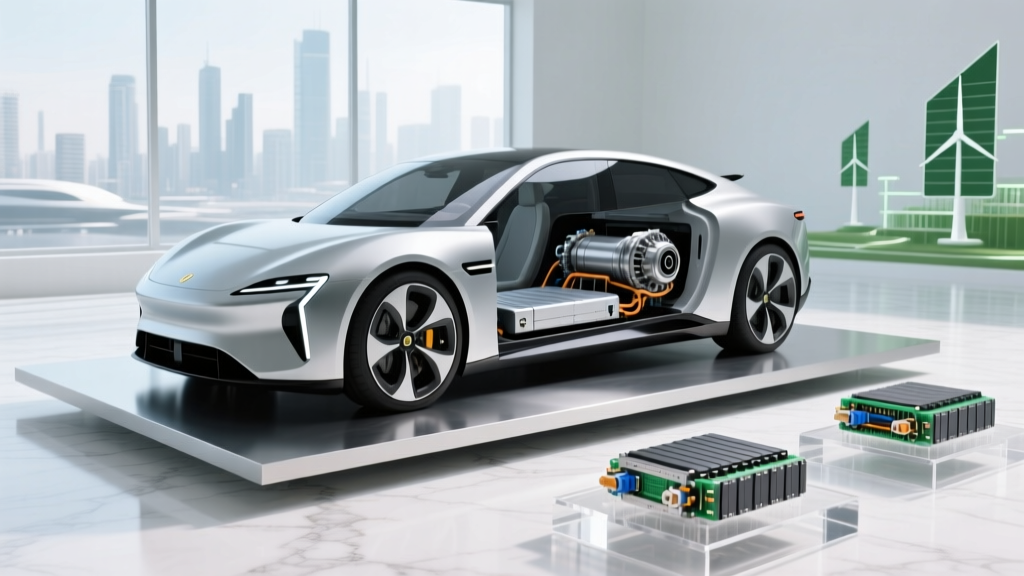
"Power components" in an EV aren't just the battery. They encompass the full high-voltage powertrain, and each has seen dramatic production scaling since 2023:
| Component | 2023 Typical Cost | 2026 Estimated Cost | Buyer Impact |
|---|---|---|---|
| Battery pack (cell + module) | ~$150–$170/kWh | ~$110–$125/kWh | 75 kWh pack now ~$2,500–$3,500 cheaper to produce |
| SiC inverter | ~$800–$1,200 | ~$450–$650 | Enables 800V architecture in sub-$45K vehicles |
| Electric drive unit (motor + gearbox) | ~$1,800–$2,400 | ~$1,200–$1,600 | Standardized platforms (e.g., Hyundai E-GMP, GM Ultium) share one unit across models |
| Onboard charger (Level 2, 11.5 kW) | ~$600–$900 | ~$350–$500 | Higher-power AC charging now standard on most trims |
| Thermal management (heat pump + coolant) | ~$500–$800 | ~$350–$550 | Heat pumps standard on more models, improving cold-weather range |
The combined effect: a mid-range EV with a 75 kWh NMC battery, 800V SiC inverter, heat pump, and 11.5 kW onboard charger costs the manufacturer roughly $6,000–$8,000 less to build in 2026 than the equivalent spec in 2023. Some of that savings reaches the sticker price; some is absorbed by R&D amortization and margin recovery.
EV vs. Gas vs. Hybrid: The 2026 Cost Comparison
Component scaling has narrowed the upfront gap between EVs and internal-combustion vehicles, but total cost of ownership (TCO) still depends heavily on your driving pattern, electricity rate, and whether you qualify for incentives. Here's a concrete 5-year comparison for a mid-size crossover driven 12,000 miles/year:
| Cost Category | 2026 EV (e.g., Hyundai Ioniq 5 SEL, ~$42,500 MSRP) | 2026 Gas Crossover (e.g., Toyota RAV4 XLE, ~$33,000 MSRP) | 2026 PHEV (e.g., Toyota RAV4 Prime, ~$44,500 MSRP) |
|---|---|---|---|
| Purchase price (after §30D credit if eligible) | $35,000 (with $7,500 credit) | $33,000 | $37,000 (with $7,500 credit) |
| Fuel/energy (5 years, 60K miles) | $3,600 (at $0.14/kWh, 3.5 mi/kWh) | $9,000 (at $3.50/gal, 30 MPG combined) | $5,200 (blended electric + gas) |
| Maintenance (5 years) | $1,200 | $3,500 | $2,800 |
| Insurance (5-year avg) | $9,500 | $7,200 | $8,100 |
| Estimated 5-year depreciation | $14,000 | $11,500 | $13,000 |
| Total 5-year cost | $63,300 | $64,200 | $66,100 |
Sources: fueleconomy.gov for efficiency data; insurance averages from industry aggregates. Actual costs vary by state, driver profile, and electricity rate.
The EV wins on fuel and maintenance but loses on insurance (typically 15–30% higher for EVs due to repair costs and parts pricing). The PHEV occupies a middle ground — beneficial if you lack reliable home charging but want some electric-only commuting (the RAV4 Prime delivers 42 miles of EPA-rated electric range).
Real Costs and Savings: What the Sticker Doesn't Tell You
Mass-production scaling has made EVs more affordable, but ownership economics still hinge on variables that no factory can control:
Home Charging Access
If you can install a Level 2 home charger (240V, 32–48A, delivering 7.7–11.5 kW), you'll pay roughly $0.10–$0.18/kWh depending on your utility — making per-mile fuel costs 50–70% lower than gas. A typical Level 2 installation runs $800–$2,500 including the charger unit ($350–$700), electrician labor ($400–$1,500), and permits ($50–$300). If your panel needs a 200A upgrade, add $1,500–$3,500.
If you cannot charge at home (apartment, street parking, HOA restrictions), you'll rely on public DC fast charging at $0.30–$0.55/kWh. At those rates, an EV's per-mile cost rises to $0.09–$0.16/mile — competitive with gas at $3.50/gallon but no longer a dramatic savings.
Climate and Range Reality
Component scaling hasn't eliminated cold-weather range loss. Expect a 20–35% reduction in below-freezing temperatures, even with a heat pump. A 310-mile EPA-rated EV may deliver 200–250 real-world highway miles in January in Minnesota. If your commute exceeds 80 miles round-trip in cold weather, prioritize a model with 320+ EPA miles or a larger battery (80+ kWh usable).
The §30D Tax Credit Landscape (2026 Rules)
The federal EV tax credit under IRS §30D remains up to $7,500, but eligibility is layered:
- MSRP caps: $80,000 for SUVs/pickups/vans; $55,000 for sedans
- Buyer income caps: $150K single / $225K head of household / $300K joint (modified AGI)
- Battery sourcing: Increasingly strict critical-minerals and battery-component requirements tied to US free-trade-agreement partners
- Point-of-sale transfer: You can apply the credit as a dealer discount at purchase rather than waiting for tax filing
Always verify current eligibility on irs.gov before purchasing — sourcing rules tighten periodically and can remove a previously eligible model mid-year.
Common Misconceptions About EV Production Scaling
| Myth | Fact |
|---|---|
| "Scaled production means all EVs are cheap now." | Component costs dropped, but MSRPs also reflect R&D recovery, software features, and margin targets. Sub-$30K EVs remain limited — most affordable options start $32,000–$38,000. |
| "Bigger factories mean no more supply shortages." | Battery cell supply has expanded, but specific chemistries (LFP for budget models, high-nickel NMC for long-range) can still face bottlenecks. Wait times of 2–8 weeks are common for popular trims. |
| "All EVs charge at the same speed now." | Charge speed varies enormously: 400V architectures peak at 150–180 kW (10–80% in ~25–30 min), while 800V platforms peak at 240–350 kW (10–80% in ~15–18 min). The SiC inverter scaling enables 800V, but not every model uses it. |
| "EV batteries need replacement within a few years." | Modern LFP and NMC packs are warrantied for 8 years/100,000 miles at ≥70% capacity retention (fueleconomy.gov data shows most packs retain 85–92% after 100K miles). Full replacement costs $8,000–$18,000 but is rarely needed in the vehicle's first decade. |
| "Mass production means every model qualifies for the tax credit." | Battery-sourcing rules under §30D disqualify some models regardless of where they're assembled. Always check the IRS qualified-vehicles list before committing. |
First-Time EV Buyer: What You Must Know Before Signing
Component scaling has made 2026 a strong year to buy, but first-timers should internalize these ownership realities:
- kW vs. kWh is non-negotiable. kW (kilowatts) measures power — how fast you charge. kWh (kilowatt-hours) measures energy — how big your battery is. A 75 kWh battery charged at 150 kW gains range much faster than at 7.7 kW. Confusing these is the #1 mistake new EV buyers make when evaluating specs.
- EPA range is a ceiling, not a floor. Highway driving at 75+ mph, cold weather, mountain grades, and full cargo loads all reduce range. Plan for 75–85% of the EPA sticker in mixed real-world conditions.
- The charge curve matters more than peak kW. A vehicle advertising "250 kW peak" may sustain that rate only between 10–40% SoC, then taper to 100 kW by 60% and 50 kW above 80%. Look for 10–80% charge times (typically 15–25 minutes for modern EVs) rather than peak kW alone.
- Preconditioning is essential for fast charging. Most EVs warm the battery to optimal temperature before DC fast charging. If you navigate to a charger using the car's built-in system, preconditioning happens automatically. Arriving at a fast charger "cold" (without preconditioning) can halve your charge speed.
- Insurance quotes before purchase. EV insurance premiums are 15–30% higher on average. Get a quote for the exact trim before signing — some models (e.g., Tesla Model Y, Hyundai Ioniq 5) are notably cheaper to insure than others in the same segment.
Your Decision Framework: Which EV Path Fits You?
Choose a battery-electric vehicle (BEV) if:
- You have reliable home Level 2 charging (or can install it for under $2,500)
- Your daily driving is under 80 miles round-trip, with occasional 200–300 mile road trips
- You qualify for the §30D credit (income under caps, eligible model)
- You want the lowest per-mile fuel cost ($0.04–$0.06/mile on home electricity)
Choose a plug-in hybrid (PHEV) if:
- You lack consistent home charging access but want some electric commuting
- You frequently drive 300+ miles in rural areas with sparse DC fast-charging infrastructure
- You want one vehicle for both city electric driving and long-distance flexibility without route-planning
- You're not ready to fully commit to charging logistics
Wait or reconsider if:
- You live in an apartment with no charging options and your area has limited public DC fast chargers
- Your daily commute exceeds 120 miles in extreme cold (below 10°F) — current battery tech makes this stressful without a 350+ mile EPA rating
- You need to tow more than 5,000 lbs regularly — EV towing range drops 40–55%, and charging infrastructure at campgrounds/trailheads remains sparse
What Scaling Means for 2027 and Beyond
The component-scaling trend continues. Solid-state batteries are entering limited production (Toyota has announced a 2027–2028 rollout targeting 750 km / ~465 miles of range), and next-gen LFP cells from CATL and BYD are pushing pack costs toward $80–$90/kWh — a threshold where EVs reach true upfront price parity with gas vehicles even without incentives. For buyers who can wait, 2027–2028 models will likely offer more range at lower prices. For buyers who need a vehicle now, 2026 pricing represents the most affordable EV market in history, with dozens of models starting under $40,000 and qualifying for federal incentives.
Frequently Asked Questions
Does mass-production scaling mean EV quality has dropped?
No. Scaling primarily affects component cost through manufacturing efficiency, not material quality. In fact, standardized platforms (like GM Ultium, Hyundai E-GMP, VW MEB) undergo extensive validation. However, rapid production ramp-ups can cause early-build-quality issues in the first 6–12 months of a new model year — a pattern common to both EVs and gas vehicles. Buying a model in its second or third production year tends to yield better fit-and-finish.
How does LFP vs. NMC battery chemistry affect my purchase decision?
LFP (lithium iron phosphate) batteries are cheaper to produce (~$90–$105/kWh vs. $110–$130/kWh for NMC), tolerate daily 100% charging without degradation concerns, and use no cobalt or nickel. The trade-off: LFP packs are heavier and offer 10–15% less energy density, meaning slightly less range for the same physical size. Budget-oriented EVs increasingly use LFP; long-range and performance models still favor NMC. If you charge at home nightly and don't need maximum range, LFP is the better longevity bet.
Will component scaling make used EVs cheaper too?
Partially. As new EV MSRPs drop, used EV prices follow with a 6–12 month lag. However, used EVs from 2022–2023 that were priced at $50,000+ have already seen steep depreciation (30–45% in some cases) because buyers know newer models offer better range and charging for similar money. This makes 2–3 year-old EVs a strong value — but always check battery State of Health (SoH) via a pre-purchase diagnostic before buying used.
Can I get the §30D tax credit as a point-of-sale discount?
Yes, as of 2024 and continuing in 2026, you can transfer the credit to the dealer at purchase, reducing your out-of-pocket cost immediately rather than claiming it on your tax return. The dealer must be IRS-registered, and you must sign a transfer election form at sale. Income and vehicle eligibility rules still apply — see irs.gov for current qualified vehicle lists.
What's the single biggest ownership cost surprise for first-time EV buyers?
Insurance. Most first-time EV buyers budget for the purchase price, home charger installation, and electricity costs — but don't anticipate insurance premiums that run $200–$400/year higher than an equivalent gas vehicle. This is driven by higher repair costs (specialized parts, ADAS sensor recalibration, battery-pack precautions) and elevated total-loss thresholds. Always get a binding insurance quote before finalizing your purchase.