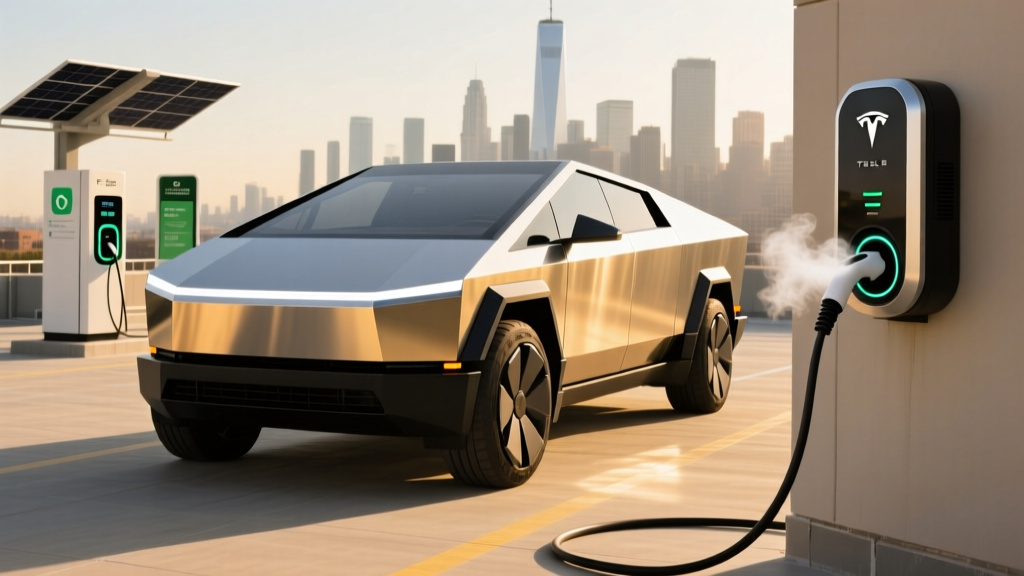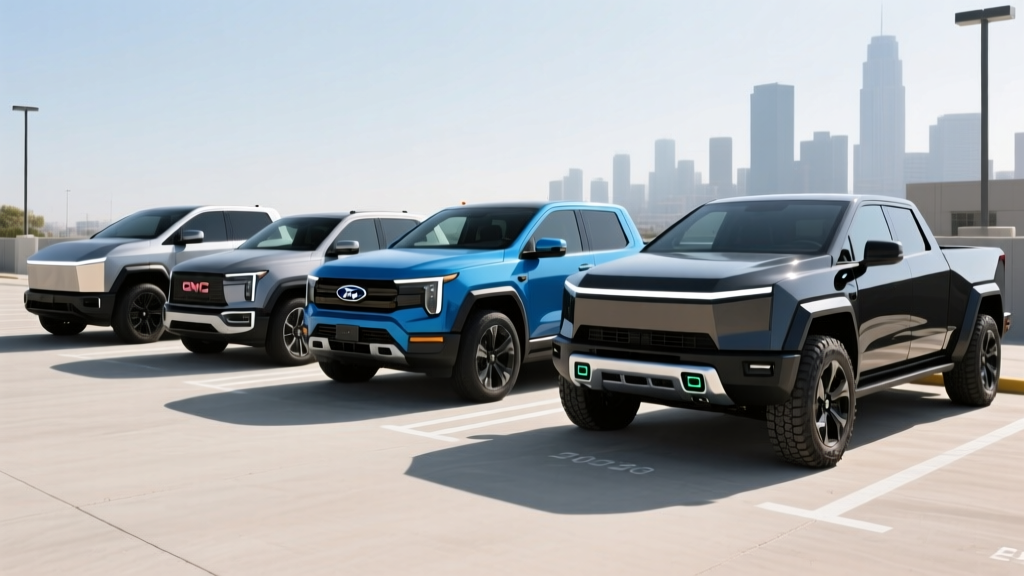
If you're researching the current electric truck slate available in the U.S. for the 2026 model year, here's the short answer: four production battery-electric pickups are on sale now — the Ford F-150 Lightning, Rivian R1T, Chevrolet Silverado EV, and Tesla Cybertruck. Each targets a different buyer: the Lightning is the fleet-and-family workhorse (starting around $55,000), the R1T is the premium adventure truck ($75,000+), the Silverado EV prioritizes maximum range and commercial duty, and the Cybertruck is the polarizing tech statement. The GMC Sierra EV and Ram 1500 REV are announced but not yet widely available at dealerships, so they remain off this active buying list for now.
Choosing among them depends less on hype and more on your actual use case — towing frequency, daily commute distance, home charging access, and budget. Below is a data-driven breakdown to help you decide.
Quick Verdict: 2026 Electric Truck Slate
- Best value work truck: Ford F-150 Lightning (~320 mi EPA, ~$55K base)
- Best range & efficiency: Chevrolet Silverado EV 4WT (~460 mi EPA est.)
- Best adventure/off-road: Rivian R1T Tri Motor (~420 mi EPA w/ Max Pack)
- Most polarizing / tech-forward: Tesla Cybertruck (~340 mi EPA, ~$80K+)
Side-by-Side Specs: The Four Production Electric Trucks
| Spec | Ford F-150 Lightning (Ext. Range) | Rivian R1T (Dual Max) | Chevy Silverado EV 4WT | Tesla Cybertruck (AWD) |
|---|---|---|---|---|
| EPA Range | ~320 mi | ~410 mi (Max Pack) | ~460 mi (est.) | ~340 mi |
| Battery (usable) | ~131 kWh (NMC) | ~141 kWh (NMC) | ~200 kWh (NMC) | ~123 kWh (NMC) |
| Peak DC Fast Charge | ~150 kW | ~220 kW | ~350 kW | ~250 kW |
| 10–80% Charge Time | ~41 min | ~28 min | ~20 min (est.) | ~25 min |
| 0–60 mph | ~3.8 sec (ER AWD) | ~3.5 sec (Dual Max) | ~5.0 sec (4WT) | ~4.1 sec (AWD) |
| Horsepower | 580 hp | 700+ hp (Tri) | 510 hp (4WT) | 600 hp (AWD) |
| Max Towing | 10,000 lb | 11,000 lb | 12,500 lb | 11,000 lb |
| Payload | ~2,235 lb | ~1,760 lb | ~1,800 lb | ~2,500 lb |
| Base MSRP (2026) | ~$55,000 | ~$75,000 | ~$55,000 (4WT) | ~$80,000 |
| Battery Warranty | 8 yr / 100,000 mi | 8 yr / 175,000 mi | 8 yr / 100,000 mi | 8 yr / 120,000 mi |
Real-World Range Reality Check
EPA estimates assume mixed driving at moderate temperatures. In practice, expect:
- Highway-only at 75 mph: subtract 15–20% from EPA range
- Cold weather (below 30°F): subtract 20–30% without preconditioning
- Towing a 7,000 lb trailer: range drops 40–50% — plan charging stops accordingly
A Lightning with a 320-mile EPA rating may deliver ~220 miles on a winter highway run. The Silverado EV's massive battery gives it the most buffer, but its sheer size also means longer charging sessions when you do plug in.
Cost of Ownership: Electric Truck vs. Gas Truck
The sticker price of an electric truck is higher than a comparable gas F-150 or Silverado, but total cost of ownership (TCO) can flip in the EV's favor over five years — especially if you charge at home. Here's a realistic comparison using the Ford F-150 Lightning Extended Range versus a gas F-150 4x4 with the 3.5L EcoBoost V6.
| 5-Year Cost Factor | F-150 Lightning (ER AWD) | F-150 Gas 4x4 (EcoBoost) |
|---|---|---|
| Purchase Price (MSRP) | ~$65,000 (mid-trim) | ~$52,000 (mid-trim) |
| Federal Tax Credit (§30D) | Up to $7,500 (if eligible) | $0 |
| Effective Purchase | ~$57,500 | ~$52,000 |
| Fuel / Charging (60K mi) | ~$3,900 (home L2 @ $0.14/kWh) | ~$9,600 (@ $3.50/gal, 19 mpg) |
| Maintenance (5 yr) | ~$1,200 | ~$3,500 |
| Insurance (5 yr avg) | ~$12,000 | ~$9,500 |
| Estimated Depreciation | ~$22,000 | ~$18,000 |
| 5-Year Total Cost | ~$96,600 | ~$92,600 |
The gap narrows to roughly $4,000 over five years, and that's before accounting for any state incentives, utility off-peak charging discounts, or employer-subsidized charging. If you rely exclusively on DC fast charging at public stations ($0.35–$0.50/kWh), the Lightning's fuel cost jumps to ~$8,500 — erasing the energy savings entirely. Home charging access is the single biggest variable in electric truck economics.
For current §30D credit eligibility, the IRS requires the buyer to meet income caps ($150K single / $300K joint), the truck must have an MSRP under $80,000 (vans, SUVs, and trucks), and battery components and critical minerals must meet domestic-sourcing thresholds that tighten annually. Check the latest rules at IRS.gov before committing.
Charging Infrastructure: What Each Truck Can Actually Handle
Electric trucks have large batteries — that means longer charging sessions unless the vehicle supports high charge rates. Here's how the current slate stacks up across charging levels:
| Truck | Level 1 (120V / 1.4 kW) | Level 2 (240V / 11.5 kW) | DC Fast Charge (Peak) |
|---|---|---|---|
| F-150 Lightning | ~3 mi/hr | ~25 mi/hr | 150 kW (~100 mi in 20 min) |
| Rivian R1T | ~3 mi/hr | ~25 mi/hr | 220 kW (~140 mi in 15 min) |
| Silverado EV | ~3 mi/hr | ~30 mi/hr (19.2 kW capable) | 350 kW (~200 mi in 15 min) |
| Cybertruck | ~3 mi/hr | ~30 mi/hr (17 kW onboard) | 250 kW (~150 mi in 15 min) |
A few practical notes:
- kW vs. kWh matters here. kW is the charge rate (how fast energy flows); kWh is the battery capacity (how much energy is stored). A 150 kW charger doesn't deliver 150 kWh in an hour — the rate tapers as the battery fills, especially above 80% State of Charge.
- Preconditioning is critical. Tesla and Rivian precondition the battery when you navigate to a charger, warming it for faster acceptance. Ford added improved preconditioning in its 2025 software update. Arriving at a DC fast charger with a cold battery can cut your peak charge rate in half.
- Home charging is non-negotiable for truck owners. With 130+ kWh batteries, Level 1 (standard outlet) is impractical — it would take 4+ days to fully charge a Lightning. Budget $800–$2,000 for a Level 2 home installation (240V / 48-amp circuit) depending on your panel capacity. A 200-amp panel upgrade, if needed, adds $1,500–$3,000.
Common Misconceptions About Electric Trucks
| Myth | Fact |
|---|---|
| "Electric trucks can't tow." | They can tow heavy loads — the Silverado EV is rated for 12,500 lb. But towing cuts range by 40–50%. Plan for charging every 100–150 miles when towing. |
| "The battery will need replacing in 5 years." | Modern NMC packs are warrantied for 8 years / 100,000+ miles with a 70% capacity retention guarantee. Real-world data from fueleconomy.gov and fleet operators shows most packs retain 90%+ capacity after 100K miles. |
| "All electric trucks qualify for the $7,500 tax credit." | Only if MSRP is under $80,000, buyer income is under the cap, and battery sourcing requirements are met. The Cybertruck and high-trim Rivians may exceed the MSRP cap. Always verify at IRS.gov. |
| "You'll save money no matter what." | If you can't charge at home and rely on DC fast charging, your per-mile energy cost can equal or exceed gas. Savings depend on home charging access and local electricity rates. |
| "Electric trucks are self-driving." | None of these trucks are autonomous. Tesla's FSD (Supervised), Ford's BlueCruise, and Rivian's Driver+ are all SAE Level 2 driver-assist systems — you must remain engaged with hands on or near the wheel at all times. |
SAE Automation Level Reminder
Level 2 (Driver Assist): The vehicle can manage steering and acceleration simultaneously, but the driver must monitor the road and intervene at any moment. This describes BlueCruise, FSD Supervised, Super Cruise, and all other consumer systems on sale today.
Level 4 (Driverless): No human intervention needed within a defined operational domain. Only robotaxi services like Waymo operate at this level — not available in any consumer truck.
Real-World Ownership Considerations
Before ordering, honestly assess these factors:
Home Charging Access
Do you have a garage or dedicated parking spot with access to a 240V outlet or the ability to install one? If you live in an apartment or park on the street, an electric truck's 130+ kWh battery makes public-only charging expensive and time-consuming. Level 2 public chargers (7–19 kW) will take 8–14 hours for a full charge.
Climate
If you live in northern states with sustained sub-freezing winters, expect 20–30% range loss. Trucks with heat pumps (Rivian, Cybertruck) manage this better than resistive heating, but the physics of cold lithium-ion cells can't be fully overcome. Garage parking helps significantly.
Driving Patterns
If your daily driving is under 100 miles and you charge overnight, even the smallest battery in this slate works fine. If you regularly drive 300+ miles in a day, only the Silverado EV's massive pack gives you a comfortable single-charge buffer. Road-trippers should map charger density along their common routes — the Tesla Supercharger network remains the most reliable for long-distance travel, though Ford and Rivian now have NACS adapters granting access.
Insurance Costs
Electric trucks carry higher insurance premiums than their gas counterparts — typically 20–35% more, driven by higher repair costs, battery replacement exposure, and purchase price. Get quotes before buying. According to IIHS, crash-test performance is strong across the board, but parts availability and specialized repair labor keep premiums elevated.
Decision Framework: Which Electric Truck Should You Buy?
If / Then Guide to the 2026 Electric Truck Slate
- If you need a work truck for a fleet or job site and want the lowest entry price: Choose the Ford F-150 Lightning. Pro Power Onboard turns it into a mobile generator (up to 9.6 kW output), and the dealer network is the largest.
- If range is your top priority and you drive long routes daily: Choose the Chevrolet Silverado EV. Its ~460-mile EPA estimate and 350 kW DC fast charging capability give it the longest legs and quickest top-ups.
- If you want an adventure vehicle with serious off-road chops: Choose the Rivian R1T with the Max Pack. Quad-motor torque vectoring, ~410 miles of range, and a 11,000-lb tow rating make it the most capable off-pavement.
- If you're a tech enthusiast who wants the most advanced (and controversial) platform: Choose the Tesla Cybertruck. Steer-by-wire, 48V architecture, and Supercharger network access are unique — but build quality inconsistency and the polarizing design aren't for everyone.
- If you can't charge at home: Reconsider whether an electric truck is the right choice right now. The large batteries make public-only charging costly and slow. A PHEV like the upcoming Ram 1500 Ramcharger (extended-range) may be a better bridge.
- If you tow more than 5,000 lb regularly over long distances: No current electric truck is ideal. Plan for a 50% range reduction and frequent charging stops. A diesel or gas truck remains more practical for heavy long-distance towing today.
Frequently Asked Questions
Are electric trucks in the 2026 slate eligible for the federal tax credit?
It depends on the specific model, trim, your income, and current battery-sourcing rules. Under §30D, trucks must have an MSRP under $80,000 and the buyer's AGI must be under $150,000 (single) or $300,000 (joint). The Ford F-150 Lightning and base Silverado EV 4WT generally qualify; higher-trim Cybertrucks and Rivians may exceed the MSRP cap. Battery critical-mineral and component sourcing requirements tighten each year — verify current eligibility at IRS.gov. The credit can now be transferred to the dealer at point of sale, reducing your out-of-pocket cost immediately.
How much does it cost to charge an electric truck at home?
At the U.S. average residential rate of ~$0.16/kWh, fully charging a Ford F-150 Lightning's 131 kWh battery costs roughly $21. For the Silverado EV's ~200 kWh pack, it's about $32. Most owners don't charge from 0–100% — a typical daily top-up from 30% to 80% on the Lightning costs around $10. Over a year of 12,000 miles, expect $500–$800 in home electricity costs, compared to $2,000–$2,500 in gas for an equivalent gas truck.
What happens to an electric truck's battery after the warranty expires?
Most NMC batteries in today's trucks are engineered for 200,000+ miles before reaching the 70% capacity-retention threshold. Replacement costs, if needed out of warranty, range from $15,000 to $30,000 depending on the pack size. However, industry data suggests most packs outlast the vehicle's useful life. Individual module replacement (rather than the full pack) is becoming more common and costs significantly less.
Can I use a Ford F-150 Lightning to power my home during an outage?
Yes. Ford's Intelligent Backup Power system (with the optional 80-amp Charge Station Pro and home integration system) allows the Lightning to supply up to 9.6 kW to your home — enough to run essential circuits for 3–10 days depending on usage. The hardware and electrician installation typically cost $3,000–$5,000 beyond the charger itself. This vehicle-to-home (V2H) feature is unique to the Lightning in the current truck slate.
Is an electric truck practical if I live in a rural area?
It depends on charging access. Rural areas often lack DC fast chargers, making road trips inconvenient. However, if you can install Level 2 at home and your daily driving is within the truck's range, rural ownership works well — you'll never visit a gas station for daily use. Check charger density on your common routes using apps like PlugShare before committing.