Quick Verdict: A Practical EV With a Leasing Advantage in SoCal
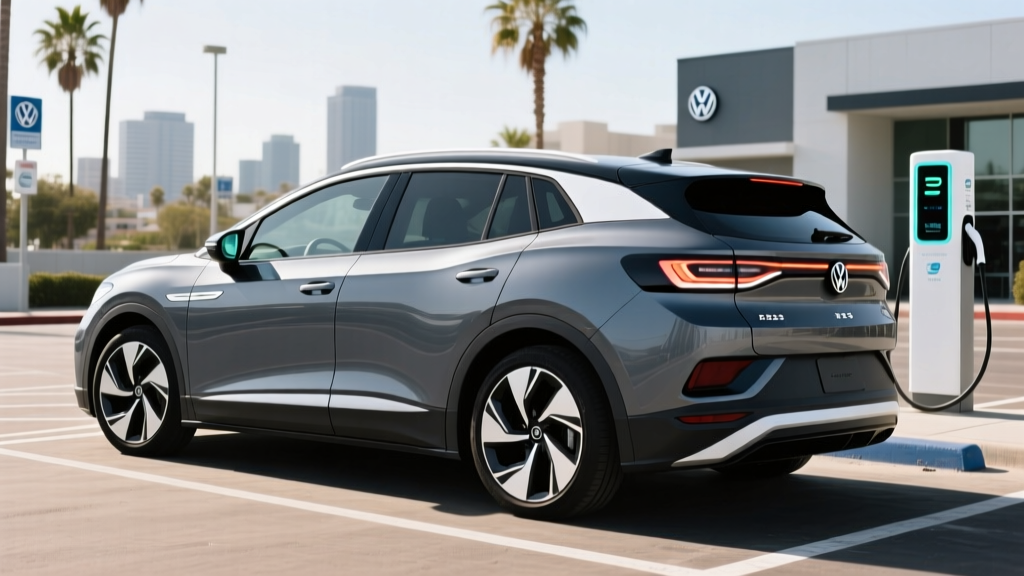
The 2025 Volkswagen ID.4 occupies a specific niche in the compact electric SUV segment: it's the mainstream, no-drama family hauler that prioritizes interior space and ride comfort over blistering acceleration or segment-leading range. For Costa Mesa shoppers searching for a "2025 Volkswagen ID.4 lease Costa Mesa" deal, the numbers tell an interesting story — VW's aggressive lease incentives, combined with the federal §30D tax credit passed through as a lease bonus, can bring the effective monthly cost well below what the MSRP alone would suggest.
This review covers every spec that matters: real-world range on the 408 and the I-5 corridor, DC fast-charging curves, battery chemistry, interior dimensions, and whether the ID.4's 8-year/100,000-mile battery warranty holds up against competitors like the Hyundai Ioniq 5, Tesla Model Y, and Ford Mustang Mach-E.
| Spec | Standard Range (62 kWh) | Pro / Pro S (82 kWh) | Pro S Plus AWD |
|---|---|---|---|
| EPA Range | 206 mi | 291 mi (RWD) / 263 mi (AWD) | 263 mi |
| Battery (usable) | 62 kWh (NMC) | 82 kWh (NMC) | 82 kWh (NMC) |
| Horsepower | 201 hp | 282 hp (RWD) / 335 hp (AWD) | 335 hp |
| 0–60 mph | ~7.7 sec | ~7.0 sec (RWD) / 4.7 sec (AWD) | 4.7 sec |
| DC Fast Charge Peak | 135 kW | 175 kW | 175 kW |
| 10–80% DC Time | ~28 min | ~28 min | ~28 min |
| Level 2 Rate | 11 kW | 11 kW | 11 kW |
| MPGe (combined) | 104 MPGe | 107 MPGe (RWD) | 98 MPGe |
| Base MSRP | $42,995 | $47,995 | $56,095 |
Range and Efficiency: EPA Sticker vs. the Real World
The headline number for the volume-selling ID.4 Pro is 291 miles EPA estimated on the rear-wheel-drive 82 kWh model, per fueleconomy.gov. The AWD Pro S drops to 263 miles. The Standard Range trim with the smaller 62 kWh pack is rated at 206 miles.
Real-World Range Expectation (82 kWh RWD): EPA stickers assume a mix of city and highway driving at moderate temperatures. In practice, Costa Mesa's mild coastal climate works in the ID.4's favor — expect 270–285 miles in typical SoCal conditions with mixed driving. However, sustained 75 mph highway driving (like the drive to Big Bear or Palm Springs) can reduce range to roughly 235–250 miles. Cold-weather trips at altitude or in sub-40°F conditions may drop that further to 210–230 miles due to cabin heating demands and increased battery resistance, even with the ID.4's standard heat pump.
Efficiency lands at 107 MPGe combined (31 kWh/100 mi) for the RWD Pro, which is respectable but trails the Hyundai Ioniq 5 Long Range (114 MPGe) and Tesla Model Y Long Range (122 MPGe). The ID.4's aerodynamic profile is less aggressive than the Tesla's, and its weight — roughly 4,680 lbs for the RWD Pro — partially explains the gap.
Charging Speed: Home Level 2 and DC Fast Charging
Charging is where the ID.4 delivers adequate but not class-leading performance. The 82 kWh models accept a peak DC fast-charge rate of 175 kW on a CCS-equipped charger (or NACS via adapter at Tesla Superchargers, as VW has adopted the NACS standard for 2025 models). VW quotes a 10–80% charge time of approximately 28 minutes under ideal conditions.
Here's the nuance that spec sheets bury: the ID.4 does not sustain 175 kW for long. The charge curve peaks near 175 kW only between roughly 10–25% state of charge, then tapers progressively — dropping to ~120 kW by 50% and ~70 kW by 70%. This is why the 10–80% time is 28 minutes rather than the ~18 minutes you'd calculate from peak rate alone. Competitors like the Ioniq 5 (which peaks at 240 kW on 800V architecture) complete the same 10–80% session in roughly 18 minutes.
| Charging Level | Power | Miles Added per Hour | Notes |
|---|---|---|---|
| Level 1 (120V) | ~1.4 kW | ~3–4 mi/hr | Emergency/trickle only |
| Level 2 (240V, 48A) | 11 kW | ~33 mi/hr | Full charge in ~8 hrs (82 kWh) |
| DC Fast (CCS/NACS) | 175 kW peak | ~190 mi in 28 min (10–80%) | Tapers above 50% SoC |
For Costa Mesa homeowners installing a Level 2 home charger, the ID.4's 11 kW onboard charger is a strong point. On a 48-amp, 240-volt circuit (requiring a 60-amp breaker), you'll recover the full 82 kWh battery overnight in roughly 8 hours. Most daily commutes in Orange County — typically 20–40 miles round trip — will require only 1–2 hours of Level 2 top-up each night. Expect a home Level 2 installation to cost $800–$2,500 depending on panel capacity and run length, per industry estimates.
Performance and Driving Dynamics
The ID.4 was never engineered to win drag races, and that's by design. The single-motor RWD Pro delivers 282 horsepower and a 0–60 mph time of roughly 7.0 seconds — adequate for highway merging and passing, but a full second behind the base Tesla Model Y Long Range. The dual-motor AWD Pro S Plus bumps output to 335 hp and cuts the sprint to 4.7 seconds, which feels genuinely quick for a family SUV.
Where the ID.4 shines is ride quality. The MEB platform's low center of gravity and four-wheel independent suspension deliver composed, European-tuned ride damping that absorbs freeway expansion joints better than the firmer Model Y. Steering is light and progressive — ideal for parking lots but lacking the feedback enthusiasts want. Regenerative braking offers two modes: a coasting "D" mode and a "B" mode with moderate regen, though it stops short of true one-pedal driving (the vehicle does not come to a complete stop on regen alone).
Interior Space, Cargo, and Technology
The ID.4's cabin is where it makes its strongest case against the Model Y and Ioniq 5. Rear legroom measures 37.6 inches — more than the Model Y's 35.2 inches — and the flat floor (no transmission tunnel) makes the middle seat genuinely usable. Front legroom is 41.1 inches.
Cargo volume behind the rear seats is 30.3 cubic feet, expanding to 64.2 cu ft with the rear seats folded. That's competitive with the Model Y (30.2 / 72.1 cu ft) and notably larger than the Ioniq 5 (27.2 / 59.3 cu ft). A small front trunk (frunk) is not available on AWD models; RWD models include a modest under-hood storage area.
Technology centers on a 12.9-inch touchscreen running VW's ID. Software 4.0, which is a significant upgrade over earlier ID.4 model years plagued by laggy, confusing menus. Wireless Apple CarPlay and Android Auto are standard. The digital instrument cluster is a compact 5.3-inch display supplemented by an augmented-reality head-up display on Pro S trims, which projects navigation arrows onto the windshield in a way that genuinely reduces eyes-off-road time.
Driver assistance comes via VW's IQ.DRIVE suite, which includes adaptive cruise control with stop-and-go, lane centering, and automatic emergency braking. This is a SAE Level 2 system — the driver must keep hands on the wheel and remain fully engaged at all times. It is not autonomous driving. The system works well on I-405 and I-5 commutes but can be overly cautious with lane-centering corrections in construction zones.
Pricing, Lease Economics, and Federal Tax Credit
The 2025 ID.4 lineup starts at $42,995 (Standard Range, including destination) and climbs to $56,095 for the Pro S Plus AWD. The volume seller — the Pro RWD with 291 miles of range — stickers at $47,995.
| Trim | Base MSRP | §30D Credit Eligibility | Effective Price (if eligible) |
|---|---|---|---|
| Standard Range | $42,995 | Up to $7,500* | ~$35,495 |
| Pro RWD | $47,995 | Up to $7,500* | ~$40,495 |
| Pro S AWD | $52,495 | Up to $7,500* | ~$44,995 |
| Pro S Plus AWD | $56,095 | Up to $7,500* | ~$48,595 |
*Per IRS §30D rules: Buyer AGI must not exceed $150K single / $300K joint. Vehicle MSRP must be ≤$80,000 (SUVs). Battery must meet critical-mineral and component sourcing thresholds — amounts may be $3,750 or $7,500 depending on sourcing compliance. Point-of-sale transfer available at participating dealers. Confirm eligibility with your tax professional.
Lease advantage in Costa Mesa: When you lease an EV, the federal tax credit flows to the lessor (VW Credit), not to you directly. However, VW typically passes this savings through as a "lease bonus" — a capitalized-cost reduction that lowers your monthly payment. For the 2025 ID.4, VW has been offering $7,500 lease bonuses on many trims, which on a 36-month lease translates to roughly $208/month in savings. Combined with manufacturer incentives and competitive money factors, Costa Mesa-area VW dealers have been advertising ID.4 leases in the $299–$399/month range depending on trim and down payment. Always confirm the exact capitalized cost, money factor, residual, and whether the $7,500 bonus is reflected before signing.
California buyers should also check the Clean Cars 4 All program and local utility rebates (e.g., Southern California Edison's EV rate plans and home-charger incentives), which can stack on top of federal credits for qualifying households.
Battery Chemistry, Degradation, and Warranty
The ID.4 uses NMC (nickel-manganese-cobalt) lithium-ion cells in both the 62 kWh and 82 kWh packs, supplied primarily by SK On. NMC offers higher energy density than LFP (lithium iron phosphate), enabling the ID.4's competitive range in a manageable package weight. The trade-off is that NMC cells are more sensitive to sustained high state-of-charge and extreme heat — VW recommends setting the daily charge limit to 80% for routine use and only charging to 100% before long trips.
VW backs the battery with an 8-year / 100,000-mile warranty covering defects and capacity loss below 70% of original capacity. This matches the industry standard set by federal mandate. Real-world degradation data from European ID.4 fleets (which have been on the road since 2021) suggests approximately 5–8% capacity loss over the first 60,000 miles, which is within normal parameters for liquid-cooled NMC packs.
Replacement cost out of warranty remains a concern for long-term owners — industry estimates for an 82 kWh ID.4 pack replacement range from $15,000 to $22,000 including labor, though prices are expected to decline as battery manufacturing scales.
How the ID.4 Stacks Up Against Key Competitors
For Costa Mesa shoppers cross-shopping the ID.4, three rivals dominate the conversation:
- Tesla Model Y Long Range: 310 miles EPA, 11.5 kWh/100 mi efficiency, access to the Supercharger network natively, and a starting price around $48,990. The Model Y is more efficient and charges faster (250 kW peak), but its ride is firmer and rear-seat space is tighter. The ID.4 offers a more traditional SUV driving experience and a quieter cabin.
- Hyundai Ioniq 5 Long Range RWD: 303 miles EPA, 800V architecture enabling 240 kW peak charging (10–80% in ~18 min), and distinctive retro-futuristic styling. Starting around $47,850. The Ioniq 5 charges significantly faster than the ID.4 and offers vehicle-to-load (V2L) capability, but has less cargo volume (27.2 cu ft).
- Ford Mustang Mach-E Extended Range: 312 miles EPA on the Select RWD trim, starting around $42,995. The Mach-E is sportier to drive with more steering feedback but has a smaller rear seat (36.1 inches of legroom) and less cargo space (29.7 cu ft).
Pros
- Spacious rear seat (37.6" legroom) and 30.3 cu ft cargo area
- Smooth, quiet ride quality tuned for comfort
- Strong lease incentives with $7,500 lease bonus pass-through
- Heat pump standard on all trims (improves cold-weather range)
- Improved ID. Software 4.0 resolves earlier infotainment complaints
- AR head-up display on Pro S trims is genuinely useful
Cons
- DC fast charging (175 kW peak) lags Ioniq 5 and Model Y
- 107 MPGe trails segment leaders in efficiency
- No true one-pedal driving — regen doesn't bring vehicle to full stop
- Touch-sensitive steering wheel controls are imprecise
- No frunk on AWD models
- Base price higher than Mach-E and Standard Range trims have limited range
Who the 2025 ID.4 Is For
Choose the ID.4 if: You prioritize rear-seat space and ride comfort over outright range or charging speed. You're a two-row family commuting in Orange County with occasional weekend road trips to San Diego or Santa Barbara. You want a mainstream-brand EV with strong dealer support and attractive lease pricing.
Look elsewhere if: You regularly drive 250+ miles one-way and need the fastest possible DC charging (Ioniq 5). You want maximum range per dollar (Model Y Long Range). You need three rows (Kia EV9). You want sporty handling dynamics (Mach-E GT).
Frequently Asked Questions
What is the real-world range of the 2025 VW ID.4?
The EPA rates the ID.4 Pro RWD at 291 miles. In real-world Southern California driving with mixed city and highway use, expect 270–285 miles. Sustained 75+ mph highway driving reduces this to roughly 235–250 miles. Cold weather below 40°F can drop range to 210–230 miles.
How fast does the ID.4 charge at home and on DC fast chargers?
At home on a 240V Level 2 charger (48A), the ID.4 charges at 11 kW, adding roughly 33 miles of range per hour and fully recharging the 82 kWh battery in about 8 hours. On a DC fast charger, it peaks at 175 kW and charges from 10–80% in approximately 28 minutes, though the charge rate tapers significantly above 50% state of charge.
Does the 2025 VW ID.4 qualify for the federal EV tax credit?
The ID.4 is eligible for up to $7,500 under IRS §30D, subject to buyer income limits ($150K single / $300K joint AGI), the $80,000 SUV MSRP cap, and battery critical-mineral and component sourcing requirements. The credit amount may be $3,750 or $7,500 depending on sourcing compliance. When leasing, the credit goes to VW Credit and is typically passed through as a lease bonus. Confirm current eligibility with your dealer and tax professional.
How much does it cost to lease a 2025 ID.4 in Costa Mesa?
Lease pricing varies by dealer, trim, down payment, and credit tier. With VW's $7,500 lease bonus and manufacturer incentives, 36-month leases have been advertised in the $299–$399/month range with $2,000–$4,000 due at signing. Always verify the capitalized cost, money factor, residual value, and whether all incentives are applied before committing.
Is the ID.4 worth buying over the Tesla Model Y or Hyundai Ioniq 5?
The ID.4 wins on rear-seat space and ride comfort. The Model Y wins on efficiency, range, and native Supercharger access. The Ioniq 5 wins on DC charging speed and V2L capability. If comfort and space top your priorities, the ID.4 is a strong choice — especially on a lease with the $7,500 bonus factored in.
What is the ID.4's battery warranty?
Volkswagen provides an 8-year / 100,000-mile battery warranty covering defects and capacity degradation below 70% of original capacity. The general vehicle warranty is 4 years / 50,000 miles bumper-to-bumper.