When Tesla unveiled the Cybertruck in 2019, it broke the internet. When deliveries finally began in late 2023, it broke expectations — both positively and negatively. Now well into 2026, with over two years of real-world ownership data, production scaling, and market reception behind us, the question many EV shoppers are asking is blunt: is Cybertruck a flop?
The answer depends entirely on what metric you use. By volume, it's selling in the low tens of thousands annually — respectable for a six-figure electric truck but far from the "500,000 reservations" hype. By capability, it's a legitimate towing and off-road platform with genuine innovation. By daily-driver practicality, it has real compromises. Let's run the numbers.
Cybertruck 2026 Specs at a Glance
| Spec | AWD (Dual-Motor) | Cyberbeast (Tri-Motor) |
|---|---|---|
| EPA Range | 340 miles | 320 miles |
| Battery (usable) | ~123 kWh, NMC | ~123 kWh, NMC |
| 0-60 mph | 4.1 sec | 2.6 sec |
| Horsepower | 600 hp | 845 hp |
| Towing Capacity | 11,000 lbs | 11,000 lbs |
| Max DC Fast Charge | ~350 kW (peak) | ~350 kW (peak) |
| 10-80% DCFC Time | ~18 minutes | ~18 minutes |
| Level 2 Home Charge | 11.5 kW (~37 mi/hr) | 11.5 kW (~37 mi/hr) |
| Efficiency | 56 MPGe / 58 kWh/100mi | 52 MPGe / 63 kWh/100mi |
| Bed Length | 6 ft (72 in) | 6 ft (72 in) |
| Cargo Volume (bed + frunk) | ~67 cu ft bed + ~7 cu ft frunk | ~67 cu ft bed + ~7 cu ft frunk |
| Base MSRP (2026) | $79,990 | $99,990 |
Sources: Tesla Cybertruck specs, EPA fueleconomy.gov
Real-World Range: What the EPA Sticker Doesn't Tell You
Real-World Expectation: 270-300 mi highway at 70-75 mph; 230-260 mi in sub-freezing temperatures; 310-340 mi in mixed city driving with regen
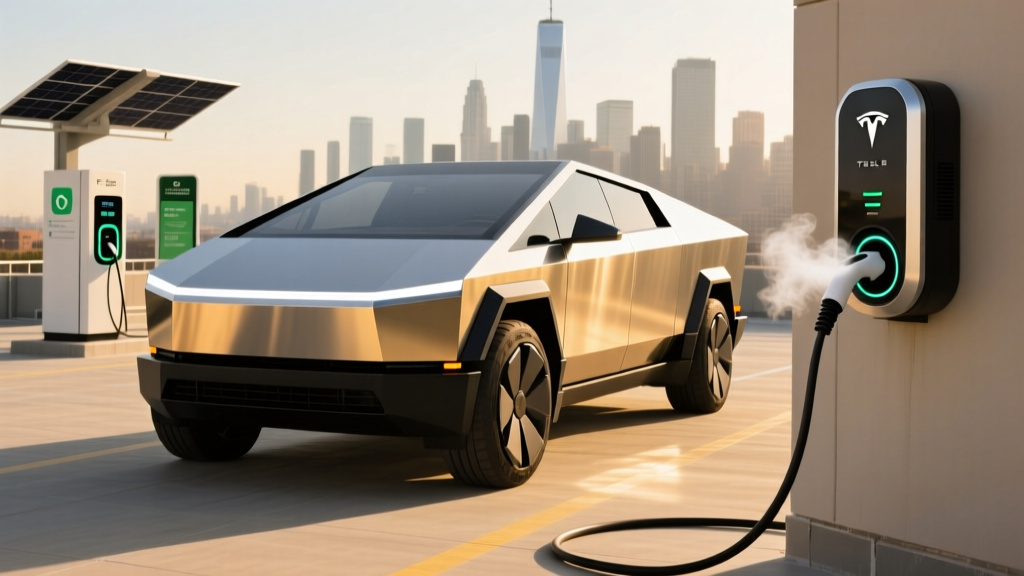
The Cybertruck's angular stainless-steel exoskeleton looks futuristic, but that flat-panel design creates a drag coefficient (Cd ~0.38 estimated) that works against highway efficiency. In our experience and consistent with third-party testing, highway-only driving at sustained speeds above 70 mph drops effective range by roughly 15-20% below the EPA sticker. The 123 kWh usable NMC battery is among the largest in any production EV, which partially offsets this — you still have a lot of electrons on board.
Cold weather compounds the loss. At 20°F, expect a 25-30% range reduction, bringing the AWD model down to roughly 230-250 real-world miles. The Cybertruck does include a heat pump for cabin and battery thermal management, which helps mitigate the worst of winter losses compared to resistive-heating EVs, but physics is physics: cold lithium cells charge slower and hold less accessible energy.
For context, the EPA combined rating of 56 MPGe (AWD) translates to roughly 58 kWh consumed per 100 miles driven. That's thirstier than a Rivian R1T Dual-Motor (~52 kWh/100mi) and significantly less efficient than a sedan like the Model S. If efficiency is your top metric, a truck is not the right body style.
Charging Speed: Supercharger V4 and Home Setup
| Level | Power | Miles Added/Hour | Notes |
|---|---|---|---|
| Level 1 (120V) | 1.4 kW | ~4 mi/hr | Emergency/trickle only — full charge takes days |
| Level 2 (240V, 48A) | 11.5 kW | ~37 mi/hr | Overnight full charge in ~10-12 hours; requires 60A circuit |
| DC Fast Charge | ~350 kW (peak) | ~800+ mi/hr (peak rate) | 10-80% in ~18 min; tapers significantly above 80% SoC |
Tesla's 800V architecture in the Cybertruck allows it to accept peak charging rates around 350 kW at V4 Supercharger stalls equipped with the integrated CCS/NACS cable. The real-world charging curve tells a more nuanced story: the truck sustains roughly 300+ kW between 10-35% State of Charge, then gradually steps down. From 50-80%, expect 150-200 kW. Above 80%, the rate drops sharply to protect the NMC cells — plan to unplug at 80% on road trips rather than wait for the final 20%, which can add 25+ minutes.
At home, the Cybertruck's onboard charger maxes out at 11.5 kW on a Tesla Wall Connector or equivalent Level 2 unit. That adds roughly 37 miles of range per hour of charging, or a full 0-100% charge in about 10-12 hours. You'll need a dedicated 60-amp circuit (hardwired) for maximum speed. If your electrical panel is at or near 200A capacity, a panel upgrade to 325A or 400A may be necessary — budget $1,500-$4,000 for that electrical work on top of the $500-$800 Wall Connector unit and $500-$2,000 for standard installation.
Important distinction: kW (kilowatts) measures charging power — the rate of energy flow. kWh (kilowatt-hours) measures battery capacity — the total energy stored. The Cybertruck charges at up to 350 kW (power) into a 123 kWh (energy) battery.
Performance and Daily Livability
The Cyberbeast's 2.6-second 0-60 time is supercar territory in a 6,600-pound truck. The dual-motor AWD model's 4.1 seconds is hardly slow. Both variants deliver instantaneous electric torque that makes merging, passing, and towing feel effortless. The steer-by-wire system (no mechanical connection between the steering wheel and the wheels) takes about 30 minutes of driving to internalize — it's precise but feels disconnected initially, and the variable ratio means small inputs at speed translate to less wheel movement than at parking-lot speeds.
Four-wheel steer (rear wheels turn up to 10 degrees) gives the Cybertruck a turning circle of roughly 40 feet — tighter than a Ford F-150 and comparable to a midsize SUV. This genuinely helps in parking garages and trailheads.
Inside, the minimalist cabin seats five (not six — no front bench option). Rear legroom measures approximately 38 inches, adequate for adults but not class-leading against the Rivian R1T's ~41 inches or the F-150 Lightning's crew cab. The 18.5-inch center touchscreen runs Tesla's latest infotainment stack, which is responsive but still lacks native Apple CarPlay and Android Auto. The yoke-style steering wheel is standard; a conventional round wheel is available as a no-cost option on 2026 models.
The 6-foot bed is shorter than a standard F-150's 5.5- or 6.5-foot options and lacks a traditional tailgate — instead, the powered tonneau cover rolls back and the ramp-style gate folds down. Tesla's Armor Glass (laminated composite) survived early demo controversies and is now production-standard, though replacement cost remains high if damaged.
Pricing, Tax Credits, and the Cost Question
| Trim | Base MSRP | Federal §30D Credit | Effective Price (if eligible) |
|---|---|---|---|
| AWD (Dual-Motor) | $79,990 | $7,500 (point-of-sale) | ~$72,490 |
| Cyberbeast (Tri-Motor) | $99,990 | $7,500 (point-of-sale) | ~$92,490 |
Does the Cybertruck qualify for the federal EV tax credit under IRS §30D? Yes — with important caveats that apply to all EV buyers in 2026:
- MSRP cap: Trucks/vans/SUVs must have an MSRP at or below $80,000. The AWD Cybertruck at $79,990 clears this by a razor-thin margin. The Cyberbeast at $99,990 does NOT qualify based on MSRP alone.
- Income cap: Adjusted gross income must not exceed $150,000 (single), $225,000 (head of household), or $300,000 (joint filers).
- Battery sourcing: Critical minerals and battery components must meet escalating domestic-content thresholds. Tesla's North American supply chain has largely met these requirements, but always verify the specific VIN on the IRS eligible-vehicles list before purchase.
- Point-of-sale transfer: As of 2024, the $7,500 credit can be transferred to the dealer at purchase, reducing your out-of-pocket cost immediately rather than waiting for tax filing.
Consult a tax professional for your specific eligibility. Rules are subject to legislative change.
At $72,490 effective (AWD, credit-eligible), the Cybertruck undercuts the Rivian R1T Dual-Motor Adventure (~$75,000 before credit) and significantly undercuts the GMC Hummer EV 3X ($104,000+). It competes most directly with the F-150 Lightning Lariat ($69,995), though the Lightning offers a larger bed, more conventional styling, and slightly lower performance.
Is Cybertruck a Flop? Sales Data and Market Context
By Tesla's own historical standards, no — but by the "millions of pre-orders" narrative, absolutely. Estimated 2024-2025 Cybertruck deliveries landed in the 40,000-70,000 range annually. That's meaningful volume for a niche electric truck, but it's not the category-defining juggernaut some predicted. For comparison, the Ford F-150 Lightning moved roughly 30,000-40,000 units in a similar timeframe, and the Rivian R1T approximately 25,000-35,000.
Several factors explain the gap between hype and reality:
- Price: The $79,990+ starting price eliminates most of the reservation-holders who imagined a $40,000 truck.
- Polarizing design: The angular stainless-steel aesthetic generates strong reactions — love it or hate it — which naturally limits the buyer pool.
- Size and practicality: At 231 inches long and 80 inches wide (mirrors folded), it fits in most standard garages but is still a large vehicle for urban parking.
- Competition: The F-150 Lightning, Rivian R1T, and Chevrolet Silverado EV all offer compelling alternatives with more conventional truck utility.
However, Cybertruck owners report high satisfaction scores in owner surveys, particularly praising performance, the Supercharger network, and the stainless-steel body's resistance to dents and corrosion. Resale values have stabilized after initial depreciation spikes typical of new EV platforms.
Warranty and Long-Term Ownership
Tesla covers the Cybertruck with the following warranty terms:
- Basic Vehicle: 4 years / 50,000 miles
- Battery & Drive Unit: 8 years / 120,000 miles (whichever comes first), with a minimum 70% capacity retention guarantee
- Armor Glass: Covered under basic warranty; out-of-warranty replacement estimated at $2,500-$4,000 per panel
The 123 kWh NMC battery is one of the largest packs in any consumer EV. NMC chemistry typically shows 8-12% degradation over 150,000 miles based on fleet data from Tesla's Model S/X platforms. With active thermal management and the large buffer, reaching 200,000+ miles with 80%+ State of Health is realistic for most owners. Full battery replacement cost, if needed outside warranty, is estimated at $18,000-$25,000 — a figure to consider for 15-year ownership horizons.
Who Should Buy the Cybertruck (And Who Shouldn't)
Buy the Cybertruck if:
- You want tri-motor performance (Cyberbeast) that no other production truck matches
- Stainless-steel durability matters — no paint to chip, no dents from door dings
- You're deeply invested in the Tesla Supercharger ecosystem for road trips
- Steer-by-wire and four-wheel steer sound like features, not drawbacks
- You tow up to 11,000 lbs and want electric torque for trailer launches
Look elsewhere if:
- You need a full-size 6.5+ foot bed for contractor/lumber use (F-150 Lightning, Silverado EV)
- Rear-seat passenger comfort is a priority (Rivian R1T, Lightning crew cab)
- You want Apple CarPlay or a conventional truck interface
- Your budget is under $70,000 before incentives
- You prefer proven, mainstream dealer service networks over Tesla's mobile-ranger model
The Verdict: Flop or Future Classic?
The Cybertruck is not a flop — it's a niche product that found its niche. It's the fastest, most technologically distinctive electric truck on the market, with genuine advantages in charging infrastructure, stainless-steel durability, and performance. It's also expensive, polarizing, less practical than conventional trucks for traditional truck work, and its sales volume reflects those trade-offs honestly.
If you're cross-shopping, test-drive a Rivian R1T for adventure lifestyle, an F-150 Lightning for traditional truck utility, and the Cybertruck for raw performance and Tesla ecosystem integration. The data doesn't support calling it a flop — but it also doesn't support calling it the truck that replaced the F-150. It's something else entirely: a high-performance electric statement vehicle that happens to have a bed.
Frequently Asked Questions
What is the real-world range of the Tesla Cybertruck?
The EPA rates the AWD Cybertruck at 340 miles and the Cyberbeast at 320 miles. Real-world highway driving at 70-75 mph typically yields 270-300 miles. In cold weather (below freezing), expect 230-260 miles. City driving with regenerative braking can approach or match EPA figures.
How fast does the Cybertruck charge at home and on the road?
On DC fast charging (Tesla Supercharger V4 or equivalent), the Cybertruck peaks at ~350 kW and charges from 10-80% in approximately 18 minutes, though the rate tapers significantly above 80% SoC. At home on a Level 2 charger (11.5 kW), it adds about 37 miles of range per hour, with a full charge taking 10-12 hours.
Does the Cybertruck qualify for the $7,500 federal EV tax credit?
The AWD Cybertruck at $79,990 MSRP qualifies under the §30D truck MSRP cap of $80,000, assuming you meet income limits ($150K single / $300K joint) and battery-sourcing requirements. The Cyberbeast at $99,990 does NOT qualify due to exceeding the MSRP cap. Always verify eligibility on the IRS clean vehicle list and consult a tax professional.
Is the Cybertruck worth buying over the F-150 Lightning or Rivian R1T?
It depends on priorities. The Cybertruck wins on acceleration (2.6 sec Cyberbeast), Supercharger network access, and stainless-steel durability. The F-150 Lightning wins on bed size, conventional truck utility, and Ford dealer service. The Rivian R1T wins on off-road capability, rear-seat space, and adventure lifestyle features. All three are legitimate choices; none is universally best.
What are the biggest Cybertruck problems reported by owners?
Common owner-reported issues include: steer-by-wire adaptation period (takes most drivers 1-2 weeks), limited rear-seat legroom vs. full-size crew cabs, high tire wear due to vehicle weight (~6,600 lbs), panel-gap inconsistencies on early production units (improved on 2025-2026 builds), and the tonneau cover mechanism requiring occasional maintenance. The Armor Glass has proven more durable than early demonstrations suggested.
Can the Cybertruck actually tow 11,000 pounds?
Yes, the 11,000-pound rating is SAE J2807-certified. However, towing at or near max capacity will reduce range by 40-50%, bringing effective range to roughly 150-180 miles between charges. Plan Supercharger stops accordingly, and note that few Supercharger stalls currently accommodate pull-through trailer parking.