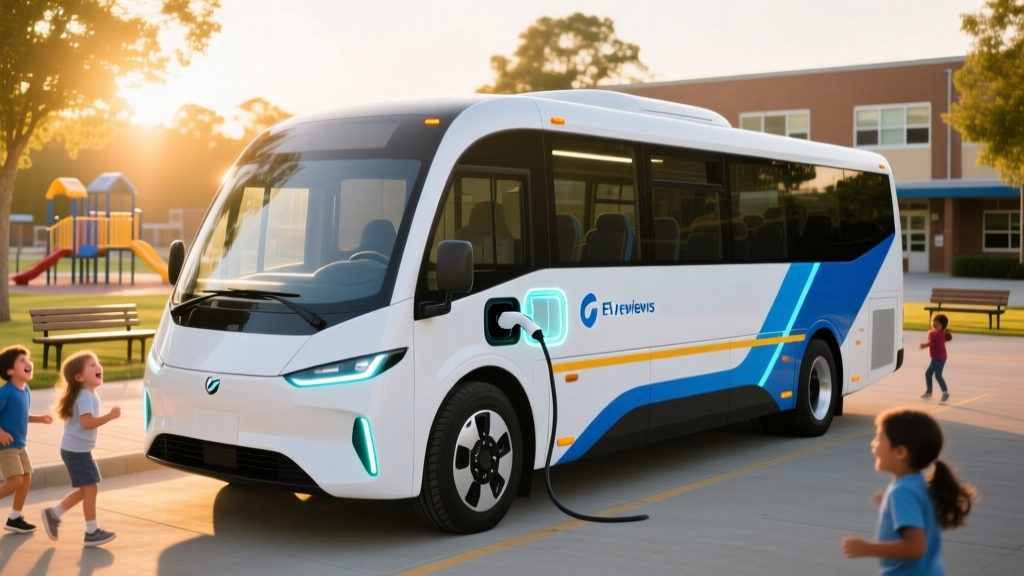
Electric school buses are no longer pilot-program novelties. By 2026, models from Blue Bird, Lion Electric, and IC Bus (Navistar) are in active revenue service across thousands of U.S. school districts, supported by billions in EPA Clean School Bus Program funding. But fleet managers and school board members still face a critical question: what does the total cost of ownership actually look like compared to a diesel bus?
This guide breaks down the real numbers — upfront purchase price, charging infrastructure, fuel savings, maintenance reductions, insurance realities, and available incentives — to answer the question that matters most: how much does an electric school bus cost over its operational life?
Electric School Bus Purchase Price: The Sticker Shock
A new Type C electric school bus in 2026 typically carries a base purchase price between $230,000 and $340,000, depending on manufacturer, battery capacity, and configuration. For context, a comparable diesel Type C bus runs $110,000 to $130,000, and a propane (LPG) model sits around $105,000 to $120,000.
| Model | Battery (kWh) | EPA Est. Range (mi) | Peak DC Charge (kW) | Base MSRP |
|---|---|---|---|---|
| Blue Bird Vision Electric | 196 kWh (LFP) | 120–150 | 150 kW | ~$265,000 |
| Lion Electric LionC | 169 kWh (NMC) | 100–140 | 150 kW | ~$250,000 |
| IC Bus CE Series Electric | 210 kWh (LFP) | 130–160 | 150 kW | ~$285,000 |
| Thomas Built Saf-T-Liner eC2 | 196 kWh (LFP) | 120–150 | 150 kW | ~$275,000 |
The premium over diesel — roughly $130,000 to $210,000 per bus — is substantial. But that gap is where incentives and long-term operational savings become the decisive factors in any procurement analysis.
5-Year Total Cost of Ownership Breakdown
Fleet economics require looking beyond the purchase price. A Type C school bus typically runs 12,000–15,000 miles per year on split-shift routes (morning and afternoon runs), with a 12–15 year service life. Below is a 5-year TCO comparison for a single bus averaging 13,000 miles annually.
| Cost Category | Electric Bus | Diesel Bus | Notes |
|---|---|---|---|
| Purchase Price | $270,000 | $120,000 | Before incentives |
| Federal/State Incentives | −$185,000 | $0 | EPA Clean School Bus + state/utility |
| Net Acquisition Cost | $85,000 | $120,000 | After incentives applied |
| Charging Infrastructure (amortized) | $18,000 | $0 | Depot charger + install, 10-yr amortization |
| Fuel/Energy (5 years) | $12,500 | $38,500 | See cost-per-mile math below |
| Maintenance (5 years) | $6,500 | $18,000 | No oil/filters/DEF; regen saves brakes |
| Insurance (5 years) | $14,000 | $11,500 | EV premiums ~15–25% higher |
| Depreciation (5 years) | $55,000 | $42,000 | EV residual values still maturing |
| Total 5-Year TCO | $191,000 | $230,000 | EV saves ~$39,000 |
The math flips the narrative: after incentives, the electric bus starts at a lower net acquisition cost and continues to save on fuel and maintenance throughout its service life. The 5-year advantage of roughly $39,000 per bus compounds significantly across a fleet.
Charging vs. Diesel: Cost Per Mile
The fuel-cost advantage of electric school buses is where TCO arguments win or lose. School bus routes are predictable — typically 60–80 miles per day, returning to a depot overnight — making them ideal for managed Level 2 or DC fast charging.
| Metric | Electric Bus | Diesel Bus |
|---|---|---|
| Energy Consumption | 2.1 kWh/mile | 6.5 mpg |
| Fuel/Energy Rate | $0.12/kWh (commercial) | $3.85/gallon (diesel) |
| Cost Per Mile | $0.25 | $0.59 |
| Annual Fuel Cost (13,000 mi) | $3,250 | $7,670 |
| 5-Year Fuel Cost (65,000 mi) | $16,250 | $38,350 |
At a national average commercial electricity rate of $0.12/kWh and diesel at $3.85/gallon, the electric bus costs $0.25 per mile to "fuel" versus $0.59 per mile for diesel — a 58% reduction. Over 13,000 annual miles, that's roughly $4,400 in annual fuel savings per bus.
Important caveats: commercial electricity rates vary widely by utility and region. Districts in the Pacific Northwest may see $0.07/kWh, while parts of the Northeast could exceed $0.18/kWh. Time-of-use (TOU) rate schedules can further reduce costs if buses charge overnight during off-peak hours. Always consult your local utility's commercial EV rate schedule.
Federal Funding: EPA Clean School Bus Program
The EPA Clean School Bus Program, funded by the Bipartisan Infrastructure Law, allocated $5 billion over five years (2022–2026) specifically for zero-emission and low-emission school bus replacements. This is the primary funding mechanism — not the IRS §30D consumer tax credit — that makes electric school bus procurement viable for most districts.
EPA Clean School Bus Program — Key Parameters (2026):
- Rebates up to $345,000 per zero-emission bus (amount varies by district priority tier)
- Additional $20,000 per bus available for charging infrastructure
- Priority scoring for high-need, rural, Tribal, and low-income districts
- Funding distributed through competitive rebate lotteries, not first-come-first-served
- Must replace an existing diesel bus (model year 2010 or earlier in recent rounds)
- Old bus must be scrapped or rendered permanently inoperable
- Zero-emission bus must be retained for at least 5 years
A note on IRS §30D: The federal consumer EV tax credit (up to $7,500 for light-duty passenger vehicles) does not apply to Class 7/8 school buses. School buses fall under the separate §45W Commercial Clean Vehicle Credit, which offers up to $40,000 for qualifying heavy-duty commercial EVs. However, many school districts, as tax-exempt entities, can access this credit as a direct payment (elective pay) under the Inflation Reduction Act — effectively converting the credit into a rebate. Consult your district's financial advisor and reference IRS guidance for current-year eligibility.
Federal Tax Credit Eligibility Checklist (§45W for Commercial Fleets)
- Vehicle must be a qualified commercial clean vehicle (GVWR over 14,000 lbs qualifies for up to $40,000)
- Must be acquired for use or lease by a business/tax-exempt entity — not for resale
- Battery capacity must be at least 15 kWh for vehicles over 14,000 lbs GVWR
- Must be manufactured primarily in North America (final assembly requirement)
- Tax-exempt entities (including public school districts) can elect direct payment from the IRS
- Critical mineral and battery component sourcing requirements apply — verify with manufacturer
- MSRP caps do not apply to §45W (unlike the consumer §30D credit)
- Income caps do not apply to §45W commercial credit
State, Local, and Utility Incentives
Beyond federal funding, most electric school bus projects stack multiple incentive layers to reduce net acquisition cost further.
Regional incentive examples (verify current availability in your jurisdiction):
- California (CARB/HYIP): Up to $120,000 per bus through the Hybrid and Zero-Emission Truck and Bus Voucher Incentive Project, plus utility make-ready infrastructure programs from PG&E, SCE, and SDG&E
- New York (NYSERDA): Up to $185,000 per Class 7/8 zero-emission bus through the New York Truck Voucher Incentive Program
- Colorado: State fleet electrification grants plus Xcel Energy commercial EV charging rebates up to $50,000 per site
- Utility make-ready programs: Many investor-owned utilities cover 50–100% of the electrical infrastructure cost (conduit, panel upgrades, transformer) for depot charging — check with your local utility
- VW Environmental Mitigation Trust: Remaining settlement funds in many states still available for school bus electrification
Incentive amounts, availability, and eligibility rules vary by jurisdiction and change frequently. Always confirm current program details with your state energy office and local utility before committing to procurement.
When EPA Clean School Bus funding, §45W direct pay, state vouchers, and utility make-ready programs are stacked, it is not uncommon for a district's net out-of-pocket cost to fall below $50,000 per bus — competitive with or even below a new diesel bus.
Maintenance Savings: Where Electric Buses Shine
School bus fleets are maintenance-intensive. Diesel buses require regular oil changes, diesel exhaust fluid (DEF), diesel particulate filter (DPF) cleaning, fuel filter replacements, and transmission service. Electric buses eliminate nearly all of these.
| Maintenance Item | Electric Bus | Diesel Bus |
|---|---|---|
| Oil & Filter Changes | $0 | $850 |
| Diesel Exhaust Fluid (DEF) | $0 | $400 |
| Fuel Filter Replacement | $0 | $200 |
| DPF Service/Cleaning | $0 | $600 |
| Transmission Service | $0 (single-speed) | $350 |
| Brake Pad Replacement | $150 (every 3–5 yrs) | $600 (every 1–2 yrs) |
| Coolant System | $100 | $200 |
| General Inspection/Misc. | $400 | $400 |
| Annual Maintenance Total | $650 | $3,600 |
The annual maintenance savings of roughly $2,950 per bus adds up quickly. Over a 12-year service life, that's approximately $35,000 in maintenance savings per bus. Regenerative braking is the biggest contributor to brake savings — the electric motor handles most deceleration, dramatically reducing friction brake wear.
Battery replacement is the primary long-term maintenance concern. Current electric school bus batteries (LFP chemistry in most 2026 models) carry warranties of 10 years or 300,000 miles with guaranteed capacity retention of 70–80%. A full battery pack replacement, if needed beyond warranty, runs $45,000 to $70,000 — a significant cost, but one that most buses will not face during their first-owner service life.
Insurance and Depreciation Realities
Honest TCO analysis requires acknowledging where electric buses cost more.
Insurance Premiums
Commercial fleet insurance for electric school buses typically runs 15–25% higher than diesel equivalents. Reasons include:
- Higher replacement cost of the vehicle and battery pack
- Limited actuarial data on electric bus collision repair costs
- Specialized high-voltage repair requirements and technician certification
- Higher parts cost for electric drivetrain components
Expect annual premiums of roughly $2,800–$3,200 per electric bus versus $2,200–$2,600 for diesel. As fleet electric bus adoption grows and repair data matures, this gap is expected to narrow.
Depreciation and Resale Value
The secondary market for electric school buses is still developing. Key factors:
- Battery State of Health (SoH) is the dominant variable in resale value — buyers will demand verified battery diagnostics
- First-generation models (2019–2022) are showing steeper depreciation as battery technology improves rapidly
- 5-year depreciation for electric school buses is estimated at 45–60% of net acquisition cost, compared to 30–40% for diesel
- However, because net acquisition cost after incentives is already much lower, the absolute dollar depreciation may still be competitive
- As LFP batteries demonstrate strong cycle-life durability (3,000+ cycles to 80% SoH), resale confidence is expected to improve through 2026 and beyond
Charging Infrastructure: The Hidden Cost
Depot charging infrastructure is the line item that catches many districts off guard. A single DC fast charger (60–150 kW) for a school bus costs $40,000–$90,000 installed, depending on site electrical capacity and utility service upgrades.
| Component | Cost Range | Notes |
|---|---|---|
| Level 2 Charger (19.2 kW) | $3,000–$7,000 | Sufficient for overnight charging; ~8 hrs for full charge |
| DC Fast Charger (60–150 kW) | $35,000–$80,000 | ~1.5–2.5 hrs for full charge; needed for mid-day top-ups |
| Electrical Panel Upgrade | $5,000–$25,000 | Required if existing service is insufficient |
| Utility Service Upgrade | $0–$50,000+ | May need new transformer or medium-voltage service |
| Permitting & Engineering | $3,000–$10,000 | Site plans, load calculations, utility interconnection |
| Software/Network Fees (annual) | $300–$800/yr | Charge management software for scheduled/managed charging |
Most districts find that Level 2 depot charging is sufficient for standard split-shift routes (morning run → return to depot → charge midday → afternoon run → charge overnight). At 19.2 kW, a 196 kWh battery adds roughly 50–60 miles of range in a 4-hour midday window — enough to replenish a typical morning route. DC fast chargers are necessary only for longer routes or when mid-day turnaround time is limited.
Pro tip: Engage your utility early in the planning process. Many utilities offer free site assessments and can identify whether your depot's existing electrical service can handle multiple bus chargers without costly upgrades. Some utilities will cover the entire make-ready cost (conduit, wiring, panel) as part of their EV infrastructure investment programs.
Frequently Asked Questions
How much does an electric school bus cost after all incentives?
After stacking EPA Clean School Bus Program rebates, the §45W commercial clean vehicle credit (up to $40,000 via direct pay for tax-exempt entities), and state/utility incentives, many districts acquire electric school buses for a net cost of $30,000–$85,000 — frequently below the cost of a new diesel bus ($110,000–$130,000). Exact savings depend on your district's priority tier, state programs, and utility participation.
Do public school districts qualify for the federal EV tax credit?
Public school districts are typically tax-exempt and cannot use traditional tax credits. However, under the Inflation Reduction Act's elective pay (direct pay) provision, tax-exempt entities can receive the §45W Commercial Clean Vehicle Credit as a direct payment from the IRS — effectively functioning as a rebate of up to $40,000 per bus. Verify eligibility with your district's financial advisor and reference IRS elective pay guidance.
How much does a school district save on fuel per year with an electric bus?
At 13,000 annual miles, $0.12/kWh electricity, and 6.5 mpg diesel at $3.85/gallon, an electric school bus saves approximately $4,400 per year in fuel costs. Over a 12-year service life, that's roughly $53,000 in fuel savings per bus. Savings vary with local electricity rates and diesel prices.
What is the real-world range of an electric school bus?
Manufacturer-claimed ranges of 120–160 miles assume optimal conditions. In real-world operation with stop-and-go routes, HVAC load (especially heating in cold climates), and hilly terrain, expect 80–120 usable miles from a 196 kWh battery. Cold-weather range loss of 20–35% is common in northern climates, which can limit usable range to 70–95 miles. Most standard routes (60–80 miles/day) remain well within range, but longer or rural routes require careful planning.
How long do electric school bus batteries last?
Most 2026 electric school bus batteries use LFP (lithium iron phosphate) chemistry, which offers superior cycle life compared to NMC. Typical warranties guarantee 70–80% capacity retention at 10 years or 300,000 miles. LFP cells are rated for 3,000–5,000 full charge cycles before reaching 80% State of Health, which translates to roughly 15+ years of school bus service in most climates. Battery replacement cost, if needed beyond warranty, is $45,000–$70,000.
Are electric school buses more expensive to insure?
Yes, typically 15–25% more than diesel equivalents. Annual premiums of $2,800–$3,200 per electric bus versus $2,200–$2,600 for diesel are common. The higher cost reflects the bus's higher replacement value, specialized repair requirements, and limited claims data. This premium is expected to decrease as electric bus adoption grows and actuarial data matures.
What charging infrastructure does a school bus depot need?
For standard split-shift routes, Level 2 chargers (19.2 kW) at each bus parking space are usually sufficient, with a full overnight charge costing $15–$25 in electricity. DC fast chargers (60–150 kW) are needed only for mid-day top-ups on longer routes. Installation costs range from $5,000 (Level 2 with existing capacity) to $90,000+ (DC fast charger with utility service upgrade). Engage your utility early — many cover make-ready infrastructure costs.