Quick Verdict: Supercar Speed Meets Family SUV Practicality
The 2022 Tesla Model X Plaid remains one of the most audacious vehicles ever built — a three-row electric SUV that hits 60 mph in 2.5 seconds while still offering 311 miles of EPA-estimated range and genuine cargo utility. Now available exclusively on the used market (Tesla discontinued the Plaid trim for the refreshed Model X lineup), it represents a unique value proposition for buyers who want hypercar performance without sacrificing daily drivability.
At its original MSRP of $120,990 before options, the Plaid was a six-figure statement. Today, used examples typically trade between $75,000 and $95,000 depending on mileage and condition — which opens an interesting question about whether the 2022 Model X Plaid 0-60 performance justifies its premium over the dual-motor Model X or competitors like the Rivian R1S and BMW iX M60.
Range, Battery & Real-World Efficiency
EPA Estimated Range: 311 miles (20" wheels) / 333 miles (22" wheels, per Tesla's original configurator data)
Real-World Expectation: Plan for 250–280 miles on sustained highway driving at 70+ mph. In cold weather (below 32°F), expect a 20–30% reduction, dropping effective range to roughly 200–240 miles. City driving with regenerative braking recovers range closer to the EPA sticker.
| Specification | 2022 Model X Plaid |
|---|---|
| Usable Battery Capacity | ~100 kWh (NMC chemistry) |
| Battery Chemistry | Nickel Manganese Cobalt (NMC) |
| EPA Range (20" wheels) | 311 miles |
| EPA Efficiency | 101 MPGe combined / 33 kWh/100mi |
| Drivetrain | Tri-Motor AWD |
| Horsepower | 1,020 hp |
| 0-60 mph | 2.5 seconds |
| Top Speed | 163 mph |
| Curb Weight | 5,185 lbs |
The Model X Plaid uses Tesla's NMC lithium-ion battery pack — not the LFP chemistry found in some Standard Range Model 3/Y vehicles. NMC offers higher energy density, which is critical for a heavy tri-motor SUV, but it also means Tesla recommends daily charging to 80–90% for longevity, reserving 100% for road trips. This is standard practice for NMC packs and aligns with what Tesla's official battery care guidance recommends.
Efficiency at 33 kWh per 100 miles is respectable for a 5,185-pound tri-motor performance SUV. For context, the dual-motor Model X Long Range achieves about 31 kWh/100mi, while the Rivian R1S quad-motor sits around 43 kWh/100mi. The Plaid's three motors and sophisticated thermal management keep it surprisingly efficient when you're not exploiting its full output.
Charging Speed: DC Fast, Level 2 & Home Setup
| Charging Level | Max Rate | Speed / Time |
|---|---|---|
| DC Fast Charge (Supercharger V3) | 250 kW peak | 10–80% in ~30 minutes |
| DC Fast Charge (Supercharger V2) | 150 kW peak | 10–80% in ~45 minutes |
| Level 2 (Tesla Wall Connector, 48A) | 11.5 kW | ~30 miles of range per hour |
| Level 2 (Generic J1772 w/ adapter, 32A) | 7.7 kW | ~20 miles of range per hour |
| Level 1 (120V household outlet) | 1.4 kW | ~3–4 miles of range per hour |
The Model X Plaid peaks at 250 kW on V3 Superchargers, but — as with all EVs — that peak is not sustained across the entire session. The charge curve is aggressive from 10–40% SoC, where you'll see 200–250 kW, then it tapers progressively. From 60–80%, expect roughly 80–120 kW. This is why the 10–80% time sits around 30 minutes rather than the theoretical minimum a flat 250 kW curve would suggest.
For home charging, the Tesla Wall Connector at 48 amps on a 60-amp circuit delivers 11.5 kW — enough to add roughly 30 miles of range per hour, or a full 10–90% charge overnight in about 8–9 hours. If your electrical panel only supports a 40-amp circuit (common in older homes), you'll get about 32 amps / 7.7 kW to the vehicle, which still covers most overnight needs. A panel upgrade to 200 amps may be necessary if you're running multiple high-draw appliances alongside an EV charger — budget $1,500–$3,000 for that work.
One advantage Tesla owners retain: access to the Tesla Supercharger network, which remains the most reliable and geographically comprehensive DC fast-charging network in the U.S. The 2022 Model X Plaid uses Tesla's proprietary connector, and with Tesla opening NACS to other manufacturers, Supercharger stalls are increasingly shared — though Tesla owners still benefit from native plug-and-charge integration.
Performance Deep Dive: The 2022 Model X Plaid 0-60 Story
The headline number — 2.5 seconds 0-60 mph — was verified by multiple independent testers including Motor Trend and Car and Driver at the time of launch. This puts the Model X Plaid in the territory of a Lamborghini Huracán or Ferrari F8 Tributo, except with three rows of seats, a frunk, and near-silent operation.
The tri-motor setup places one motor on the front axle and two on the rear, enabling torque vectoring across the rear wheels. This is what gives the Plaid its startling launch traction — all 5,185 pounds of SUV squat and grip rather than spin. The carbon-sleeved rotors in the Plaid's motors allow them to spin at higher RPMs without expanding, which is why the performance holds up at higher speeds compared to the dual-motor variant.
Quarter-mile times land in the 9.9–10.1 second range at roughly 140 mph. Braking from 60 mph takes about 110 feet with the standard brakes, or roughly 105 feet with the optional carbon-ceramic package (a $20,000 add when new). Track use will reveal the Plaid's weight — sustained hot laps cause brake fade and thermal management intervention — but for street and drag-strip use, the performance is staggering and repeatable.
Interior, Cargo & Technology
The 2022 Model X Plaid carries over the pre-refresh interior with the yoke steering wheel (standard on Plaid), a 17-inch landscape-oriented center touchscreen, and a rear-seat entertainment display. Build quality on 2022 examples improved over earlier Model X years, though panel gaps and minor trim inconsistencies remain more noticeable than in a similarly priced BMW iX or Mercedes EQS SUV.
| Dimension | Measurement |
|---|---|
| Cargo (behind 3rd row) | ~15 cu ft (seats up) |
| Cargo (3rd row folded) | ~57 cu ft |
| Cargo (all rear rows folded) | ~82 cu ft |
| Front Legroom | 41.2 in |
| 2nd Row Legroom | 38.4 in |
| 3rd Row Legroom | 32.7 in (tight for adults) |
| Frunk | ~6.6 cu ft |
| Seating Config | 5-seat (bench), 6-seat (captains), 7-seat |
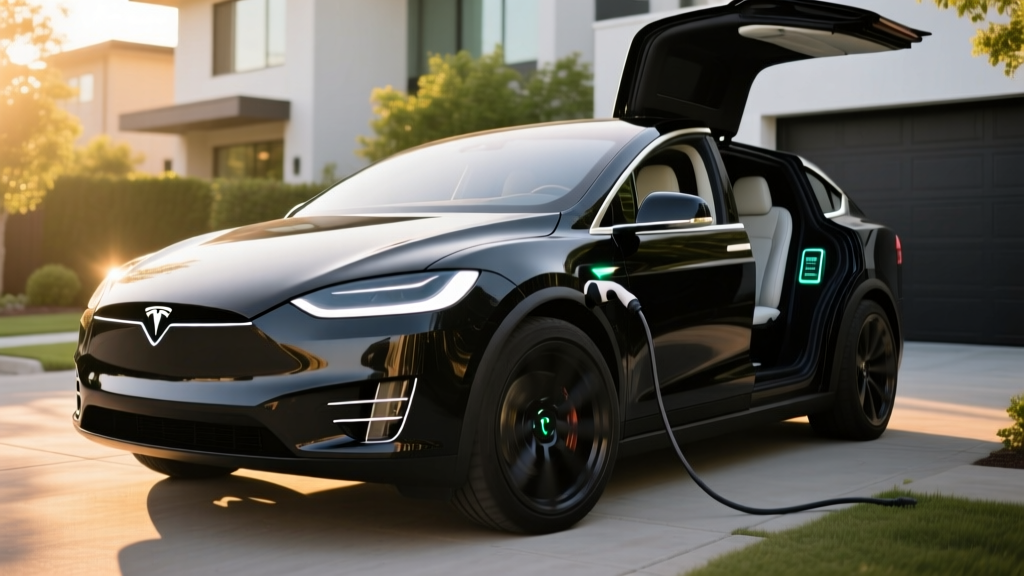
The third row is best suited for children or occasional use — adults will find the 32.7 inches of legroom cramped on longer trips. The falcon-wing rear doors are the Model X's signature feature: they open upward with articulating hinges, making it genuinely easy to load car seats or access the second row in tight parking spaces. The trade-off is complexity — sensors can be finicky in heavy rain, and the doors are slower to operate than conventional ones.
Tech highlights: The infotainment system includes a full gaming suite (Cyberpunk 2077, Stardew Valley), Netflix/YouTube streaming while parked, and Tesla's visualization-heavy driving display. The Plaid trim adds a 22-speaker audio system with active noise cancellation that genuinely rivals anything from Burmester or Bowers & Wilkins.
Driver assistance: Basic Autopilot (Traffic-Aware Cruise Control + Autosteer) is included. Full Self-Driving (Supervised) was a $12,000 option at purchase. Important clarification: FSD remains an SAE Level 2 system — the driver must remain fully engaged and responsible at all times. It is not autonomous driving.
Pricing, Tax Credits & Used Market Value
| Item | Amount |
|---|---|
| Original 2022 MSRP (Plaid) | $120,990 |
| Typical Used Price (2026) | $75,000 – $95,000 |
| Federal Used EV Credit (§25E) | Up to $4,000 (if eligible) |
| New EV Credit (§30D) | Not eligible — vehicle is used |
Because the 2022 Model X Plaid is now a used vehicle, the $7,500 federal new-EV tax credit (§30D) does not apply. However, buyers may qualify for the §25E Used Clean Vehicle Credit — up to $4,000 or 30% of the sale price (whichever is less). Per IRS guidelines, eligibility requires:
- Sale price at or below $25,000 (the Model X Plaid exceeds this — making it ineligible for §25E)
- Buyer AGI at or below $75,000 single / $150,000 joint
- Purchase from a licensed dealer
- Vehicle at least 2 model years old
In practice, no federal tax credit is available for a used Model X Plaid at current market prices. The §25E credit's $25,000 price cap effectively excludes all used Teslas above Model 3 Standard Range territory. State-level incentives vary — check your local DMV or energy office for any applicable rebates.
Ownership Costs: Warranty, Insurance & Maintenance
Tesla's warranty for the 2022 Model X Plaid includes:
- Basic Vehicle: 4 years / 50,000 miles
- Battery & Drive Unit: 8 years / 150,000 miles (minimum 70% capacity retention)
The 8-year battery warranty is the critical one. If your pack degrades below 70% of original capacity within that window, Tesla will repair or replace it. Real-world degradation data from Tessie and other fleet-tracking sources suggest Model X packs lose roughly 8–12% capacity over the first 100,000 miles — well within the warranty threshold.
Insurance costs are a real consideration: expect $3,500–$5,500 annually for a Model X Plaid, depending on your driving record, location, and coverage. This is significantly higher than a dual-motor Model X or competing luxury EVs, driven by the Plaid's repair costs and performance profile. Get quotes before committing.
Maintenance is minimal compared to ICE equivalents — no oil changes, no transmission fluid, no spark plugs. Budget for tire replacements (the Plaid's 20" or 22" performance tires run $350–$500 each and wear faster due to the vehicle's weight and torque), cabin air filter changes (~$150 every 2 years), and wiper fluid. Tesla's mobile service handles most minor repairs at your home or office.
How It Stacks Up: Plaid vs. the Competition
| Spec | 2022 Model X Plaid | 2024 Rivian R1S Quad | 2024 BMW iX M60 |
|---|---|---|---|
| 0-60 mph | 2.5 sec | 3.5 sec | 3.6 sec |
| EPA Range | 311 mi | 321 mi (Max Pack) | 296 mi |
| DC Fast Charge Peak | 250 kW | 220 kW | 200 kW |
| Horsepower | 1,020 hp | 830 hp | 610 hp |
| 3rd Row | Yes (tight) | Yes (tight) | No |
| Towing | 5,000 lbs | 7,700 lbs | 3,500 lbs |
| Off-Road Capability | Limited | Excellent | Limited |
Choose the Model X Plaid if: You prioritize outright acceleration and performance above all else, want access to the Supercharger network, and value Tesla's software/OTA update ecosystem.
Choose the Rivian R1S if: You need serious off-road capability, higher towing capacity, and a more rugged adventure-oriented SUV — and don't mind sacrificing 0.5–1.0 seconds to 60.
Choose the BMW iX M60 if: You want a more traditionally luxurious interior, a quieter ride, and don't need a third row — accepting lower performance and range in exchange for build quality refinement.
Pros, Cons & Who Should Buy
Pros
- 2.5-second 0-60 is supercar territory in a family SUV
- 311-mile EPA range is practical for road trips
- Access to Tesla Supercharger network (most reliable DC charging)
- Falcon-wing doors are genuinely useful for car-seat loading
- OTA updates continue to add features years after purchase
- Tri-motor AWD provides exceptional traction in all conditions
- Strong over-the-air gaming and entertainment suite
Cons
- No federal tax credit available at used market prices
- Third row is tight for adults on longer trips
- Falcon-wing doors can be slow and sensor-prone in heavy rain
- Insurance costs are $3,500–$5,500/year
- Pre-refresh interior shows age vs. newer competitors
- Yoke steering is polarizing and not universally preferred
- Build quality still trails German luxury competitors
Who this EV suits best: The Model X Plaid is ideal for the performance-oriented family buyer who wants one vehicle that can do school runs, road trips, and occasional track days without compromise. It's also a strong fit for current Tesla owners who value ecosystem continuity. It's less ideal for buyers who prioritize interior luxury above raw speed, need a genuinely comfortable third row for regular adult passengers, or want serious off-road capability.
Frequently Asked Questions
What is the real-world range of the 2022 Model X Plaid?
EPA-rated at 311 miles, but expect 250–280 miles in real-world highway driving at 70+ mph. Cold weather (below freezing) can drop that to 200–240 miles. City driving with regenerative braking gets you closer to the EPA number.
How fast does the Model X Plaid charge?
It peaks at 250 kW on Tesla V3 Superchargers, achieving a 10–80% charge in approximately 30 minutes. At home on a Level 2 Tesla Wall Connector (48A), it adds about 30 miles of range per hour, fully charging overnight in 8–9 hours.
Does the 2022 Model X Plaid qualify for any federal tax credit?
No. The §30D new-vehicle credit doesn't apply to used purchases, and the §25E used-EV credit requires a sale price at or below $25,000 — far below the Model X Plaid's $75,000–$95,000 used market value. Check your state for any local incentives.
Is the Model X Plaid worth buying over a dual-motor Model X?
If you value the 2.5-second 0-60 and tri-motor traction, yes — the performance gap is substantial. If you primarily commute and don't exploit the power, the dual-motor Long Range offers similar range and most of the utility at $20,000–$30,000 less on the used market.
How reliable is the Model X Plaid's battery long-term?
Tesla's NMC packs in the Model X/S platform have shown 8–12% degradation over 100,000 miles based on fleet data. The 8-year/150,000-mile battery warranty (70% retention minimum) provides strong protection. Avoid habitual 100% charges and DC fast-charging to extend longevity.
Can the Model X Plaid tow?
Yes, it's rated for 5,000 pounds of towing capacity. However, towing will reduce range by approximately 40–50%, so plan for more frequent charging stops on long hauls.