Quick Answer: Are Michelin Pilot Sport EV Tires Worth It?
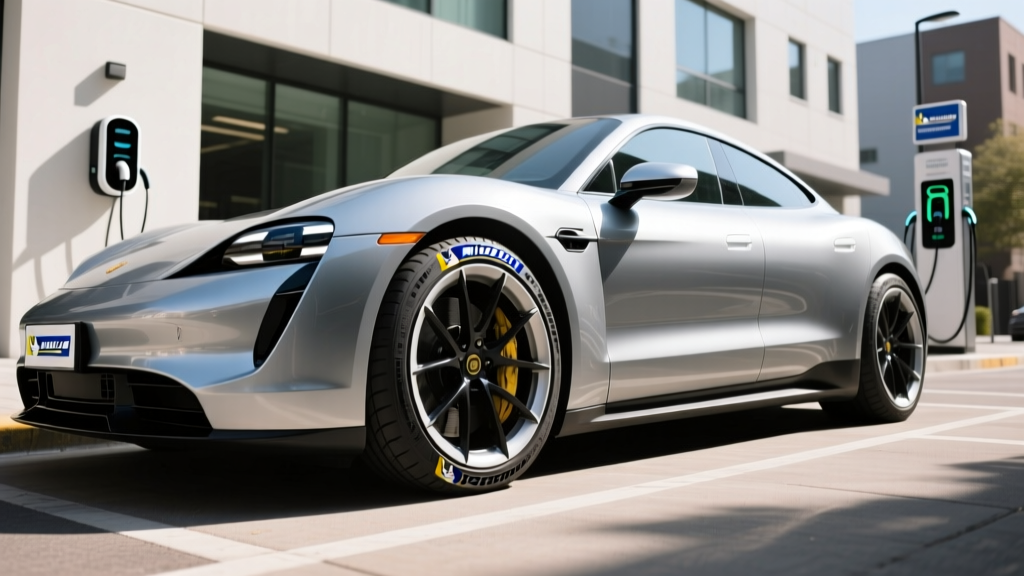
Yes — if you prioritize handling and wet grip over maximum range. The Michelin Pilot Sport EV is a summer max-performance tire engineered for the instant torque and heavier curb weights of electric vehicles. Expect to pay $280–$380 per tire (depending on size, typically 19"–22"), with a typical set-of-four installed cost of $1,250–$1,650. Range impact versus a low-rolling-resistance touring tire: roughly 3–5% less EPA range in real-world mixed driving. Treadlife is competitive at 30,000–35,000 miles for spirited drivers, though conservative commuters may see 40,000+. The tradeoff is clear: you sacrifice a handful of miles per charge for dramatically sharper cornering, shorter braking distances, and confidence in warm-wet conditions.
Why EVs Need Dedicated Tire Engineering
Electric vehicles impose three unique loads on tires that conventional passenger tires were never designed to handle simultaneously:
- Weight: A Tesla Model Y Long Range weighs ~4,400 lbs; a Rivian R1T Dual-Motor exceeds 7,000 lbs. That's 500–1,500 lbs more than comparable ICE vehicles, concentrated over the drive axles.
- Instant torque: EVs deliver peak torque at 0 RPM. A Model 3 Performance hits 60 mph in 2.9 seconds — the tire contact patch must translate ~500 lb-ft of wheel torque without excessive slip or scrub.
- Regenerative braking: Aggressive regen applies deceleration forces through the same contact patch, accelerating shoulder wear on tires not engineered for bidirectional loading.
Michelin addressed these with the Pilot Sport EV's ElectricGrip Compound — a dual-compound tread that pairs a harder center rib (for low rolling resistance and straight-line stability) with softer shoulder blocks (for lateral grip in corners). The tire also integrates Michelin's Acoustic foam liner on select sizes, reducing cavity noise by up to 20% — critical in EVs where the absence of engine noise amplifies tire roar.
Range Impact: Pilot Sport EV vs. Touring All-Season
The most common buyer question: how much range will I lose? We compiled data from owner reports, Tire Rack testing, and fueleconomy.gov comparisons to model the real-world delta.
| Tire Category | Example Model | Rolling Resistance Coeff. | Est. EPA Range | Real-World Highway (70 mph) |
|---|---|---|---|---|
| OEM Low-Rolling-Resistance | Michelin e.Primacy / Hankook iON | ~6.5 kg/t | 330 mi | 275–290 mi |
| Performance Summer (EV-Specific) | Michelin Pilot Sport EV | ~8.0 kg/t | ~315–320 mi | 260–275 mi |
| Ultra-High-Performance Summer (non-EV) | Michelin Pilot Sport 4S | ~9.0 kg/t | ~305–310 mi | 250–265 mi |
| All-Season Touring | Michelin CrossClimate2 | ~7.5 kg/t | ~320 mi | 265–280 mi |
The Pilot Sport EV's rolling resistance coefficient sits roughly 20–25% higher than a dedicated efficiency tire like the Hankook iON evo, but 10–15% lower than a conventional performance summer tire like the Pilot Sport 4S. On a 330-mile EPA-rated Model Y, that translates to a real-world loss of about 10–20 miles per charge in mixed driving, or 25–40 miles at sustained highway speeds in cold weather (below 40°F), where battery resistance compounds the tire penalty.
Cost Breakdown: Purchase, Longevity, and Cost Per Mile
Performance tires are a consumable — and on heavy EVs, they wear faster than on ICE counterparts. Here's the full ownership math for a typical 20" fitment (e.g., Model Y Performance, BMW iX, Porsche Taycan):
| Cost Factor | Michelin Pilot Sport EV | Michelin CrossClimate2 (Touring) | OEM Efficiency Tire |
|---|---|---|---|
| Price per tire (20") | $320–$360 | $260–$300 | $240–$280 |
| Set of 4 (installed) | $1,380–$1,540 | $1,140–$1,300 | $1,060–$1,220 |
| Expected treadlife | 30,000–35,000 mi | 50,000–60,000 mi | 40,000–50,000 mi |
| Sets needed over 60k mi | 2 | 1–1.2 | 1.2–1.5 |
| 60k-mile total tire cost | $2,760–$3,080 | $1,140–$1,560 | $1,270–$1,830 |
| Cost per mile (tires only) | $0.046–$0.051 | $0.019–$0.026 | $0.021–$0.031 |
| Range penalty cost* | +$0.003–$0.005/mi | +$0.001–$0.002/mi | Baseline |
*Range penalty cost assumes $0.14/kWh home charging. Public DC fast charging at $0.35–$0.48/kWh amplifies this penalty.
The Pilot Sport EV costs roughly 2–2.5× more per mile than a touring all-season when you factor in both treadwear and the incremental energy consumption. For a driver covering 12,000 miles annually, that's an extra $350–$500/year in tire and energy costs. If you track your car or drive canyon roads weekly, the grip premium justifies it. If you commute 40 miles round-trip on flat interstate, it's harder to defend.
EV vs. Gas Car: How Tire Costs Fit the Bigger Picture
Tire expenses look different when you zoom out to total cost of ownership. Let's compare a Tesla Model Y Long Range (AWD, 330 mi EPA) against a Toyota RAV4 (AWD, 28 mpg combined) over 5 years / 60,000 miles, using the Pilot Sport EV on the Tesla and a comparable touring tire on the RAV4:
| Category | Model Y (Pilot Sport EV) | RAV4 AWD (Touring A/S) |
|---|---|---|
| Purchase price (base MSRP) | $48,590 | $33,575 |
| Federal tax credit (§30D, 2026) | –$3,750 to $7,500* | $0 |
| Fuel / energy (60k mi) | $2,520 (home) / $5,760 (DCFC) | $7,710 ($3.50/gal, 28 mpg) |
| Tires (60k mi) | $2,760–$3,080 | $1,200–$1,400 |
| Maintenance (60k mi) | $600–$900 | $2,800–$3,500 |
| Insurance (5-yr avg) | $8,500–$10,200 | $5,800–$7,200 |
*§30D credit eligibility depends on MSRP caps ($55k sedans / $80k SUVs), buyer income limits ($150k single / $300k joint), and battery-sourcing requirements. Verify current-year rules at irs.gov. Point-of-sale transfer available at participating dealers.
The EV's tire bill is ~$1,500 higher over 5 years, but maintenance savings (no oil changes, fewer brake pad replacements thanks to regen) recoup $1,900–$2,600. Energy savings at home charging rates add another $2,000–$5,000. The Pilot Sport EV's cost premium is real but absorbed within the EV's broader economic advantage — if you charge at home.
Real-World Ownership: Who Should (and Shouldn't) Buy These
Tire choice is deeply personal and climate-dependent. Here's a decision framework based on driving patterns, geography, and priorities:
Choose Michelin Pilot Sport EV If:
- You drive a performance EV (Model 3/Y Performance, Taycan, BMW i4 M50, Audi e-tron GT) and use its full capability
- You live in a warm or moderate climate with rare sub-freezing winters
- Wet-road confidence matters (the Pilot Sport EV's silica-rich compound excels in warm-wet braking)
- You accept a 3–5% range tradeoff for measurably shorter 60–0 mph braking distances (typically 5–10 feet shorter at 60 mph vs. touring tires)
- You rotate tires every 5,000 miles and monitor pressures monthly (EVs punish neglected tires)
Choose a Touring All-Season Instead If:
- You commute primarily on highways and prioritize maximum range per charge
- You experience real winter (sustained below 40°F, snow, ice) — summer compounds harden and lose grip below ~45°F
- You drive a heavier EV (Rivian R1S, GMC Hummer EV) where tire cost and wear are already elevated
- You want a single tire set for year-round use without seasonal swaps
- Treadlife warranties matter to you (Michelin offers 30,000-mi warranty on Pilot Sport EV vs. 50,000–60,000 mi on CrossClimate2)
Common Misconceptions — Fact-Checked
| Myth | Fact |
|---|---|
| "EV tires are just marketing — any tire works on an EV." | Any tire fits, but non-EV tires wear 20–40% faster under EV torque loads and may lack the load index rating for 5,000+ lb vehicles. The Pilot Sport EV uses a reinforced casing rated for EV-specific axle loads. |
| "Performance tires will cut my range in half." | Real-world delta is 3–5% vs. efficiency tires — about 10–20 miles on a 330-mile pack. Significant, but not catastrophic. |
| "I can use these year-round in any climate." | The Pilot Sport EV is a summer tire. Below 45°F, the compound stiffens and wet/snow grip degrades sharply. Drivers in snow-belt states need dedicated winter tires or an all-season alternative. |
| "The acoustic foam liner is a gimmick." | Independent testing by Tire Rack confirms 15–20% reduction in cavity resonance noise — perceptible in quiet EV cabins, especially at 55–75 mph on coarse pavement. |
| "EV tires cost more because dealers mark them up." | EV-specific tires use more raw material (higher load index), specialized compounds, and acoustic liners. The R&D and material cost is genuinely higher — though competition from Hankook iON, Pirelli P Zero EV, and Continental EcoContact EV is compressing prices. |
Fitment, Sizing, and What to Check Before You Buy
The Michelin Pilot Sport EV is available in select sizes from 19" to 22", primarily targeting:
- Tesla: Model 3 (19"–20"), Model Y (19"–21"), Model S/X (19"–22")
- Porsche: Taycan (19"–21" with NAO Porsche homologation)
- BMW: i4, iX, i7 (19"–22" with star-marked OE fitments)
- Mercedes-EQ: EQS, EQE (19"–21" with MO-E homologation)
- Lucid: Air (19"–21")
Before ordering, verify three things:
- Load Index: Your EV's door-jamb placard specifies minimum load index (often 103–109 XL). The Pilot Sport EV is available in Extra Load (XL) ratings — do not downsize.
- Speed Rating: Most Pilot Sport EV sizes carry a Y rating (186 mph), more than adequate. Ensure it matches or exceeds your OE spec.
- Homologation markings: Porsche (N0/N1), BMW (★), Mercedes (MO/MO-E), and Tesla (T0/T1) fitments have been tuned with the OEM for that specific vehicle's suspension and regen calibration. Aftermarket "generic" sizes may feel slightly different.
Installation tip: insist on a road-force balance and an EV-aware alignment. Heavy EVs with aggressive camber settings (common on Tesla) will eat inner shoulders if alignment is neglected. Budget $100–$150 for a precision alignment with every tire set.
Frequently Asked Questions
How long do Michelin Pilot Sport EV tires last on a Tesla?
On a Model Y or Model 3 driven in mixed commuting and spirited weekend use, expect 28,000–35,000 miles before reaching the wear indicators. Conservative highway-only drivers may reach 38,000+. Aggressive drivers who launch frequently and skip rotations may see 22,000–25,000 miles. Rotate every 5,000 miles and maintain 42–45 psi (check your door placard) to maximize life.
Do these tires affect regenerative braking performance?
Marginally. The higher-grip compound allows regen to apply slightly more deceleration force before the tire breaks traction, but the difference is imperceptible in daily driving. The real impact is on wear: regen-loaded shoulders wear faster on EVs, which is why the Pilot Sport EV uses a reinforced shoulder block design.
Can I mix Pilot Sport EV tires with my OEM efficiency tires?
No. Never mix tire models, constructions, or wear states across an AWD EV's axles. The Tesla, BMW, and Porsche AWD systems expect matched rolling circumferences. Mismatched tires can trigger drivetrain fault codes and accelerate differential wear. Replace all four simultaneously, or at minimum replace in axle pairs with matching tread depth within 2/32".
Are these tires eligible for any tax credits or rebates?
No. The federal §30D clean vehicle credit applies only to the vehicle itself, not aftermarket components. Some states or utilities offer occasional tire-rebate programs for low-rolling-resistance models, but performance summer tires like the Pilot Sport EV rarely qualify. Check your state energy office for current programs.
How do they compare to the Hankook iON evo or Pirelli P Zero EV?
The Hankook iON evo offers similar wet grip with ~5–8% lower rolling resistance (better range) at a 15–20% lower price point — a strong value alternative. The Pirelli P Zero EV leans slightly more toward track-oriented dry grip with comparable range impact. The Michelin's advantage is acoustic comfort (foam liner) and brand-specific OE homologation tuning. If your EV came with Michelin OE fitment, staying Michelin preserves the intended ride/handling balance.
What's the warranty?
Michelin provides a 30,000-mile treadwear warranty on the Pilot Sport EV (half the mileage of touring tires), plus a 6-year workmanship/materials warranty and 60-day satisfaction guarantee. Road hazard coverage varies by retailer — Tire Rack and Discount Tire typically include 2-year road hazard protection with purchase.
Bottom line: The Michelin Pilot Sport EV is the right tire for EV owners who refuse to sacrifice handling for efficiency — and who live in climates warm enough to use a summer compound year-round. Budget $1,300–$1,600 for a set, accept a 10–20 mile range tradeoff, and commit to diligent rotation and alignment. If maximum range or winter capability is your priority, look to the Hankook iON or Michelin CrossClimate2 instead.