The Quick Answer: Are Electric Food Trucks Worth It?
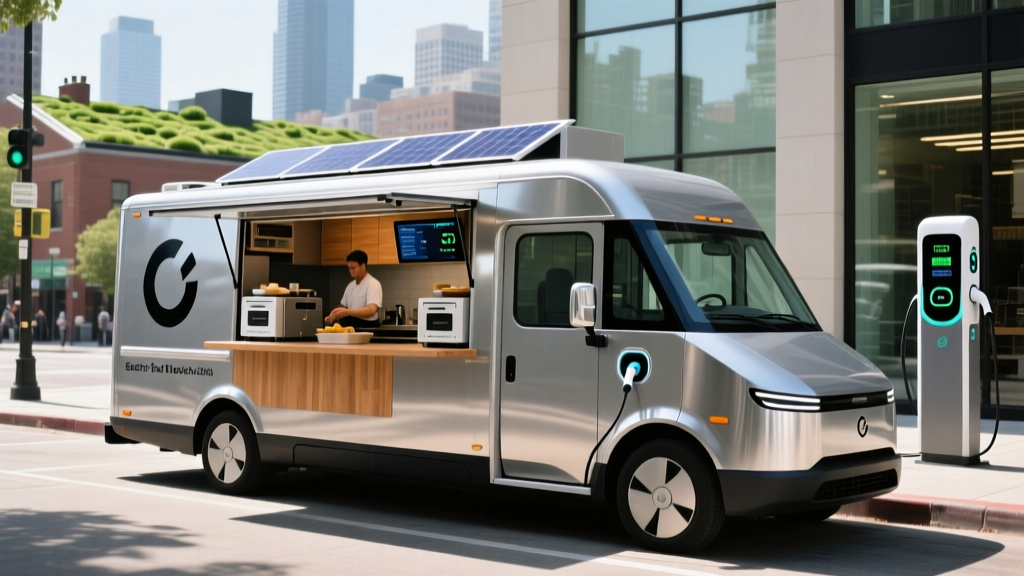
Bottom line: Electric food trucks in 2026 typically cost between $120,000 and $250,000 fully outfitted — roughly 30-50% more than a comparable diesel truck. However, operators recoup that premium within 3-6 years through fuel savings ($8,000-$15,000/year), drastically lower maintenance ($3,000-$5,000/year saved), and access to zero-emission zones in cities like Los Angeles, New York, and San Francisco. Real-world range sits between 80 and 150 miles depending on battery size and cooking load, which covers most urban routes but rules out long-distance catering without route planning.
If you operate in a metro area with predictable daily routes under 100 miles, have access to overnight depot charging, and face tightening local emissions rules, an electric food truck is a sound investment. If you chase festivals across state lines or operate in regions with sparse charging infrastructure, a diesel or hybrid truck remains the pragmatic choice for now.
Electric Food Truck Platforms: What's Available in 2026
The electric commercial vehicle market has matured enough that several chassis platforms now support food truck upfits. Here are the primary options operators are working with:
| Platform | Battery (kWh) | EPA Range (mi) | Real-World Range* | Peak DC Charge (kW) | 10-80% Time | Chassis MSRP (est.) |
|---|---|---|---|---|---|---|
| BrightDrop Zevo 600 | 165 kWh (NMC) | 160 | 110-130 | 120 kW | ~55 min | $110,000-$125,000 |
| Ford E-Transit (Extended) | 68 kWh (NMC) | 126 | 80-100 | 115 kW | ~34 min | $55,000-$65,000 |
| Lightning eMotors (Class 4-5) | 120-200 kWh (LFP) | 130-200 | 90-150 | 80-100 kW | ~60-75 min | $130,000-$180,000 |
| Workhorse E-Gen (custom) | 80-160 kWh | 100-150 | 75-120 | 60-80 kW | ~50-80 min | $100,000-$150,000 |
*Real-world range accounts for cooking equipment draw (electric griddles, fryers, refrigeration pulling 5-15 kW continuous), stop-and-go urban driving, and moderate climate. Cold weather can reduce range an additional 15-25%.
A critical distinction for food truck operators: your battery capacity (kWh) powers both propulsion and cooking. A truck with a 165 kWh battery that draws 10 kW for kitchen equipment loses roughly 1 kWh per mile of driving plus 10 kWh per hour of cooking. Plan your energy budget for both. Most operators find that a dedicated secondary battery bank or shore-power hookup at the event site solves the cooking-draw problem, preserving the traction battery for driving.
Electric vs. Diesel Food Truck: Cost Comparison
The upfront sticker shock of an electric food truck is real. But total cost of ownership tells a different story over a 5-7 year operating window. Here's how the numbers stack up for a typical urban operator driving 12,000 miles/year and operating 250 days/year:
| Cost Category | Electric Food Truck | Diesel Food Truck | Annual EV Savings |
|---|---|---|---|
| Purchase Price (fitted) | $175,000 | $120,000 | -$55,000 upfront |
| Fuel / Energy (per year) | $4,200 (electricity @ $0.14/kWh) | $14,500 (diesel @ $4.20/gal, 8 MPG) | $10,300 |
| Maintenance (per year) | $1,800 | $5,500 | $3,700 |
| Insurance (per year) | $4,500 | $3,800 | -$700 |
| DEF / Fluids (per year) | $0 | $600 | $600 |
| 5-Year Total Operating Cost | $52,500 | $122,000 | $69,500 |
| 5-Year Total w/ Purchase | $227,500 | $242,000 | $14,500 net savings |
The break-even point typically lands between years 3 and 5, depending on local electricity rates, diesel prices, and whether you qualify for commercial EV incentives. The IRS §30D and §45W clean vehicle credits can offset up to $7,500 (light-duty) or $40,000 (commercial heavy-duty, up to 30% of cost) — though eligibility depends on battery sourcing requirements, MSRP caps, and your business tax liability. Consult a tax professional before projecting credit amounts into your business plan.
Additionally, many states and local air-quality districts offer point-of-purchase rebates for commercial EVs. California's Hybrid and Zero-Emission Truck and Bus Voucher Incentive Project (HVIP), for example, has offered vouchers of $20,000-$75,000 for eligible commercial electric vehicles, though funding availability fluctuates.
Charging Infrastructure: What Operators Actually Need
This is where most electric food truck operators hit their first real obstacle. You need a charging strategy that accounts for both the truck's traction battery and your kitchen's energy demands.
Depot Charging (Home Base)
Most food trucks return to a commissary kitchen or depot each night. Installing a Level 2 charger (19.2 kW, 240V/80A) at your base is the minimum viable setup. Here's what that involves:
- Equipment: Commercial-rated Level 2 EVSE — $1,500-$3,500
- Electrical work: 240V/100A circuit, conduit run, panel upgrade if needed — $3,000-$12,000 depending on distance from panel and whether your building needs a service upgrade (200A to 400A)
- Permits and inspection: $200-$800
- Total install: $5,000-$16,000
- Charge time (68 kWh battery): ~4 hours from 10% to full
- Charge time (165 kWh battery): ~9-10 hours from 10% to full (overnight)
Important: kW is the rate of charging (power); kWh is the total energy stored (capacity). A 19.2 kW Level 2 charger delivers 19.2 kWh of energy per hour of charging. A 165 kWh battery needs roughly 8.5 hours at that rate for a full charge — which fits an overnight window perfectly.
On-Route DC Fast Charging
For mid-day top-ups between lunch and dinner service, DC fast chargers add meaningful range quickly. A BrightDrop Zevo 600 at a 120 kW DC charger can recover roughly 60 miles of range in 20 minutes. However, charge curves taper significantly above 80% state of charge — the last 20% can take as long as the first 60%. Plan to charge from 20-80% and move on rather than waiting for a full battery.
Shore Power at Event Sites
Many festival venues and food truck parks now offer 240V/50A shore power hookups ($15-$40/day). This lets you run kitchen equipment off grid power rather than draining your traction battery — a critical operational advantage. Always confirm hookup availability and amperage before booking an event.
Real-World Ownership Considerations
The spec sheet only tells part of the story. Here's what experienced electric food truck operators report after their first year:
Cold Weather Range Loss
Lithium-ion batteries lose efficiency in cold temperatures, and electric food trucks are no exception. Operators in Chicago, Minneapolis, and Denver report 15-25% range reduction when ambient temperatures drop below 30°F. A truck rated for 130 miles may deliver only 100 miles in January. Battery preconditioning (available on most 2025+ platforms) mitigates this by warming the pack before driving, but it draws energy from the battery itself. If you operate in cold climates, spec 20-30% more battery capacity than your route requires.
Cooking Equipment Energy Draw
This is the variable most EV food truck buyers underestimate. Here's typical continuous draw for common kitchen equipment:
- Electric griddle (36"): 9-12 kW
- Electric fryer (single basket): 6-8 kW
- Commercial refrigerator: 0.5-1.5 kW
- Exhaust hood fan: 0.3-0.8 kW
- POS system + lighting: 0.3-0.5 kW
A full electric kitchen running simultaneously can pull 20-25 kW. Over a 4-hour lunch service, that's 80-100 kWh — which could consume more than half of a 165 kWh battery. This is why most successful electric food truck operators either (a) use propane for high-draw cooking appliances and reserve the battery for driving and refrigeration, or (b) require shore power at every event site. Fully electric cooking off the traction battery alone is feasible only with very large battery packs and short driving distances.
Insurance and Registration
Commercial EV insurance premiums run 10-20% higher than diesel equivalents due to higher replacement costs and specialized repair requirements. Budget $4,000-$5,500/year depending on your coverage area and claims history. Some insurers offer green-fleet discounts that partially offset this.
Maintenance Reality
Electric drivetrains eliminate oil changes, fuel filter replacements, DEF fluid, exhaust system repairs, and transmission service. Brake wear drops 50-70% thanks to regenerative braking. The primary maintenance items are tire rotation, cabin air filter, brake fluid checks, coolant system service, and wiper blades. Most operators report annual maintenance costs of $1,500-$2,500 vs. $5,000-$7,000 for diesel. However, battery replacement is the long-tail cost to plan for: a 165 kWh NMC pack replacement in 2026 runs $25,000-$40,000 out of warranty. Most commercial packs carry 8-year/100,000-mile warranties with a capacity retention threshold of 70%, and real-world degradation data suggests most packs retain 85-90% capacity at 100,000 miles.
Common Misconceptions About Electric Food Trucks
| Myth | Fact |
|---|---|
| "Electric food trucks can't power cooking equipment." | They can, but high-draw appliances (griddles, fryers) will deplete the traction battery rapidly. Most operators use propane for cooking and electricity for driving + refrigeration, or rely on shore power at sites. |
| "You'll never make your money back." | At current diesel and electricity prices, most operators break even on the purchase premium within 3-5 years through fuel and maintenance savings, before factoring in incentives. |
| "Range is too limited for food truck routes." | Most urban food truck routes cover 30-70 miles/day. A 130-mile real-world range covers this with margin. Long-distance catering requires planning but is feasible with DC fast-charger stops. |
| "Charging takes too long during service hours." | Most charging happens overnight at depot (8-10 hours). Mid-day DC fast charges of 20-30 minutes can be scheduled during prep or transition between meal services. |
| "The battery will need replacing every few years." | Modern NMC and LFP commercial packs are warrantied for 8 years/100,000 miles and typically retain 85-90% capacity at that point. Full replacement is a year 10+ concern for most operators. |
Decision Framework: Is an Electric Food Truck Right for You?
Choose an electric food truck if:
- Your daily route is under 100 miles in a metro area
- You have (or can install) overnight Level 2 depot charging
- You operate in a city with zero-emission mandates or clean-air zones (LA, NYC, SF, Seattle)
- You can access shore power at your primary event sites
- You plan to keep the truck 5+ years (to recoup the purchase premium)
- You qualify for commercial EV tax credits (§45W, up to $40,000) or state incentives
- You want to market your brand as sustainable and zero-emission
Stick with diesel or consider a hybrid if:
- You regularly drive 150+ miles/day or chase multi-state festival circuits
- Your depot lacks 240V electrical service and upgrading is cost-prohibitive ($15,000+)
- You operate primarily in rural areas with no DC fast-charging infrastructure
- You need maximum cooking power without shore power access
- You plan to sell or replace the truck within 3 years
- Your business doesn't have sufficient tax liability to use federal EV credits
First-Time Buyer Checklist
If you're seriously evaluating an electric food truck, work through this sequence before signing anything:
- Audit your daily route: Track GPS miles for 30 days. Add 25% buffer for cold weather and detours. That's your minimum required real-world range.
- Assess your depot electrical capacity: Have a licensed electrician evaluate whether your building can support a 240V/80-100A circuit. Get a written estimate for any panel upgrade.
- Map your charging options: Identify DC fast chargers along your regular routes using apps like PlugShare or A Better Routeplanner. Note connector types (CCS1 vs. NACS) and peak kW ratings.
- Calculate your energy budget: Add your daily driving kWh (roughly 2-3 kWh/mile for a loaded food truck) to your daily cooking kWh. Confirm your battery size covers both, or plan for propane cooking.
- Verify incentive eligibility: Check IRS.gov for current §45W commercial clean vehicle credit rules, including battery sourcing and domestic assembly requirements. Check your state air-quality district for additional vouchers.
- Request a total-cost-of-ownership projection: Ask the dealer or upfitter for a 5-year TCO comparison specific to your mileage, local utility rate, and maintenance plan. Compare against your current or prospective diesel truck.
- Confirm the upfitter's EV experience: Not all food truck builders understand high-voltage systems. Choose an upfitter with documented electric commercial vehicle builds and proper certification for working around 400V+ battery systems.
Frequently Asked Questions
Can I convert an existing diesel food truck to electric?
Technically yes, but it's rarely cost-effective. EV conversion of a Class 3-5 truck typically costs $80,000-$150,000 for the powertrain swap, battery installation, and engineering certification — often approaching the cost of a purpose-built electric chassis. Conversion also voids the original manufacturer's warranty and may complicate insurance and DOT compliance. Purpose-built platforms like the BrightDrop Zevo or Ford E-Transit are the recommended path.
How long does it take to charge an electric food truck?
On a Level 2 charger (19.2 kW), a 68 kWh battery charges in about 4 hours; a 165 kWh battery takes 9-10 hours. On a DC fast charger (100-120 kW), you can recover 60-80 miles of range in 20-30 minutes (10-80% state of charge). Charging slows significantly above 80% due to battery management system taper — don't plan around charging to 100% on the road.
Do electric food trucks qualify for the $7,500 federal tax credit?
The §30D credit (up to $7,500) applies to light-duty vehicles under 14,000 lbs GVWR purchased for personal use. Most food trucks exceed this weight or are purchased for commercial use. Instead, commercial buyers should look at the §45W Commercial Clean Vehicle Credit, which covers up to 30% of the vehicle cost (max $40,000 for vehicles over 14,000 lbs GVWR). Eligibility depends on battery component sourcing, final assembly in North America, and your business's tax liability. Always verify current rules with a tax professional and IRS.gov.
What happens if the battery degrades and I lose range?
Commercial EV battery warranties typically guarantee 70% capacity retention for 8 years or 100,000 miles. Real-world data from fleet operators suggests most NMC packs retain 85-90% at 100,000 miles, meaning a 130-mile truck might deliver 110-117 miles at that point. LFP (lithium iron phosphate) chemistry, used in some Lightning eMotors platforms, offers even better longevity with 90%+ retention at 200,000+ miles, though at the cost of heavier weight and lower energy density.
Are there any electric food truck-specific insurance providers?
Several commercial insurers now offer EV-specific fleet policies, including Progressive Commercial, Liberty Mutual, and Hartford. Premiums run 10-20% higher than diesel equivalents, but some carriers offer discounts for vehicles with advanced driver-assistance systems (ADAS) like automatic emergency braking and lane-keeping assist. Get quotes from at least three carriers and ask specifically about EV fleet rates.