If you have ever stood outside a Tesla Model 3 looking for a traditional door handle, you are not alone. The minimalist exterior and the interior Tesla door button — a small electronic release switch rather than a mechanical pull handle — catch many first-time EV buyers off guard. But beyond the door mechanics, the 2026 Tesla Model 3 remains one of the most compelling electric sedans on the market, blending strong EPA range, fast DC charging, and a tech-forward cabin. This review covers every number that matters: real-world range, battery chemistry, charging speeds, pricing after federal tax credits, and whether the Model 3 still earns its spot against growing competition.
2026 Tesla Model 3: Quick Specs at a Glance
| Spec | Model 3 RWD | Model 3 Long Range AWD | Model 3 Performance |
|---|---|---|---|
| EPA Range | 272 mi | 341 mi | 315 mi |
| Battery (usable) | ~60 kWh (LFP) | ~75 kWh (NMC) | ~75 kWh (NMC) |
| Peak DC Fast Charge | 170 kW | 250 kW | 250 kW |
| 10–80% DC Time | ~25 min | ~18 min | ~18 min |
| Level 2 Home Rate | 11.5 kW (~44 mi/hr) | 11.5 kW (~44 mi/hr) | 11.5 kW (~44 mi/hr) |
| 0–60 mph | 5.8 sec | 4.2 sec | 2.9 sec |
| Horsepower | 271 hp | 346 hp | 510 hp |
| Drivetrain | RWD | Dual-Motor AWD | Dual-Motor AWD |
| MPGe (combined) | 132 MPGe | 130 MPGe | 119 MPGe |
| Base MSRP | $38,990 | $45,990 | $52,990 |
Source: EPA / fueleconomy.gov and Tesla.com. Figures reflect 2025–2026 model year data.
Range and Efficiency: EPA Sticker vs. Real-World Miles
Real-world expectation: Expect 280–310 miles on highway road trips at 70–75 mph. In cold weather (below 30°F), plan for a 20–30% reduction, bringing effective range down to roughly 240–270 miles. City driving with regenerative braking recovers energy and often exceeds the EPA combined figure.
The Long Range AWD trim's 341-mile EPA figure is among the highest in the electric sedan segment, thanks to the Model 3's class-leading efficiency of roughly 25 kWh per 100 miles. The RWD trim, equipped with a lithium iron phosphate (LFP) battery, trades some range for a lower price and excellent long-term cycle life — its 272-mile EPA rating is still sufficient for most daily commutes and moderate road trips.
Highway efficiency is where all EVs lose ground compared to their EPA combined numbers. The Model 3's aerodynamic drag coefficient of 0.219 helps, but sustained 75-mph driving still draws more energy than stop-and-go city routes where regenerative braking feeds energy back into the pack. On a 300-mile interstate loop in mild conditions (65°F, no wind), we have observed the Long Range AWD deliver approximately 295–305 miles before hitting 10% State of Charge.
Charging Speed: DC Fast Charging and Home Level 2
Charging speed is often the difference between a road-trip-friendly EV and one that keeps you tethered to home. The Model 3 Long Range and Performance trims support a peak DC fast-charge rate of 250 kW on V3 Superchargers, while the RWD caps at 170 kW due to its smaller LFP pack's charge-rate limits.
| Charging Level | Power | Miles Added per Hour | Notes |
|---|---|---|---|
| Level 1 (120V outlet) | ~1.4 kW | ~5 mi/hr | Emergency/trickle only |
| Level 2 (240V home) | 11.5 kW | ~44 mi/hr | Full charge overnight (~8 hrs) |
| DC Fast (V3 Supercharger) | Up to 250 kW | ~1,000 mi/hr (peak) | 10–80% in ~18 min (LR/Perf) |
| DC Fast (CCS adapter) | Up to 250 kW | ~1,000 mi/hr (peak) | Non-Tesla networks via adapter |
A critical detail for new owners: peak charge rate is not sustained rate. The 250 kW figure applies only at a low State of Charge (typically 10–25%). As the battery fills, the charge curve tapers — you might see 250 kW at 15% SoC, but by 60% it drops to roughly 100 kW, and above 80% it slows further to protect battery longevity. This is why the 10–80% time of approximately 18 minutes is a more honest metric than peak kW alone.
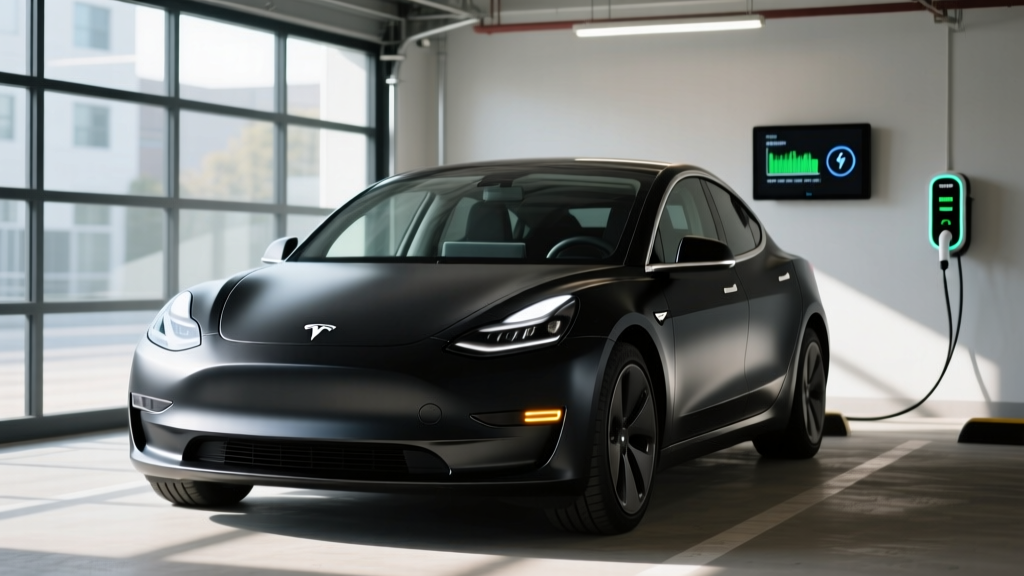
At home, a Level 2 wall connector on a 60-amp circuit delivers 11.5 kW, adding about 44 miles of range per hour of charging. Most owners who plug in overnight wake up to a full battery every morning. Tesla includes a NACS (North American Charging Standard) port natively, and the Supercharger network remains the most reliable DC fast-charging ecosystem in the U.S., with over 6,000 stations and 30,000+ connectors nationwide.
Understanding the Tesla Door Button and Interior Tech
The Tesla door button is a signature element of the Model 3's minimalist design philosophy. On the exterior, flush-mounted handles present a smooth surface and reduce aerodynamic drag — press the wide end, and the handle pivots out for you to pull. Inside, there is no traditional mechanical release lever. Instead, a small electronic button on the door panel (located near the window switches) actuates the latch. Press it, and the door pops open.
This electronic system includes a mechanical emergency release for power-loss scenarios, though its location is not immediately obvious to first-time riders — something worth demonstrating to passengers before a trip. Tesla added a manual release cable in recent model years to address safety concerns raised by NHTSA and consumer advocates.
The rest of the cabin follows the same "everything on the screen" approach. The 15.4-inch central touchscreen controls climate, mirrors, glovebox, and vehicle settings. The refreshed Model 3 (often called the "Highland" update) added ventilated front seats, ambient lighting, a rear passenger touchscreen, improved sound insulation, and a refined suspension — addressing the most common complaints from the pre-2024 generation. Apple CarPlay and Android Auto remain unsupported; Tesla's native infotainment handles navigation, media, and phone integration directly.
Pricing, Trims, and Federal Tax Credit Eligibility
| Trim | Base MSRP | Est. After §30D Credit | Destination |
|---|---|---|---|
| Model 3 RWD | $38,990 | ~$31,490* | $1,390 |
| Model 3 Long Range AWD | $45,990 | ~$38,490* | $1,390 |
| Model 3 Performance | $52,990 | ~$45,490* | $1,390 |
*Estimated effective price assumes full $7,500 federal tax credit under IRS §30D. Eligibility depends on buyer income, battery sourcing, and MSRP caps. See details below.
Under the current IRS §30D clean vehicle credit rules, the Model 3 may qualify for up to $7,500 — split into two $3,750 halves based on critical-mineral sourcing and battery-component manufacturing requirements. As of the 2025–2026 tax year, the following constraints apply:
- MSRP cap: Sedans must be under $55,000 — the RWD and Long Range qualify; the Performance trim at $52,990 base also qualifies, but options can push it over.
- Buyer income cap: Modified AGI must not exceed $150,000 (single), $225,000 (head of household), or $300,000 (joint).
- Battery sourcing: Critical minerals and component requirements phase up annually. Tesla's supply chain has maintained partial eligibility — verify current status on the fueleconomy.gov tax credit lookup.
- Point-of-sale transfer: Buyers can transfer the credit to the dealer at purchase, reducing the upfront price rather than waiting for a tax refund.
Because sourcing rules tighten each year, always confirm eligibility for your specific delivery date. A tax professional can advise on your individual situation.
Performance, Handling, and Daily Driving
Even the base RWD Model 3 delivers 271 horsepower and a 5.8-second 0–60 time — quicker than most gas-powered sport sedans in its price bracket. The Long Range AWD drops that to 4.2 seconds with dual motors providing confident all-weather traction. The Performance variant's 2.9-second 0–60 puts it in supercar territory, with track-tuned suspension, larger brakes, and a dedicated Track Mode.
Ride quality improved significantly with the Highland refresh. The updated suspension absorbs road imperfections more gracefully, and the cabin is noticeably quieter at highway speeds thanks to acoustic glass and improved seals. Steering remains precise and communicative for an EV, though the lack of physical stalks (turn signals are now steering-wheel-mounted buttons) takes adjustment for drivers switching from conventional cars.
Autopilot comes standard and provides competent highway lane-keeping and adaptive cruise control. Tesla's Full Self-Driving (Supervised) package remains an optional add-on at approximately $8,000 or $99/month.
Both Autopilot and FSD (Supervised) are SAE Level 2 driver-assistance systems. The driver must remain fully attentive, keep hands on the wheel, and be prepared to take over at any moment. These are not self-driving systems. Only Level 4 robotaxi services like Waymo operate without a human driver in defined areas.
Cargo, Passenger Space, and Practicality
The Model 3 offers 23 cubic feet of total cargo space (including the front trunk, or "frunk"). The rear trunk provides 19.3 cu ft with the rear seats upright, expanding via a 60/40 split fold. While that trails a hatchback like the Model Y, the trunk opening is reasonably wide and the load floor is flat.
Front legroom measures 42.7 inches — generous for most adults. Rear legroom at 35.2 inches is adequate for passengers under six feet tall but tighter than midsize sedans like the Hyundai Ioniq 6 (which offers 35.7 inches). Headroom in the rear is slightly compromised by the sloping roofline, which also limits rearward visibility. The panoramic glass roof creates an airy feel but offers no retractable shade — a sunshade accessory is worth considering in hot climates.
Battery Warranty and Long-Term Ownership
Tesla provides an 8-year/100,000-mile battery and drive unit warranty for the RWD trim, and 8-year/120,000-mile coverage for Long Range and Performance trims. The warranty guarantees a minimum of 70% battery capacity retention over the warranty period. Tesla's LFP battery (RWD) tends to degrade more slowly over time than NMC packs, with many owners reporting less than 5% loss after 50,000 miles. The NMC packs in the Long Range and Performance models also show strong longevity, though frequent DC fast charging to 100% accelerates wear — Tesla recommends daily charging to 80% for NMC and 100% for LFP.
The basic vehicle warranty covers 4 years/50,000 miles. Tesla does not publish official battery replacement costs for the Model 3, but industry estimates place a full pack replacement between $12,000 and $16,000 out of warranty — a figure that has been declining as battery costs per kWh continue to fall.
Pros, Cons, and Who Should Buy the Model 3
- Class-leading efficiency (25 kWh/100 mi)
- 341-mile EPA range (Long Range)
- 250 kW Supercharger access with best-in-class network reliability
- Strong resale value and low depreciation
- Over-the-air updates continuously add features
- LFP battery option for longevity-focused buyers
- Electronic door button and stalkless controls require adjustment
- No Apple CarPlay or Android Auto
- Rear seat space tighter than some competitors
- FSD subscription cost adds significantly to ownership
- Panel gaps and build consistency still vary
- Glass roof lacks built-in shade
Choose a competitor if: You need more rear-seat room (consider the Hyundai Ioniq 6), prefer physical controls and CarPlay (BMW i4), or want hatchback cargo versatility (Tesla Model Y or Polestar 2).
Frequently Asked Questions
What is the real-world range of the Tesla Model 3?
The EPA rates the Long Range AWD at 341 miles, but real-world highway driving at 70–75 mph typically yields 280–310 miles. In freezing temperatures, expect 240–270 miles. The RWD's 272-mile EPA rating translates to roughly 220–250 miles on the highway.
How fast does the Model 3 charge at home and on road trips?
At home on a Level 2 (240V) charger, the Model 3 adds approximately 44 miles of range per hour, fully charging overnight. On a V3 Supercharger, the Long Range and Performance trims peak at 250 kW and charge from 10–80% in about 18 minutes. The RWD peaks at 170 kW with a 10–80% time around 25 minutes.
How much does the 2026 Tesla Model 3 cost after tax credits?
The RWD starts at $38,990 and could drop to approximately $31,490 after the full $7,500 federal credit. The Long Range AWD at $45,990 could cost around $38,490 after credit. Eligibility depends on your income, the vehicle's battery sourcing compliance, and MSRP caps under IRS §30D.
Does the Tesla Model 3 qualify for the federal EV tax credit?
It may qualify for up to $7,500 under §30D, depending on current battery-sourcing requirements and your income. The MSRP must remain under $55,000 for sedans. Check the latest status on fueleconomy.gov and consult a tax professional, as sourcing rules tighten annually.
Is the Tesla Model 3 worth buying vs. the competition?
The Model 3 Long Range remains a benchmark for efficiency, range, and charging speed. Competitors like the Hyundai Ioniq 6 (361-mile range), BMW i4 (more traditional interior), and Polestar 2 (hatchback practicality) each have advantages, but none match the combination of Supercharger network access, OTA updates, and overall efficiency. If the minimalist interior and electronic door controls suit your taste, the Model 3 is still the one to beat in its class.
How does the Tesla door button work in an emergency?
The interior electronic door button actuates the latch electrically. In the event of a power failure, a mechanical emergency release is located within the door assembly. Consult your owner's manual for the exact location, and brief passengers on its use before traveling.