The Quick Answer
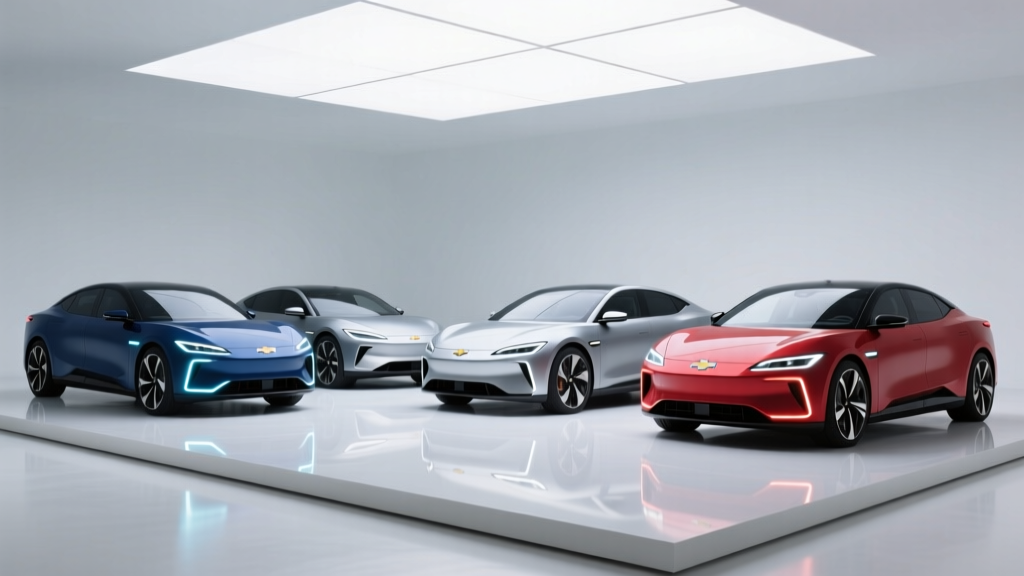
Chevrolet's 2026 electric vehicle lineup spans three models: the Equinox EV (EPA range up to 319 miles, starting around $33,600), the Blazer EV (up to 324 miles, starting near $44,600), and the Silverado EV (up to 492 miles, starting around $57,800 for fleet-oriented WT trims). All three ride on GM's Ultium battery platform and support DC fast charging from 150 kW to 350 kW depending on model and trim. Federal tax credit eligibility under IRS §30D varies by model, trim, battery sourcing, and your personal income — verify current-year rules at irs.gov before assuming a flat $7,500 discount. For most buyers, the Equinox EV 2LT with the larger battery is the value sweet spot, offering over 300 miles of EPA range for under $40,000 before incentives.
2026 Chevy Electric Vehicle Lineup at a Glance
Chevrolet has consolidated its EV offerings around three Ultium-based nameplates for 2026. The discontinued Bolt EV and EUV are no longer in production (a next-generation Bolt on the Ultium platform has been announced but is not yet available). Here's how the current three-stack up in hard numbers:
| Spec | Equinox EV | Blazer EV | Silverado EV |
|---|---|---|---|
| EPA Range (max) | 319 mi (3LT, FWD) | 324 mi (RS, RWD) | 492 mi (4WT, Max Range) |
| Battery (usable, est.) | ~85 kWh (NMC) | ~102 kWh (NMC) | ~200 kWh (NMC, Max Range) |
| Peak DC Fast Charge | 150 kW | 190 kW | 350 kW (4WT/5WT) |
| 10–80% DC Charge Time | ~32 min | ~28 min | ~20 min (est.) |
| Level 2 (240V) Rate | 11.5 kW | 11.5 kW | 19.2 kW (available) |
| 0–60 mph | ~8.0 sec (FWD) | ~4.0 sec (SS AWD) | ~4.5 sec (4WT AWD) |
| Horsepower | 213 hp (FWD) | 557 hp (SS AWD) | 664 hp (4WT AWD) |
| Starting MSRP | ~$33,600 | ~$44,600 | ~$57,800 (WT) |
| Battery Warranty | 8 yr / 100,000 mi | 8 yr / 100,000 mi | 8 yr / 100,000 mi |
Sources: fueleconomy.gov, Chevrolet official specifications. Ranges reflect highest-EPA-rated trim per model. Real-world highway and cold-weather results will be lower — see ownership section below.
Equinox EV: The Budget-Conscious Daily Driver
The Equinox EV fills the role the Bolt once held — an accessible, practical crossover for commuting and errands. The 2LT trim with the larger battery and front-wheel drive delivers the best efficiency in the lineup, achieving roughly 3.3–3.5 kWh/mile in mixed driving per EPA data. That translates to about 110–120 MPGe combined.
Charging at 150 kW peak is adequate but not class-leading. The charge curve tapers meaningfully above 80% state of charge (SoC), so plan to charge from 10–80% rather than topping to full at a DC station. At home on a Level 2 charger (11.5 kW), a full recharge from near-empty takes roughly 8.5 hours — easily accomplished overnight.
Blazer EV: Performance Meets Practicality
The Blazer EV targets buyers who want crossover space with genuine performance credentials. The SS trim with dual-motor AWD produces 557 hp and hits 60 mph in roughly 4 seconds — territory that would have been exotic a decade ago. The more mainstream RS and 2LT trims with rear-wheel drive prioritize range, hitting up to 324 miles EPA.
At 190 kW peak DC charging, the Blazer EV adds roughly 78 miles of range in 10 minutes under ideal conditions (low SoC, warm battery, functioning preconditioning). The 19.2 kW Level 2 option available on higher trims cuts home recharge times to about 5.5 hours from empty — useful if your daily driving exceeds 80 miles and you want faster turnaround.
The Blazer EV competes most directly with the Hyundai Ioniq 5, Ford Mustang Mach-E, and Tesla Model Y. Its advantage is interior space and a more traditional crossover silhouette; its disadvantage is a higher starting price and slightly slower peak charging than the Ioniq 5's 800V architecture (which peaks above 230 kW).
Silverado EV: Electric Truck Capability
The Silverado EV is GM's answer to the Ford F-150 Lightning and Rivian R1T, and it leads on paper with a 492-mile EPA range on the 4WT Max Range trim — the longest of any production electric pickup as of early 2026. That figure comes from a massive ~200 kWh usable battery pack, which also makes the truck heavy (over 9,000 lbs curb weight for some trims).
The Silverado EV's 350 kW peak charging capability is among the fastest in any production vehicle, but sustaining that rate requires a compatible 350+ kW CCS or NACS station and optimal battery temperature. In practice, expect 10–80% in roughly 20 minutes at a high-power Electrify America or Tesla Supercharger (with NACS adapter, now standard on newer GM EVs). The available 19.2 kW Level 2 onboard charger means a full home recharge still takes about 10–11 hours for the Max Range pack.
EV vs. Gas vs. Hybrid: Cost Comparison
The decision between a Chevy EV, a comparable gas Chevrolet (like the Equinox or Blazer ICE), or a hybrid (such as the Equinox Hybrid) hinges on your driving volume, electricity cost, and how long you plan to keep the vehicle. Here's a five-year comparison for a driver covering 15,000 miles annually:
| Cost Factor (5 Years) | Equinox EV 2LT | Equinox Gas (1.5T AWD) | Equinox Hybrid (est.) |
|---|---|---|---|
| Purchase Price (MSRP) | $39,400 | $32,500 | $35,000 |
| Federal Tax Credit (§30D) | Up to $7,500* | $0 | $0 (HEV) |
| Effective Purchase Price | $31,900 | $32,500 | $35,000 |
| Fuel/Energy (75,000 mi) | $3,750 (home, $0.14/kWh) | $9,375 (gas, $3.50/gal, 28 MPG) | $6,250 (gas, $3.50/gal, 42 MPG) |
| Maintenance (5 yr est.) | $1,200 | $3,500 | $2,800 |
| Insurance (5 yr est.) | $9,500 | $7,500 | $8,000 |
| Total 5-Year Cost | $46,350 | $52,875 | $52,050 |
*Federal tax credit eligibility depends on your adjusted gross income (≤$150K single / ≤$300K joint), vehicle MSRP caps (≤$55,000 for SUVs), battery critical-mineral and component sourcing requirements, and point-of-sale transfer rules. Verify at irs.gov and consult a tax professional. Credit amounts and eligibility rules are subject to legislative change.
Key takeaway: the EV wins on total cost primarily through energy and maintenance savings, but only if you can charge at home at residential electricity rates. Public DC fast charging at $0.35–$0.55/kWh narrows the gap significantly, and insurance premiums for EVs remain 15–25% higher on average due to repair costs and battery replacement exposure.
Real-World Ownership: What First-Time Chevy EV Buyers Need to Know
Home Charging Is Non-Negotiable for Most Owners
Over 80% of EV charging happens at home. If you have a garage or driveway with access to a 240V outlet (or can install one), a Chevy EV is a practical daily driver. A Level 2 home charger installation typically costs $800–$2,500 depending on your electrical panel capacity, distance from panel to garage, and local permitting. If your home has a 200-amp panel with spare capacity, expect the lower end. If you need a panel upgrade to 200A, add $1,500–$3,000.
If you live in an apartment, rely on street parking, or cannot install a home charger, EV ownership becomes significantly more challenging. Public charging infrastructure has expanded — GM's Ultium vehicles can access Tesla Superchargers via the NACS port (standard on 2026 models) — but relying exclusively on public charging adds cost ($0.30–$0.55/kWh vs. $0.10–$0.18/kWh at home) and time.
Climate Matters More Than You Think
NMC battery chemistry, which all three Chevy EVs use, performs well in moderate climates but loses 15–30% of usable range in sustained sub-30°F temperatures. This isn't a defect — it's electrochemistry. Cold slows lithium-ion diffusion, and cabin heating (even with the available heat pump on higher trims) draws 3–6 kW continuously. If you live in Minnesota, Maine, or the Mountain West, budget for winter range loss and prioritize the longest-range trim available.
Preconditioning Is Your Fast-Charging Secret
GM's Ultium platform includes battery preconditioning for DC fast charging — but only when you navigate to a charging station using the built-in infotainment navigation. If you just drive to a charger without routing through the nav system, the battery may arrive cold and accept significantly less than peak kW. Always route through the vehicle's navigation to a DC station to activate preconditioning and achieve advertised charge speeds.
Common Misconceptions About Chevy EVs
| Myth | Fact |
|---|---|
| "The battery will need replacing in 5 years and cost $20,000." | GM warranties the Ultium battery for 8 years/100,000 miles against defects and excessive degradation (below 70% capacity retention). Industry data from Recurrent Auto shows most EV batteries lose only 10–15% capacity over 100,000+ miles. Replacement is rare and typically covered under warranty during the coverage period. |
| "You can't road-trip an EV." | With 300+ miles of range and access to Tesla Superchargers (via NACS), DC fast charging, and Electrify America stations, road trips are viable — they just require planning. Expect 20–30 minutes of charging every 200–250 miles on the highway. Apps like A Better Routeplanner and PlugShare make this straightforward. |
| "Every Chevy EV qualifies for the full $7,500 tax credit." | Eligibility under IRS §30D depends on battery sourcing (critical minerals and components must meet phased-in domestic/content thresholds), your income level, the vehicle's MSRP, and whether you purchase new (not lease, which falls under §45W commercial credit). The credit can be transferred to the dealer at point of sale for an immediate price reduction, but only if all criteria are met. Check the latest qualified vehicle list at fueleconomy.gov. |
| "EVs are worse for the environment because of electricity generation." | Even on coal-heavy grids, EVs produce fewer lifecycle emissions than comparable gas cars over their operational life, per Argonne National Laboratory and EPA analysis. On grids with significant renewables (which most US grids are shifting toward), the advantage widens substantially. The upstream emissions argument doesn't hold against real lifecycle data. |
| "Charging takes too long." | Home Level 2 charging happens while you sleep — 8 hours adds 200–300 miles, more than most people drive in a week. Road-trip DC fast charging adds 150–250 miles in 20–30 minutes. The only scenario where charging time is a genuine friction point is apartment living without home charger access. |
Decision Framework: Which Chevy EV Is Right for You?
If-Then Buying Guide
- Choose the Equinox EV if: Your budget is under $42,000, you commute 30–80 miles daily, you have home charging access, and you don't need to tow. The 3LT with FWD gives you the best range-per-dollar ratio in the Chevy lineup.
- Choose the Blazer EV if: You want more interior space and performance than the Equinox, you're cross-shopping the Model Y or Ioniq 5, and you're willing to pay $44,000–$58,000 depending on trim. The RS with RWD maximizes range; the SS is for driving enthusiasts who accept a range trade-off (~280 miles EPA).
- Choose the Silverado EV if: You need a full-size pickup for work or recreation, you tow occasionally (not daily long-haul), you value the 492-mile range for job-site commuting without charging stops, and your budget exceeds $57,000. The WT trims target fleet/commercial buyers; the RST and LT trims add consumer-oriented features at higher prices.
- Choose a gas or hybrid Chevy instead if: You cannot install a home charger, you regularly tow over 7,000 lbs for long distances, you live in an area with sparse public charging infrastructure, or your daily driving exceeds 250 miles with no time for charging stops. The Equinox Hybrid (42 MPG) is a strong bridge option if you want fuel savings without charging dependence.
Frequently Asked Questions
Does the Chevy Bolt EV still exist in 2026?
No. Chevrolet discontinued the Bolt EV and Bolt EUV after the 2023 model year. A next-generation Bolt based on the Ultium platform has been announced by GM but is not yet available for purchase as of early 2026. The Equinox EV effectively replaces the Bolt in Chevy's lineup at a slightly higher price point but with significantly more range, faster charging, and modern architecture.
Can I use Tesla Superchargers with a Chevy EV?
Yes. Starting with 2025 model-year vehicles, GM EVs are equipped with the North American Charging Standard (NACS) port natively, granting direct access to Tesla's Supercharger network without an adapter. This adds over 20,000 additional fast-charging stalls to the networks available to Chevy EV owners. Older 2024 GM EVs with CCS ports can use a GM-approved NACS adapter.
What does the battery warranty actually cover?
GM's Ultium battery warranty covers 8 years or 100,000 miles (whichever comes first) against defects in materials or workmanship and against capacity loss below a defined threshold — typically 70% of original capacity. If your battery degrades to below 70% within the warranty period, GM will repair or replace it. Normal degradation above that threshold is not covered. This warranty is consistent with industry standards from Ford, Hyundai, and Tesla.
How much does it cost to charge a Chevy EV at home?
At the US average residential electricity rate of roughly $0.16/kWh (varies widely by state — check your utility bill), fully charging the Equinox EV's ~85 kWh battery costs about $13.60. That delivers roughly 280–300 real-world miles, or about $0.045–$0.05 per mile. Compare that to a gas Equinox at 28 MPG and $3.50/gallon: $0.125 per mile. Home charging saves roughly $0.07–$0.08 per mile, or $1,050–$1,200 annually at 15,000 miles/year.
Is the Silverado EV practical for daily driving?
For commuting and daily errands, yes — especially if you charge at home. The 492-mile range means most owners will charge once or twice a week, not daily. The challenge is size: at over 233 inches long, the Silverado EV won't fit in compact urban garages or tight parking spaces. If you have the space and the charging access, it's a capable daily driver that eliminates fuel stops for regular use.
What's the difference between kW and kWh?
This is the most common point of confusion for new EV buyers. kW (kilowatts) measures power — the rate of energy flow, like the size of a water hose. Your charger's kW rating (e.g., 150 kW DC fast charger) tells you how fast energy can flow into the battery. kWh (kilowatt-hours) measures energy — the total amount stored, like the size of a water tank. Your battery's kWh rating (e.g., 85 kWh) tells you how much energy it holds. More kWh = more range. Higher kW = faster charging. They are not interchangeable.