Quick Answer: Ford Hands-Free Driving for 2028 EV Buyers
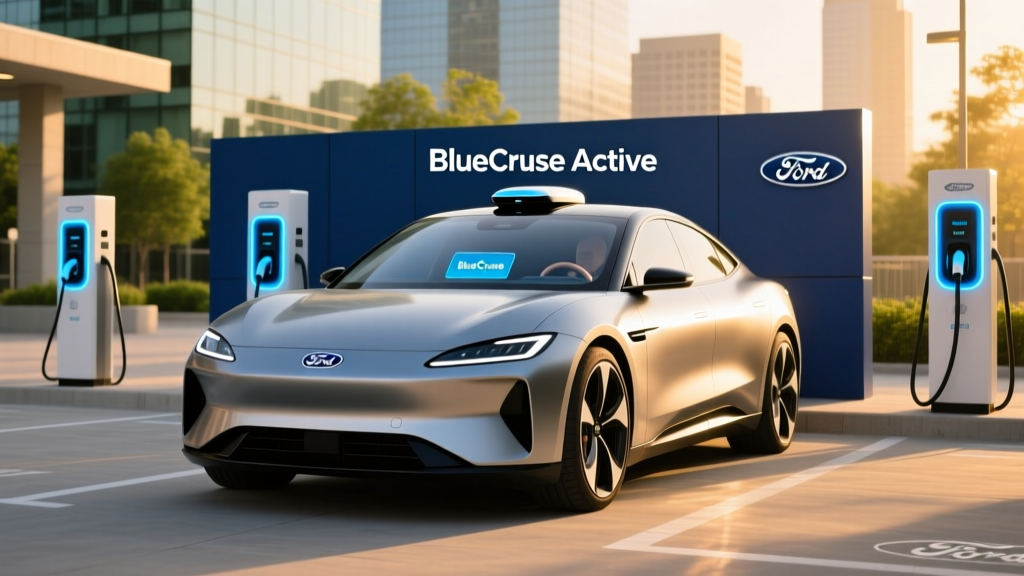
Ford's hands-free driving system, BlueCruise, is available on the 2026 Mustang Mach-E and F-150 Lightning and is expected to carry forward into 2028 EV models. It is an SAE Level 2 driver-assistance system — not self-driving. You must remain attentive, eyes on the road, and ready to take over instantly. BlueCruise costs $2,100 upfront (as part of a package) or roughly $75/month via subscription after an initial trial. For 2028 Ford EVs, expect expanded hands-free highway coverage beyond the current 130,000+ miles of qualified divided highways, but the fundamental requirement for driver supervision will not change.
What Is Ford BlueCruise and How Does It Actually Work?
BlueCruise is Ford's hands-free advanced driver-assistance system (ADAS). It combines adaptive cruise control with lane-centering steering on pre-mapped, qualified divided highways. A driver-facing infrared camera monitors your eye gaze to confirm attentiveness. If the system detects you're not watching the road, it issues escalating alerts and will eventually bring the vehicle to a controlled stop.
SAE Level 2 — Not Self-Driving
BlueCruise operates at SAE Level 2 automation. The vehicle controls steering and speed under specific conditions, but the driver is fully responsible for the vehicle at all times. This is the same automation tier as Tesla Autopilot, GM Super Cruise, and Hyundai Highway Driving Assist. Only fully driverless robotaxi services like Waymo operate at Level 4. Do not nap, phone-scroll, or assume the car will handle unexpected construction zones, stopped emergency vehicles, or unmapped roads.
As of mid-2026, BlueCruise 1.4 (the latest generation) supports hands-free driving on over 130,000 miles of qualified divided highways across the U.S. and Canada, adds lane-change assist (the car changes lanes when you tap the turn signal), and offers hands-free parallel parking in select scenarios. Ford has confirmed that future 2028 EV models — likely including next-generation versions of the Mach-E, F-150 Lightning, and potentially new entries from its expanded EV lineup — will ship with an evolved BlueCruise iteration, though final 2028 specs remain preliminary and unannounced.
2028 Ford EV Outlook: Expected Models and BlueCruise Integration
Ford's EV roadmap through 2028 includes several known and anticipated models. Here is what we know based on current production and confirmed plans:
| Model | Status (2026) | Expected 2028 Availability | BlueCruise Expected | EPA Range (Current Gen) |
|---|---|---|---|---|
| Mustang Mach-E | In production | Likely refreshed/next-gen | Yes (standard on upper trims) | 250–320 mi |
| F-150 Lightning | In production | Likely refreshed | Yes (Lariat and above) | 240–320 mi |
| Ford Explorer EV (NA) | Announced for NA market | Expected by 2027–2028 | Likely | TBD (est. 280–310 mi) |
| Next-Gen Midsize Crossover | Teased/confirmed | 2027–2028 | Likely | TBD |
Note: 2028 model-year specs are preliminary. EPA range, pricing, and BlueCruise feature sets will be confirmed closer to launch. Source: Ford Media Center.
The key ownership question is not whether BlueCruise will exist on 2028 Fords — it will — but whether its subscription model, coverage area, and real-world reliability justify the cost for your driving patterns.
Real Costs: BlueCruise, EV Ownership, and What You'll Actually Spend
Buying a Ford EV with hands-free driving involves layered costs beyond the sticker price. Here is a realistic breakdown using the 2026 Mustang Mach-E Premium as a baseline (expect 2028 pricing to be similar or slightly higher, adjusted for inflation and battery-cost trends).
| Cost Category | Ford Mach-E Premium (EV) | Ford Edge (Gas Baseline) |
|---|---|---|
| Base MSRP | $44,995 | $41,295 |
| BlueCruise Package (upfront) | +$2,100 (included in some trims) | N/A (no equivalent) |
| BlueCruise Subscription (after trial) | ~$75/month or $800/year | $0 |
| Federal §30D Tax Credit (if eligible) | Up to $3,750–$7,500 (see IRS rules) | $0 |
| Annual Fuel/Energy Cost (15,000 mi/yr) | ~$550–$800 (home charging) | ~$1,800–$2,200 (gas at $3.40/gal) |
| Annual Maintenance | ~$300–$400 | ~$900–$1,200 |
| Annual Insurance (avg.) | ~$2,100–$2,600 | ~$1,600–$2,000 |
| Estimated 5-Year Total Cost | ~$52,000–$58,000 (after credit) | ~$61,000–$67,000 |
Sources: fueleconomy.gov, IRS §30D guidelines. Insurance estimates via industry averages; actual premiums vary by state, driver profile, and carrier.
BlueCruise Pricing: Upfront vs. Subscription
Ford currently offers BlueCruise two ways:
- Included with purchase: On higher trims (Mach-E GT, F-150 Lightning Platinum), BlueCruise hardware is bundled, and you receive a complimentary trial period (typically 90 days to 1 year depending on model year).
- Subscription after trial: Approximately $75/month or $800/year. Ford has also offered a $2,100 one-time purchase option on some model years, effectively giving you lifetime access. For 2028 models, expect Ford to continue this hybrid pricing approach, though exact amounts are unconfirmed.
For a buyer who drives 20,000+ highway miles per year on qualified BlueCruise routes, the subscription pays for itself in reduced fatigue. For someone who drives primarily in urban or unmapped areas, BlueCruise's hands-free feature activates rarely — making it a poor value.
EV vs. Gas: How Does a Ford EV with BlueCruise Compare?
The hands-free driving feature doesn't change the fundamental EV-vs-gas equation — that comes down to energy costs, maintenance, and driving patterns. But it does add a technology premium that gas competitors (like Toyota's RAV4 with Toyota Safety Sense or Honda's CR-V with Honda Sensing) don't carry.
| Factor | Ford EV (Mach-E/Lightning) | Comparable Gas Vehicle |
|---|---|---|
| Energy cost per mile | $0.04–$0.06 (home L2) | $0.12–$0.16 (gasoline) |
| Energy cost per mile (public DCFC) | $0.10–$0.18 | $0.12–$0.16 |
| Maintenance intervals | Tires, cabin filter, wiper fluid | Oil, filters, spark plugs, brakes, transmission fluid |
| Brake wear | Minimal (regen braking) | Normal replacement every 30–50k mi |
| Hands-free highway driving | BlueCruise (SAE L2, 130k+ mi mapped) | Adaptive cruise + lane-keep (hands-on required) |
| Cold-weather range impact | -20% to -35% at 20°F | Minimal (slight MPG drop) |
| Long road-trip refueling | 20–35 min per DCFC stop | 5 min per gas stop |
| Home "refueling" convenience | Wake up to a full battery daily | Must visit gas station |
Real-World Ownership: What First-Time Ford EV Buyers Must Know
If you're considering a 2028 Ford EV with BlueCruise, these are the practical realities that spec sheets don't convey:
Home Charging Is the Make-or-Break Factor
The economics in the cost table above assume predominant home Level 2 charging (240V, 32–48A). A home Level 2 installation typically costs:
- Charger hardware: $400–$700 (Ford Connected Charge Station or third-party like ChargePoint Home Flex or Emporia Level 2)
- Electrician labor + permit: $800–$2,500 (varies by panel proximity and local code)
- Electrical panel upgrade (if needed): $1,500–$3,500 (older homes with 100A service may need 200A)
- Total typical install: $1,200–$3,200 without panel upgrade; $3,000–$6,000 with upgrade
If you live in an apartment, condo, or street-parking situation without reliable home or workplace charging, an EV's per-mile cost advantage shrinks significantly because you'll rely on public DC fast chargers at $0.30–$0.50/kWh — often comparable to or exceeding gasoline cost per mile.
Cold Weather Cuts Range — Plan for It
Ford's EVs use liquid-cooled NMC (nickel manganese cobalt) battery packs. In sustained sub-freezing temperatures (below 32°F / 0°C), expect 20–35% range reduction compared to the EPA sticker. A Mach-E with an EPA-estimated 312 miles may deliver 200–250 miles in January in Minnesota. The F-150 Lightning (EPA 320 mi extended range) may drop to 210–260 miles under the same conditions. Ford's heat pump (standard on recent Mach-E models) mitigates this somewhat but doesn't eliminate it.
BlueCruise Coverage: Where It Works and Where It Doesn't
BlueCruise activates only on pre-mapped, qualified divided highways. As of 2026, that includes most major interstates but excludes:
- Two-lane undivided highways
- Most state routes and local roads
- Construction zones (the system may disengage abruptly)
- Unmapped new highway segments
If your commute is primarily on I-95, I-5, or I-80, BlueCruise will activate frequently. If you drive rural routes or surface streets, you'll use standard adaptive cruise with hands-on-wheel — making the BlueCruise premium harder to justify.
| Common Misconception | Fact |
|---|---|
| "BlueCruise is self-driving" | It is SAE Level 2. You must remain attentive and ready to take over at any moment. The driver-facing camera enforces this. |
| "EVs are always cheaper to own" | EVs save on fuel and maintenance, but higher insurance premiums, upfront cost, and home-charging installation can offset savings — especially for low-mileage drivers. |
| "I'll get the full $7,500 tax credit" | The §30D credit depends on your income (AGI caps: $150k single, $300k joint), the vehicle's MSRP (cap: $55k cars, $80k SUVs/trucks), battery critical-mineral sourcing, and North American assembly. Many buyers qualify for partial or zero credit. Check IRS rules before counting on it. |
| "Public charging is as cheap as home charging" | Public DC fast chargers average $0.30–$0.50/kWh — 3–5× the cost of home Level 2 charging at $0.08–$0.14/kWh (national avg. residential rate). |
| "The battery will need replacing in 5 years" | Ford's EV battery warranty covers 8 years/100,000 miles against defects and capacity loss below 70%. Real-world NMC degradation data shows most packs retain 85–92% capacity at 100k miles. Replacement, if ever needed, currently runs $12,000–$18,000 but is rarely required within the vehicle's normal lifespan. |
Decision Framework: Should You Buy a Ford EV with BlueCruise for 2028?
Choose a Ford EV with BlueCruise if:
- You have reliable home or workplace Level 2 charging (or can install it for under $3,000)
- You drive 15,000+ miles/year, with a significant portion on mapped divided highways
- You value reduced highway fatigue on long commutes or frequent road trips
- You qualify for at least a partial §30D tax credit (check income and MSRP caps)
- You live in a moderate climate or accept cold-weather range reduction as a trade-off
Reconsider or choose a hybrid (PHEV) instead if:
- You lack home charging access and public charging infrastructure is sparse in your area
- You drive fewer than 10,000 miles/year — fuel savings won't offset the EV price premium
- Your routes are primarily rural, undivided, or unmapped roads where BlueCruise won't activate
- You regularly tow heavy loads in cold weather (EV range drops dramatically under combined load + cold)
- Your budget doesn't absorb the $2,100+ BlueCruise premium plus potential subscription fees on top of a higher base MSRP
FAQ: Ford Hands-Free Driving and 2028 EV Ownership
Will BlueCruise be standard on all 2028 Ford EVs?
Based on Ford's current strategy, BlueCruise hardware will likely be standard on mid-to-upper trims (Premium, GT, Platinum) but may be optional or unavailable on base trims. A subscription or one-time purchase will still be required to activate hands-free functionality after any included trial period. Final 2028 trim-level details are unconfirmed.
Can BlueCruise handle city streets and stop-and-go traffic?
BlueCruise's hands-free mode activates only on qualified divided highways. In city driving, the Mach-E and Lightning offer standard adaptive cruise control with stop-and-go and lane-centering, but you must keep your hands on the wheel. It is not a hands-free system in urban environments.
How does BlueCruise compare to GM Super Cruise and Tesla Autopilot?
All three are SAE Level 2 systems. Super Cruise (GM) covers 750,000+ miles of mapped roads — significantly more than BlueCruise's 130,000+ miles. Tesla Autopilot/FSD (Supervised) operates on virtually any road but requires hands-on-wheel (no hands-free on any road, despite the "Full Self-Driving" name). BlueCruise's advantage is its hands-free capability on highways; Super Cruise offers broader coverage; Tesla offers the broadest road coverage but no hands-free mode. None are self-driving.
What happens if I stop paying the BlueCruise subscription?
If you cancel the subscription, hands-free mode deactivates. You retain standard adaptive cruise control, lane-centering, and all other ADAS features — but the system will require hands on the steering wheel at all times, even on qualified highways. The hardware remains in the vehicle; only the hands-free software feature is subscription-gated.
Is the Ford EV battery warranty adequate for long-term ownership?
Ford covers its EV battery packs for 8 years or 100,000 miles (whichever comes first) against defects and capacity loss below 70% of original capacity. This is in line with industry standards (Hyundai offers 10yr/100k, Tesla offers 8yr/100k–120k depending on model). For most owners driving 12,000–15,000 miles/year, the battery will outlast the vehicle's practical ownership period with 85%+ capacity remaining.
Do I need a panel upgrade to charge a Ford EV at home?
Possibly. The Ford Connected Charge Station draws up to 48A (11.5 kW) on a 60A circuit. If your home has a 200A electrical panel with available capacity, you likely won't need an upgrade. Homes with 100A service or panels near capacity may require a $1,500–$3,500 upgrade. Always get a load calculation from a licensed electrician before committing to a charger install.