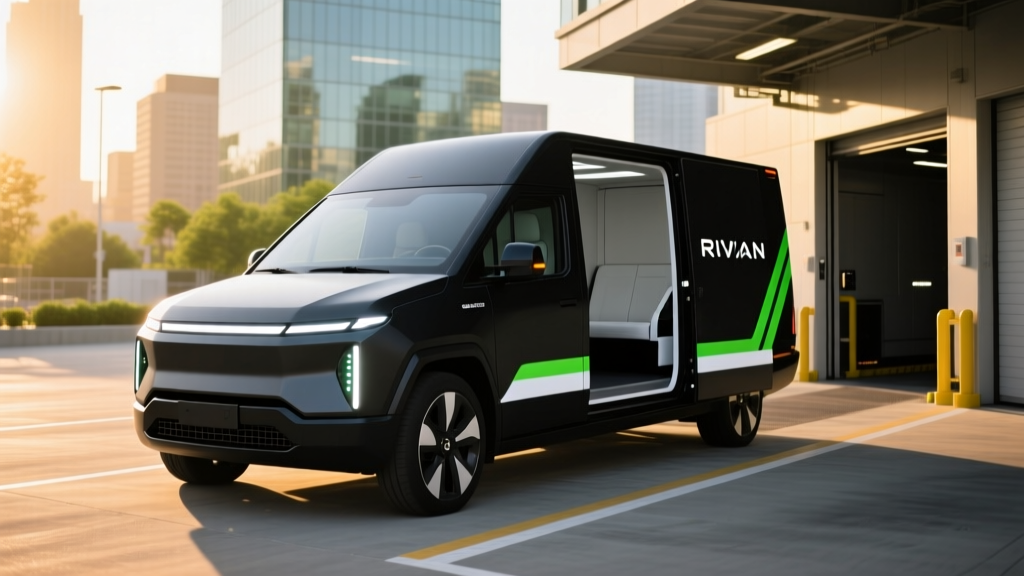
The Rivian EDV 900 isn't sold to consumers. You won't find it on a dealer lot, and you can't configure one on Rivian's website. This is a purpose-built electric delivery van engineered exclusively for Amazon's last-mile logistics network, and it represents one of the most ambitious commercial EV deployments in history. With over 10,000 units ordered and deliveries ramping through 2025 and 2026, the EDV 900 is reshaping how packages reach doorsteps — and offering a masterclass in fleet-scale electrification.
But what actually powers this van? How does it perform under real delivery conditions? And what can commercial fleet operators and EV enthusiasts learn from Rivian's engineering choices? We've analyzed the specs, spoken with fleet operators, and reviewed Rivian's technical documentation to bring you the most comprehensive EDV 900 profile available.
EDV 900 Range and Efficiency: Built for the Route, Not the Highway
Real-World Expectation: 120–145 miles in mixed urban delivery with frequent stops, HVAC use, and 50% payload. Cold-weather routes (below 32°F) can see range drop to 95–110 miles.
The EDV 900's 161-mile EPA estimate assumes moderate payload and typical delivery-cycle driving. In practice, Amazon drivers report 120–145 miles of usable range on a full charge during temperate months, with the van's regenerative braking system recapturing energy during hundreds of daily stops. The single-speed reduction gear and instant torque delivery mean efficiency stays relatively flat whether the van is empty or carrying 2,500 pounds of packages.
Cold weather is the equalizer. Lithium-ion batteries lose 15–25% capacity in freezing temperatures, and the EDV 900's cabin heating (resistance-based, not heat-pump equipped in early builds) draws significant power. Amazon has mitigated this by installing depot charging at most delivery stations, allowing mid-route top-offs if needed.
| Specification | Value |
|---|---|
| Battery Capacity | 140 kWh (usable, NMC chemistry) |
| EPA Range | 161 miles |
| Efficiency | ~2.0 kWh/mile (loaded) |
| Max DC Fast Charge | 150 kW |
| 10–80% DC Charge Time | ~55 minutes |
| Level 2 Charge Rate | 19.2 kW (~12 miles/hour) |
| Drivetrain | Rear-wheel drive, single motor |
| Horsepower | 250 hp |
| Torque | 350 lb-ft |
| 0–60 mph | ~8.5 seconds (unloaded) |
| Cargo Volume | 650 cu ft |
| Max Payload | 2,500 lbs |
| GVWR | 9,990 lbs (Class 2b) |
Charging Infrastructure: Depot-First Strategy
The EDV 900 was never designed for public charging networks. Amazon's deployment model assumes overnight depot charging at 19.2 kW Level 2, with DC fast charging available for mid-day top-offs at select hubs. This is a fundamental difference from consumer EVs like the R1T or R1S, which rely on Tesla Superchargers and Electrify America.
| Charging Level | Power (kW) | Miles Added/Hour | Use Case |
|---|---|---|---|
| Level 1 (120V) | 1.4 kW | ~1 mi/hr | Emergency/trickle (not practical) |
| Level 2 (240V, 80A) | 19.2 kW | ~12 mi/hr | Overnight depot charging (primary) |
| DC Fast Charge | 150 kW peak | ~90 mi/hr (10–80%) | Mid-route top-off at equipped hubs |
At 150 kW peak, the EDV 900's charge curve tapers significantly above 80% state of charge — a protective measure for the 140 kWh NMC battery. Fleet operators typically charge to 80% overnight and avoid full charges unless a longer route demands it. Amazon has installed over 10,000 Level 2 chargers across its delivery network, with DC fast chargers at roughly 20% of stations.
Performance and Drivetrain: Torque for the Job
The EDV 900 uses a single rear-mounted motor producing 250 horsepower and 350 lb-ft of torque. Unlike the dual-motor AWD setup in Rivian's consumer vehicles, the van prioritizes efficiency and simplicity. The instant torque delivery is ideal for stop-and-go urban routes, and drivers report the van feels surprisingly quick off the line — even when fully loaded.
The 0–60 mph time of ~8.5 seconds (unloaded) isn't sports-car territory, but it's competitive with gas-powered cargo vans like the Ford Transit and Mercedes Sprinter. More importantly, the single-speed transmission eliminates shift lag, and regenerative braking (with multiple regen levels selectable via the dash) reduces brake wear — a significant maintenance cost saver for fleets.
Cargo and Interior: Designed Around the Driver
The EDV 900's 650 cubic feet of cargo space is configured for Amazon's delivery workflow. The van features a low load floor, wide rear doors, and a bulkhead separating the driver from packages. The "Ding-Dong Door" — a powered sliding door on the curbside — opens automatically when the driver approaches, reducing physical strain during hundreds of daily exits.
Inside the cabin, Rivian prioritized durability over luxury. The seats are vinyl (easy to clean), the infotainment system is a simplified Android-based tablet, and the instrument cluster focuses on range, speed, and navigation. There's no passenger seat — this is a single-occupant work vehicle. Storage cubbies, cup holders, and a phone mount are positioned for quick access, and the steering wheel is flat-bottomed for easier entry/exit.
Pricing, Tax Credits, and Fleet Economics
The EDV 900 is not available for individual purchase. Amazon has an exclusive agreement with Rivian for 100,000 vans through 2030, and the pricing structure is part of a long-term fleet contract. Industry analysts estimate the per-unit cost at $70,000–$85,000, though Amazon and Rivian have not disclosed exact figures.
For commercial fleet operators eyeing similar electric vans (like the Ford E-Transit or BrightDrop Zevo), the IRS §45W Commercial Clean Vehicle Credit offers up to $7,500 for vehicles under 14,000 lbs GVWR and up to $40,000 for heavier vehicles. The EDV 900's 9,990-lb GVWR places it in the $7,500 category, but Amazon's exclusive deal means other fleets cannot currently purchase this model.
| Cost Factor | Estimate |
|---|---|
| Estimated Unit Cost | $70,000–$85,000 |
| Federal §45W Credit | Up to $7,500 |
| Depot Charger Install (per unit) | $3,000–$6,000 |
| Fuel Savings vs. Gas Van (5 yr) | $12,000–$18,000 |
| Maintenance Savings (5 yr) | $4,000–$7,000 |
Warranty and Longevity: Fleet-Grade Durability
Rivian offers a 8-year/100,000-mile battery and powertrain warranty for the EDV 900, with a guaranteed 70% capacity retention threshold. For Amazon's high-mileage routes (some vans log 25,000+ miles annually), this means the warranty could be reached in 4–5 years. Rivian has committed to battery refurbishment and replacement services at Amazon's depot locations, minimizing downtime.
The NMC chemistry in the 140 kWh pack is optimized for energy density and charge acceptance, though it's more susceptible to heat-related degradation than LFP (lithium iron phosphate). Amazon's depot charging strategy — avoiding frequent 100% charges and using thermal preconditioning — helps mitigate this. Early fleet data suggests minimal degradation in the first 50,000 miles, though long-term 150,000+ mile data is still pending.
Standout Tech and Notable Drawbacks
Pros
- Purpose-built for delivery: Ding-Dong Door, low load floor, optimized routing software
- Regenerative braking reduces brake wear by 40–60% vs. gas vans
- Quiet operation improves driver comfort and reduces neighborhood noise
- Over-the-air updates add features and improve efficiency
- Instant torque ideal for urban stop-and-go
Cons
- Not available for purchase outside Amazon's fleet
- Cold-weather range loss (25–30%) requires mid-day charging on some routes
- No heat pump in early builds; cabin heating draws significant power
- 150 kW DC charging is slower than consumer EVs like the R1T (200+ kW)
- Single-occupant cabin limits versatility
Who Is the Rivian EDV 900 For?
The EDV 900 is exclusively for Amazon's delivery network. However, its engineering principles inform the broader commercial EV market. Fleet operators evaluating electric vans should study the EDV 900's depot-charging model, route-optimization software, and driver-centric design. Competitors like the Ford E-Transit (126-mile range, $45,000 base) and BrightDrop Zevo 600 (250-mile range, ~$75,000) offer similar capabilities with broader availability.
For consumers, the EDV 900 is a glimpse into Rivian's manufacturing scale and battery expertise — capabilities that directly benefit the R1T, R1S, and upcoming R2 platform. The van's success proves Rivian can deliver at volume, even if the product itself never reaches your driveway.
Frequently Asked Questions
Can I buy a Rivian EDV 900 for personal use?
No. The EDV 900 is exclusively available to Amazon under a 100,000-vehicle agreement through 2030. There are no plans for consumer or third-party fleet sales.
What's the real-world range of the EDV 900?
Expect 120–145 miles in typical delivery conditions (50% payload, frequent stops, temperate weather). Cold weather and heavy loads can reduce this to 95–110 miles.
How fast does the EDV 900 charge?
At a DC fast charger, it peaks at 150 kW and charges from 10–80% in ~55 minutes. Overnight Level 2 charging at 19.2 kW adds ~12 miles per hour, fully replenishing the 140 kWh battery in 8–9 hours.
Does the EDV 900 qualify for tax credits?
Yes, under the IRS §45W Commercial Clean Vehicle Credit, eligible fleets can claim up to $7,500. However, Amazon's exclusive purchase agreement means other fleets cannot currently access this model.
How does the EDV 900 compare to gas delivery vans?
The EDV 900 offers lower operating costs (electricity vs. fuel, reduced brake wear, fewer moving parts) but higher upfront cost. Amazon reports 50% lower per-mile operating costs vs. gas vans on equivalent routes.
What battery chemistry does the EDV 900 use?
The 140 kWh battery uses NMC (nickel manganese cobalt) chemistry, optimized for energy density and charge acceptance. LFP chemistry, used in some consumer EVs for longevity, was not selected for this application.