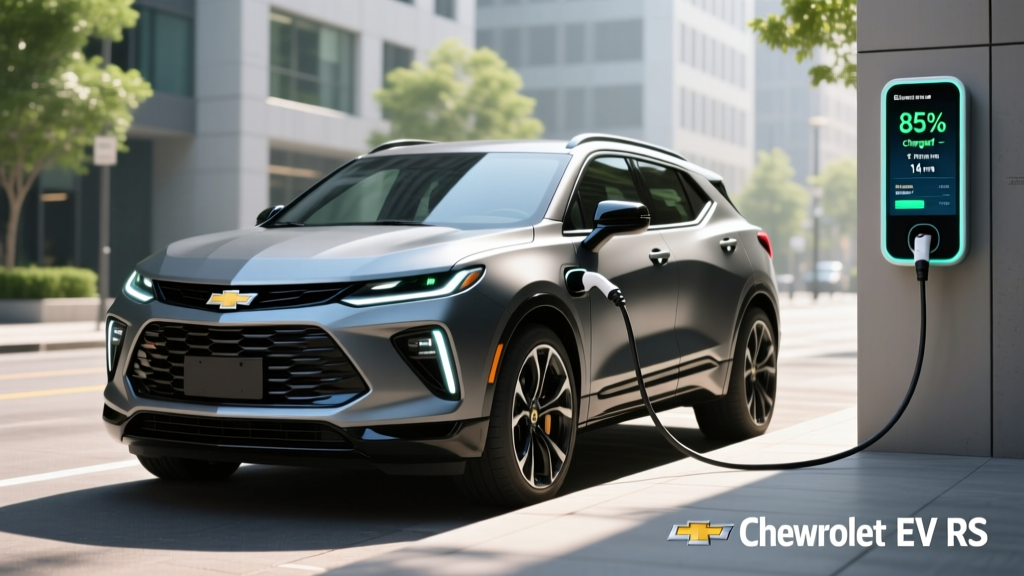
Quick Verdict: The Blazer EV RS Hits the Midsize SUV Sweet Spot
The 2026 Chevrolet Blazer EV RS occupies a specific lane in the midsize electric SUV segment: sporty styling, competitive range, and a price point that undercuts the Tesla Model Y and Hyundai Ioniq 5 while offering more interior volume than either. After GM's rocky 2024 launch plagued by software glitches, the 2026 model year benefits from a fully matured Ultifi software platform and the transition to the North American Charging Standard (NACS) port. The RS trim, with its dual-motor all-wheel-drive setup producing 557 horsepower, is the performance-oriented choice — but buyers should weigh whether that power justifies a real-world range drop compared to the rear-wheel-drive 2LT.
This review covers the Blazer EV RS with exact specs, real-world range data, charging-curve behavior, federal tax-credit eligibility under current IRS §30D rules, and a direct comparison to the competitors you're likely cross-shopping.
Range, Efficiency, and the Real-World Reality Check
The 2026 Chevrolet Blazer EV RS with the dual-motor AWD powertrain carries an EPA-estimated range of 279 miles on its 102 kWh usable battery pack (GM's Ultium platform, NMC lithium-ion chemistry). The rear-wheel-drive 2LT variant stretches that to 324 miles EPA — a significant 45-mile gap driven by the RS's additional front motor, heavier curb weight (~5,800 lbs), and stickier performance tires.
| Condition | Expected Range | Notes |
|---|---|---|
| EPA Combined (sticker) | 279 miles | Mixed city/highway cycle |
| Highway (70-75 mph, mild weather) | ~240–255 miles | Aerodynamic drag reduces efficiency at speed |
| City / Stop-and-go (mild weather) | ~275–290 miles | Regen braking recovers energy; best-case scenario |
| Cold weather (20–35°F, highway) | ~195–220 miles | Battery resistance + cabin heating; heat pump helps but doesn't eliminate loss |
| Towing (3,500-lb trailer, flat terrain) | ~150–175 miles | Expect 40-45% range reduction under load |
Efficiency lands at 87 MPGe combined (EPA), translating to roughly 39 kWh per 100 miles in mixed driving. That's competitive with the Ford Mustang Mach-E GT but trails the more efficiency-focused Hyundai Ioniq 5 (114 MPGe) and Tesla Model Y Long Range (122 MPGe). The Blazer EV's weight and wide tires work against it on the efficiency front — you're trading electrons for presence and acceleration.
Battery Chemistry, Capacity, and Long-Term Degradation
The Blazer EV RS uses GM's Ultium battery platform with NMC (nickel manganese cobalt) chemistry in a 12-module configuration. The total pack capacity is approximately 102 kWh usable (gross capacity is higher, with a software buffer protecting the cells from deep discharge and overcharge extremes).
NMC chemistry offers higher energy density than LFP (lithium iron phosphate), which is why GM can pack 102 kWh into this platform without excessive weight. The trade-off: NMC cells are more sensitive to sustained high state-of-charge storage and extreme heat. For daily driving, GM recommends charging to 80-90% and only hitting 100% before long road trips — standard NMC best practice.
| Spec | Value |
|---|---|
| Battery (usable) | 102 kWh, NMC (Ultium) |
| EPA Range (AWD RS) | 279 miles |
| EPA Range (RWD 2LT) | 324 miles |
| Efficiency | 87 MPGe / 39 kWh/100mi |
| Drivetrain | Dual-motor AWD |
| Horsepower | 557 hp (combined) |
| Torque | 648 lb-ft |
| 0-60 mph | ~4.0 seconds |
| Max DC Fast Charge | 190 kW (peak) |
| 10-80% DC Charge Time | ~28 minutes |
| Level 2 Charge Rate | 11.5 kW (~34 mi/hr) |
| Charge Port | NACS (native, no adapter) |
| Towing Capacity | 3,500 lbs (properly equipped) |
| Cargo Volume (rear seats up) | 30.3 cu ft |
| Cargo Volume (rear seats folded) | 60.9 cu ft |
| Front Legroom | 42.2 inches |
| Rear Legroom | 38.4 inches |
| Curb Weight | ~5,800 lbs |
Battery warranty: GM covers the Blazer EV's battery and powertrain for 8 years / 100,000 miles, with a capacity-retention threshold of 60% — meaning if your pack drops below 60% of original capacity within that window, GM will repair or replace it. Industry data from Recurrent's fleet analysis suggests modern NMC packs with active thermal management (like Ultium's) typically retain 88-92% capacity at 100,000 miles under normal use.
Charging Speed: DC Fast, Level 2, and the Curve Reality
The Blazer EV RS peaks at 190 kW on a DC fast charger — respectable, though it trails the Hyundai Ioniq 5's 240 kW and the Tesla Model Y's ~250 kW peak. Here's what that means in practice:
| Charging Method | Power (kW) | Speed (mi/hr added) | Time / Notes |
|---|---|---|---|
| DC Fast Charge (peak) | 190 kW | ~280 mi/hr (at peak) | 10-80% in ~28 min |
| DC Fast Charge (sustained avg, 10-80%) | ~130-140 kW avg | ~200 mi/hr avg | Charge curve tapers above 60% SoC |
| DC Fast Charge 80-100% | Drops to 25-50 kW | ~40-70 mi/hr | Add ~35-45 min for final 20%; skip unless needed |
| Level 2 Home (240V, 48A) | 11.5 kW | ~34 mi/hr | 0-100% in ~9 hours; overnight ready |
| Level 2 Public (lower-power) | 7.2 kW | ~21 mi/hr | Common at shopping centers, workplaces |
| Level 1 (120V household) | 1.4 kW | ~4 mi/hr | Emergency/trickle only; ~70 hours 0-100% |
Charging curve reality check: The 190 kW peak only sustains roughly between 10-40% state of charge. By 60% SoC, you'll see rates drop to ~120 kW, and above 80%, the taper is aggressive. This is normal physics for NMC packs — thermal management protects the cells. On a road trip, plan your stops around the 10-80% window for the fastest overall travel time.
Home charging setup: The Blazer EV's 11.5 kW onboard charger is a strong point. With a 48-amp Level 2 home station (like a ChargePoint Home Flex or Wallbox Pulsar Plus), you'll add roughly 34 miles of range per hour — enough to fully replenish overnight from any realistic daily driving. Budget $500-$1,200 for the charger unit and $800-$2,500 for professional installation (depending on panel capacity and run length; a 200-amp panel upgrade can add $1,500-$3,000 if needed).
The 2026 Blazer EV ships with a native NACS charge port, meaning direct access to Tesla's Supercharger network (17,000+ stalls in North America) without an adapter. This is a significant practical advantage over CCS-equipped competitors still relying on adapter dongles.
Performance: 557 HP and the Sporty Promise
The RS trim's dual-motor AWD setup delivers 557 horsepower and 648 lb-ft of torque, launching the Blazer EV to 60 mph in approximately 4.0 seconds. That puts it in the same performance bracket as the Ford Mustang Mach-E GT and well ahead of the base Tesla Model Y Long Range (4.8 sec). Instant torque delivery makes the RS feel quicker than the stopwatch suggests — around-town acceleration is genuinely thrilling.
GM's Adaptive Ride Control (standard on RS) uses continuously variable dampers that firm up in Sport mode and soften for highway cruising. The ride quality is a genuine strength — compliant without being floaty, a balance some competitors (looking at you, Mach-E) struggle with. The steering is precise if somewhat numb, typical of electric power steering tuned for efficiency over feel.
One-pedal driving is available with strong regenerative braking, and the steering-wheel paddle allows on-demand regen boost without committing to full one-pedal mode. Brake feel is progressive — GM avoided the grabby regen-to-friction handoff that plagues some EVs.
Interior, Tech, and Daily Livability
The Blazer EV RS interior is a mixed bag of premium materials and cost-cutting. Soft-touch surfaces cover the dash and door uppers, but hard plastics appear on the lower door panels and center console sides — noticeable at this price point. The RS-specific interior adds red contrast stitching, a flat-bottom steering wheel, and unique seat trim.
Infotainment: A 17.7-inch diagonal touchscreen dominates the dash, running GM's latest Ultifi software (the same platform that had launch issues in 2024 but is now substantially more stable after multiple OTA updates). Wireless Apple CarPlay and Android Auto are standard. The screen is bright, responsive, and logically organized — a marked improvement over the pre-2025 interface. Physical knobs for volume and climate would be welcome, but GM has committed to the touchscreen-only approach.
Driver Assistance: The Blazer EV RS includes Super Cruise — GM's Level 2 hands-free driving system — as standard on the RS trim. Super Cruise operates on over 750,000 miles of LiDAR-mapped highways in North America and uses a driver-attention camera to monitor eye gaze. It's one of the most capable Level 2 systems available, but it is emphatically not self-driving — you must remain attentive and ready to resume control at any time.
- SAE Level 2 — driver must remain engaged and supervised at all times
- Only functions on pre-mapped divided highways (not city streets, rural roads, or unmapped routes)
- Disengages in construction zones, severe weather, or when lane markings are obscured
- Does not navigate highway exits, stoplights, or stop signs autonomously
- Requires active subscription after initial 3-year included trial
Cargo and passenger space: With 30.3 cubic feet behind the rear seats and 60.9 cu ft with them folded, the Blazer EV is competitive with the Model Y (30.2 / 72.1 cu ft) and significantly roomier than the Ioniq 5 (27.2 / 59.3 cu ft). Rear legroom of 38.4 inches accommodates adults comfortably on long trips. There is no front trunk (frunk) — the space is occupied by HVAC and power-electronics hardware.
Pricing, Trims, and Federal Tax Credit Eligibility
The 2026 Blazer EV RS AWD starts at an MSRP of $56,595 (including destination charge). Key options include a panoramic sunroof ($1,495), enhanced Super Cruise mapping package, and premium paint colors. A well-equipped RS typically lands between $58,000 and $62,000 before incentives.
| Trim | MSRP | Drivetrain | EPA Range | §30D Credit Eligible? |
|---|---|---|---|---|
| 2LT RWD | $48,795 | RWD (single motor) | 324 mi | Yes — up to $7,500 (see rules below) |
| RS AWD | $56,595 | AWD (dual motor) | 279 mi | Yes — up to $7,500 (see rules below) |
| SS (performance) | $65,995 (est.) | AWD (dual motor) | ~260 mi (est.) | No — exceeds $80,000 SUV MSRP cap when optioned |
Federal tax credit (§30D) — current 2026 rules: The Blazer EV qualifies for up to $7,500 in federal tax credits, but eligibility depends on three filters that you must verify individually:
- MSRP cap: SUVs must be below $80,000 MSRP — the 2LT and RS clear this easily; a loaded SS may not.
- Buyer income cap: Modified adjusted gross income (MAGI) must not exceed $300,000 (married filing jointly), $225,000 (head of household), or $150,000 (single). Check your prior-year or current-year MAGI — whichever is lower.
- Battery sourcing: At least 60% of critical minerals and 75% of battery components must be sourced from the US or FTA partners. GM has progressively shifted Ultium sourcing; the 2026 Blazer EV is expected to meet both thresholds, but verify the specific VIN on fueleconomy.gov before purchasing.
- Point-of-sale transfer: You can elect to transfer the credit to the dealer at purchase, reducing your out-of-pocket cost immediately rather than waiting to claim it on your tax return. This requires dealer participation and IRS registration at time of sale.
After the $7,500 credit (assuming full eligibility), the RS effectively costs ~$49,095 — competitive with a similarly equipped Model Y Long Range and significantly less than the Mach-E GT. Consult a tax professional for your specific situation; rules are subject to change. Reference IRS.gov §30D guidance for the latest requirements.
Blazer EV RS vs. the Competition
Here's how the Blazer EV RS stacks up against the three midsize EV SUVs you're almost certainly comparing it to:
| Spec | Blazer EV RS AWD | Tesla Model Y LR AWD | Hyundai Ioniq 5 Limited AWD | Ford Mach-E GT |
|---|---|---|---|---|
| Base MSRP | $56,595 | $48,990 | $58,400 | $59,995 |
| EPA Range | 279 mi | 320 mi | 290 mi | 280 mi |
| Battery (kWh usable) | 102 | 78 | 77.4 | 91 |
| 0-60 mph | 4.0 sec | 4.8 sec | 5.1 sec | 3.5 sec |
| Peak DC Charge (kW) | 190 | 250 | 240 | 150 |
| 10-80% DC Time | ~28 min | ~22 min | ~18 min | ~38 min |
| Cargo (rear up, cu ft) | 30.3 | 30.2 | 27.2 | 29.7 |
| Driver Assist (L2) | Super Cruise | Autopilot / FSD | HDA-2 | BlueCruise |
| Charge Port | NACS (native) | NACS (native) | CCS (adapter req.) | CCS (adapter req.) |
- You want a comfortable, quiet highway cruiser with strong acceleration and premium ride quality
- Super Cruise hands-free driving on mapped highways is a priority (it's standard on RS)
- You value native NACS charging and Supercharger network access without adapter hassle
- Interior space and ride comfort matter more than peak efficiency or fastest charging
- Maximum range is your top priority → Tesla Model Y Long Range (320 mi EPA) wins here
- Fastest DC charging matters for frequent road trips → Ioniq 5 (18-min 10-80%) is significantly quicker
- You want the lowest entry price → Model Y or Blazer 2LT RWD undercut the RS by $7,000+
- Track-day performance is the goal → Mach-E GT is quicker; consider the upcoming Blazer SS instead
Pros, Cons, and Who Should Buy
- Comfortable, well-damped ride that outclasses most rivals in this segment
- Super Cruise standard — one of the best Level 2 highway systems available
- Native NACS port: full Supercharger access without an adapter
- Spacious interior with strong cargo volume (30.3 cu ft)
- Strong 557-hp dual-motor acceleration (4.0 sec 0-60)
- 11.5 kW Level 2 charging enables fast overnight home replenishment
- Competitive pricing after federal tax credit (~$49K effective)
- Efficiency trails key competitors (87 MPGe vs. 114-122 MPGe for Ioniq 5 / Model Y)
- DC charging peak of 190 kW is slower than Ioniq 5 (240 kW) and Model Y (250 kW)
- No front trunk (frunk) — missed opportunity for additional storage
- Hard plastics on lower interior surfaces at this price point
- AWD RS range (279 mi) noticeably less than RWD 2LT (324 mi)
- Touchscreen-only climate controls may frustrate some drivers
- GM's software reputation still recovering from 2024 launch issues
Who the Blazer EV RS is best for: Daily commuters and families who prioritize ride comfort, highway driving assistance (Super Cruise), and straightforward charging access. It's an excellent choice for buyers who do 80% of their driving within a 100-mile radius and take 2-3 road trips per year where Supercharger access matters. It's less ideal for efficiency-obsessed hypermilers, frequent long-distance road-trippers who want the fastest charge stops, or anyone who needs a frunk for gear storage.
5-Year Ownership Cost Snapshot
Beyond the sticker price, here's what Blazer EV RS ownership looks like over five years (assuming 15,000 miles/year, 80% home charging at $0.14/kWh national average, 20% DC fast charging at $0.40/kWh):
| Category | Estimated Cost | Notes |
|---|---|---|
| Purchase (after §30D credit) | $49,095 | Assumes full $7,500 eligibility |
| Electricity (5 years, 75K miles) | $4,800 | ~$960/year at blended rate |
| Home Charger + Installation | $1,500–$3,000 | One-time; Level 2 48A station |
| Insurance (5-year avg) | $12,000–$15,000 | EV premiums run 15-25% higher than ICE equivalents |
| Maintenance (5 years) | $1,200–$1,800 | Tires, cabin filter, wiper fluid, brake fluid; no oil changes |
| Estimated Depreciation (5 yr) | $18,000–$22,000 | EVs depreciating faster than historical ICE averages |
| Total 5-Year Cost (est.) | $86,600–$95,700 | Varies significantly by electricity rate, insurance, and resale |
Compared to a gas-powered midsize SUV averaging 24 MPG at $3.40/gallon, the Blazer EV RS saves roughly $6,000-$7,500 in fuel costs over five years — but that savings is partially offset by higher insurance premiums and potentially steeper depreciation. The economics favor buyers who can charge at home at residential rates and who plan to keep the vehicle beyond the steepest depreciation years (years 1-3).
Frequently Asked Questions
What is the real-world range of the Chevrolet Blazer EV RS?
The EPA rates the Blazer EV RS AWD at 279 miles. In real-world highway driving at 70-75 mph in mild weather, expect 240-255 miles. In cold weather (below 35°F), highway range drops to approximately 195-220 miles. City driving with regenerative braking can approach or slightly exceed the EPA figure.
How fast does the Blazer EV RS charge at home and on the road?
On a DC fast charger, it peaks at 190 kW and charges from 10-80% in approximately 28 minutes. At home on a 48-amp Level 2 station (240V), it charges at 11.5 kW, adding about 34 miles of range per hour — a full charge from empty takes roughly 9 hours, making overnight charging practical.
How much does the Blazer EV RS cost after the federal tax credit?
The 2026 Blazer EV RS starts at $56,595 MSRP. If you qualify for the full $7,500 federal tax credit under IRS §30D (based on income limits, MSRP cap, and battery-sourcing requirements), the effective price drops to approximately $49,095. You can transfer the credit to the dealer at point of sale for an immediate price reduction.
Does the Blazer EV qualify for the federal EV tax credit?
Yes, the 2026 Blazer EV (2LT and RS trims) is expected to qualify for up to $7,500 under §30D, provided the buyer meets income thresholds ($150K single / $300K joint MAGI), the MSRP is under $80,000, and the battery meets critical-mineral and component-sourcing requirements. Always verify the specific VIN on fueleconomy.gov and consult a tax professional before relying on credit eligibility.
Is the Blazer EV RS worth buying over the Tesla Model Y or Ioniq 5?
It depends on your priorities. The Blazer EV RS wins on ride comfort, standard Super Cruise, and native NACS charging. The Model Y wins on range (320 mi), charging speed (250 kW), and lower base price. The Ioniq 5 wins on charging speed (18-min 10-80%) and efficiency (114 MPGe). If comfort and highway-assist tech are your top criteria, the Blazer EV RS is the strongest choice in this group.
What are the biggest drawbacks of the Blazer EV RS?
The main compromises are below-average efficiency (87 MPGe), slower DC charging than key rivals (190 kW peak vs. 240-250 kW), no front trunk, and some hard interior plastics at this price point. The AWD RS also gives up 45 miles of range compared to the RWD 2LT trim.
Does the Blazer EV RS have Super Cruise, and is it self-driving?
Yes, Super Cruise is standard on the RS trim. It provides hands-free driving on over 750,000 miles of mapped highways in North America. However, it is an SAE Level 2 driver-assistance system — not self-driving. You must remain attentive, keep your eyes on the road, and be ready to take over at any time. It does not handle city streets, stoplights, or unmapped routes.
Sources: EPA range and efficiency data from fueleconomy.gov; vehicle specifications from Chevrolet.com; federal tax credit rules from IRS.gov §30D.