Quick Verdict: What the Canoo Truck Actually Delivers
The Canoo Lifestyle Delivery Vehicle (LDV) — commonly called the Canoo Truck — enters the 2026 model year as one of the most unconventional electric pickups on the market. Built on Canoo's multi-purpose platform (MPP) with a cab-forward, skateboard-chitecture design, it prioritizes interior volume and urban maneuverability over traditional truck swagger. With an EPA-estimated range of 200 miles, a starting MSRP around $34,900, and a modular bed system, the Canoo Truck targets urban contractors, fleet operators, and adventurous commuters who need cargo flexibility without full-size truck footprint.
But the Canoo Truck's unconventional approach comes with trade-offs. Its range is modest by 2026 standards, DC fast-charging peaks at a conservative 80 kW, and the brand's production scale remains limited compared to legacy automakers. This review breaks down every spec that matters for real buyers — from real-world highway range to IRS §30D tax credit eligibility — so you can decide whether this compact EV pickup fits your use case.
Range, Battery, and Efficiency
Real-World Expectation: 170–185 miles on highway drives at 70 mph; 140–155 miles in sustained cold weather (below 30°F) with cabin heating. City/regenerative driving can approach the EPA sticker.
The Canoo Truck is powered by an 80 kWh usable battery pack using NMC (nickel-manganese-cobalt) chemistry. NMC offers higher energy density than LFP, which helps Canoo package meaningful capacity into a compact skateboard platform, though it means the battery is more sensitive to repeated DC fast-charging at high states of charge. Canoo's thermal management system includes active liquid cooling and heating to mitigate degradation and support cold-weather preconditioning.
| Specification | Value |
|---|---|
| EPA Range | 200 miles |
| Battery Capacity (usable) | 80 kWh |
| Battery Chemistry | NMC |
| Efficiency | 2.5 kWh/mile (~134 MPGe combined) |
| Drivetrain | Rear-wheel drive (single motor); AWD dual-motor optional |
| Horsepower | 200 hp (RWD) / 300 hp (AWD) |
| 0–60 mph | 6.3 seconds (RWD) / 5.0 seconds (AWD) |
At 2.5 kWh per mile, the Canoo Truck's efficiency is reasonable for a boxy, upright vehicle, though it trails more aerodynamic crossovers. Expect higher consumption — closer to 3.0 kWh/mile — when carrying heavy payloads or towing near its rated capacity.
Charging: DC Fast, Level 2, and Real-World Times
Charging speed is where the Canoo Truck reveals its urban-fleet orientation. DC fast-charging peaks at 80 kW — adequate for the 80 kWh pack but noticeably slower than competitors like the Ford Maverick-based EV concepts or Hyundai's 240 kW-capable platforms.
| Charging Level | Power (kW) | Time / Rate |
|---|---|---|
| DC Fast Charge (peak) | 80 kW | 10–80% in ~50 minutes |
| DC Fast Charge (sustained avg.) | ~60 kW | Charge curve tapers above 60% SoC |
| Level 2 (240V, 48A) | 11.5 kW | ~34 miles of range per hour; 0–100% in ~7 hours |
| Level 1 (120V) | 1.4 kW | ~4 miles of range per hour |
The 10–80% DC fast-charge time of approximately 50 minutes is functional for lunch-break top-ups but means longer highway road trips require more planning. The charge curve holds near peak through roughly 50% state of charge, then tapers progressively — a common NMC characteristic. Canoo includes battery preconditioning when a DC fast-charger is set as the navigation destination, which helps optimize charge speed in cold weather.
For home charging, a Level 2 wall connector at 11.5 kW (48 amps on a 60-amp circuit) will fully replenish the pack overnight. Installation typically runs $800–$2,000 depending on panel capacity and conduit distance, per U.S. Department of Energy guidance. If your home has a 100-amp electrical panel, a panel upgrade to 200 amps may be necessary, adding $1,500–$3,000.
Performance, Payload, and Cargo
The Canoo Truck's single-motor RWD configuration delivers 200 horsepower and 250 lb-ft of torque — enough for confident highway merging and urban driving. The optional dual-motor AWD bumps output to 300 hp and 350 lb-ft, improving both acceleration and traction for job-site use.
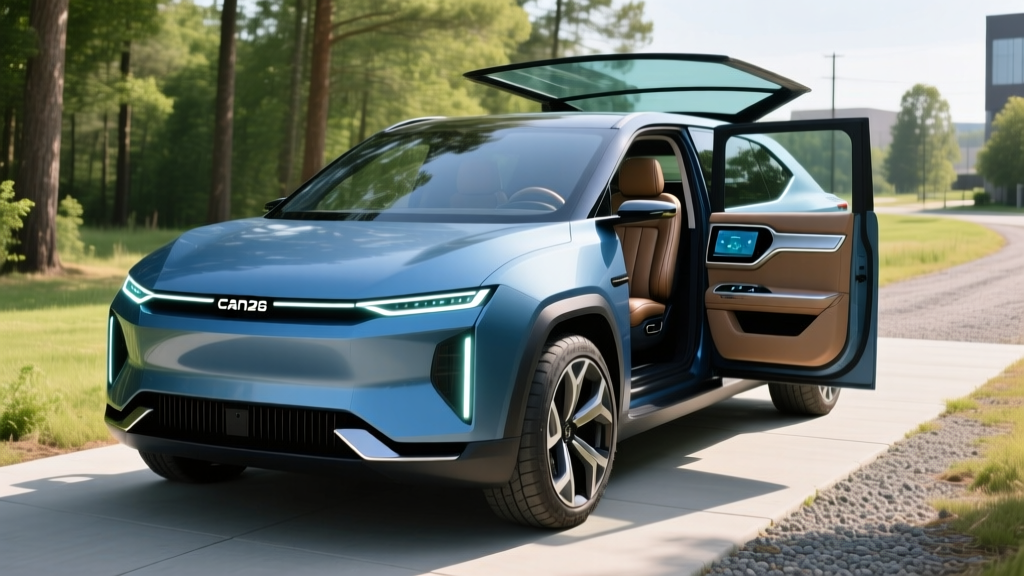
The standout feature is interior space. The cab-forward design eliminates a traditional hood, pushing the windshield forward and creating a remarkably roomy cabin for a compact footprint. The vehicle sits on a 112.2-inch wheelbase with an overall length of approximately 184 inches — shorter than a Toyota Tacoma but with interior volume rivaling midsize trucks.
| Dimension | Value |
|---|---|
| Cargo Bed Length | 72 inches (6 ft) |
| Cargo Bed Volume | ~55 cu ft (with tailgate closed) |
| Frunk (Front Trunk) | 12 cu ft |
| Payload Capacity | 1,800 lbs |
| Towing Capacity | 3,500 lbs (estimated, AWD) |
| Front Headroom | 42.5 inches |
| Front Legroom | 44.2 inches |
The 6-foot bed with fold-down sides and the 12-cubic-foot frunk provide flexible cargo options. The modular bed system includes integrated tie-downs, a slide-out cargo tray, and available rack mounting points. However, the 3,500-pound towing estimate (AWD) is best suited for light utility trailers — this is not a heavy-duty hauler.
Pricing, Trims, and Federal Tax Credit Eligibility
| Trim | Base MSRP | Est. Price After §30D Credit* |
|---|---|---|
| Base RWD | $34,900 | $27,400 |
| AWD Premium | $42,500 | $35,000 |
| AWD Adventure | $47,900 | $40,400 |
*Federal tax credit estimates assume full §30D eligibility. Actual credit depends on buyer income, battery sourcing, and MSRP caps. See IRS rules below.
The Canoo Truck qualifies for up to $7,500 under the IRS §30D Clean Vehicle Credit, provided all eligibility criteria are met. Under current 2026 rules, this credit can be transferred to the dealer at point of sale, effectively reducing the purchase price at the dealership rather than requiring you to claim it on your tax return.
- MSRP Cap: Pickup trucks/vans must be under $80,000 — all Canoo trims qualify.
- Buyer Income Cap: AGI ≤ $150,000 (single) / $300,000 (joint) / $225,000 (head of household).
- Battery Sourcing: Critical minerals and battery components must meet escalating domestic-content thresholds per IRS guidelines. Canoo has indicated compliance, but buyers should verify the specific VIN on the IRS clean vehicle report before purchase.
- Assembly: Final assembly must occur in North America — Canoo's Bentonville, Arkansas facility meets this requirement.
Always confirm credit eligibility for your specific VIN at fueleconomy.gov before signing a purchase agreement. Rules change, and manufacturer sourcing certifications can shift model year to model year.
Tech, Driver Assistance, and Interior
The Canoo Truck features a minimalist interior anchored by a 12.3-inch central touchscreen running an Android Automotive-based infotainment system with wireless Apple CarPlay and Android Auto. A configurable digital instrument cluster replaces traditional gauges, and over-the-air (OTA) updates are standard.
Driver assistance is SAE Level 2 — meaning the driver must remain fully engaged at all times. The Canoo Driver Assist suite includes:
- Adaptive cruise control with stop-and-go
- Lane-keeping assist with centering
- Automatic emergency braking with pedestrian detection
- Blind-spot monitoring with rear cross-traffic alert
- 360-degree camera system
Notable tech drawbacks: the Canoo Truck lacks Apple's next-gen vehicle integration, has no built-in dashcam, and the single-zone HVAC system is basic for the price point. The absence of a heat pump (resistive heating is standard) also contributes to the cold-weather range loss noted earlier.
Warranty and Ownership Costs
| Coverage | Term |
|---|---|
| Battery & Powertrain | 8 years / 100,000 miles |
| Battery Retention Guarantee | ≥70% capacity at 8 yr/100k mi |
| Bumper-to-Bumper | 3 years / 36,000 miles |
| Roadside Assistance | 5 years / 60,000 miles |
The 8-year/100,000-mile battery warranty with a 70% capacity retention floor is industry-standard, matching what you'll find from Ford, Hyundai, and Rivian. Canoo's NMC pack should hold up well with routine Level 2 home charging; repeated daily DC fast-charging will accelerate degradation modestly.
Estimated 5-year total cost of ownership for the Base RWD trim (15,000 miles/year, $0.14/kWh home electricity, no major incentives beyond §30D):
- Purchase (after credit): ~$27,400
- Charging (5 years): ~$5,250
- Insurance (5 years): ~$9,500
- Maintenance (5 years): ~$1,200
- Estimated Depreciation: ~$10,000
- 5-Year TCO: ~$53,350
Canoo Truck vs. Key Competitors
How does the Canoo Truck stack up against other compact and midsize electric pickups available in 2026?
| Spec | Canoo Truck (AWD) | Ford F-150 Lightning (Std. Range) | Rivian R1T (Dual-Motor) |
|---|---|---|---|
| EPA Range | 200 mi | 240 mi | 270 mi |
| Battery | 80 kWh NMC | 98 kWh NMC | 106 kWh NMC |
| Peak DC Charge | 80 kW | 150 kW | 220 kW |
| 0–60 mph | 5.0 sec | 5.8 sec | 4.5 sec |
| Payload | 1,800 lbs | 2,235 lbs | 1,760 lbs |
| Towing | 3,500 lbs | 7,700 lbs | 11,000 lbs |
| Starting MSRP | $34,900 (RWD) | $54,995 | $69,900 |
The Canoo Truck wins decisively on starting price and compact maneuverability. It loses on range, charging speed, and towing capacity. If you need a workhorse for heavy trailers or frequent 300-mile highway runs, the F-150 Lightning or Rivian R1T are better fits — at significantly higher cost. If you're a contractor navigating city streets, need a compact bed for tools and materials, and charge at home nightly, the Canoo's value proposition is compelling.
- Lowest starting MSRP in the EV pickup segment
- Compact footprint with surprisingly roomy cabin
- Modular, flexible bed system with integrated tie-downs
- Point-of-sale tax credit can drop price under $28K
- Standard OTA updates and modern infotainment
- 200-mile EPA range limits road-trip utility
- 80 kW peak DC charging is slow for 2026 standards
- No heat pump — cold-weather range suffers
- 3,500-lb towing is light-duty only
- Limited service center network vs. legacy brands
Who Should Buy the Canoo Truck?
- You're an urban contractor or small business owner needing a compact cargo hauler
- Your daily driving is under 100 miles and you charge at home
- You want the most affordable new EV pickup available
- Maneuverability matters more than towing capacity
- You regularly tow over 3,500 lbs or take 300+ mile road trips
- You need DC fast-charging above 150 kW for frequent highway travel
- You live in a region with limited Canoo service infrastructure
- You need a crew cab with a full rear seat
Frequently Asked Questions
What is the real-world range of the Canoo Truck?
The EPA rates the Canoo Truck at 200 miles. In real-world highway driving at 70 mph, expect 170–185 miles. In cold weather (below 30°F) with cabin heat, range can drop to 140–155 miles due to the resistive heating system and lack of a heat pump. City driving with regenerative braking can match or slightly exceed the EPA number.
How fast does the Canoo Truck charge?
DC fast-charging peaks at 80 kW, delivering a 10–80% charge in approximately 50 minutes. At home on a Level 2 charger (11.5 kW / 48 amps), you'll add about 34 miles of range per hour, with a full charge taking roughly 7 hours. Level 1 (standard 120V outlet) adds about 4 miles per hour — suitable only for emergency or supplemental charging.
How much does the Canoo Truck cost after tax credits?
The Base RWD starts at $34,900. With the full $7,500 §30D federal tax credit applied at point of sale, the effective price drops to approximately $27,400. Eligibility requires meeting IRS income caps ($150K single / $300K joint), and the vehicle's battery must meet critical-mineral and component sourcing thresholds. Verify your VIN on fueleconomy.gov before purchase.
Is the Canoo Truck worth buying vs. the F-150 Lightning or Rivian R1T?
It depends on your use case. The Canoo is the most affordable EV pickup by a wide margin and excels in urban environments with its compact size and flexible bed. However, it offers less range (200 vs. 240–270 miles), slower charging (80 kW vs. 150–220 kW), and far less towing capacity (3,500 lbs vs. 7,700–11,000 lbs). For heavy-duty work or frequent long trips, the Lightning or R1T justify their higher prices. For city-based commercial use or budget-conscious commuters, the Canoo is a strong value.
Does the Canoo Truck qualify for the federal EV tax credit?
Yes — the Canoo Truck is eligible for up to $7,500 under §30D, as it meets the MSRP cap (under $80,000 for trucks), is assembled in North America (Bentonville, AR), and Canoo has indicated battery sourcing compliance. However, buyer income limits apply, and sourcing certifications can change. Always confirm eligibility for your specific VIN through the IRS clean vehicle credit page before committing.
What is the Canoo Truck's battery warranty?
Canoo covers the battery and powertrain for 8 years or 100,000 miles, whichever comes first. The warranty guarantees at least 70% capacity retention over that period. This aligns with the industry standard set by most mainstream EV manufacturers.