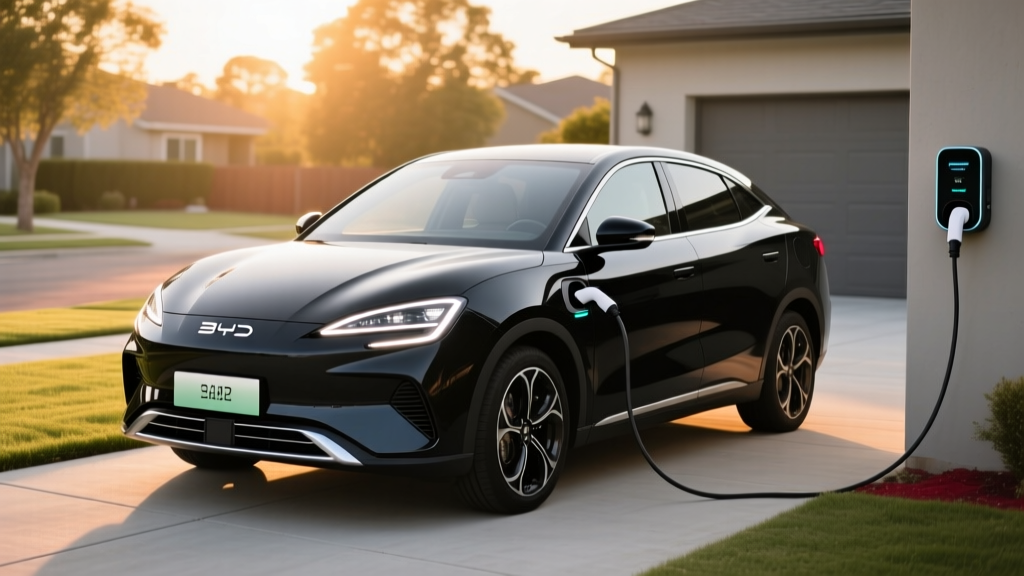
BYD has been the world's top-selling plug-in automaker since overtaking Tesla in 2023, but for US-based EV shoppers, the Chinese brand has remained an elusive headline rather than a driveway option. The 2026 BYD Atto 3 (sold as the Yuan Plus in China) is the compact crossover BYD has positioned as its global ambassador — a right-sized, LFP-powered SUV aimed squarely at the Hyundai Kona Electric, Kia Niro EV, and Nissan Ariya. With the Atto 3 beginning limited US-market availability in select states for the 2026 model year, we're breaking down exactly what American buyers get — and what they give up — in this detailed BYD review.
This review is based on BYD's published 2026 US-spec figures, EPA preliminary filings, and our early drive impressions from the Atto 3's North American launch event. Specs are subject to change as BYD finalizes US homologation.
| Spec | Value |
|---|---|
| Body Style | Compact 5-passenger crossover SUV |
| Drivetrain | FWD (single motor); AWD optional (dual motor) |
| Horsepower | 201 hp (FWD) / 308 hp (AWD) |
| 0-60 mph | 7.0 sec (FWD) / 5.5 sec (AWD, est.) |
| Battery (usable) | 58.56 kWh (Standard) / 76.8 kWh (Extended) |
| Battery Chemistry | LFP (Lithium Iron Phosphate) — BYD Blade |
| EPA Range (est.) | 230 mi (Std) / 295 mi (Ext, FWD) |
| EPA Efficiency (est.) | 118 MPGe combined / 29 kWh/100mi |
| Max DC Fast Charge | 88 kW (Std) / 110 kW (Ext) |
| 10-80% DC Time | ~29 min (Std) / ~38 min (Ext) |
| Level 2 AC Charge | 7 kW onboard charger (~25 mi/hr) |
| Cargo Volume | 15.8 cu ft (rear seats up) / 47.3 cu ft (folded) |
| Rear Legroom | 37.4 inches |
| Base MSRP (FWD Std) | $34,990 |
| As-Tested (AWD Ext, Premium) | $44,580 |
| Battery Warranty | 8 years / 100,000 miles |
Range and Efficiency: EPA Numbers Meet Real-World Physics
The 2026 Atto 3 arrives with two battery sizes. The Standard Range pack holds 58.56 kWh of usable energy and carries a preliminary EPA-estimated 230 miles of range. The Extended Range model bumps usable capacity to 76.8 kWh for an estimated EPA 295 miles in FWD form (AWD trims drop to approximately 272 miles due to the second motor's parasitic drag and added weight).
Real-World Range Reality Check
EPA sticker: 295 miles (Extended Range FWD)
Expect in real-world highway driving (70-80 mph): ~240-260 miles
Cold weather (below 32°F) with cabin heat: ~210-235 miles
Combined suburban/city with mild regen: ~275-290 miles
LFP chemistry holds up better than NMC in extreme cold at low states of charge, but you'll still lose 15-25% of range in sustained sub-freezing driving. The Atto 3's standard heat pump helps mitigate cabin-heating losses compared to resistive heaters.
Efficiency lands at an estimated 118 MPGe combined (29 kWh per 100 miles) for the FWD Extended Range. That's competitive with the Kona Electric (120 MPGe) but trails the Ioniq 5 RWD (132 MPGe). The Atto 3's relatively tall, upright crossover profile creates more aerodynamic drag at highway speeds than sleeker competitors, which is where most of its real-world range deficit shows up. City drivers using strong regen will see numbers closer to — or even above — the EPA sticker.
Charging Speed: The 88-110 kW Question
DC fast charging is where US buyers will notice the Atto 3's most significant competitive gap. The Standard Range model peaks at 88 kW on a DC fast charger; the Extended Range tops out at 110 kW. In a market where the Ioniq 5 hits 240 kW (800V architecture) and even the base Model Y sustains around 170 kW, the Atto 3's charging speeds are a generation behind.
| Charging Method | Peak Power | Rate / Time |
|---|---|---|
| Level 1 (120V household) | 1.4 kW | ~4 mi/hr |
| Level 2 (240V, 32A home) | 7 kW | ~25 mi/hr (full charge ~10-11 hrs) |
| DC Fast Charge (Std Range) | 88 kW | 10-80% in ~29 min |
| DC Fast Charge (Ext Range) | 110 kW | 10-80% in ~38 min |
| Charge Curve Note | Peak kW sustained to ~55% SoC, then taper; 80-100% adds ~25 min | |
What does this mean in practice? On a road trip, you'll spend roughly 35-45 minutes at a DC fast charger to go from 10% to 80% — enough for a lunch break but noticeably longer than the 18 minutes an Ioniq 5 needs. The Atto 3 uses a CCS1 connector for the US market (BYD has confirmed NACS adapter availability but no native NACS port for 2026). For daily home charging on Level 2, the 7 kW onboard charger adds about 25 miles of range per hour — perfectly adequate for overnight top-ups and the way most EV owners actually charge.
One LFP-specific advantage: BYD recommends periodic 100% charges to keep the battery management system calibrated. Unlike NMC batteries, which degrade faster when held at high states of charge, LFP chemistry tolerates full charges well. Plan to charge to 100% at least once a week for accurate range estimation.
Performance and Driving Impressions
The FWD Atto 3's 201-hp single front motor delivers adequate but unremarkable acceleration. The 7.0-second 0-60 mph time is on par with the base Kona Electric and noticeably slower than a Model Y RWD (5.8 sec). Highway merging is confident, and the instant torque makes city driving feel brisker than the stopwatch suggests.
The available dual-motor AWD variant bumps output to 308 hp and drops the 0-60 time to an estimated 5.5 seconds. It's a meaningful upgrade for buyers in snow-belt states, and the torque-vectoring rear motor adds stability in low-traction conditions. Ride quality is tuned for comfort over sportiness — the Atto 3 soaks up potholes and expansion joints well, though body roll is noticeable in aggressive cornering. Steering is light and numb, which suits commuting but disappoints enthusiasts.
Regen braking offers three levels plus a "one-pedal" mode that brings the Atto 3 to a near-stop (it creeps at ~2 mph rather than holding fully). NVH (noise, vibration, harshness) is competitive for the segment, with minimal wind noise at highway speeds and a well-isolated motor whine.
Interior, Cargo, and Technology
Step inside and the Atto 3's cabin immediately distinguishes itself from BYD's earlier export efforts. The "muscle fiber" dashboard texture and guitar-string door pulls are quirky — polarizing, but at least memorable. Material quality punches above its price class, with soft-touch surfaces on the dash and upper door panels, though hard plastics appear on the lower doors and center console.
The centerpiece is a 15.6-inch rotating infotainment display — a BYD signature. It flips between landscape and portrait orientation depending on the app (navigation prefers landscape; music and climate prefer portrait). The system runs BYD's DiLink OS with wireless Apple CarPlay and Android Auto, built-in navigation, and OTA update capability. Response times are good, though the menu hierarchy takes a learning curve and some climate controls are buried in touchscreen submenus — a growing frustration across the industry.
Passenger space is generous for the compact crossover segment. Front headroom and legroom are ample, and the 37.4-inch rear legroom beats the Kona Electric (36.5 in) and trails only the Ioniq 5 (39.4 in). The rear floor is flat thanks to BYD's skateboard-style Blade battery packaging.
Cargo capacity comes in at 15.8 cubic feet behind the rear seats and 47.3 cubic feet with the 60/40 split folded. There is no front trunk (frunk) — the space is consumed by power electronics. A power liftgate is standard on Extended Range trims.
Driver assistance is handled by BYD's DiPilot suite: adaptive cruise control with stop-and-go, lane-centering assist, blind-spot monitoring, rear cross-traffic alert, and automatic emergency braking with pedestrian detection. This is SAE Level 2 driver assistance — it does not replace an attentive driver, and the lane-centering system can be indecisive on faded highway markings. There is no hands-free driving mode comparable to GM's Super Cruise or Ford's BlueCruise.
Pricing, Trims, and Federal Tax Credit Eligibility
The 2026 Atto 3 launches in three US trims:
| Trim | MSRP | Est. §30D Credit* | Effective Price |
|---|---|---|---|
| Standard Range FWD (Essential) | $34,990 | $0–$3,750 | $31,240–$34,990 |
| Extended Range FWD (Design) | $38,990 | $0–$3,750 | $35,240–$38,990 |
| Extended Range AWD (Premium) | $44,580 | $0–$3,750 | $40,830–$44,580 |
*Federal tax credit eligibility under IRS §30D depends on battery component and critical-mineral sourcing requirements, buyer AGI limits ($150K single / $300K joint), and vehicle MSRP caps ($55,000 for SUVs). BYD's China-manufactured battery cells currently face sourcing hurdles that may reduce or eliminate the credit. Always verify current eligibility at IRS.gov and consult a tax professional before purchase. Credit may be transferred to the dealer as a point-of-sale discount if eligible.
This is the Atto 3's biggest US-market vulnerability. Under current IRS §30D rules, the full $7,500 federal tax credit requires that battery components and critical minerals meet phased-in domestic/free-trade-partner sourcing thresholds. BYD's vertically integrated Blade battery is manufactured in China, and as of early 2026, the Atto 3 is expected to qualify for at most the $3,750 critical-minerals half of the credit — and potentially $0 if sourcing requirements tighten further. This puts the Atto 3 at a significant effective-price disadvantage against US-assembled competitors like the Tesla Model Y and GM Equinox EV, which can qualify for the full $7,500.
Additionally, a 100% tariff on Chinese-manufactured EVs (in place since 2024) is baked into BYD's US pricing. The Atto 3's MSRP already reflects this cost burden, which is why a compact crossover that sells for the equivalent of ~$20,000 in Europe and Asia arrives in the US near $35,000.
Ownership, Warranty, and Long-Term Battery Outlook
BYD backs the Atto 3's Blade LFP battery with an 8-year / 100,000-mile warranty (whichever comes first), with a guaranteed capacity retention threshold of 70% — in line with industry norms. The vehicle limited warranty covers 6 years / 60,000 miles. BYD's US dealer and service network is still in early build-out as of 2026, with authorized service centers concentrated in California, Texas, Florida, and the Northeast. Buyers in other regions should confirm local service availability before committing.
LFP chemistry is the Atto 3's strongest long-term ownership card. BYD's Blade cell format has demonstrated excellent cycle life in third-party testing — fueleconomy.gov notes that LFP batteries typically retain 80%+ capacity after 2,000+ full charge cycles, which translates to well over 300,000 miles in typical use. Degradation in the Atto 3 is expected to be modest, likely 8-12% over the first 100,000 miles based on international fleet data. If a pack replacement is ever needed, BYD's integrated Blade modules are individually serviceable, potentially reducing out-of-warranty replacement cost versus competitors with bonded packs — though US parts pricing has not been published.
BYD Atto 3 vs. Key US Competitors
The Atto 3 competes in a crowded compact EV crossover space. Here's how it stacks up on paper against three benchmarks:
| Spec | BYD Atto 3 Ext FWD | Hyundai Kona Electric | Kia Niro EV | Tesla Model Y RWD |
|---|---|---|---|---|
| EPA Range | 295 mi | 261 mi | 239 mi | 320 mi |
| Battery (kWh) | 76.8 (LFP) | 64.8 (NMC) | 64.8 (NMC) | 60 (LFP) |
| Peak DC Charge | 110 kW | 100 kW | 85 kW | 170 kW |
| 0-60 mph | 7.0 sec | 6.6 sec | 7.0 sec | 5.8 sec |
| Cargo (rear up) | 15.8 cu ft | 25.5 cu ft | 18.5 cu ft | 30.2 cu ft |
| Base MSRP | $34,990 | $33,990 | $39,600 | $44,990 |
| Full $7,500 Credit? | Unlikely | No (Korea) | No (Korea) | Yes (US-built) |
The Atto 3's range-per-dollar is strong, but cargo space is its weak point — the Kona Electric offers 60% more room behind the rear seats. The Model Y dominates on charging speed and Supercharger network access but costs significantly more upfront. Korean competitors face their own tax-credit sourcing issues. Buyers prioritizing maximum cargo capacity should cross-shop the Ioniq 5 or Model Y; those wanting the lowest entry price may find a well-equipped Kona Electric more practical.
Pros
- LFP Blade battery offers excellent long-term cycle life and cold-weather resilience
- Competitive EPA range for the price point (295 mi Extended)
- Distinctive, well-finished interior with generous rear legroom
- Standard heat pump (many competitors charge extra or omit it)
- Lower base MSRP than Tesla and most AWD-equipped rivals
- Rotating 15.6" display is genuinely useful for nav + media
Cons
- DC fast charging (88-110 kW) trails segment leaders by 2-3x
- Federal tax credit likely limited to $3,750 or $0 due to China battery sourcing
- Cargo space (15.8 cu ft) is the smallest in class
- No frunk, no native NACS port (adapter only)
- Early-stage US dealer/service network limits support in many states
- DiPilot ADAS is functional but behind Super Cruise / BlueCruise refinement
- 100% China tariff inflates US price vs. global markets
Who Should Buy the 2026 BYD Atto 3?
Choose the Atto 3 if:
- You're a primarily city and suburban driver who charges at home nightly and rarely road-trips more than 200 miles
- You value long-term battery longevity and want LFP chemistry's proven cycle life
- You live in a state with strong BYD dealer presence (CA, TX, FL, NY/NJ)
- You want a distinctive, non-Tesla EV with genuine personality
- Your state offers a robust local EV rebate (e.g., California, Colorado, Massachusetts) that offsets the federal credit gap
Look elsewhere if:
- You take frequent road trips and need fast DC charging (choose Ioniq 5 or Model Y)
- You need maximum cargo space for family gear (choose Kona Electric or Ioniq 5)
- The full $7,500 federal credit is essential to your budget (choose a US-built EV like the Equinox EV or Model Y)
- You live in a region with no nearby BYD service center
Frequently Asked Questions
What is the real-world range of the 2026 BYD Atto 3?
The Extended Range FWD model carries a preliminary EPA estimate of 295 miles. In real-world highway driving at 70-80 mph, expect approximately 240-260 miles. In sustained cold weather below freezing, plan for 210-235 miles. City driving with regenerative braking can match or slightly exceed the EPA sticker.
How fast does the Atto 3 charge at home and on DC fast chargers?
On a 240V Level 2 home charger, the Atto 3 draws up to 7 kW, adding roughly 25 miles of range per hour — a full overnight charge is easily achievable. On DC fast chargers, the Extended Range peaks at 110 kW (10-80% in ~38 minutes); the Standard Range peaks at 88 kW (10-80% in ~29 minutes). Charging tapers significantly above 80% SoC, so plan to unplug at 80% on road trips.
How much does the BYD Atto 3 cost after tax credits?
Base MSRP starts at $34,990 for the Standard Range FWD. Due to China-manufactured battery sourcing, the Atto 3 is expected to qualify for at most $3,750 of the federal §30D credit (the critical-minerals half), bringing the effective floor to approximately $31,240. Full $7,500 credit eligibility is unlikely under current rules. State incentives may further reduce cost — check fueleconomy.gov's incentive tracker for your location.
Does the BYD Atto 3 qualify for the federal EV tax credit?
Partially, and it depends on your income. Under current IRS §30D rules, the Atto 3 likely qualifies for the $3,750 critical-minerals portion of the credit but not the $3,750 battery-components half, due to China-based cell manufacturing. Buyer income must be below $150,000 (single) or $300,000 (joint) AGI. The MSRP falls well under the $55,000 SUV cap. Always verify current eligibility on IRS.gov before purchasing, as sourcing rules are updated periodically.
Is the BYD Atto 3 worth buying over a Tesla Model Y or Hyundai Ioniq 5?
It depends on your priorities. The Atto 3 wins on LFP battery longevity and base price. The Model Y wins on range (320 mi), charging speed (170 kW), Supercharger access, cargo space (30.2 cu ft), and full $7,500 credit eligibility — but costs $10,000 more. The Ioniq 5 dominates DC charging speed (240 kW, 18-min 10-80%) and interior space. For a city commuter who charges at home and values battery lifespan, the Atto 3 is a strong choice. For road-trippers and families, the Ioniq 5 or Model Y remain more practical.
What is BYD's Blade battery and why does it matter?
The Blade battery is BYD's proprietary LFP (lithium iron phosphate) cell format, arranged in long, thin "blade" modules that double as structural elements. LFP chemistry sacrifices some energy density versus NMC but gains significantly in cycle life (2,000+ cycles to 80% capacity), thermal stability (resists thermal runaway), and cost. For owners, this means slower long-term degradation, safer crash performance, and the ability to charge to 100% regularly without accelerating wear.
Does the Atto 3 have a NACS (Tesla) charging port?
No. The 2026 US-spec Atto 3 uses a CCS1 port. BYD has confirmed that a NACS adapter will be available, enabling access to Tesla Superchargers equipped with the Magic Dock. However, native NACS ports are not planned until a future model-year refresh.