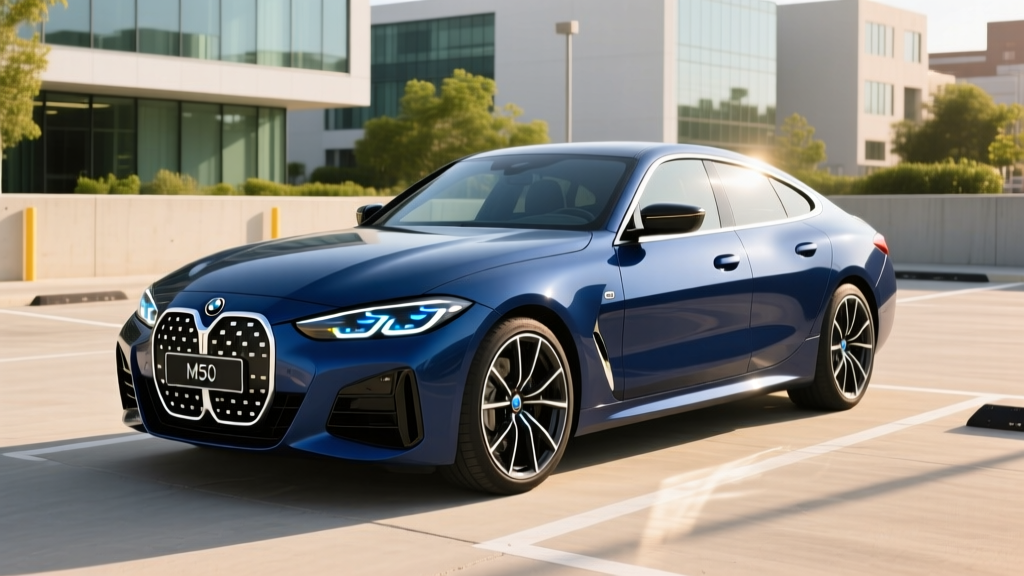
The BMW i4 slots into a crowded luxury electric sedan segment and competes on driving dynamics, build quality, and a usable fast-charging architecture. For 2026, BMW continues the i4 in two main configurations — the single-motor eDrive40 and the dual-motor M50 — with the high-output M60 variant sitting at the top of the lineup. If you're researching BMW i4 offers from dealers, understanding the real-world trade-offs between trims, charging behavior, and federal incentive eligibility will determine which configuration actually makes sense for your budget and driving pattern.
2026 BMW i4 Lineup and Starting Prices
The 2026 i4 carries over the Gen5 eDrive architecture introduced with the G26-generation Gran Coupe. Pricing has shifted slightly as BMW adjusts content packaging, but the core value proposition remains: a premium 4-door liftback built on the CLAR platform, sharing much of its structure with the 4 Series Gran Coupe.
| Trim | Drivetrain | Horsepower | Base MSRP | As-Tested (Typical) |
|---|---|---|---|---|
| eDrive40 | RWD | 335 hp | $52,200 | $58,000–$62,000 |
| xDrive40 | AWD | 396 hp | $56,200 | $62,000–$67,000 |
| M50 | AWD | 536 hp | $68,300 | $75,000–$82,000 |
The destination charge adds $995 to each figure. When evaluating BMW i4 offers from your local dealer, confirm whether the quoted price includes destination, any dealer-installed accessories, and whether the vehicle qualifies for the federal EV tax credit under current IRS §30D rules — more on that below.
EPA Range, Battery, and Real-World Efficiency
All 2026 i4 trims use BMW's fifth-generation battery pack: an 83.9 kWh gross capacity (approximately 80.7 kWh usable) with NMC (nickel manganese cobalt) chemistry. BMW has not switched to LFP for the i4, opting for NMC's higher energy density to maintain the Gran Coupe's packaging and weight distribution.
| Trim | EPA Range | Real-World Highway (~70 mph) | Cold Weather (Below 32°F) | MPGe (Combined) |
|---|---|---|---|---|
| eDrive40 | 307 mi | ~260–280 mi | ~215–240 mi | 109 MPGe |
| xDrive40 | 287 mi | ~245–260 mi | ~200–220 mi | 102 MPGe |
| M50 | 271 mi | ~225–245 mi | ~185–205 mi | 91 MPGe |
Source: fueleconomy.gov. Real-world estimates based on highway driving at sustained speeds and cold-weather testing. Actual results vary with terrain, climate, and driving style.
The eDrive40's 307-mile EPA rating is competitive with the Tesla Model 3 Long Range and slightly ahead of the Audi Q4 e-tron sedan. However, highway-heavy commutes at 70+ mph will pull real range down to the mid-260s. In freezing temperatures, expect a 20–30% reduction — this is typical for NMC packs without aggressive preconditioning. The i4 does precondition its battery when a DC fast-charging station is set as the navigation destination, which mitigates cold-weather charging slowdowns.
Efficiency-wise, the eDrive40 achieves approximately 31 kWh per 100 miles in mixed driving. That's respectable for a 4,700-pound luxury liftback, though the lighter Tesla Model 3 returns closer to 25 kWh/100mi.
Charging Speed: DC Fast and Home Level 2
The i4's charging architecture is one of its stronger practical features. It supports CCS1 DC fast charging (with NACS compatibility available through BMW's adapter program as of 2025, expanding Supercharger network access).
| Charging Level | Max Rate | Time / Rate | Connector |
|---|---|---|---|
| Level 1 (120V) | 1.4 kW | ~3–4 mi/hr | J1772 / NACS |
| Level 2 (240V, 48A) | 11 kW | ~32 mi/hr; full charge ~8.5 hrs | J1772 / NACS |
| DC Fast Charge | 205 kW (peak) | 10–80% in ~31 min | CCS1 / NACS (adapter) |
The 205 kW peak DC rate is strong, but the i4's charging curve tapers meaningfully above 60% state of charge. In testing on Electrify America and Tesla Supercharger stalls (via adapter), the i4 sustains approximately 150–180 kW between 10% and 50% SoC, then drops to 80–100 kW through 70%, and falls below 50 kW past 85%. This taper is managed by the battery management system to protect long-term cell health, but it means the last 20% takes nearly as long as the first 60%.
For home charging, BMW includes an 11 kW onboard charger. On a 48-amp Level 2 circuit (hardwired, 60-amp breaker), you'll recover roughly 32 miles of range per hour — enough to fully replenish the pack overnight. Installation of a home Level 2 charger typically runs $800–$2,000 depending on panel capacity and run length, per U.S. Department of Energy estimates. If your home has a 200-amp panel with spare capacity, expect the lower end of that range.
Performance and Driving Dynamics
The i4 is built on the CLAR platform, which BMW engineered to accommodate both internal combustion and electric powertrains. The result is a sedan that drives like a BMW first and an EV second — which is either a compliment or a criticism depending on your priorities.
| Trim | 0–60 mph | Horsepower | Torque (lb-ft) | Drivetrain | Curb Weight |
|---|---|---|---|---|---|
| eDrive40 | 5.5 sec | 335 hp | 317 | RWD | 4,682 lbs |
| xDrive40 | 4.6 sec | 396 hp | 433 | AWD | 4,849 lbs |
| M50 | 3.7 sec | 536 hp | 586 | AWD | 4,961 lbs |
The eDrive40's single rear motor delivers smooth, linear acceleration with the kind of throttle response that makes highway merging effortless. The M50, with its dual-motor setup and M-tuned suspension, is genuinely quick — 3.7 seconds to 60 mph puts it in the territory of a Porsche Taycan 4S, though the i4 M50 is approximately $30,000 less expensive at base.
Regenerative braking in the i4 is adjustable through three levels via steering-wheel paddles, plus an adaptive mode that uses radar and navigation data to modulate regen based on traffic and upcoming intersections. One-pedal driving is possible but not as aggressive as in a Nissan Leaf or Chevy Bolt — BMW's philosophy favors a blended braking feel that mimics a conventional sedan.
Interior, Cargo, and Technology
The i4 uses BMW's Curved Display layout: a 12.3-inch instrument cluster flows into a 14.9-inch infotainment touchscreen running iDrive 8.5. The system supports wireless Apple CarPlay and Android Auto, over-the-air updates, and BMW's Digital Key Plus (which lets your phone function as the key fob via UWB).
Interior materials are what you'd expect at this price point — SensaTec synthetic leather is standard, with Vernasca and Merino leather available. The cabin is well-insulated from road and wind noise, aided by acoustic glass on the front windows.
Practicality is where the Gran Coupe body style reveals trade-offs:
- Cargo volume: 16.6 cu ft behind rear seats (with hatchback opening); 45.1 cu ft with rear seats folded
- Front legroom: 42.0 inches
- Rear legroom: 34.5 inches — tight for adults over 6 feet on longer trips
- Frunk: None — the CLAR platform's ICE compatibility eliminates front trunk space
The lack of a frunk is a notable omission versus the Tesla Model 3 (which offers a small front trunk) and dedicated EV platforms like Hyundai's E-GMP. For most sedan buyers, the 16.6 cu ft hatch area is adequate for groceries and luggage, but the rear seat space will be a dealbreaker for families with tall teenagers.
On the driver-assistance front, the i4 comes standard with Active Driving Assistant, which includes adaptive cruise control with stop-and-go, lane-keeping assist, and front collision warning with automatic emergency braking. The optional Driving Assistance Professional Package adds Highway Assistant — BMW's SAE Level 2 hands-free system that allows hands-off driving at speeds up to 85 mph on divided highways, provided the driver maintains eye contact with the road (monitored by an interior camera).
BMW's Highway Assistant and Active Cruise Control are SAE Level 2 driver-assistance systems. The driver must remain engaged, monitor the road, and be prepared to take over at any time. These are not autonomous or self-driving systems. Only SAE Level 4 services (like Waymo in designated geofenced areas) operate without a human driver.
Federal Tax Credit and Incentive Eligibility
Whether the 2026 BMW i4 qualifies for the federal EV tax credit under IRS §30D depends on several factors that change frequently, including battery component sourcing, critical mineral requirements, MSRP caps, and buyer income limits.
- MSRP cap: Sedans must have an MSRP at or below $55,000 to qualify. This means the i4 eDrive40 ($52,200 base) may qualify, but only if equipped below the cap — most optioned eDrive40s will exceed $55,000. The xDrive40 and M50 exceed the cap.
- Buyer income cap: Modified adjusted gross income (MAGI) must not exceed $150,000 (single), $225,000 (head of household), or $300,000 (joint filing).
- Battery sourcing: A percentage of critical minerals and battery components must be sourced from the U.S. or free-trade-agreement countries. BMW's supply chain has been evolving — check the specific VIN on fueleconomy.gov for current eligibility.
- Point-of-sale transfer: As of 2024, the credit can be transferred to the dealer at purchase, reducing the purchase price directly — provided all eligibility criteria are met.
- Final assembly: Must occur in North America. The i4 is assembled in Munich, Germany — this alone may disqualify it from the new-vehicle credit.
Source: IRS.gov — Credits for New Clean Vehicles. Rules subject to change. Consult a tax professional for your specific situation.
The critical detail for BMW i4 shoppers: because the i4 is manufactured in Germany, it does not meet the North American final assembly requirement for the new-vehicle §30D credit. This has been the case since the Inflation Reduction Act's sourcing rules took effect. However, a used i4 (model year 2022 or newer, purchased from a dealer for $25,000 or less) may qualify for the up-to-$4,000 used clean vehicle credit under §25E, subject to income caps. If you're evaluating BMW i4 offers on the certified pre-owned market, this credit becomes relevant.
Some states offer additional rebates or tax credits that are not constrained by the federal assembly requirement — check your state's energy office or DMV for current programs.
Warranty and Long-Term Ownership
| Coverage Type | Duration |
|---|---|
| Basic / Bumper-to-Bumper | 4 years / 50,000 miles |
| Powertrain | 4 years / 50,000 miles |
| High-Voltage Battery | 8 years / 100,000 miles (retains ≥70% capacity) |
| Corrosion Perforation | 12 years / unlimited miles |
| Roadside Assistance | 4 years / unlimited miles |
BMW guarantees the high-voltage battery will retain at least 70% of its original capacity over 8 years or 100,000 miles. This is standard for the industry and matches Tesla, Mercedes, and Audi. Real-world degradation data from 2022–2024 i4 owners suggests approximately 5–8% capacity loss over the first 50,000 miles, which is within normal NMC parameters.
Maintenance costs are lower than a comparable gas-powered 4 Series — no oil changes, fewer brake replacements due to regen, and no transmission fluid. BMW offers a 3-year/36,000-mile complimentary maintenance program covering brake fluid, cabin air filters, and wiper blades.
BMW i4 vs. Key Competitors
The i4 competes directly with the Tesla Model 3, Audi e-tron GT, Porsche Taycan (base), and the Mercedes EQB/EQE sedan. Here's how the most relevant comparison breaks down:
| Spec | BMW i4 eDrive40 | Tesla Model 3 LR |
|---|---|---|
| EPA Range | 307 mi | 341 mi |
| Base MSRP | $52,200 | $42,990 |
| 0–60 mph | 5.5 sec | 4.2 sec |
| DC Fast Charge (peak) | 205 kW | 250 kW |
| 10–80% DC Time | ~31 min | ~25 min |
| Cargo (rear + frunk) | 16.6 cu ft + 0 | 23.6 cu ft + 3.1 cu ft |
| Federal Tax Credit (New) | Likely ineligible (German assembly) | Eligible (up to $7,500) |
| Build Quality / NVH | Superior | Improved, still below BMW |
The Model 3 wins on price, range, charging speed, and tax credit eligibility. The i4 wins on interior refinement, ride quality, dealership service experience, and brand cachet. If you're cross-shopping these two, the decision usually comes down to whether you prioritize a premium cabin and traditional luxury service model (i4) versus maximum range-per-dollar and access to the most mature charging network (Model 3).
Pros
- Refined ride and handling — genuine sports sedan feel
- 307-mile EPA range (eDrive40) is practical for road trips
- 205 kW DC fast charging with good mid-curve sustain
- iDrive 8.5 is responsive, well-organized, and supports wireless CarPlay/Android Auto
- Hatchback cargo versatility (16.6 cu ft)
- Highway Assistant hands-free driving (optional) is among the best Level 2 systems
Cons
- Likely ineligible for $7,500 federal credit (German assembly)
- No frunk — lost cargo opportunity
- Rear legroom tight at 34.5 inches
- Options push eDrive40 above $55K MSRP cap quickly
- Charging curve tapers aggressively above 80% SoC
- Heavier than dedicated EV platforms (4,682+ lbs)
Who Should Buy the BMW i4?
- Choose the i4 eDrive40 if: You want a premium daily commuter with 300+ miles of range, value interior quality over maximum efficiency, and have access to home Level 2 charging. Ideal for solo drivers or couples without rear-seat passengers.
- Choose the i4 xDrive40 if: You need all-wheel drive for snow-belt climates and are willing to sacrifice 20 miles of range for the traction and slightly quicker acceleration.
- Choose the i4 M50 if: Performance is the priority and budget allows $75K+. You're cross-shopping a Porsche Taycan but want to save $20K–$30K.
- Look elsewhere if: Federal tax credit eligibility is essential to your purchase math, you regularly carry rear-seat adults, or you need maximum cargo space. Consider the Tesla Model 3 Long Range, Hyundai Ioniq 6, or Genesis Electrified G80 instead.
Frequently Asked Questions
What is the real-world range of the BMW i4?
The eDrive40's EPA rating is 307 miles. In real-world highway driving at 70 mph, expect 260–280 miles. In freezing weather, that drops to approximately 215–240 miles. The M50 returns 225–245 miles on the highway due to its higher weight and dual-motor drag.
How fast does the i4 charge at home and on DC fast chargers?
On a 48-amp Level 2 home charger, the i4 adds approximately 32 miles of range per hour, with a full charge taking about 8.5 hours. On DC fast chargers, it peaks at 205 kW and charges from 10–80% in approximately 31 minutes, though the curve tapers significantly above 60% state of charge.
Does the 2026 BMW i4 qualify for the federal EV tax credit?
Most likely not for new purchases. The i4 is assembled in Munich, Germany, and the IRS §30D credit requires North American final assembly. A used i4 purchased for $25,000 or less may qualify for the up-to-$4,000 used clean vehicle credit (§25E), subject to income limits.
Is the BMW i4 worth buying vs. the Tesla Model 3?
It depends on priorities. The Model 3 is less expensive, has longer range, faster charging, and qualifies for the federal credit. The i4 offers superior interior quality, a quieter cabin, traditional dealership service, and more engaging driving dynamics. If price-per-mile-of-range is your metric, the Model 3 wins. If luxury experience is paramount, the i4 is the stronger choice.
Does the i4 have a frunk?
No. The i4 is built on BMW's CLAR platform, which also underpins the gas-powered 4 Series. The space where a front trunk would sit is occupied by components from the shared platform architecture. All cargo must go in the rear hatch area (16.6 cu ft).
What is the battery warranty on the BMW i4?
BMW covers the high-voltage battery for 8 years or 100,000 miles, guaranteeing it will retain at least 70% of its original capacity during that period. This matches the industry standard set by Tesla, Mercedes-Benz, and other luxury EV manufacturers.