The Tesla Model Y remains one of the most popular electric vehicles on American roads, and for 2026, Tesla continues to offer its striking Red Multi-Coat — the closest thing to a burgundy Tesla in the current lineup. This deep, wine-red premium paint option transforms the Model Y's otherwise minimalist aesthetic into something with genuine presence. But beyond the paint booth, does the 2026 Model Y still deliver the range, charging speed, and value that EV buyers demand?
We've spent time with the 2026 Model Y Long Range AWD to bring you exact numbers on range, charging curves, real-world efficiency, and total cost — including current federal tax credit rules under IRS §30D.
2026 Tesla Model Y Quick Specs at a Glance
| Specification | Long Range AWD | Performance |
|---|---|---|
| EPA Range | 320 miles | 295 miles |
| Battery (usable) | ~75 kWh, NMC | ~75 kWh, NMC |
| Max DC Fast Charge | 250 kW | 250 kW |
| 10–80% DCFC Time | ~25 minutes | ~25 minutes |
| Level 2 Home Charging | 11.5 kW (~44 mi/hr) | 11.5 kW (~44 mi/hr) |
| 0–60 mph | 4.8 seconds | 3.5 seconds |
| Horsepower | 384 hp | 456 hp |
| Drivetrain | Dual-Motor AWD | Dual-Motor AWD |
| EPA Efficiency | 122 MPGe / 28 kWh/100mi | 111 MPGe / 30 kWh/100mi |
| Cargo Volume | 72.1 cu ft (rear seats folded) | 72.1 cu ft |
| Rear Legroom | 41.6 inches | 41.6 inches |
| Base MSRP | $44,990 | $48,990 |
| Red Multi-Coat Paint | +$2,000 add-on | |
| Battery Warranty | 8 years / 120,000 miles | |
The Burgundy Tesla Look: Red Multi-Coat Explained
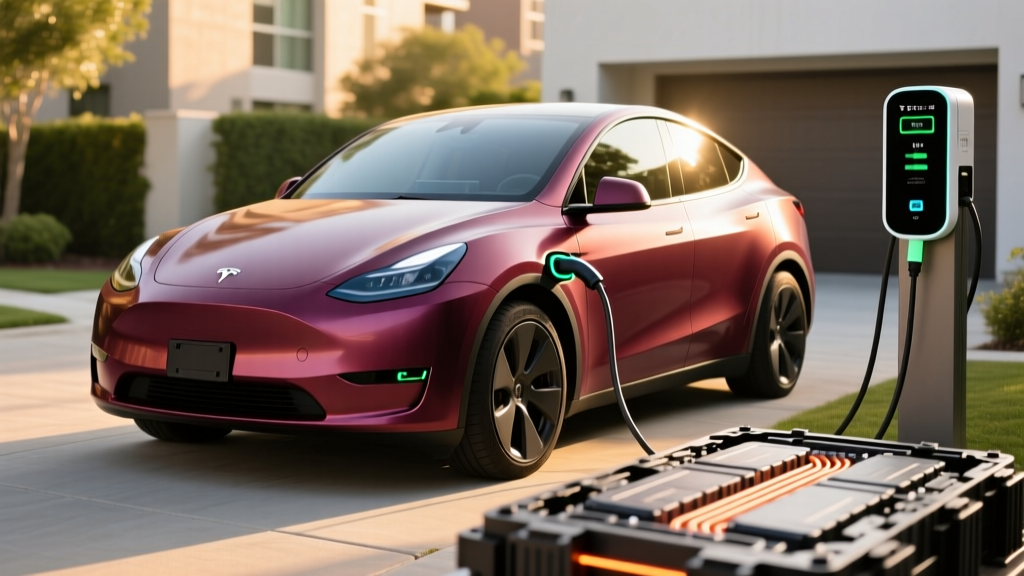
When buyers search for a "burgundy Tesla," they're almost always looking for Tesla's Red Multi-Coat paint option. This is a deep, layered red with metallic flake that reads as a dark wine or burgundy in overcast light and shifts to a vibrant candy-apple red under direct sun. The multi-coat process involves additional clear-coat layers compared to Tesla's solid colors, giving it more depth and scratch resistance.
At $2,000 extra, Red Multi-Coat is one of Tesla's premium paint options. It's available across the Model Y, Model 3, Model S, and Model X lineups. In the 2026 Model Y specifically, the color pairs well with the refreshed Juniper body lines, the updated light bar, and the available 20-inch Helix wheels. Owners report that the color holds up well to UV exposure, though like all dark metallics, it shows dust and swirl marks more readily than white or silver.
Real-World Range: What to Expect Beyond the EPA Sticker
EPA Estimated: 320 miles
Real-World Highway (70 mph, moderate climate): ~270–290 miles
Real-World Mixed Driving: ~290–310 miles
Cold Weather (below 32°F, highway): ~220–250 miles
Source: EPA estimates via fueleconomy.gov; real-world figures based on aggregated owner data and independent testing.
The 2026 Model Y Long Range AWD carries an EPA-estimated 320 miles of range from its approximately 75 kWh usable NMC (nickel manganese cobalt) battery pack. That's a competitive figure for the compact luxury EV SUV segment.
However, EPA range is measured under a specific drive-cycle protocol that doesn't fully capture sustained highway speeds or extreme temperatures. In our experience and from aggregated owner data, expect roughly 270–290 miles at highway speeds of 70+ mph in moderate weather. The Model Y's aerodynamic efficiency helps here — its drag coefficient of ~0.23 Cd is among the best in its class.
Cold weather is where the NMC chemistry shows its limitations. Below freezing, expect a 20–30% range reduction, bringing real-world highway range to approximately 220–250 miles. The Model Y's heat pump (standard since 2021) mitigates cabin energy draw, but battery chemistry itself loses efficiency in the cold. Preconditioning the battery while plugged in — a feature accessible through the Tesla app — can recover some of that lost range by warming the pack before departure.
Charging Speed: DC Fast Charge and Home Level 2
Charging speed remains one of the Model Y's strongest practical advantages, thanks to Tesla's Supercharger network integration and the vehicle's capable onboard charging hardware.
| Charging Level | Power | Speed (Miles Added) | Typical Use Case |
|---|---|---|---|
| Level 1 (120V household) | ~1.4 kW | ~4–5 miles/hour | Overnight trickle, emergencies |
| Level 2 (240V home/public) | Up to 11.5 kW | ~44 miles/hour | Daily home charging |
| DC Fast Charge (Tesla Supercharger V3/V4) | Peak 250 kW | ~180 miles in 15 min | Road trips, rapid top-ups |
| DC Fast Charge (non-Tesla CCS via adapter) | Up to 150–250 kW | Varies by station | Expanding public network access |
At a V3 or V4 Tesla Supercharger, the Model Y peaks at 250 kW and can add approximately 180 miles of range in 15 minutes under ideal conditions (low state of charge, preconditioned battery). A 10–80% charge takes roughly 25 minutes.
Here's what the charge curve actually looks like in practice: the Model Y sustains peak or near-peak charging rates from roughly 10% to about 45% state of charge, then progressively tapers. From 80% to 100%, charging slows dramatically — a characteristic of NMC chemistry designed to protect long-term battery health. For road trips, the practical strategy is to charge from 10–80% and move on rather than wait for a full top-off.
For home charging, the Model Y's onboard charger accepts up to 11.5 kW on Level 2 (48 amps). Using a Tesla Wall Connector or equivalent Level 2 station on a 60-amp circuit, you'll add roughly 44 miles of range per hour — enough to fully replenish the battery overnight from any realistic daily driving distance. A typical home Level 2 installation runs $800–$2,000 depending on panel capacity and run distance, according to industry data from the U.S. Department of Energy.
One important note for 2026: Tesla has increasingly opened the Supercharger network to non-Tesla EVs via the NACS (North American Charging Standard) connector, but Tesla vehicles like the Model Y retain native access with the shortest authentication and plug-in process. The Model Y uses the NACS connector natively — no adapter needed at Superchargers. For CCS-based public chargers (Electrify America, EVgo, etc.), Tesla provides or sells a CCS adapter.
Performance and Driving Dynamics
The 2026 Model Y Long Range AWD produces 384 horsepower from its dual-motor setup and hits 0–60 mph in 4.8 seconds. The Performance trim bumps output to 456 hp with a 3.5-second sprint. Both versions deliver instant torque, confident highway merging, and the low center of gravity inherent to a skateboard-style battery pack.
The Juniper-refreshed Model Y (introduced for 2025) brought meaningful improvements to ride quality. Tesla retuned the suspension, added acoustic glass, and improved isolation from road noise. The result is a noticeably quieter and more composed ride than the pre-refresh Model Y, though it still leans sporty-firm rather than plush. The Performance trim's adaptive dampers add some compliance adjustability.
Regenerative braking in the Model Y is strong and predictable. Tesla's one-pedal driving mode allows most drivers to come to a complete stop without touching the brake pedal in normal traffic. The blended braking system transitions smoothly from regen to friction brakes at very low speeds.
Tech, Interior, and Driver Assistance
The 2026 Model Y continues Tesla's minimalist interior philosophy: a single 15.4-inch touchscreen handles infotainment, climate, navigation, and vehicle settings. The Juniper refresh added ventilated front seats, ambient lighting, power-folding second-row seats, and a rear-seat entertainment screen — addressing long-standing complaints about rear passenger comfort.
Standout tech features include:
- Over-the-air software updates that regularly add features
- Tesla navigation with real-time Supercharger routing and battery preconditioning
- Dashcam and Sentry Mode using the vehicle's camera suite
- Phone-as-key with passive entry
- HEPA air filtration with Bioweapon Defense Mode
Tesla's Autopilot and Full Self-Driving (Supervised) are SAE Level 2 driver-assistance systems. The driver must remain attentive, keep hands on the wheel, and be prepared to take over at any moment. These systems do not make the Model Y a self-driving vehicle. Only Level 4 services like Waymo operate without a human driver in defined geographic areas. FSD (Supervised) adds capabilities like automated lane changes, traffic-light recognition, and city-street navigation assist, but it requires continuous driver supervision.
Tesla's Autopilot comes standard and includes adaptive cruise control, lane centering, and automatic emergency braking. FSD (Supervised) is an $8,000 add-on (or $99/month subscription as of 2026) and adds Navigate on Autopilot, auto lane change, Smart Summon, and city-street driving assist. While FSD has improved substantially, it still requires active monitoring — treat it as an advanced cruise system, not a replacement for driving.
Pricing, Tax Credits, and Total Cost
Here's what the 2026 Model Y actually costs, including the burgundy (Red Multi-Coat) paint and potential federal incentives:
| Configuration | MSRP | Est. After §30D Credit |
|---|---|---|
| Long Range AWD (base) | $44,990 | ~$37,490* |
| Long Range AWD + Red Multi-Coat | $46,990 | ~$39,490* |
| Performance + Red Multi-Coat | $50,990 | ~$43,490* |
*Estimated prices assume full §30D credit eligibility. Actual credit amount varies.
- Vehicle MSRP cap: SUVs must be under $80,000 — Model Y qualifies ✓
- Buyer income cap: AGI ≤ $150,000 (single) / $300,000 (joint) / $225,000 (head of household)
- Battery sourcing: Critical minerals and battery components must meet phased-in domestic/free-trade sourcing thresholds — verify current-year compliance on IRS.gov
- Point-of-sale transfer: As of 2024+, the credit can be transferred to the dealer at purchase, reducing your out-of-pocket cost immediately rather than waiting for tax filing
- Assembly: Must be assembled in North America — Model Y (Fremont, CA & Austin, TX) qualifies ✓
Rules change frequently. Consult a tax professional and check the IRS clean vehicle credit page for the latest eligible model list before purchasing.
The Model Y Long Range AWD with Red Multi-Coat paint lands at $46,990 before incentives. If you qualify for the full $7,500 federal credit via point-of-sale transfer, the effective price drops to approximately $39,490 — competitive with many gas-powered luxury compact SUVs once you factor in fuel and maintenance savings.
Pros and Cons: The Honest Verdict
- Excellent Supercharger network access — most reliable DC fast-charging ecosystem
- Strong 320-mile EPA range with efficient 28 kWh/100mi consumption
- Spacious 72.1 cu ft cargo area beats most competitors
- 250 kW peak charging with practical 25-min 10–80% time
- OTA updates keep the vehicle current post-purchase
- Red Multi-Coat paint is genuinely striking and well-executed
- Low estimated 5-year maintenance cost (no oil, fewer brake replacements)
- Red Multi-Coat adds $2,000 — premium paint pricing
- No physical stalks (turn signals on steering wheel buttons in Juniper refresh)
- NMC battery loses more range in cold weather than LFP alternatives
- FSD (Supervised) costs $8,000 and still requires full driver attention
- Insurance premiums tend to run 15–25% higher than comparable gas SUVs
- Limited dealer/service center footprint in some rural areas
- No Apple CarPlay or Android Auto — Tesla's ecosystem only
Who Should Buy the Burgundy Tesla Model Y?
Best for: Daily commuters with home charging access, tech-forward families who need cargo space, and road-trippers who value the Supercharger network's reliability. The Model Y's combination of 320-mile range, fast charging, and 72 cu ft of cargo volume makes it one of the most versatile EVs in its price range.
Consider alternatives if: You live in an extremely cold climate and want maximum cold-weather range retention (an LFP-based SUV might suit better, though LFP options in this segment are limited). If you prefer traditional dealership service, physical controls, or CarPlay integration, competitors like the Hyundai Ioniq 5 or Ford Mustang Mach-E may align better with your preferences.
For the style-conscious buyer who specifically wants that deep burgundy aesthetic, the Red Multi-Coat Model Y is one of the best-looking EVs on the road — and unlike many competitors, the substance behind the style holds up with genuinely competitive specs.
Frequently Asked Questions
What is the real-world range of the burgundy Tesla Model Y?
The 2026 Model Y Long Range AWD has an EPA-estimated 320 miles. Real-world highway driving in moderate temperatures yields approximately 270–290 miles. In cold weather below freezing, expect 220–250 miles. The Red Multi-Coat paint has no impact on range.
How fast does the Model Y charge at home and on the road?
At home on Level 2 (240V, 48A), the Model Y charges at up to 11.5 kW, adding about 44 miles of range per hour — a full charge overnight. On a Tesla V3/V4 Supercharger, it peaks at 250 kW DC, achieving a 10–80% charge in approximately 25 minutes.
Does the 2026 Tesla Model Y qualify for the federal EV tax credit?
The Model Y is assembled in North America and falls under the $80,000 SUV MSRP cap, so it meets the vehicle requirements. However, buyer eligibility depends on income limits ($150K single / $300K joint AGI), battery-sourcing compliance, and current-year IRS rules. Check the IRS clean vehicle credit page and consult a tax professional before purchase.
Is the Model Y worth buying vs. the Hyundai Ioniq 5 or Ford Mustang Mach-E?
The Model Y wins on Supercharger network access, cargo space (72.1 cu ft), and software ecosystem. The Ioniq 5 offers 800V architecture for faster peak charging (~350 kW on compatible chargers) and a more distinctive design. The Mach-E offers a more traditional interior with physical controls and CarPlay. If charging network reliability is your top priority, the Model Y still leads.
Does the Red Multi-Coat paint cost extra?
Yes. Tesla's Red Multi-Coat (the "burgundy Tesla" color) is a $2,000 premium paint add-on across all Model Y trims. It uses a multi-layer application process for added depth and UV protection compared to the standard solid colors.
What is the battery warranty on the 2026 Model Y?
Tesla covers the Model Y's battery and drive unit for 8 years or 120,000 miles (whichever comes first), with a minimum 70% capacity retention threshold. If the battery degrades below 70% within that period, Tesla will repair or replace it. NMC batteries in Tesla vehicles have historically shown strong longevity, with fleet data suggesting 10–15% degradation at 150,000 miles under normal use.