What Is the Garage 54 Cybertruck?
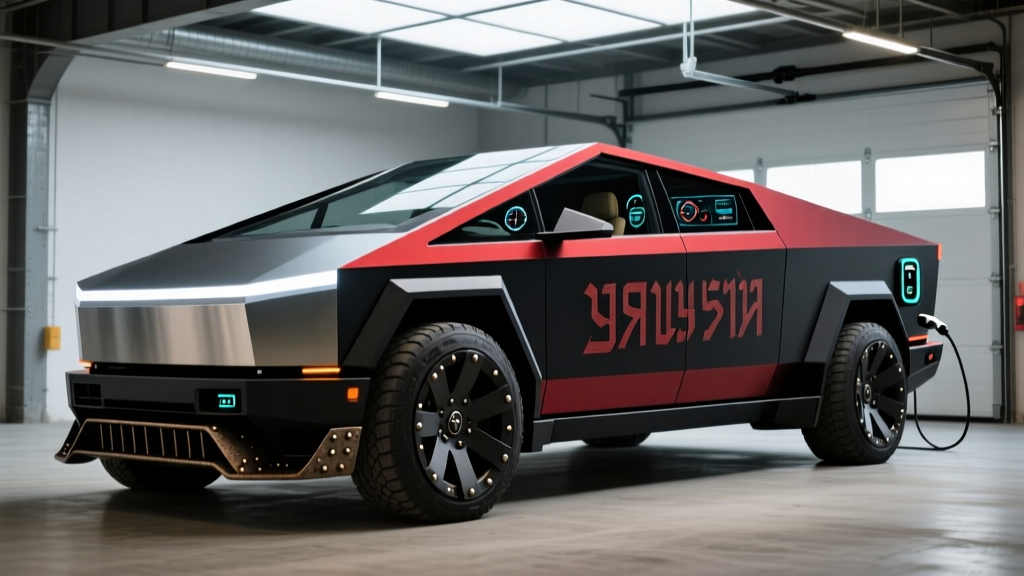
If you have spent any time in EV enthusiast circles over the past year, you have likely encountered the Garage 54 Cybertruck — a one-off electric vehicle project from the Russian YouTube channel and automotive workshop Garage 54. Unlike Tesla's production Cybertruck, this is a custom-built, hand-fabricated electric truck designed to replicate the Cybertruck's angular stainless-steel aesthetic while using an entirely independent electric powertrain.
Garage 54, based in Russia, is known for extreme automotive builds — engine swaps, forced-induction experiments, and full EV conversions. Their Cybertruck tribute is not a Tesla product, not affiliated with Tesla Inc., and not available for retail purchase. It is a showcase project that demonstrates what an independent workshop can achieve with off-the-shelf EV components, custom fabrication, and significant labor hours.
This review examines the known technical specifications, real-world performance observations from Garage 54's published testing, and what this build reveals about the state of independent EV conversions in 2026.
Powertrain, Battery, and Performance Specs
Garage 54's Cybertruck replica does not use a Tesla drivetrain. Instead, the team sourced components from the Chinese EV supply chain and integrated them into a custom tubular steel chassis. Here is what we know from their build documentation and road-test videos:
| Specification | Value / Detail |
|---|---|
| Drivetrain | Rear-wheel drive (single motor), AWD option explored |
| Motor Type | Permanent magnet synchronous motor (sourced from Chinese EV supplier) |
| Estimated Power Output | ~200–250 kW (~268–335 hp) at the wheels |
| 0–60 mph (claimed) | ~6.5–7.5 seconds (single-motor RWD configuration) |
| Battery Chemistry | NMC (Nickel Manganese Cobalt) lithium-ion pouch cells |
| Battery Capacity (estimated) | ~80–100 kWh (usable, based on module count shown in build) |
| Battery Voltage | ~400V nominal architecture |
| Thermal Management | Liquid cooling via custom loop |
| Top Speed | Electronically limited; tested to ~110 mph |
The motor and inverter are not from any single OEM platform. Garage 54 has used components consistent with those found in Chinese-market EVs like the BYD Han or NIO ES6, though exact part numbers have not been publicly confirmed. The battery pack is assembled from commercially available NMC pouch cells, wired in a series-parallel configuration and housed in a custom aluminum enclosure mounted low in the chassis for weight distribution.
Compared to Tesla's production Cybertruck Rear-Wheel Drive (which delivers 315 miles EPA range, a 0–60 time of ~6.5 seconds, and an 8-year/120,000-mile battery warranty per Tesla's official specs), the Garage 54 build trades factory refinement and warranty coverage for the ability to customize every parameter.
Range and Efficiency: Real-World Observations
Garage 54's Cybertruck does not carry an EPA range certification. Based on the team's road-test footage and battery telemetry shown in their videos, the estimated real-world range is approximately 180–220 miles (290–355 km) under mixed driving conditions. This accounts for the truck's high drag coefficient, heavy steel body panels, and NMC cell efficiency at moderate temperatures.
Because this is a one-off build, there is no fueleconomy.gov listing and no standardized efficiency rating. Garage 54 has reported energy consumption in the range of 38–45 kWh per 100 miles during their testing — significantly higher than a production Tesla Cybertruck AWD (rated at approximately 56 MPGe combined, or roughly 36 kWh/100 mi per the EPA). The higher consumption is expected given the replica's heavier curb weight (estimated at 6,800–7,200 lbs vs. the production Cybertruck's ~6,600 lbs), less aerodynamically optimized body, and the absence of Tesla's heat pump and advanced thermal management algorithms.
Cold-weather impact: NMC cells lose approximately 20–30% of usable capacity in sub-freezing temperatures without active pack preconditioning. Garage 54's liquid cooling loop provides some thermal regulation, but the system lacks the sophisticated heat-pump integration found in production EVs. In Russian winter testing (ambient temperatures around 14°F / -10°C), the team observed range reductions consistent with a 25–35% loss, bringing effective range down to roughly 130–160 miles.
Charging Capabilities
Charging is one area where independent EV conversions face real constraints. Without access to a manufacturer's proprietary charging protocol and network integration, Garage 54's Cybertruck relies on standard CCS (Combined Charging System) compatibility via an aftermarket charge controller.
| Charging Level | Power / Rate | Estimated Time |
|---|---|---|
| Level 1 (120V AC) | ~1.4 kW | ~60+ hours (0–100%) |
| Level 2 (240V AC, 48A) | ~11.5 kW | ~8–9 hours (0–100%) |
| DC Fast Charge (CCS) | ~80–120 kW peak (estimated) | ~45–60 minutes (10–80%) |
The DC fast-charging rate is limited by the aftermarket BMS (Battery Management System) and charge controller, not by the cells themselves. NMC pouch cells of this type can typically accept higher C-rates, but without OEM-grade thermal preconditioning and charge-curve optimization, the system must be conservative to avoid cell damage. Expect the charge rate to taper significantly above 70% state of charge — a common characteristic of non-OEM charge profiles.
For comparison, Tesla's production Cybertruck can accept up to 250 kW on a V3 Supercharger, achieving a 10–80% charge in approximately 20 minutes. The Garage 54 build charges roughly 2–3x slower on DC fast charging, which is a meaningful limitation for road-trip use but acceptable for a showcase vehicle that primarily drives locally.
Build Quality, Interior, and Technology
The Garage 54 Cybertruck's exterior is hand-formed from stainless steel sheet, welded and finished to approximate the Cybertruck's signature exoskeleton look. The result is visually striking but comes with trade-offs:
- Body panel gaps are wider than production standards — expected for hand-fabricated work.
- Sealing and weatherproofing are adequate but not OEM-grade; the team has documented water ingress issues during early testing that were subsequently addressed.
- The bed is functional but smaller than the production Cybertruck's 6.5-foot bed, due to the rear battery and motor packaging.
Inside, the cabin is spartan compared to any production EV. Garage 54 installed a basic touchscreen infotainment unit (Android-based, aftermarket), manual climate controls, and fabricated seats. There is no advanced driver-assistance system — no Autopilot, no adaptive cruise, no lane-keeping. This is a SAE Level 0 vehicle in terms of automation: the driver is responsible for all driving tasks at all times.
Cargo space: Exact cubic-foot measurements have not been published. Visually, the cabin offers seating for four adults with generous headroom (thanks to the tall roofline) but limited rear legroom compared to a production crew-cab truck. The bed appears to offer roughly 30–35 cubic feet of usable volume — adequate for gear but less than the production Cybertruck's ~67 cu ft bed.
Cost of the Build and Tax Credit Reality
Garage 54 has not published an exact build cost, but based on component sourcing visible in their videos and typical pricing for Chinese-market EV drivetrain components, a reasonable estimate for the parts alone falls between $35,000 and $50,000 USD. That figure does not include the hundreds of labor hours required for chassis fabrication, bodywork, wiring, and system integration. At a professional shop rate, total build cost could easily exceed $80,000–$100,000.
This vehicle does not qualify for the IRS §30D Clean Vehicle Credit. Key reasons:
- The §30D credit applies only to new vehicles purchased from a licensed manufacturer/dealer with a valid VIN and MSRP.
- Battery sourcing and critical-mineral requirements (per IRS guidelines) cannot be verified for a custom-built pack.
- The vehicle has not undergone FMVSS safety certification or NHTSA compliance testing.
- MSRP caps ($80,000 for trucks) and buyer income limits ($300,000 MFJ / $150,000 single) apply only to qualifying production vehicles.
For buyers interested in a production electric truck that does qualify for federal incentives, the U.S. Department of Energy's EV database lists all currently eligible models. The Tesla Cybertruck, Ford F-150 Lightning, and Rivian R1T (in qualifying trims) remain the primary options in the electric truck segment.
How Does It Compare to the Production Tesla Cybertruck?
Setting aside the fact that the Garage 54 Cybertruck is a one-off art project rather than a purchasable vehicle, a direct comparison reveals what OEM engineering brings to the table:
| Attribute | Garage 54 Replica | Tesla Cybertruck AWD |
|---|---|---|
| EPA Range | None (est. 180–220 mi) | 340 mi (EPA est.) |
| Battery | ~80–100 kWh NMC (custom) | ~123 kWh (usable), NMC |
| 0–60 mph | ~6.5–7.5 sec | 4.1 sec |
| Peak DC Charge | ~80–120 kW | 250 kW |
| 10–80% DC Time | ~45–60 min | ~20 min |
| Driver Assist | None (SAE Level 0) | Autopilot (SAE Level 2) |
| Warranty | None | 4 yr/50,000 mi vehicle; 8 yr/120,000 mi battery |
| Base MSRP | N/A (custom build) | $79,990 (AWD) |
| Federal Tax Credit | Not eligible | Eligibility varies by trim/buyer (§30D rules apply) |
The production Cybertruck's advantages in range, charging speed, safety systems, warranty, and legal roadworthiness are substantial. The Garage 54 build's value lies entirely in its uniqueness, the engineering spectacle, and the educational content it generates — not in practical transportation.
Warranty, Safety, and Legal Considerations
As a custom-built vehicle, the Garage 54 Cybertruck carries no manufacturer warranty of any kind — no battery warranty, no powertrain coverage, no roadside assistance. Any cell failure, inverter fault, or structural issue is the owner's responsibility to diagnose and repair.
Safety: The vehicle has not been crash-tested by NHTSA or IIHS. The stainless-steel body panels may provide some occupant protection, but without engineered crumple zones, airbag integration, or electronic stability control, crash safety is entirely unverified. Garage 54 has shown basic seatbelt installations, but the build lacks the restraint systems and structural engineering of a certified production vehicle.
Street legality: In most jurisdictions, a vehicle like this would require a custom-vehicle registration, special insurance, and possibly a kit-car or specially-constructed-vehicle (SPCNS) title. In Russia, Garage 54 has navigated local registration requirements, but importing such a vehicle to the United States and achieving DOT/EPA compliance would be extremely difficult and costly.
Who Is This Build For?
The Garage 54 Cybertruck is not a vehicle you can buy. It is a proof-of-concept and content project that demonstrates:
- Independent EV conversion is feasible with Chinese-market drivetrain components
- Custom fabrication can replicate a production vehicle's aesthetic at a fraction of the tooling cost
- The gap between a one-off build and a production EV remains enormous in range, charging, safety, and reliability
This build is best appreciated by: EV conversion hobbyists, engineering enthusiasts, and anyone interested in the technical challenges of building an electric vehicle from scratch. It is not a practical alternative to purchasing a production electric truck.
- Unique, head-turning design that closely mimics the Cybertruck aesthetic
- Demonstrates viable independent EV conversion using accessible components
- Customizable powertrain parameters (motor, battery, controller)
- Educational build documentation via Garage 54's YouTube channel
- Not available for purchase — one-off project only
- No EPA range certification, no crash testing, no warranty
- DC fast charging significantly slower than production EVs (~80–120 kW peak)
- No driver-assistance features (SAE Level 0)
- High energy consumption (~38–45 kWh/100 mi) due to weight and aero
- Cold-weather range loss of 25–35% without advanced thermal management
- Not eligible for any federal or state EV incentives
Frequently Asked Questions
Can I buy the Garage 54 Cybertruck?
No. This is a one-off custom build created by the Garage 54 workshop in Russia. It is not a production vehicle and is not offered for sale. Garage 54 builds vehicles primarily for their YouTube content and engineering experimentation.
What is the real-world range of the Garage 54 Cybertruck?
Based on the team's road-test videos, expect approximately 180–220 miles under mixed driving conditions at moderate temperatures. Cold weather (below freezing) reduces this to roughly 130–160 miles due to NMC cell chemistry limitations and the absence of a heat pump.
How fast does the Garage 54 Cybertruck charge?
On a DC fast charger via CCS, the estimated peak rate is 80–120 kW, with a 10–80% charge taking approximately 45–60 minutes. Home Level 2 charging at 11.5 kW takes roughly 8–9 hours for a full charge.
Does the Garage 54 Cybertruck qualify for the federal EV tax credit?
No. The IRS §30D Clean Vehicle Credit requires a new vehicle purchased from a licensed manufacturer with verified battery sourcing and critical-mineral compliance. A custom-built vehicle does not meet any of these criteria. Check IRS.gov for current eligibility rules.
Is the Garage 54 Cybertruck street-legal in the United States?
Importing and registering this vehicle in the U.S. would require DOT/EPA compliance, crash-safety exemptions, and a specially-constructed-vehicle title process that varies by state. It is not straightforward and would likely cost tens of thousands of dollars in compliance work alone.
How does it compare to a Tesla Cybertruck for daily use?
It does not compare for daily use. The production Tesla Cybertruck offers 340 miles of EPA range, 250 kW DC fast charging, Autopilot driver assist, an 8-year battery warranty, full crash safety certification, and federal tax credit eligibility. The Garage 54 build is an engineering showcase, not a practical daily driver.